⏱️ Reading time: 7 minutes
In October 2025, an 1855 Premier Cru Classé of Sauternes did what was thought unthinkable: Château Sigalas-Rabaud announced a no-alcohol sweet wine. The symbolism is dizzying.
If one of the summits of French winegrowing agrees to remove ethanol from its wine, it’s because dealcoholisation is no longer a marketers’ whim but a groundswell. In France, the segment still accounts for only around 1% of the wine market by volume, but its sales jumped 12.7% in volume and 21.5% in value year on year. Globally, the IWSR values the no-alcohol wine market at nearly €2 billion in 2025, with a projection of €10 billion by 2030.
Behind this explosion lies a question that is anything but trivial: can you remove the alcohol from a wine without betraying it? For ethanol isn’t a simple “ingredient” you subtract. It carries part of the aromas, structures the palate, transports the volatile molecules to our nose. To remove it is to touch the very definition of the product. And at the heart of this debate, a discreet but omnipresent technology in French cellars: membrane dealcoholisation. Precision science to some, industrial denaturing to others. A deep dive.
WHEN THE MEMBRANE MOVES INTO THE CELLAR
A market that has stopped being a niche
The phenomenon is driven by a new category of consumers: the “flexi-drinkers”, who alternate between classic wine and no-alcohol alternatives. Nearly three-quarters of the French practise this back-and-forth. In 2025, 19% of them say they drink no-alcohol wine, and the most receptive targets aren’t committed abstainers but 25-to-49-year-olds keen to moderate their consumption. Dry January, now recognised by 71% of the consumers surveyed, has durably established the idea that you can raise a no-alcohol glass without looking like an overgrown teenager with a soda.
For winemakers, the argument is also economic. In a wine market in overall decline, dealcoholisation opens a double-digit-growth outlet — at an estimated processing surcharge of 10 to 20%. The question remains how, technically, you empty a bottle of its alcohol without emptying it of its soul.
REVERSE OSMOSIS: WINE THROUGH A MOLECULAR SIEVE
How a membrane separates alcohol from wine

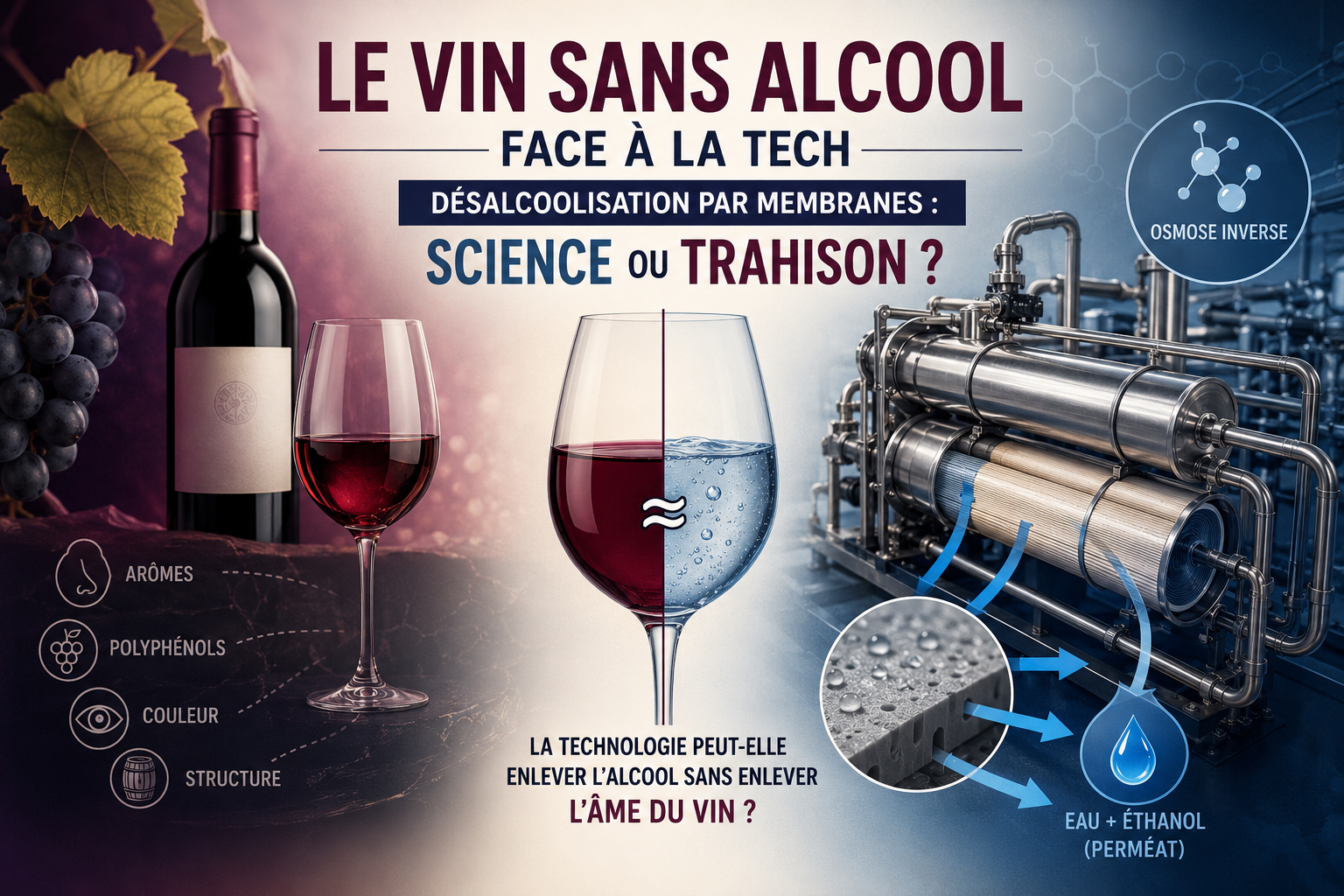
The principle of membrane techniques — one of the three processes authorised by European regulation, alongside vacuum evaporation and distillation — rests on reverse osmosis and nanofiltration. The wine is pushed under high pressure (up to 60 bar for a red, 40 for a white in reverse osmosis) through a membrane with microscopic pores. This lets a “permeate” through: a mix of water and alcohol, stripped of the larger molecules that make up the colour, the tannins and part of the wine’s body.
The operation takes place cold, at around 10 to 18°C, with no thermal shock. That’s its defenders’ key argument: where distillation heats the wine and risks “cooking” certain fragile aromatic compounds, the membrane works at cellar temperature. But the process has a physical limit: it requires several successive passes, since each cycle removes only a little alcohol. Reverse osmosis alone is therefore suited to adjusting the alcohol level (down to -20%) or to partial dealcoholisation, much less to total “zero alcohol”.
To go further, reverse osmosis is then coupled with a second stage that removes the alcohol from the permeate before returning the aqueous fraction to the wine. Two options: the membrane contactor, which extracts the ethanol by osmotic evaporation using water as a solvent (the recovered alcohol then measures only around 10%), or distillation of the permeate, more efficient (alcohol at 85%) and the only method capable of truly total dealcoholisation. Strictly membrane-based couplings, for their part, remain confined to a reasonable reduction of around 3% vol.
In other words, the membrane doesn’t destroy the alcohol: it displaces it, molecule by molecule, cold and under pressure. The whole debate, in reality, lies in what it leaves behind.
THE SCIENCE CAMP
“We’re not denaturing anything, we’re adjusting”
The membrane’s defenders first put forward a historical argument: adjusting the alcohol level by reverse osmosis is nothing new. For some thirty years, winemakers have used it to correct by a degree or two wines that are too concentrated in alcohol, particularly in very hot, dry vintages. With climate change pushing alcohol levels up, the oenologist Matthieu Dubernet noted as far back as Vinitech that this category, “which appeared only a decade ago, is no longer a niche and is becoming a market in its own right”. The technology is also compact, mobile, and the least costly way to remove a few degrees.
Then comes the cold argument. By avoiding any rise in temperature, reverse osmosis preserves a wine’s balance better than classic distillation — or so its promoters argue. Finally, the public-health argument: faced with a real demand for moderation, offering a 0.5% wine that keeps the codes of wine (the glass, the table, the sharing) rather than a soda is meeting a social need. Moderato’s co-founder, Fabien Marchand-Cassagne, observes that where dedicated corners were set up in stores, sales were “multiplied by four”. Proof, for this camp, that the product finds its audience as soon as you stop hiding it.
THE BETRAYAL CAMP
What the purists can’t stomach
The first criticism is oenological. Alcohol is a carrier of aromas: it transports the volatile molecules and gives the wine its volume in the mouth. Removing it amounts to amputating the wine of part of what makes it come alive. And here the membrane reveals its cruellest paradox: reverse osmosis, precisely because it works cold, doesn’t separate and then reincorporate the original aromas, unlike the most advanced vacuum-distillation systems that recover the volatile compounds to restore them. The method reputed to be the “gentlest” is also the one that struggles most to give the wine back its aromatic breadth.
Second grievance: the water footprint. Reverse osmosis coupled with a membrane contactor is very water-hungry. As the IFV points out, “in the end, the volume of water can exceed the volume of wine treated” — quite something for a sector that lays claim to terroir and environmental restraint. As for the membrane contactor used on its own, some professionals bluntly call it “dealcoholisation on the cheap”, because it tends to oxidise the wine.
The final blow is regulatory, and it’s symbolic. A fully dealcoholised wine (≤ 0.5% vol.) can claim no appellation: it drops down to Vin de France, losing both AOC and IGP. Only partial dealcoholisation remains open to geographical indications, and even then: in 2025, the National IGP Committee opened it only to a few pilot IGPs (Périgord, Comté Tolosan, Val de Loire), with an alcohol floor above 6%. For the guardians of the appellations, removing the alcohol means leaving wine as the terroir defined it. The brake is also visible on the consumer side: 58% still cite “taste and quality” as the main obstacle.
SCIENCE OR BETRAYAL? THE VERDICT IS YOURS
A definition of wine shifting before our eyes
The most striking thing is the speed at which the law is legitimising what purists contest. Before December 2021, the word “wine” was reserved for products measuring at least 8.5 or 9% alcohol. Since then, the CMO reform has authorised the labels “dealcoholised wine” and “partially dealcoholised wine”. In March 2025, a delegated regulation even opened organic certification to certain dealcoholised wines. And the “Wine Package” adopted in late 2025 introduces the label “no-alcohol wine” for products between 0 and 0.5% vol. Methodically, the regulations are making dealcoholisation a fully-fledged oenological practice.
One detail remains that speaks volumes. For its no-alcohol sweet wine, Château Sigalas-Rabaud didn’t choose the membrane: the operation was entrusted to Moderato, by vacuum column distillation at 30°C. As if, for a summit of Sauternes, aromatic preservation came before the membrane cold argument. “Membrane” technology dominates French cellars for alcohol adjustment and partial dealcoholisation; but as soon as it comes to aiming for excellence on a total zero-alcohol, finesse is often sought elsewhere.
So, science or betrayal? The membrane is probably both at once: an engineering feat that answers a real social expectation, and a compromise that reminds us, with every glass, that alcohol wasn’t just a flaw to be corrected. No-alcohol wine isn’t a fake wine — it’s a new object, borrowing the codes of wine without quite being one. It’s up to each of us to decide whether the boundary it crosses is a step forward or a red line.
So which side are you on — science or betrayal? Have you ever tasted a wine dealcoholised by membranes? Tell us in the comments.
Sources: DGCCRF / economie.gouv.fr (dealcoholisation and labelling rules, 2025) · Delegated Regulation (EU) 2025/405 · INAO – National IGP Committee (March 2025) · IWSR · No/Low Barometer 2025 (Backline) · LSA Conso and Rayon Boissons (market figures, Jan. 2026) · IntoTheMinds (Jan. 2026) · Réussir Vigne (Sept. 2025) · Techniloire / Vinitech (M. Dubernet) · IFV (P. Cottereau) · B&S Tech · VINEAS – dealcoholisation by membrane coupling · desalcoolisation.com. Processes and figures verified as of 28 June 2026; regulatory thresholds and labels may change with the implementation of the “Wine Package”.