🇬🇧 Series · The Vinous Trinity · Article 7/15 · France · ⏱ 5 min
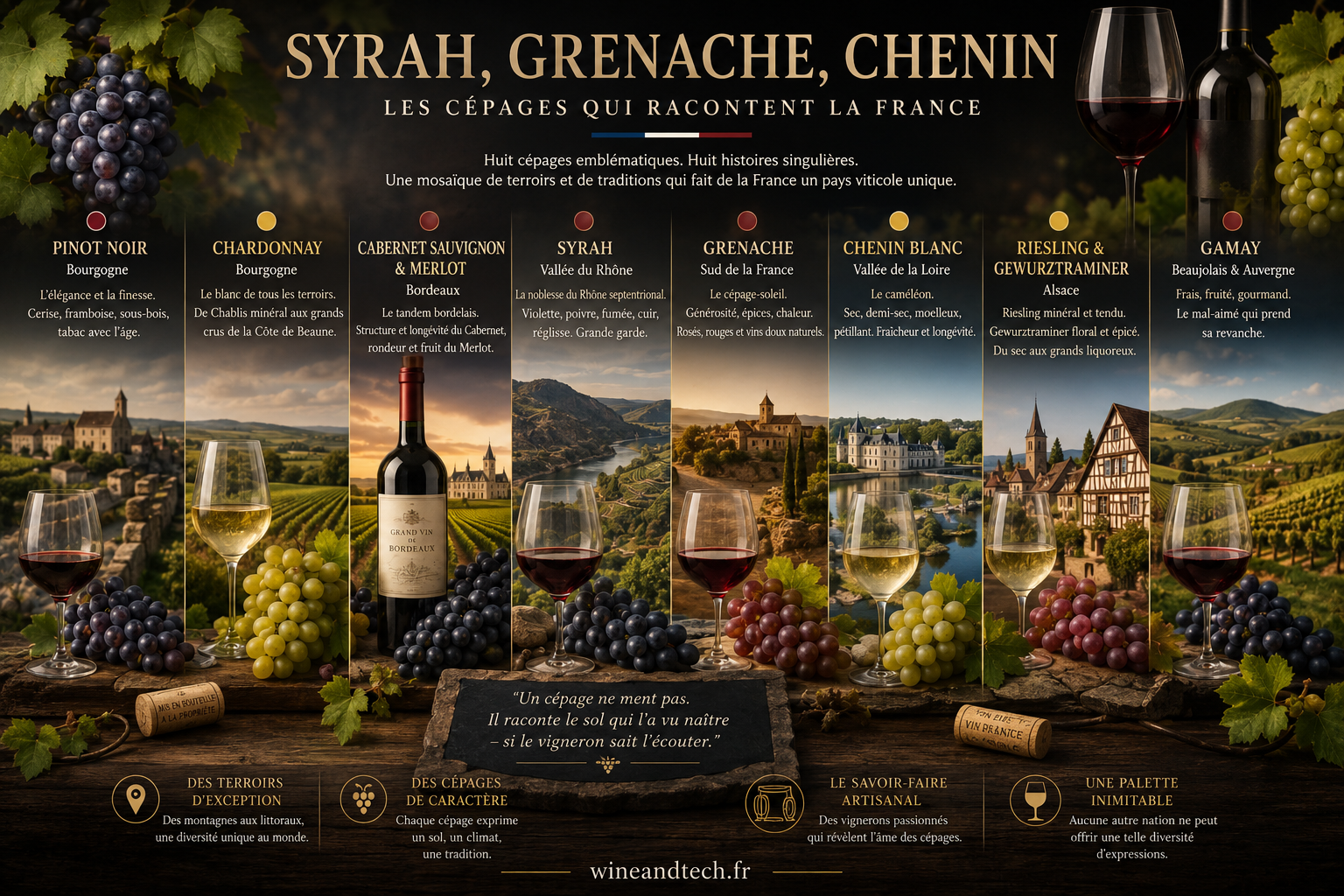
In France, grape varieties are not simply types of grape. They are characters, each with its own personality, its preferred soils, its infinite variations depending on the land and the winemaker. Syrah, Grenache, Chenin Blanc, Pinot Noir, Chardonnay, Riesling, Gamay: every one of these names tells a story of soil, climate and tradition. Together, they form a palette no other wine nation can match.
🍇 Grape varieties explored in this article
Pinot Noir · Chardonnay · Cabernet Sauvignon & Merlot · Syrah · Grenache · Chenin Blanc · Riesling · Gamay
🔴 Pinot Noir · the soul of Burgundy
Pinot Noir is perhaps the most difficult grape variety in the world to master. Thin skin, light tannins, extraordinary sensitivity to terroir: it expresses with remarkable precision the differences between parcels sometimes separated by just a few dozen metres. In Burgundy, it produces wines of finesse, elegance and aromatic complexity (cherry, raspberry, flowers, undergrowth, tobacco with age) that have forged its worldwide reputation. But Burgundian Pinot Noir is not limited to inaccessible grands crus: a village Bourgogne or a Côte de Nuits-Villages from an artisan winemaker between €18 and €30 can deliver a remarkable experience. It also thrives in Alsace, Champagne and Savoie.
🟡 Chardonnay · the white of all terroirs
Chardonnay is the most widely planted white grape variety in the world, but it is in Burgundy that it reaches its highest expression. From the Côte de Beaune (Meursault, Puligny-Montrachet, Chassagne-Montrachet) to taut, mineral Chablis, from fruity, affordable Mâcon-Villages to Champagne where it forms the base of Blancs de Blancs, Chardonnay covers an extraordinary range of styles. Its initial neutrality makes it a chameleon grape: it takes on the imprint of terroir and winemaker with remarkable fidelity. A Chablis Premier Cru or a Mâcon-Uchizy from an artisan producer between €12 and €22: wines of real class at reasonable prices.
🔴 Cabernet Sauvignon & Merlot · the Bordeaux tandem
In Bordeaux, blending is never accidental. Cabernet Sauvignon (structure, firm tannins, longevity, blackcurrant, cedar) and Merlot (roundness, ripe red fruits, earlier accessibility) complement each other with a logic that defined the concept of fine wine for the entire world. The left bank (Médoc, Graves) favours Cabernet Sauvignon on its well-drained gravels. The right bank (Saint-Émilion, Pomerol) favours Merlot on its cooler clays. The real secret: hundreds of artisan estates produce increasingly high-quality Bordeaux at €10-18, often from old vines on remarkable terroirs.
🔴 Syrah · the nobility of the northern Rhône
On the steep granites of Côte-Rôtie, Hermitage or Cornas, Syrah reaches a level of expression that few grape varieties in the world can match: violet, black olive, white pepper, smoke, leather, liquorice. Wines of striking power and depth, capable of ageing 20 to 30 years. What makes Rhône Syrah unique is a long winemaking history, a marked climate and particularly demanding granite terroirs. In Crozes-Hermitage or Saint-Joseph, more accessible neighbours, remarkable Syrahs can be found between €12 and €20. It also succeeds in Languedoc and Provence, with looser, fruitier expressions.
🔴 Grenache · the generosity of the deep South
Originally from Spain (Garnacha), naturalised French in the southern Rhône and Languedoc, Grenache is the sunshine grape. It finds in Châteauneuf-du-Pape, on its terraces of rounded stones, one of its most emblematic French expressions, producing wines of remarkable generosity, warmth and spiced complexity. But it appears everywhere across the south of France: in rosé in Provence, in sweet natural wines (Banyuls, Maury, Rasteau), in Languedoc where century-old vines often yield the country’s best value-for-money. A Rasteau or Gigondas from an artisan winemaker at €12-18: southern generosity at an honest price.
🟡 Chenin Blanc · the Loire’s chameleon
Chenin Blanc is perhaps one of the most versatile white grape varieties in France. From the Loire Valley, it produces dry wines of striking tension and minerality (Savannières), fresh and complex off-dry wines (Vouvray), sweet wines of astonishing aromatic richness (Coteaux du Layon, Bonnezeaux) and remarkable sparkling wines (Vouvray pétillant, Crémant de Loire). Its naturally high acidity allows it to age 30, 40, even 50 years while retaining intact freshness. A dry Vouvray or an Anjou blanc from a winemaker between €10 and €16 can reveal astonishing complexity with a few years in the cellar.
🟡 Riesling & Gewurztraminer · two of Alsace’s great grape varieties
Alsace has the rare distinction of labelling wines by grape variety, and two dominate. Riesling, mineral, taut, citrus with petrol notes emerging with age, is one of France’s greatest dry whites, capable of exceptional longevity on the finest terroirs of the wine route. Gewurztraminer, at the opposite extreme, is flamboyant and opulent: rose, lychee, spice, ginger. Both can range from bone-dry to late harvest, up to Sélections de Grains Nobles, the equivalent of the world’s greatest sweet wines. Exceptional wines, often undervalued relative to their quality.
🔴 Gamay · the unloved grape having its moment
Long confined to the image of Beaujolais Nouveau, a marketing product drunk in November and forgotten by December, Gamay is now at the heart of a worldwide enthusiasm for light, fresh, easy-drinking wines. On the granites of Beaujolais, it produces the 10 crus explored in the previous article. But Gamay also grows in Touraine (Touraine Gamay, fresh and fruity), in Auvergne (Côtes d’Auvergne, often remarkable at under €10), in Savoie. A new generation of winemakers vinifies it with renewed finesse, gentler extraction, more precise ageing. A grape that turns out to have real depth.
The inimitable · what these grape varieties share
What sets many French grape varieties apart, including some now planted worldwide like Chardonnay, Cabernet Sauvignon or Merlot, is their capacity to produce profoundly different expressions depending on their territory. Savagnin from Jura, Mondeuse from Savoie, Romorantin from the Loire, Nielluccio from Corsica, Mourvèdre from Bandol: grape varieties that cannot be reproduced anywhere else with the same results. This combination, grape variety × terroir × tradition, is what makes France a unique wine country. Not because its wines are systematically the best in the world, but because they are irreplaceable.
A grape variety doesn’t lie. It tells the story of the soil that gave it birth, if the winemaker knows how to listen.