WineAndTech’

Tag: Italy

  • From Barolo to Nero d’Avola: a journey from North to South Italy

    From Barolo to Nero d’Avola: a journey from North to South Italy

    🇬🇧 Series · The Vinous Trinity · Article 5/15 · Italy

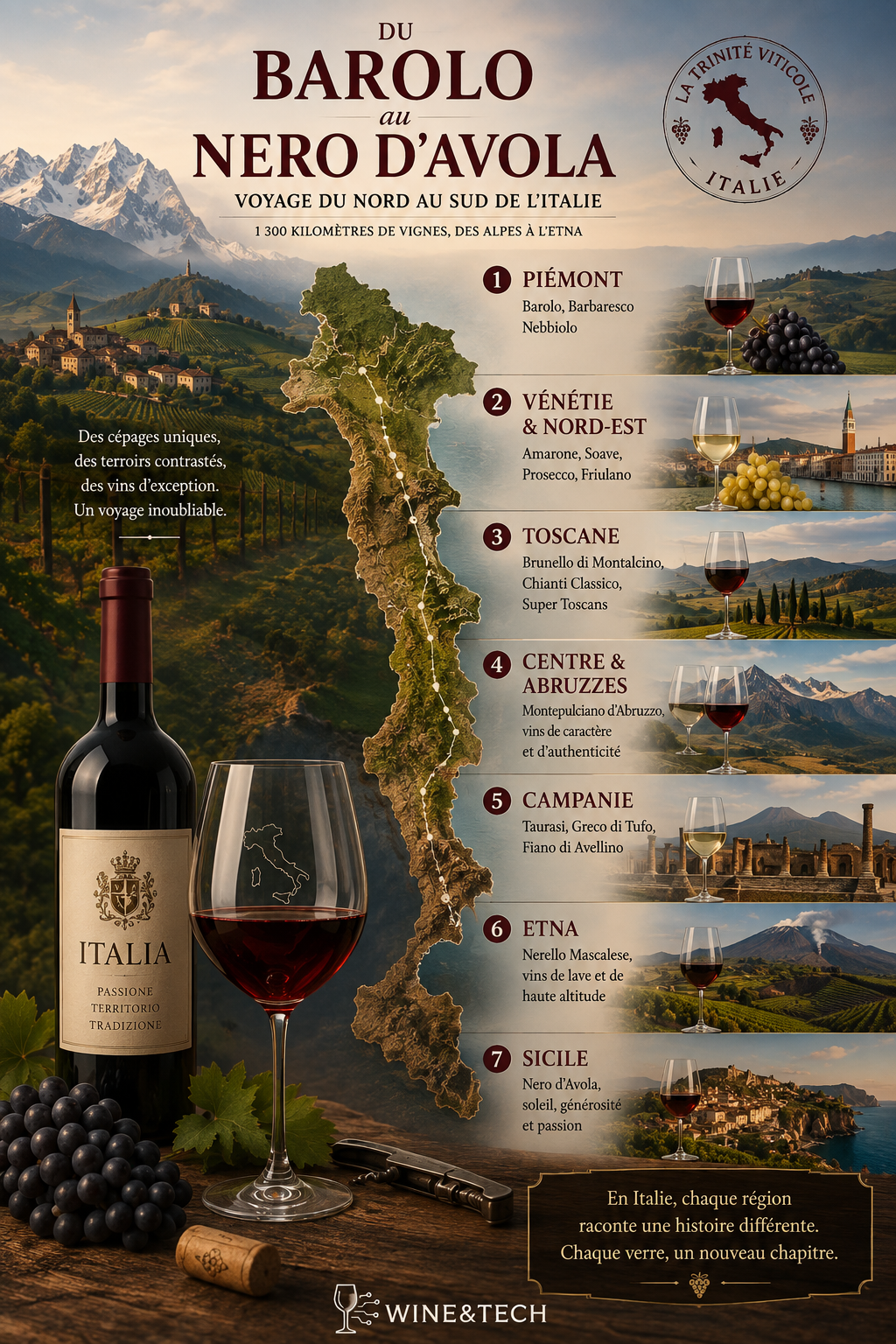
    From Turin to Palermo, nearly 1,300 kilometres of travel through the Italian vineyards. Italian wine doesn’t reveal itself in a single glance, it unfolds, at the pace of grape varieties that change every hundred kilometres, terroirs shifting from Alpine granite to Sicilian volcanic ash. This journey from north to south is one of the most rewarding the wine world has to offer.

    🗺️ Stops on the journey

    Piedmont · Veneto & North-East · Tuscany · Centre & Abruzzo · Campania · Etna · Sicily

    🏔️ The Great North: Barolo, Barbaresco and Piedmont’s power

    The journey begins in the Langhe hills of Piedmont. Barolo and Barbaresco, both from Nebbiolo, are the undisputed aristocrats of northern Italy: wines with a garnet colour that pales quickly, austere tannins in youth, that develop after 10 to 20 years a complexity of tar, faded rose, truffle and black cherry that is absolutely unique in the world. Barolo is often called the king of Italian wines; Barbaresco, generally earlier in its evolution, can show itself more approachable when young. But Piedmont is not just its two DOCG kings: Barbera d’Asti (juicy, fresh, delicious young at €9–12), Dolcetto d’Alba (elegantly bitter), Moscato d’Asti (delicate sparkling sweet, irresistible), the palette is immense.

    🌊 Veneto and the North-East: from Amarone to Soave

    Heading east, the Veneto establishes itself as Italy’s most productive wine region, offering one of the widest ranges of styles on the peninsula. From sparkling, fresh Prosecco di Valdobbiadene, to Soave Classico of remarkable minerality on volcanic soils, to Valpolicella Ripasso gaining body through partial drying, through to Amarone della Valpolicella : grapes dried through appassimento, concentrated, long-aged, a wine of power and meditation capable of crossing several decades for the finest cuvées. Friuli produces some of Italy’s finest dry whites: Friulano, Ribolla Gialla, Pinot Grigio of a precision and tension rarely matched anywhere.

    🌿 Tuscany: Brunello, Chianti, Super Tuscans

    At the midpoint, Tuscany asserts itself as the great theatre. Chianti Classico : Sangiovese on the hills between Florence and Siena, cherry, tobacco, bright acidity, is one of Italy’s most versatile food-wine pairings. Brunello di Montalcino is another dimension entirely: made exclusively from Sangiovese, known locally as Brunello, it must wait at least five years before release, including a minimum of two years in wood. Capable of crossing several decades in the cellar, it ranks among the great ageing wines of the peninsula. The Super Tuscans of Bolgheri (Sassicaia, Ornellaia, Tignanello) helped to revolutionise Italian wine from the 1970s onwards, introducing Cabernet Sauvignon and Merlot into world-class blends freed from appellation constraints.

    ☀️ From Centre to South: Montepulciano, Taurasi and Campania’s awakening

    Continuing south, less publicised but increasingly high-quality wines emerge. Montepulciano d’Abruzzo, not to be confused with Tuscany’s Vino Nobile, is one of Italy’s best value wines: generous red with supple tannins, accessible from €8–10. Campania confirms its reputation as a revelation: Taurasi, made from Aglianico and often nicknamed the Barolo of the South for its ageing potential and structure, Greco di Tufo (nervously taut yet opulent white), Fiano di Avellino (complex, hazelnut and saffron notes). Grape varieties of an originality and depth the world is progressively discovering.

    🌋 Etna and the end of the journey: Nerello Mascalese and Nero d’Avola

    The journey ends on the slopes of Etna, the tallest active volcano in Europe. Etna has become one of the great wine revelations of the past twenty years: Nerello Mascalese, grown on the volcanic slopes, sometimes at over 1,000 metres altitude, produces reds of a finesse, freshness and complexity unexpected at these latitudes. Fine tannins, vibrant acidity, notes of red fruits, spice and volcanic stone: some of these wines evoke in their delicacy the great Pinot Noirs of Burgundy. It is one of the great emotions of contemporary Italian wine. And Nero d’Avola, the emblematic grape of Sicily, brings the journey to a close with its warm, generous reds, fleshy tannins and ripe dark fruits, in the light and warmth of deep Sicily.


    What this journey reveals

    This 1,300 km journey reveals a fundamental truth: few countries in the world can offer such a succession of styles, grape varieties and identities over such a short distance. Every stop contradicts the previous one. A Barolo and a Nerello from Etna are two wines so different you struggle to believe they come from the same country and yet both reach absolute peaks in their respective registers. This is precisely why Italy is the most fascinating wine country to explore.

    You don’t visit Italian wine country. You explore it, as long as you’re ready to be surprised at every stop.

  • France · Italy · Spain: the vinous trinity — a multilingual series

    🇬🇧 This series explores Europe’s three great wine countries. Italy articles are published in French and Italian on the same page. Spain articles in French and Spanish. The French version is the original — this is the English translation.

    🇫🇷 Cette série explore les trois grands pays du vin européen. Les articles sur l’Italie sont publiés en français et en italien. Les articles sur l’Espagne, en français et en espagnol.

    🇮🇹 Questa serie esplora i tre grandi paesi europei del vino. Gli articoli sull’Italia saranno pubblicati in francese e in italiano sulla stessa pagina. La versione inglese è disponibile in fondo alla pagina.

    🇪🇸 Esta serie explora los tres grandes países del vino europeos. Los artículos sobre España se publicarán en francés y en español en la misma página. La versión en inglés está disponible al final de la página.

    Three countries. Thousands of appellations. And close to 70% of global wine export value. France, Italy and Spain don’t dominate the wine world by chance — they are three civilisations of the vine, three thousand-year histories that shaped wine culture as we know it today. Over the next eight months, we’ll explore them together, in depth, and in their own languages.

    Sixteen articles. Four languages. Three countries. One thread: the conviction that the world’s finest wines are also its most accessible — and that they deserve to be discovered in the language that gave them life.


    🇫🇷 France: where the concept of terroir was born

    Thirteen major wine regions. Over 350 AOC/AOP appellations. Around 200 grape varieties cultivated. France invented the concept of terroir — the idea that soil, climate and the history of a place translate directly into the glass. From Alsatian Riesling to Châteauneuf-du-Pape Grenache, from Muscadet sur lie to Champagne, every French bottle tells a story of a precise location. And for every legendary grand cru, ten independent winemakers produce artisanal gems for under €15.

    Coming up: an overview of the regions, overlooked terroirs, emblematic grape varieties, winemaker portraits, and our selection of 5 bottles under €15.


    🇮🇹 Italy: diversity in its purest form

    Five hundred indigenous grape varieties. Twenty fully active wine regions. 77 DOCG, 341 DOC. Italy is the most complex and generous wine country in the world — and probably the one that delivers the most surprises in every bottle. Nebbiolo, Sangiovese, Vermentino, Nerello Mascalese: grape varieties that cannot be replicated anywhere else. A Barbera d’Asti at €9 that outclasses many New World wines at €25.

    Italy articles will be published in French and Italian on the same page — because Nebbiolo makes more sense when you read «vino di grande struttura tannica» alongside its translation. Coming up: overview, North-to-South journey, inimitable grape varieties, vignaioli portraits, selection under €15.


    🇪🇸 Spain: the world’s largest vineyard

    Nearly one million hectares of vines. Over 70 denominations of origin. And the best value-for-money in Europe. Spain underwent a spectacular quality revolution from the 1990s onwards: Rioja, Ribera del Duero, Priorat, Rías Baixas, Bierzo — world-class terroirs, inimitable grape varieties, prices that remain remarkably reasonable. An artisanal Rioja Crianza between €8 and €12 is still very much a reality.

    Spain articles will be published in French and Spanish on the same pageporque el vino se entiende mejor en su idioma. Coming up: overview, new rising stars, grape varieties, family bodegas, selection under €12.


    The programme: 16 articles, 4 languages, 8 months

    🇫🇷 France — articles in French · English version available

    • The French wine panorama: 13 regions, one obsession
    • The overlooked regions: where France excels in silence
    • Syrah, Grenache, Chenin: the grape varieties that tell France’s story
    • Winemaker portraits: French craftsmanship up close
    • France in 5 bottles under €15: our selection

    🇮🇹 Italy — French + italiano on the same page · English version available

    • Italy of the 500 grape varieties: an extraordinary panorama / L’Italia dei 500 vitigni : un panorama unico
    • From Barolo to Nero d’Avola: a journey from North to South / Dal Barolo al Nero d’Avola : viaggio da Nord a Sud
    • Nebbiolo, Sangiovese, Vermentino: inimitable treasures / Nebbiolo, Sangiovese, Vermentino : tesori inimitabili
    • The vignaioli: when one family does everything / I vignaioli : quando una famiglia fa tutto
    • Italy in 5 bottles under €15 / L’Italia in 5 bottiglie sotto i 15 €

    🇪🇸 Spain — French + español on the same page · English version available

    • The wine landscape of Spain: one million hectares, one revolution / España vinícola : un millón de hectáreas, una revolución
    • Beyond Rioja: Spain’s new wine stars / Más allá de La Rioja : las nuevas estrellas del vino español
    • Tempranillo, Garnacha, Albariño: the grape varieties to know / Tempranillo, Garnacha, Albariño : los varietales que hay que conocer
    • Family bodegas: centuries of tradition, modern ambition / Las bodegas familiares : tradición y modernidad
    • Spain in 5 bottles under €12 / España en 5 botellas por menos de 12 €

    Wine makes more sense in its native tongue. This series is an invitation to taste differently — with the words of the