🇬🇧 Series · The Vinous Trinity · Article 5/15 · Italy
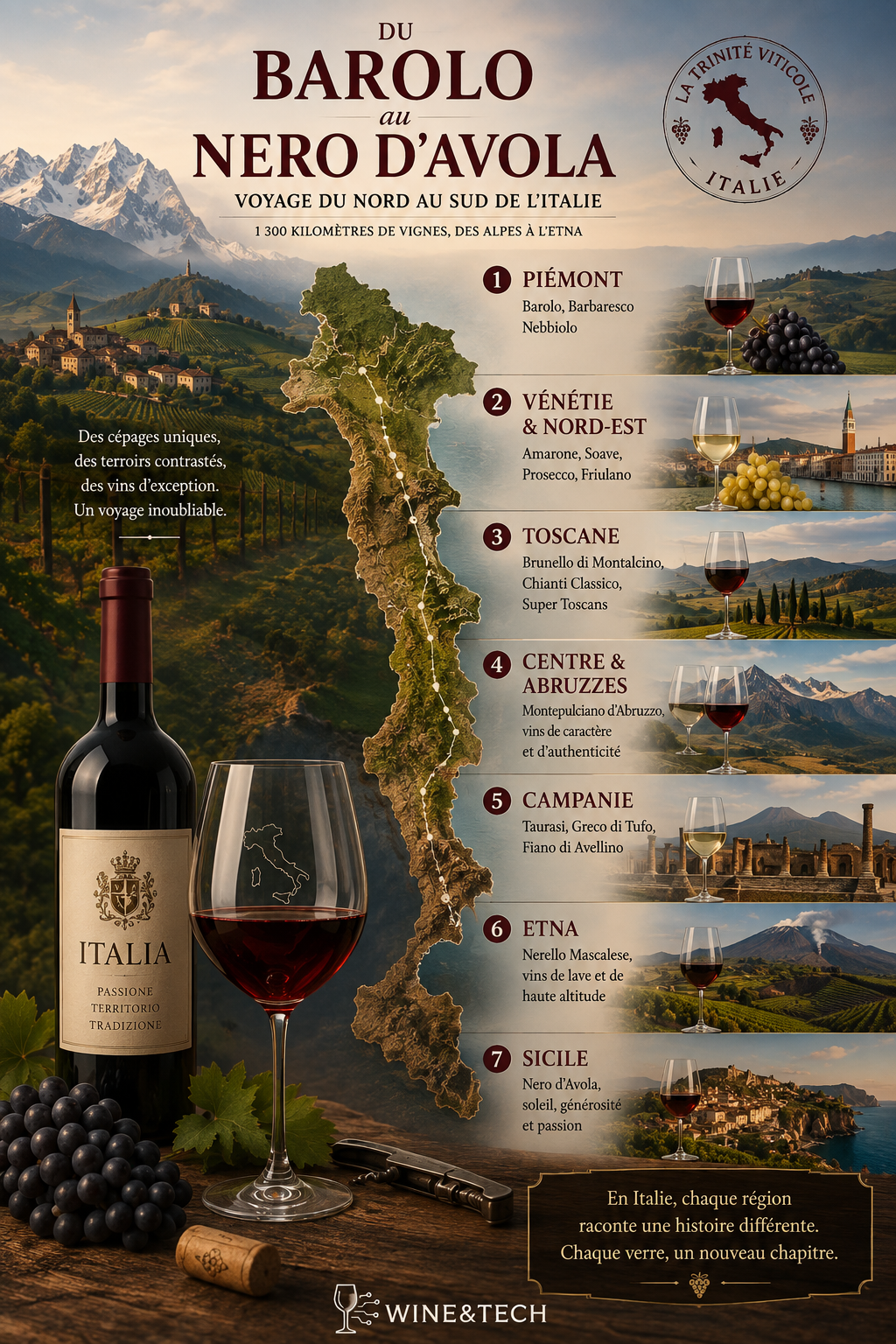
From Turin to Palermo, nearly 1,300 kilometres of travel through the Italian vineyards. Italian wine doesn’t reveal itself in a single glance, it unfolds, at the pace of grape varieties that change every hundred kilometres, terroirs shifting from Alpine granite to Sicilian volcanic ash. This journey from north to south is one of the most rewarding the wine world has to offer.
🗺️ Stops on the journey
Piedmont · Veneto & North-East · Tuscany · Centre & Abruzzo · Campania · Etna · Sicily
🏔️ The Great North: Barolo, Barbaresco and Piedmont’s power
The journey begins in the Langhe hills of Piedmont. Barolo and Barbaresco, both from Nebbiolo, are the undisputed aristocrats of northern Italy: wines with a garnet colour that pales quickly, austere tannins in youth, that develop after 10 to 20 years a complexity of tar, faded rose, truffle and black cherry that is absolutely unique in the world. Barolo is often called the king of Italian wines; Barbaresco, generally earlier in its evolution, can show itself more approachable when young. But Piedmont is not just its two DOCG kings: Barbera d’Asti (juicy, fresh, delicious young at €9–12), Dolcetto d’Alba (elegantly bitter), Moscato d’Asti (delicate sparkling sweet, irresistible), the palette is immense.
🌊 Veneto and the North-East: from Amarone to Soave
Heading east, the Veneto establishes itself as Italy’s most productive wine region, offering one of the widest ranges of styles on the peninsula. From sparkling, fresh Prosecco di Valdobbiadene, to Soave Classico of remarkable minerality on volcanic soils, to Valpolicella Ripasso gaining body through partial drying, through to Amarone della Valpolicella : grapes dried through appassimento, concentrated, long-aged, a wine of power and meditation capable of crossing several decades for the finest cuvées. Friuli produces some of Italy’s finest dry whites: Friulano, Ribolla Gialla, Pinot Grigio of a precision and tension rarely matched anywhere.
🌿 Tuscany: Brunello, Chianti, Super Tuscans
At the midpoint, Tuscany asserts itself as the great theatre. Chianti Classico : Sangiovese on the hills between Florence and Siena, cherry, tobacco, bright acidity, is one of Italy’s most versatile food-wine pairings. Brunello di Montalcino is another dimension entirely: made exclusively from Sangiovese, known locally as Brunello, it must wait at least five years before release, including a minimum of two years in wood. Capable of crossing several decades in the cellar, it ranks among the great ageing wines of the peninsula. The Super Tuscans of Bolgheri (Sassicaia, Ornellaia, Tignanello) helped to revolutionise Italian wine from the 1970s onwards, introducing Cabernet Sauvignon and Merlot into world-class blends freed from appellation constraints.
☀️ From Centre to South: Montepulciano, Taurasi and Campania’s awakening
Continuing south, less publicised but increasingly high-quality wines emerge. Montepulciano d’Abruzzo, not to be confused with Tuscany’s Vino Nobile, is one of Italy’s best value wines: generous red with supple tannins, accessible from €8–10. Campania confirms its reputation as a revelation: Taurasi, made from Aglianico and often nicknamed the Barolo of the South for its ageing potential and structure, Greco di Tufo (nervously taut yet opulent white), Fiano di Avellino (complex, hazelnut and saffron notes). Grape varieties of an originality and depth the world is progressively discovering.
🌋 Etna and the end of the journey: Nerello Mascalese and Nero d’Avola
The journey ends on the slopes of Etna, the tallest active volcano in Europe. Etna has become one of the great wine revelations of the past twenty years: Nerello Mascalese, grown on the volcanic slopes, sometimes at over 1,000 metres altitude, produces reds of a finesse, freshness and complexity unexpected at these latitudes. Fine tannins, vibrant acidity, notes of red fruits, spice and volcanic stone: some of these wines evoke in their delicacy the great Pinot Noirs of Burgundy. It is one of the great emotions of contemporary Italian wine. And Nero d’Avola, the emblematic grape of Sicily, brings the journey to a close with its warm, generous reds, fleshy tannins and ripe dark fruits, in the light and warmth of deep Sicily.
What this journey reveals
This 1,300 km journey reveals a fundamental truth: few countries in the world can offer such a succession of styles, grape varieties and identities over such a short distance. Every stop contradicts the previous one. A Barolo and a Nerello from Etna are two wines so different you struggle to believe they come from the same country and yet both reach absolute peaks in their respective registers. This is precisely why Italy is the most fascinating wine country to explore.
You don’t visit Italian wine country. You explore it, as long as you’re ready to be surprised at every stop.