WineAndTech’

Tag: Spanish wines

  • Beyond Rioja: Spain’s new wine stars

    Beyond Rioja: Spain’s new wine stars

    🇬🇧 Series · The Vinous Trinity · Article 6/15 · Spain · ⏱ 5 min

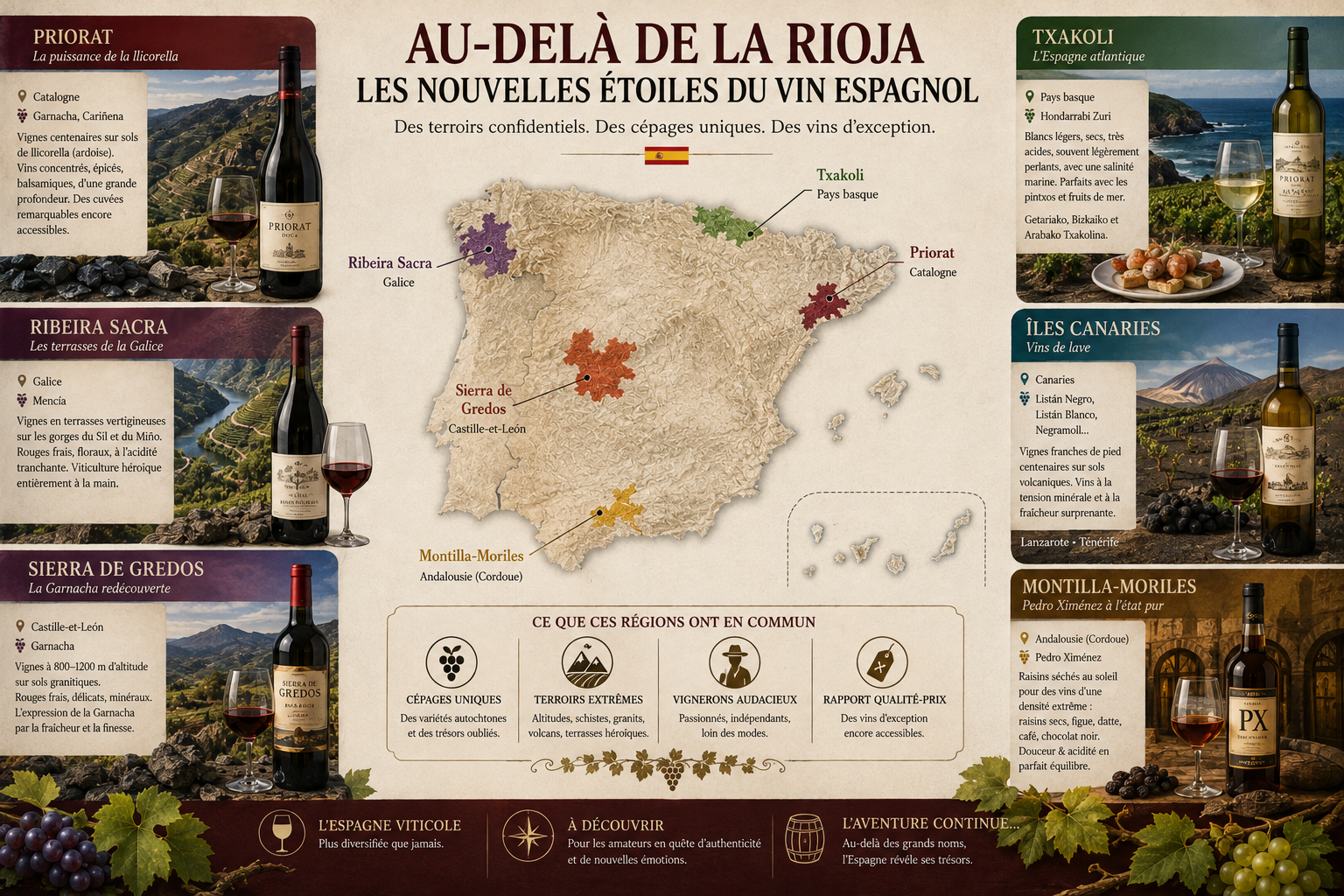
    Rioja, Ribera del Duero, Rías Baixas. The three names international wine buyers know. The Spanish vineyard doesn’t stop there. Beyond these appellations, other regions are doing work that deserves attention: more confidential, with different priorities. Old terroirs, indigenous grape varieties, producers who have no interest in making wines that taste like anything else.

    🗺️ Regions explored in this article

    Priorat · Ribeira Sacra · Sierra de Gredos · Canary Islands · Txakoli · Montilla-Moriles

    Priorat · the power of llicorella

    Priorat (DOCa since 2000) built its reputation in the 1990s on something very specific: century-old Garnacha and Cariñena vines on llicorella, a crumbling black slate that gives wines their mineral grip and distinctive balsamic character. The result is concentrated, complex, long-lived. Among the top producers, prices have followed the reputation. But artisan winemakers here still craft remarkable bottles at prices that remain accessible.

    Ribeira Sacra · Galicia’s terraced vineyards

    In the gorges of the Sil and Miño in Galicia, Ribeira Sacra grows Mencía on vertiginous granite terraces that require entirely manual work. Fresh, floral, precise reds with a natural acidity that surprises anyone expecting southern Spanish weight. An appellation that was still little-known five years ago and is now on the radar of most serious sommeliers. Prices haven’t caught up yet.

    Sierra de Gredos · Garnacha rediscovered

    Between Madrid and Ávila, the Sierra de Gredos gave a handful of producers something they couldn’t find elsewhere: old Garnacha vines at 800 to 1,200 metres, on granite. Fresh, delicate, mineral reds. Producers like Comando G and Bernabeleva showed that Spanish Garnacha doesn’t have to mean extracted and heavy. The style they developed is now influencing producers across the country.

    Canary Islands · wines from lava

    The Canaries escaped phylloxera. The result is ungrafted vines, some over a century old, on black volcanic soils, with rare pre-phylloxera varieties: Listán Negro, Listán Blanco, Negramoll. Wines of mineral tension and freshness that are completely unexpected at these latitudes. Lanzarote and Tenerife both have serious producers. Prices are still reasonable.

    Txakoli · Atlantic Spain

    Txakoli is the Basques’ white wine: light (10-11% alcohol), often lightly sparkling, dry, very acidic, with a marine salinity that makes it an obvious match for pintxos and seafood. Three appellations: Getariako Txakolina, Bizkaiko Txakolina, Arabako Txakolina. Same philosophy throughout: a sharp, lively, genuine wine. Still affordable.

    Montilla-Moriles · Pedro Ximénez in its purest form

    Montilla-Moriles, in the Córdoba area, makes wine from Pedro Jiménez grapes dried in the sun until concentrated. The result: a dense, sweet wine full of raisins, fig, date, coffee and dark chocolate, with enough natural acidity to keep it balanced. Often available at lower prices than comparable wines from Jerez, for similar quality.


    What connects these regions

    It isn’t geography. It’s a certain stubbornness. Producers making wine from grape varieties nobody planted for decades, on terroirs nobody paid attention to. More sommeliers and wine merchants are noticing now. The prices haven’t fully caught up. That will change.

    Spain has shown the world its Rioja. The rest is only now becoming visible.

  • Spanish wine: a million hectares, a quiet revolution

    Spanish wine: a million hectares, a quiet revolution

    ⏱ 4 min

    If France is the homeland of terroir and Italy the homeland of absolute diversity, Spain is the homeland of generosity. Close to a million hectares of vines — the largest wine-growing area in the world. Over 70 designations of origin. A quiet quality revolution that began in the 1990s and has never let up. Tempranillo, Garnacha, Albariño, Mencía: inimitable grape varieties offering character and complexity at prices that remain among the most reasonable in Europe. Spain doesn’t just make wine: it has reinvented its wine identity, region by region.

    ~950,000

    hectares (world record)

    70+

    designations of origin

    2

    DOCa (Rioja · Priorat)

    ~4,000

    wineries and bodegas

    The quiet revolution

    In the 1980s, Spain was still mainly a supplier of bulk wine. Then a combination of new winemaking talent, massive investment in cellars, the rediscovery of old vines and a renewed regional pride changed everything. Today, Spain produces some of the most original and complex wines in the world — while keeping prices that remain, on the whole, lower than their French or Italian equivalents of the same quality.

    🏔️ The Historic North: Rioja, Ribera del Duero, Navarra

    Rioja (DOCa since 1991) remains the region’s figurehead — its Tempranillo, aged in barrel across three tiers (Crianza: at least twelve months in barrel for reds, Reserva: 1 year in barrel + 1 year in bottle, Gran Reserva: 2 years in barrel + 3 in bottle), defined the Spanish style for the entire world. But it’s also where small artisan producers do some of the most interesting work: a quality Crianza remains accessible at €8–14. Ribera del Duero, at 850m altitude, produces a more structured, denser Tempranillo (known locally as Tinto Fino) with more pronounced natural acidity. Vega Sicilia, Pingus — the legends are here. But so are many remarkable artisan producers at far lower prices. Navarra, long known for its Garnacha rosés, is now exploring far more ambitious styles.

    🌊 Atlantic Galicia: Rías Baixas, Bierzo, Ribeiro

    Spain’s green, rainy north-west is the polar opposite of the sun-drenched Spanish wine cliché. Rías Baixas produces Albariño — a fresh, aromatic, high-acid white, perfect with Galician seafood and one of the most seductive Atlantic whites in Europe. Bierzo, with its Mencía grown on granite and slate, is one of the most exciting discoveries of the past twenty years: fresh, floral, age-worthy reds at still-modest prices. Ribeiro offers original, little-known blends of indigenous white varieties.

    ☀️ The Levante and the South: Priorat, Jumilla, Jerez

    Priorat (DOCa since 2000 — one of only two in the whole of Spain, alongside Rioja) produces wines of striking concentration and complexity, made from century-old Garnacha and Cariñena grown on llicorella (black slate) soils. Intense, deep, built to age. Jumilla and its Monastrell offer full-bodied, highly accessible wines. But it’s Jerez that perhaps represents Spain’s most original proposition: fino, manzanilla, amontillado, oloroso, Pedro Ximénez — five radically different styles, produced through a solera ageing system unique in the world, blending biological and oxidative winemaking. One of wine’s great forgotten treasures — and one of its greatest gifts of generosity.

    🥂 Bubbles and Whites: Cava and Rueda

    Cava (Penedès, Catalonia) produces traditional-method sparkling wine from indigenous grape varieties (Macabeu, Xarel·lo, Parellada) at prices that rival entry-level Champagne — with a very different character, more fruit-forward, mineral in its own way. Rueda and its Verdejo is Spain’s best-selling white wine domestically: crisp, herbaceous, fresh — a delicious, very affordable alternative to Sauvignon Blanc.


    Price: the real revolution

    This is perhaps where Spain impresses most: quality has risen, but prices haven’t kept pace. A serious producer’s Rioja Crianza at €8–14. An old-vine Garnacha from Aragón at €7–10. A Jumilla Monastrell at €6. A quality Cava at €8. Few countries today offer a comparable quality-to-price ratio. Across every price bracket, from everyday wines to great age-worthy cuvées, Spanish wine manages to combine identity, quality and accessibility. That is probably its greatest strength. It’s the great promise of Spanish wine — and it delivers.

    It took Spain thirty years to reveal what its vines had been hiding for centuries.