WineAndTech’

Tag: Toscane

  • The vignaioli: when a family does everything

    The vignaioli: when a family does everything

    🇬🇧 Series · The Vinous Trinity · Article 11/15 · Italy · ⏱ 5 min

    In Italy, the vignaiolo is not a winemaker like any other. An artisan who grows the grapes, vinifies the harvest and bottles, most of the time, without an intermediary. Sometimes on just a few hectares, passed down through several generations. This model is behind what Italian wine has that is most singular: a direct relationship between a person, a piece of land and a bottle.

    🏡 The vignaiolo: a philosophy as much as a trade

    The term vignaiolo refers to a precise reality. Unlike négociant houses that buy grapes or wines in bulk to blend them, the vignaiolo manages the whole process: vineyard, cellar, ageing, bottling. What France calls a récoltant-manipulant (though in Italy, unlike France, not all of them go as far as commercialising their wine). This independence often goes hand in hand with an intimate knowledge of the terroir. Each bottle carries the imprint of a family, a place, a conviction.

    🌿 From vine to bottle: independence as a choice

    The internal diversity of the Italian artisan vineyard is striking. A Piedmontese vignaiolo on 5 hectares in the Langhe has little in common with a Tuscan owner managing 30 hectares in Chianti Classico. What unites them is the conviction that wine expresses first and foremost the place and the person who makes it. This sets them apart from large cooperatives and industrial groups that prioritise consistency and volume. That said, it would be wrong to tar everything with the same brush: some Italian cooperatives now produce remarkable terroir wines. The same conviction also explains why many have chosen organic farming: not for the sake of fashion, but because coherence between vineyard and cellar matches their way of working.

    🏔️ Piedmont: the families behind the great wines

    In the Langhe, modern Barolo owes a great deal to a handful of families. Families like the Conterno, Mascarello, Rinaldi and Giacosa have embodied different expressions of this Piedmontese tradition. Names little known to the general public, venerated by serious wine lovers. These producers were at the heart of the 1980s-90s controversy between traditionalists and modernists. The former defended long ageing in large oak barrels, a rustic style but of remarkable longevity. The latter made greater use of small French barrels, different extraction approaches and shorter ageing periods. It is this diversity that makes Piedmont so difficult to summarise.

    🌿 Tuscany: tradition and renaissance

    The Tuscan transformation was radical. In the 1970s, Chianti was often synonymous with wine sold in fiasco bottles. A few families changed everything. The Antinoris on a large scale, Sergio Manetti at Montevertine on a smaller one. Today, dozens of small family estates produce Chianti Classico of great quality. It should be noted, though, that Montevertine is not really a Chianti Classico renaissance example in the strict sense: the estate actually left the Chianti Classico appellation to market its celebrated Pergole Torte as a Vino da Tavola, then IGT Toscana.

    In Maremma, new vignaioli are settling on terroirs still little explored. In Montalcino, historic families are defending their appellation against the temptation of economic growth, international prestige and artisan identity. A balance that is genuinely difficult to hold.

    ☀️ The South and the islands: the renaissance

    The South and the islands were long associated with production partly aimed at volume and blending markets. That has changed. In Campania, houses like Mastroberardino and Quintodecimo revealed the potential of Aglianico, Greco di Tufo and Fiano d’Avellino. In Sicily, Etna attracted a new generation of producers, local and from elsewhere. In Sardinia, families who had cultivated Vermentino for generations are beginning to be recognised at their true value. The lesson is simple: when a family bets on quality, the results follow.

    🆕 The new generation: break or continuity?

    Across Italy, a new generation is taking over. Trained at oenology university or abroad, they arrive with questions about century-old practices. Some choose total continuity: the same wine, the same methods. Others reinterpret: same vineyard, natural winemaking, fewer inputs. Both coexist, and that is what makes Italian wine so difficult to sum up in a sentence.


    What large structures cannot copy

    What gives a vignaiolo their value is precisely what a large structure cannot reproduce: a single family, a single piece of land, a coherent style over the long term. Each bottle is the signature of a specific place, bringing readability to the terroir and genuine personality.

    A vignaiolo doesn’t buy grapes. They harvest their own life into a bottle.
  • Nebbiolo, Sangiovese, Vermentino: Italy’s inimitable treasures

    Nebbiolo, Sangiovese, Vermentino: Italy’s inimitable treasures

    🇬🇧 Series · The Vinous Trinity · Article 8/15 · Italy · ⏱ 5 min

    🇫🇷+🇮🇹 Lire en français + italiano → [lien à ajouter] · Mon 🇫🇷 / Wed 🇮🇹 / Fri 🇪🇸

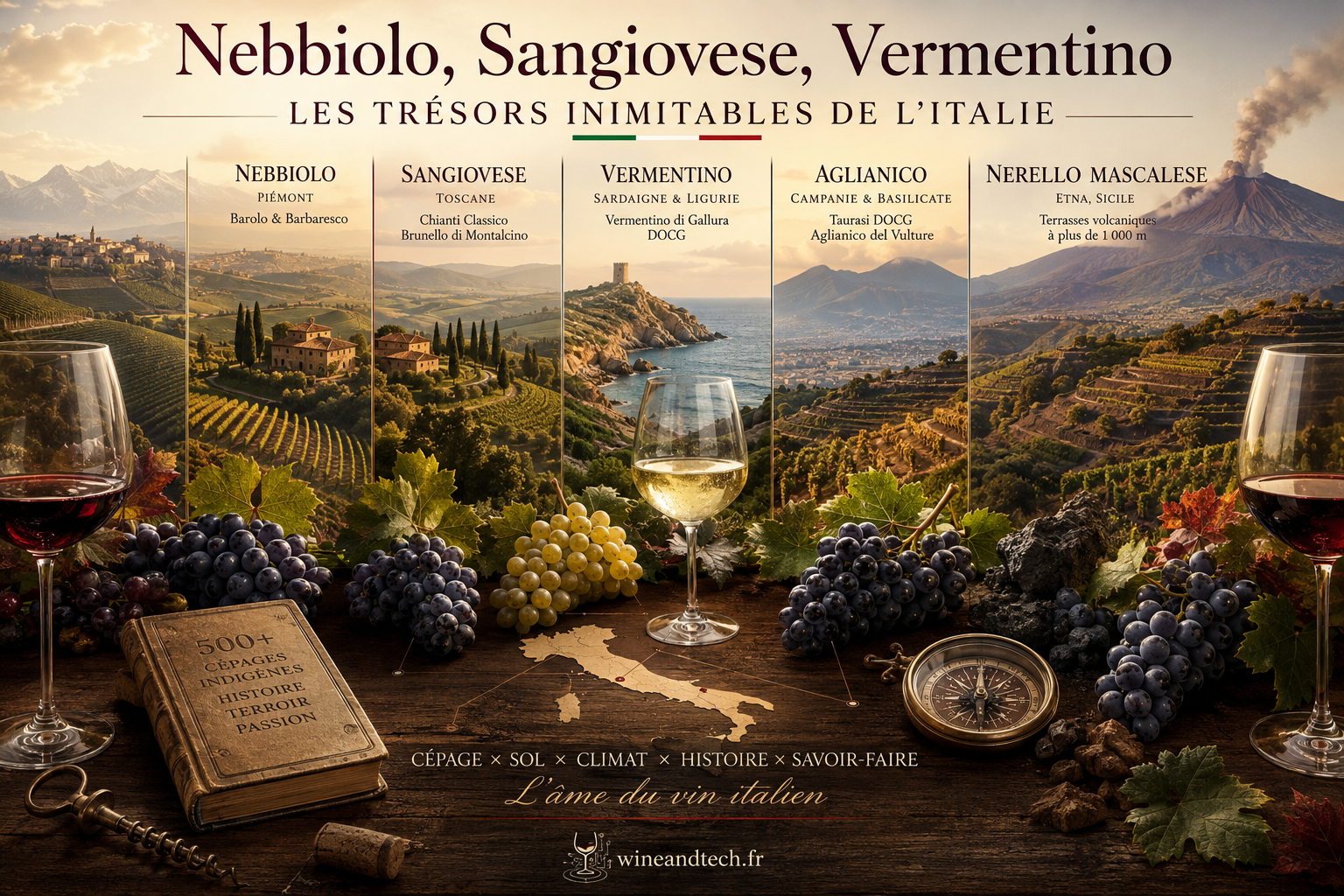
    Italy officially catalogues more than 500 indigenous grape varieties. Among them, some stand apart for a rare quality: their capacity to express with particular force the territory that shaped them.

    Grown far from their home ground, they can produce excellent wines, but their expression changes. Vinified differently, they reveal other facets. Nebbiolo, Sangiovese, Vermentino, Aglianico, Nerello Mascalese: these names are deeply bound to a soil, a climate, a history and craftsmanship passed down through the generations.

    🍇 Grape varieties explored in this article

    Nebbiolo · Sangiovese · Vermentino · Barbera and Dolcetto · Aglianico · Nerello Mascalese

    🔴 Nebbiolo · the king of the Langhe

    Nebbiolo is one of Italy’s most emblematic grape varieties. Its most prestigious home is the Piedmontese Langhe, where it gives rise to the two great DOCGs, Barolo and Barbaresco. It is also present in other Alpine and Piedmontese territories, notably Valtellina in Lombardy, and at Gattinara and Ghemme in northern Piedmont.

    Its signature is immediately recognisable: a colour often relatively pale despite an important tannic structure, high acidity and a remarkable capacity for ageing.

    In youth, its tannins can be particularly firm. Over the years, the wine gains complexity and develops aromas of faded rose, cherry, liquorice, tar, undergrowth and truffle.

    This alliance of aromatic finesse, structure and ageing potential puts Nebbiolo among the world’s great long-lived grape varieties.

    Its expression varies considerably according to soils, exposures and altitude. In the Langhe, the combination of marl, hillsides, microclimates and winemaking tradition has forged an identity difficult to reproduce anywhere else.

    🔴 Sangiovese · the soul of Tuscany

    Sangiovese is the most widely planted grape variety in Italy and arguably one of the most polymorphic on the peninsula. Its most celebrated expression remains deeply linked to Tuscany.

    In Chianti Classico, it produces wines characterised by bright acidity, structured tannins and aromas of cherry, violet, herbs and spice, to which notes of leather and tobacco can be added with age.

    In Montalcino, under the name Brunello, it reaches an expression of particular depth and longevity. In Montepulciano, it forms the heart of Vino Nobile di Montepulciano, in a generally softer and more accessible style.

    This should not be confused with Montepulciano d’Abruzzo, made from the Montepulciano grape variety and not from Sangiovese.

    The strength of Sangiovese lies precisely in its capacity to change face according to its environment. But in central Tuscany, on the soils of galestro and alberese, it finds a particularly emblematic expression, where acidity, structure and freshness balance with remarkable precision.

    🟡 Vermentino · the white of the shores

    Vermentino is one of the Mediterranean’s great white grape varieties.

    It is found in Sardinia, Liguria and Tuscany, as well as in Corsica, where it is traditionally called Rolle.

    In Sardinia, its most prestigious expression is found in Vermentino di Gallura DOCG, the emblematic appellation of the island’s north-east. The regulations require a minimum of 95% Vermentino.

    In the glass, it generally offers dry, fresh and aromatic whites, with notes of white flowers, citrus, peach, white-fleshed fruits and almond, accompanied by a sometimes slightly bitter finish that adds length.

    In Gallura, the granite soils, the wind and the Mediterranean climate contribute strongly to its identity.

    The result is a wine that combines freshness, salinity and elegance. A bottle of Vermentino di Gallura around €12-18 offers a remarkable pleasure-to-price ratio, particularly at table with fish, seafood or Mediterranean cuisine.

    🔴 Barbera and Dolcetto · everyday elegance in Piedmont

    In Piedmont, two other grape varieties occupy an essential place in everyday wine culture: Barbera and Dolcetto.

    Barbera, with its bright acidity, moderate tannins and generous fruit, produces wines that are particularly easy to pair at table. Young and fruity or aged to greater depth, it remains one of Piedmont’s great convivial wines.

    Dolcetto, despite its name, is not a sweet wine. Its name refers to the sweetness of its grapes rather than the sweetness of the wine produced.

    It generally yields soft, fruity and accessible reds, with tannins more present than one might expect and characteristic notes of dark fruits, cherry and almond.

    Barbera and Dolcetto represent another face of Piedmont: less aristocratic than Barolo or Barbaresco, but deeply rooted in everyday life and regional gastronomy.

    🔴 Aglianico · the power of the South

    Aglianico is one of southern Italy’s great red grape varieties and remains relatively underrated internationally.

    Its two most celebrated expressions are found in Campania, with Taurasi DOCG, and in Basilicata, with Aglianico del Vulture.

    It produces structured, deep wines well-suited to ageing: firm tannins, high acidity, dark fruits, spice, balsamic notes and touches of tobacco and undergrowth with development.

    At Taurasi, its keeping potential can be extraordinary. The altitude and relatively cool conditions of some vineyards help preserve its freshness despite the southern latitudes.

    Its late ripening cycle also shapes its identity. Aglianico can reach full maturity late in the season, sometimes into October in certain areas, which builds concentration and complexity in its wines.

    Austere in youth, but capable of becoming spectacular with time.

    🔴 Nerello Mascalese · the child of Etna

    Nerello Mascalese is inseparable from Etna, in eastern Sicily.

    Long used mainly in regional blends, it has undergone a genuine qualitative renaissance over several decades. The rise of Etna wines has revealed its full potential when vinified with precision and drawn from carefully selected parcels.

    On the slopes of the volcano, it produces wines of astonishing finesse: high natural acidity, fine tannins, red fruits, pomegranate, flowers, spice and notes evoking rock or smoke.

    One of its distinctive qualities lies in Etna’s exceptional environment. The vineyards are planted on soils derived from successive lava flows and at sometimes considerable altitude, with significant thermal variation between day and night.

    This combination of volcano, altitude, exposure, Mediterranean climate and the diversity of lava flows creates a mosaic of particularly expressive terroirs.

    The result can evoke, in its finesse and freshness, some of the great reds of northern Italy or Burgundy, while retaining a profoundly Sicilian identity.

    Etna is not just a dramatic backdrop. It’s a genuine winegrowing matrix.


    Inimitable by nature

    Italian wine’s real strength isn’t the number of its grape varieties. It’s the organic bond that links them to their territories.

    Nebbiolo in the Langhe.
    Sangiovese on the Tuscan hills.
    Vermentino facing the winds of Gallura.
    Aglianico on the volcanic heights of Vulture or around Taurasi.
    Nerello Mascalese on the slopes of Etna.

    Elsewhere, these grape varieties can produce excellent wines. But their identity changes when the environment that shaped them disappears.

    This is the full magic of Italian terroir: grape variety × soil × climate × history × craftsmanship.

    More than 500 indigenous grape varieties, hundreds of territories, centuries of adaptation. Italy hasn’t simply preserved this diversity.

    It has transformed it into living heritage.

    And it is perhaps there that its greatest treasure lies: grape varieties the whole world can plant, but whose soul no one can totally reproduce.

    A grape variety doesn’t lie. Separate it from its land, and it tells a different story, or stops telling any at all.

    🇫🇷+🇮🇹 Lire cet article en français + italiano → [lien à ajouter après liaison Polylang]

  • Italy: Tuscany — Promis, Nothing but Pleasure

    Italy: Tuscany — Promis, Nothing but Pleasure

    “The wines of Tuscany are wines that reflect the beauty and elegance of this region, and that have an extraordinary capacity for ageing.” – Wine Spectator

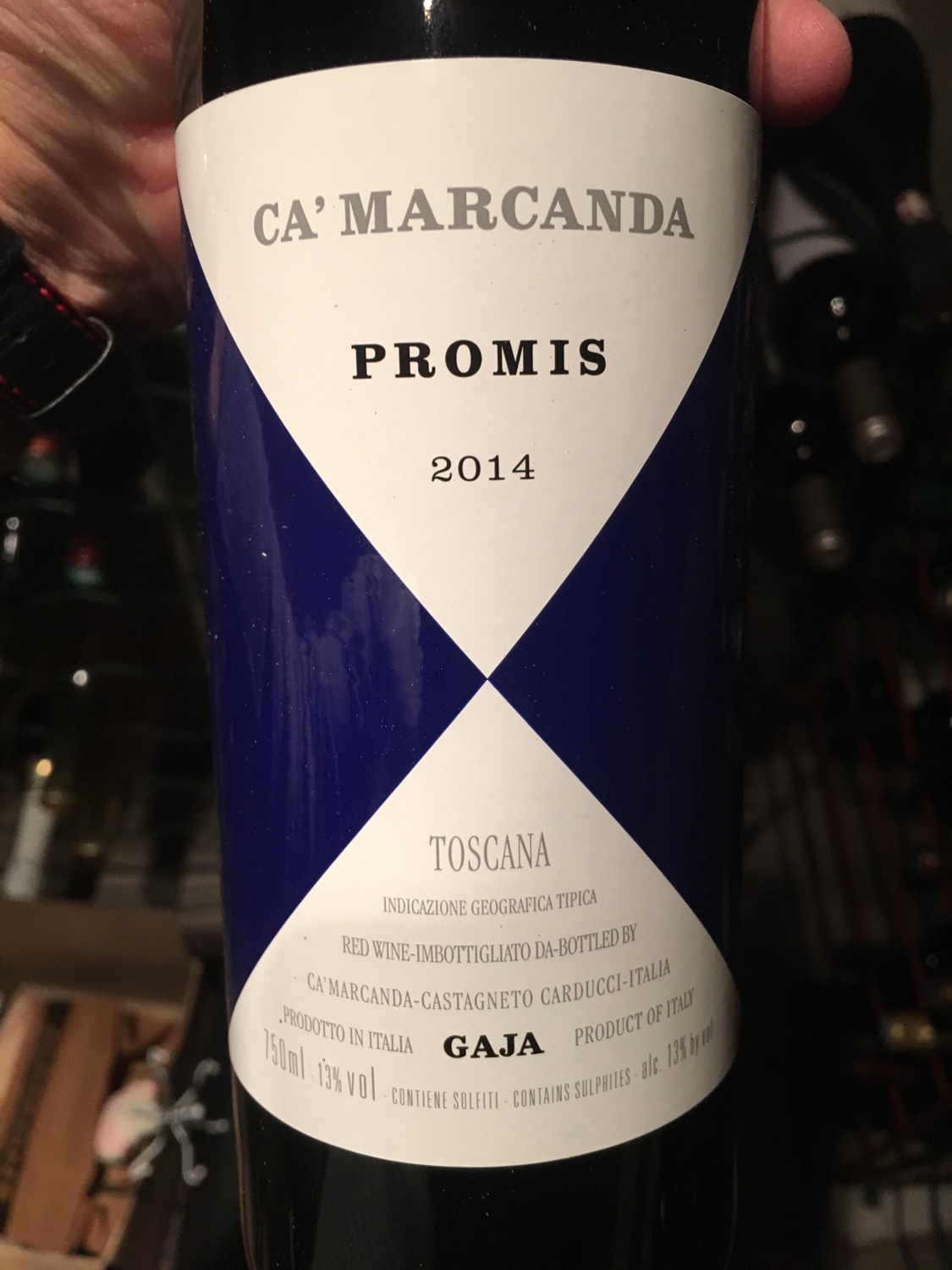
    Promis is produced by the Ca’Marcanda estate, located in the Bolgheri region of Tuscany. This estate belongs to the famous Gaja family of wine producers, who have a long winemaking tradition in Italy.

    Ca’Marcanda was founded by Angelo Gaja in 1996, with the aim of producing wines that reflect the unique terroir of the Bolgheri region. The estate covers around 150 hectares of vineyards, planted mainly with Bordeaux varieties such as Cabernet Sauvignon, Merlot, Cabernet Franc and Petit Verdot.

    Ca’Marcanda is known for producing wines of great quality, combining complexity, elegance and power. Besides Promis, the estate also produces several other prestigious wines, such as Magari, Camarcanda and Ca’Marcanda Vistamare.

    The 2019 vintage of Ca’Marcanda’s Promis is considered an excellent vintage in Tuscany. This wine is a blend of three varieties: Merlot, Syrah and Sangiovese.

    On the nose, Promis 2019 offers intense aromas of red and black fruit, such as cherry, blackberry and plum, along with notes of sweet spice and vanilla from its ageing in French oak barrels.

    On the palate, the wine is rich, powerful and structured, with firm tannins and a balanced acidity. The red and black fruit flavours are confirmed on the palate, along with notes of liquorice, tobacco and dark chocolate.

    Ca’Marcanda’s Promis is often considered a wine for keeping, one that can be cellared for several years and that improves with age. It’s recommended to serve Promis 2019 at a temperature of 16 to 18 degrees Celsius, and it pairs very well with rich meat dishes, such as roasts and game, as well as with mature cheeses.

  • Florence: A Look at Italy’s Wine-Business City? Part 2

    Florence: A Look at Italy’s Wine-Business City? Part 2

    The “buchette del vino”, or “wine windows”, are small wooden windows that were used for centuries to sell wine directly to customers in the street. These windows are often adorned with carvings and decorative designs, adding to the enchantment of the city of Florence. The “wine windows” are unique to Florence and are a symbol of the city’s wine culture.

    We’ve chosen to take you to the restaurant Babae. The place is beautiful, and the simplicity of the menu takes nothing away from the deliciousness of the dishes.

    Just want to have a glass? No problem — the wine window is there to oblige.

    Wine Window Babae

    During our visit to that temple of wine that is Florence, we absolutely insisted on systematically tasting an Italian wine — and, while we were at it, a Tuscan one! As you can imagine, that wasn’t hard.

    The owner of Babae recommended this young Grottaia. This wine is mainly made from Sangiovese grapes, a red variety typical of Tuscany, and may also contain other varieties such as Cabernet Sauvignon or Merlot. It gives off lovely aromas of spice and tobacco. A well-balanced tannic structure, combined with aromas of red fruit and spice, made it a perfect companion for our little midday break.

    Babae Firenze

    For the evening, we chose a restaurant right in the centre, near the famous Piazza del Duomo. The dishes are hearty and refined and, here again, it wasn’t hard to find a local wine. Agricola Toscana blows the codes apart — no doubt about it, we’re in the heart of Italy. Don’t hesitate to book through The Fork to enjoy a discount.

    This time we chose a wine di Montalcino, produced in the Montalcino area — in Tuscany, of course! It’s made from the same grape as the famous Brunello di Montalcino, Sangiovese, but it’s generally lighter and more accessible to drink young. Terre d’Elle Grazie is a well-regarded producer of Rosso di Montalcino. The wine offers aromas of fresh red fruit, floral notes and a lively acidity. Its freshness is everywhere; just close your eyes and all of Italy comes to dazzle you through the whole length. It went wonderfully with our pasta and meats.

    Florence is a real favourite; wine is a deciding factor for a tourism stay.
    Florence is one of Italy’s most emblematic and culturally rich cities. It’s famous for its history, its architecture, its art and its cuisine.

    Florence is home to Renaissance masterpieces, notably the Santa Maria del Fiore cathedral, the Ponte Vecchio, the Uffizi Gallery and the Palazzo Vecchio. The city is brimming with museums, art galleries, artisan boutiques and picturesque markets, such as the leather market.

    Impossible not to taste Tuscan pizzas! Let me give you a must-visit address. Head over towards the Ponte Vecchio, then push on a little further and drop by Gusta Pizza; unfortunately you can’t book a table — first come, first served — but I’m telling you, these pizzas are extraordinary!

    To round off the evening, let me share a good tip:

    The Lion’s Fountain is anchored in a stunning neighbourhood, perfect for a little pick-me-up! This lively district is ideal for spending evenings full of life while marvelling at the shops and their masterful ceilings.