🇬🇧 Series · The Vinous Trinity · Article 8/15 · Italy · ⏱ 5 min
🇫🇷+🇮🇹 Lire en français + italiano → [lien à ajouter] · Mon 🇫🇷 / Wed 🇮🇹 / Fri 🇪🇸
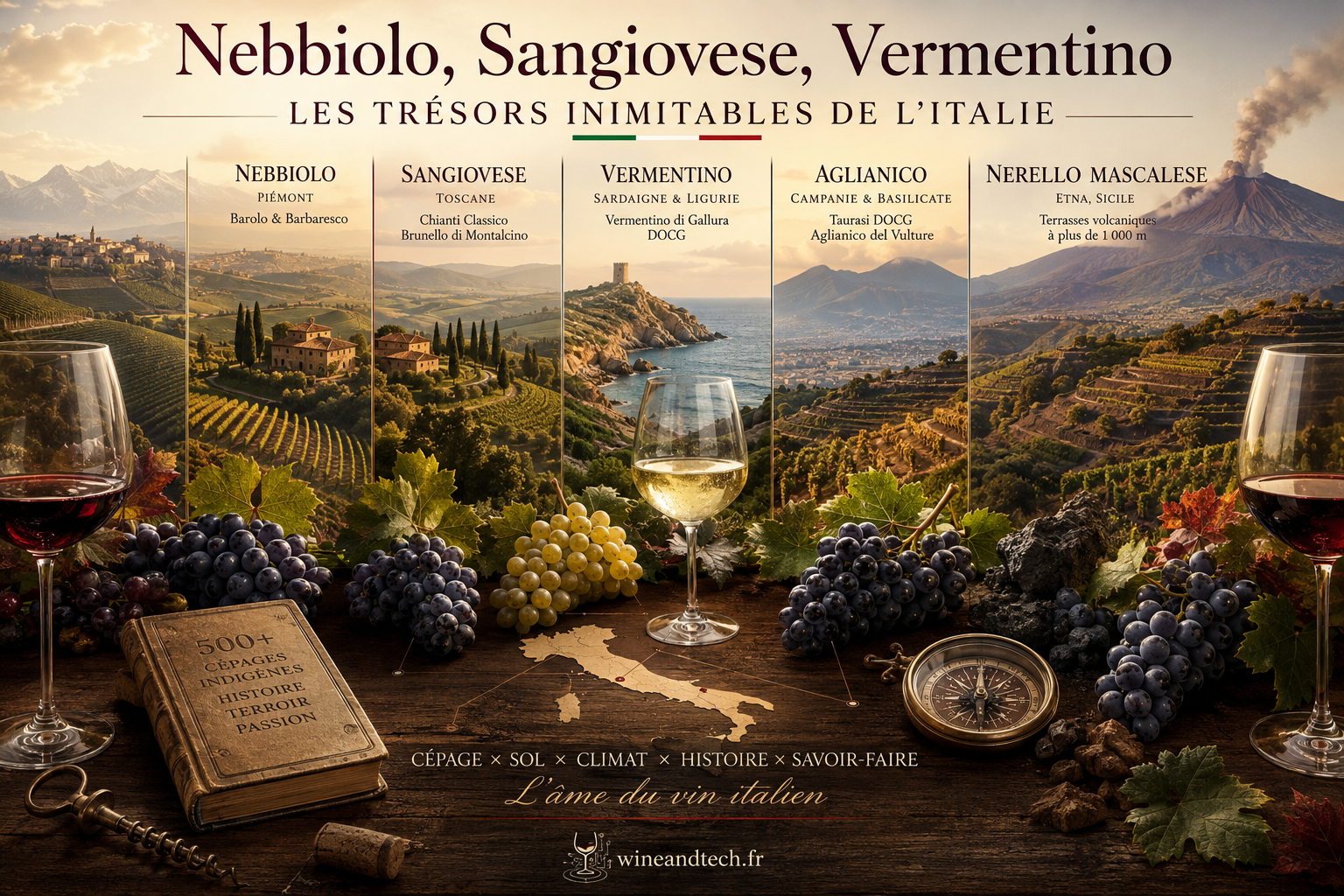
Italy officially catalogues more than 500 indigenous grape varieties. Among them, some stand apart for a rare quality: their capacity to express with particular force the territory that shaped them.
Grown far from their home ground, they can produce excellent wines, but their expression changes. Vinified differently, they reveal other facets. Nebbiolo, Sangiovese, Vermentino, Aglianico, Nerello Mascalese: these names are deeply bound to a soil, a climate, a history and craftsmanship passed down through the generations.
🍇 Grape varieties explored in this article
Nebbiolo · Sangiovese · Vermentino · Barbera and Dolcetto · Aglianico · Nerello Mascalese
🔴 Nebbiolo · the king of the Langhe
Nebbiolo is one of Italy’s most emblematic grape varieties. Its most prestigious home is the Piedmontese Langhe, where it gives rise to the two great DOCGs, Barolo and Barbaresco. It is also present in other Alpine and Piedmontese territories, notably Valtellina in Lombardy, and at Gattinara and Ghemme in northern Piedmont.
Its signature is immediately recognisable: a colour often relatively pale despite an important tannic structure, high acidity and a remarkable capacity for ageing.
In youth, its tannins can be particularly firm. Over the years, the wine gains complexity and develops aromas of faded rose, cherry, liquorice, tar, undergrowth and truffle.
This alliance of aromatic finesse, structure and ageing potential puts Nebbiolo among the world’s great long-lived grape varieties.
Its expression varies considerably according to soils, exposures and altitude. In the Langhe, the combination of marl, hillsides, microclimates and winemaking tradition has forged an identity difficult to reproduce anywhere else.
🔴 Sangiovese · the soul of Tuscany
Sangiovese is the most widely planted grape variety in Italy and arguably one of the most polymorphic on the peninsula. Its most celebrated expression remains deeply linked to Tuscany.
In Chianti Classico, it produces wines characterised by bright acidity, structured tannins and aromas of cherry, violet, herbs and spice, to which notes of leather and tobacco can be added with age.
In Montalcino, under the name Brunello, it reaches an expression of particular depth and longevity. In Montepulciano, it forms the heart of Vino Nobile di Montepulciano, in a generally softer and more accessible style.
This should not be confused with Montepulciano d’Abruzzo, made from the Montepulciano grape variety and not from Sangiovese.
The strength of Sangiovese lies precisely in its capacity to change face according to its environment. But in central Tuscany, on the soils of galestro and alberese, it finds a particularly emblematic expression, where acidity, structure and freshness balance with remarkable precision.
🟡 Vermentino · the white of the shores
Vermentino is one of the Mediterranean’s great white grape varieties.
It is found in Sardinia, Liguria and Tuscany, as well as in Corsica, where it is traditionally called Rolle.
In Sardinia, its most prestigious expression is found in Vermentino di Gallura DOCG, the emblematic appellation of the island’s north-east. The regulations require a minimum of 95% Vermentino.
In the glass, it generally offers dry, fresh and aromatic whites, with notes of white flowers, citrus, peach, white-fleshed fruits and almond, accompanied by a sometimes slightly bitter finish that adds length.
In Gallura, the granite soils, the wind and the Mediterranean climate contribute strongly to its identity.
The result is a wine that combines freshness, salinity and elegance. A bottle of Vermentino di Gallura around €12-18 offers a remarkable pleasure-to-price ratio, particularly at table with fish, seafood or Mediterranean cuisine.
🔴 Barbera and Dolcetto · everyday elegance in Piedmont
In Piedmont, two other grape varieties occupy an essential place in everyday wine culture: Barbera and Dolcetto.
Barbera, with its bright acidity, moderate tannins and generous fruit, produces wines that are particularly easy to pair at table. Young and fruity or aged to greater depth, it remains one of Piedmont’s great convivial wines.
Dolcetto, despite its name, is not a sweet wine. Its name refers to the sweetness of its grapes rather than the sweetness of the wine produced.
It generally yields soft, fruity and accessible reds, with tannins more present than one might expect and characteristic notes of dark fruits, cherry and almond.
Barbera and Dolcetto represent another face of Piedmont: less aristocratic than Barolo or Barbaresco, but deeply rooted in everyday life and regional gastronomy.
🔴 Aglianico · the power of the South
Aglianico is one of southern Italy’s great red grape varieties and remains relatively underrated internationally.
Its two most celebrated expressions are found in Campania, with Taurasi DOCG, and in Basilicata, with Aglianico del Vulture.
It produces structured, deep wines well-suited to ageing: firm tannins, high acidity, dark fruits, spice, balsamic notes and touches of tobacco and undergrowth with development.
At Taurasi, its keeping potential can be extraordinary. The altitude and relatively cool conditions of some vineyards help preserve its freshness despite the southern latitudes.
Its late ripening cycle also shapes its identity. Aglianico can reach full maturity late in the season, sometimes into October in certain areas, which builds concentration and complexity in its wines.
Austere in youth, but capable of becoming spectacular with time.
🔴 Nerello Mascalese · the child of Etna
Nerello Mascalese is inseparable from Etna, in eastern Sicily.
Long used mainly in regional blends, it has undergone a genuine qualitative renaissance over several decades. The rise of Etna wines has revealed its full potential when vinified with precision and drawn from carefully selected parcels.
On the slopes of the volcano, it produces wines of astonishing finesse: high natural acidity, fine tannins, red fruits, pomegranate, flowers, spice and notes evoking rock or smoke.
One of its distinctive qualities lies in Etna’s exceptional environment. The vineyards are planted on soils derived from successive lava flows and at sometimes considerable altitude, with significant thermal variation between day and night.
This combination of volcano, altitude, exposure, Mediterranean climate and the diversity of lava flows creates a mosaic of particularly expressive terroirs.
The result can evoke, in its finesse and freshness, some of the great reds of northern Italy or Burgundy, while retaining a profoundly Sicilian identity.
Etna is not just a dramatic backdrop. It’s a genuine winegrowing matrix.
Inimitable by nature
Italian wine’s real strength isn’t the number of its grape varieties. It’s the organic bond that links them to their territories.
Nebbiolo in the Langhe.
Sangiovese on the Tuscan hills.
Vermentino facing the winds of Gallura.
Aglianico on the volcanic heights of Vulture or around Taurasi.
Nerello Mascalese on the slopes of Etna.
Elsewhere, these grape varieties can produce excellent wines. But their identity changes when the environment that shaped them disappears.
This is the full magic of Italian terroir: grape variety × soil × climate × history × craftsmanship.
More than 500 indigenous grape varieties, hundreds of territories, centuries of adaptation. Italy hasn’t simply preserved this diversity.
It has transformed it into living heritage.
And it is perhaps there that its greatest treasure lies: grape varieties the whole world can plant, but whose soul no one can totally reproduce.
A grape variety doesn’t lie. Separate it from its land, and it tells a different story, or stops telling any at all.
🇫🇷+🇮🇹 Lire cet article en français + italiano → [lien à ajouter après liaison Polylang]