WineAndTech’

Tag: Sierra de Gredos

  • The Spanish vineyard of tomorrow: climate change, organic farming and natural wine

    The Spanish vineyard of tomorrow: climate change, organic farming and natural wine

    🇬🇧 Series · The Vinous Trinity · Article 15/15 · Spain · ⏱ 5 min

    Three countries, fifteen articles, a series that ends. What Spain will have brought to The Vinous Trinity: a lesson on old vines, families holding on, terroirs once written off that are now revealing themselves. And now, a question: where is the Spanish vineyard heading?

    🇰 What we take away

    Spain has a reputation for being a vineyard easy to summarise. Rioja, Tempranillo, Albariño: three names will do, apparently.

    This series will have shown otherwise. Spain is the country where you can still find century-old ungrafted vines on volcanic or granite terroirs that nobody knew twenty years ago. The country where families have defended for four or five generations varieties the rest of the world has forgotten. The country where the most interesting viticultural work is often done without a budget, in regions that still have no international name.

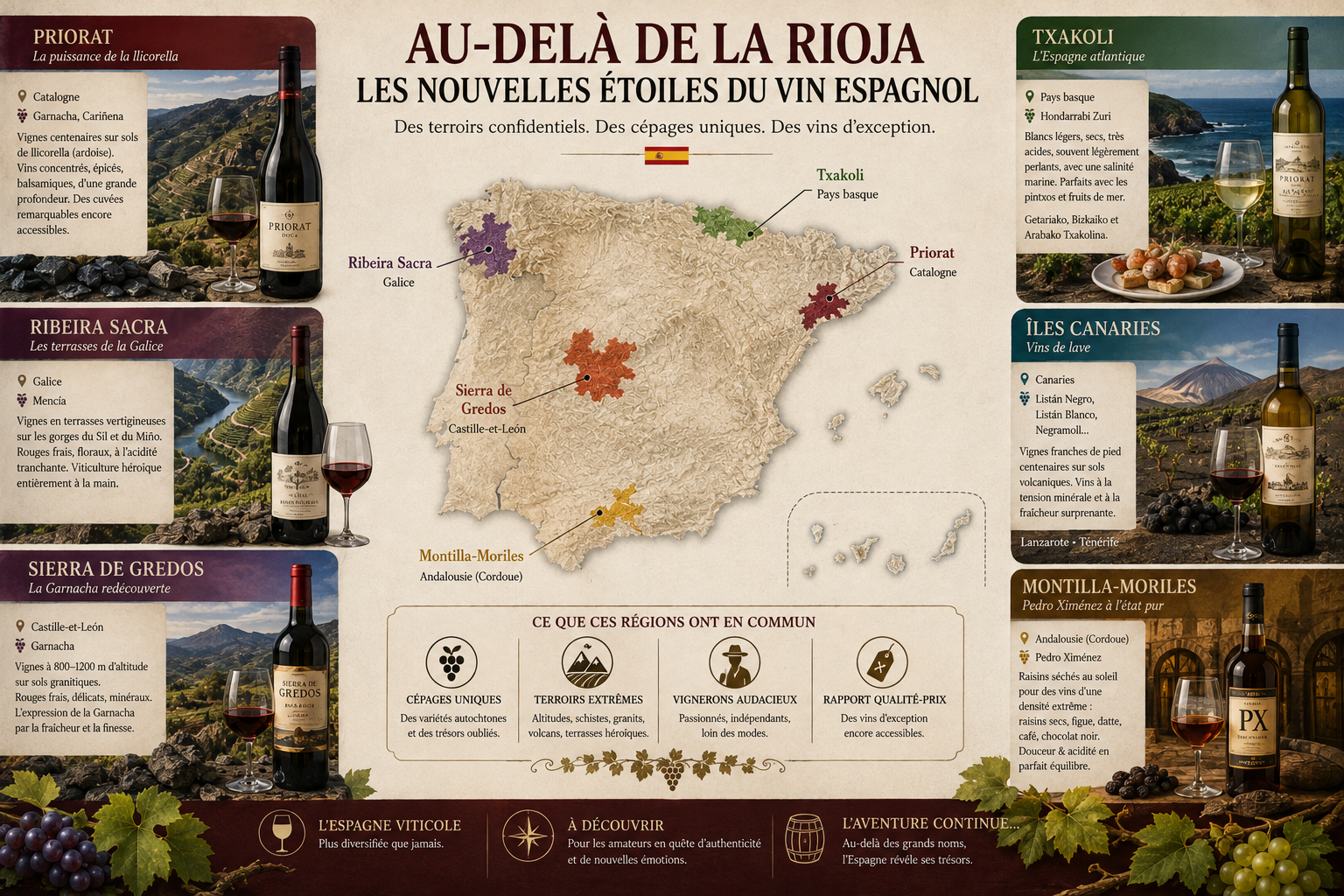
    Priorat, Ribeira Sacra, Sierra de Gredos, the Canary Islands, Txakoli: places that did not appear on the world wine map thirty years ago and which now hold a recognised position on it.

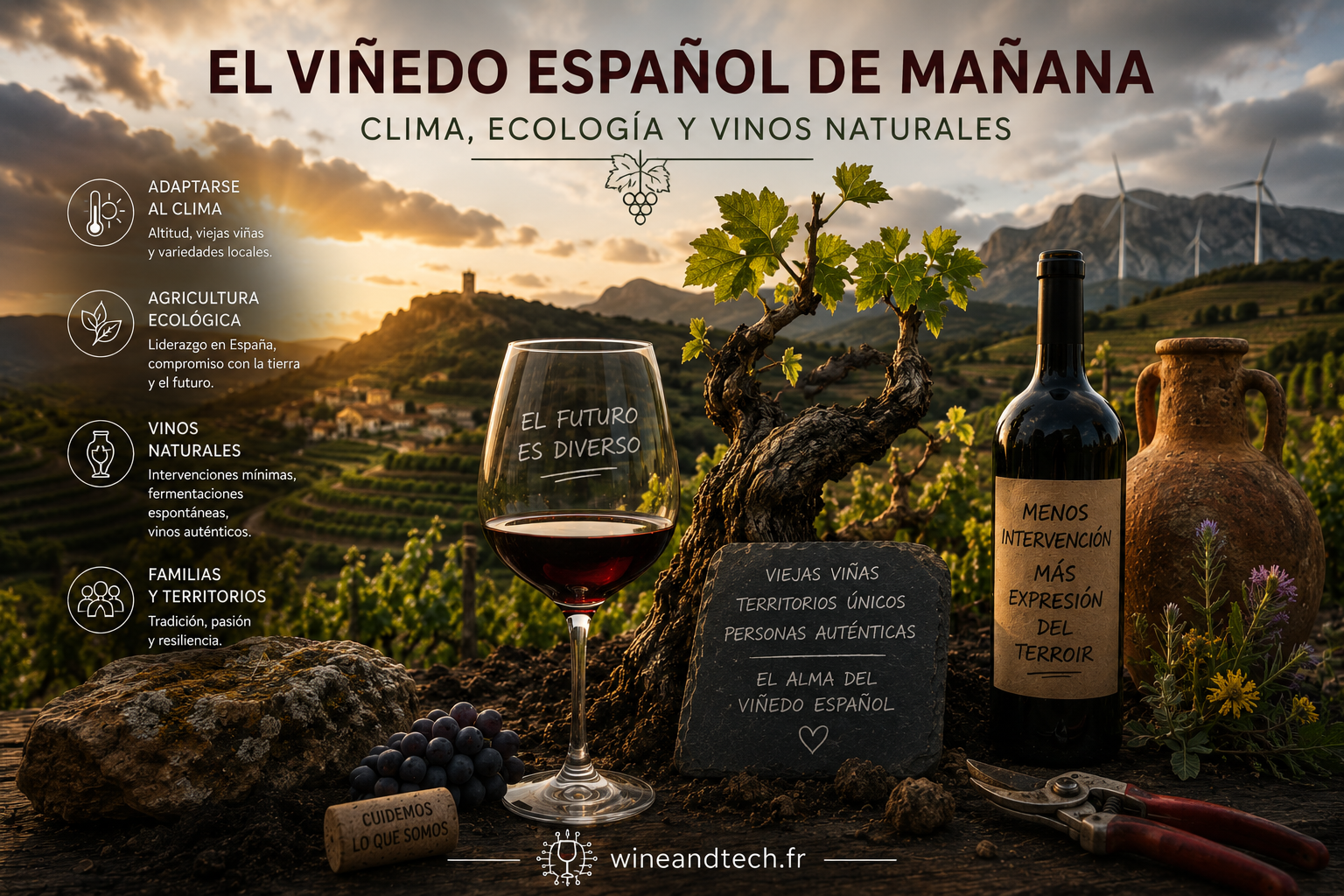
    🌡️ Climate change: Europe’s most acute challenge

    Spain is among the European countries most exposed to the effects of climate warming. This is not an opinion: scientific projections show an intensification of heat episodes, drought and water stress across the Iberian Peninsula. In certain very hot areas of La Mancha, the Levant or Extremadura, high ripeness levels can lead to naturally very elevated alcohol content. Drought and increasing aridification are advancing across several regions of the Centre and South, adding pressure on water resources.

    Spain’s response runs through altitude. Sierra de Gredos, where some old Garnacha vines are cultivated between 800 and 1,200 metres. Producers are also seeking solutions in forgotten local varieties: varieties selected and cultivated for centuries in demanding environments can represent a valuable resource for adaptation, particularly when they ripen late or show good tolerance to water stress.

    Galicia, wetter and more Atlantic, still benefits from a climate that allows it to retain a certain freshness. But warming is already shifting the balances: Albariño more easily reaches higher ripeness levels and water management is becoming a topic there too. The Rías Baixas season is lengthening; Albariño is gaining in maturity.

    🌿 Organic farming: Spain in the lead

    Spain is by far Europe’s largest organic vineyard by surface area. In 2023, around 166,000 hectares of vines were managed organically, representing roughly one fifth of the national vineyard.

    This figure deserves nuance. It covers very different realities: between a small family estate with a longstanding ecological commitment and a large structure certified to meet market demand, the motivations and practices can vary considerably.

    The gap between an artisan producer in the Sierra de Gredos and a large certified organic cooperative in Extremadura is significant.

    But the underlying trend is real. A new generation of family wineries is explicitly choosing organic or biodynamic conversion as both philosophy and identity.

    🍷 Natural wine in Spain: a movement taking shape

    The natural wine movement was slow to take hold in Spain. Spanish wine culture was traditionally oriented toward stabilised, technical wines designed to withstand transport and storage.

    The 2000-2010 generation changed that. Producers such as Comando G in Gredos, Partida Creus in Catalonia or Envínate in the Canary Islands and Galicia helped popularise a low-intervention winemaking approach: spontaneous fermentations, reduced use of sulphur and limited cellar inputs.

    These wines quickly found an audience among specialist wine merchants, sommeliers and importers internationally, before gradually gaining visibility on the Spanish market itself.


    What the series will have shown, and what remains

    A vineyard that had not yet said its last word. Terroirs once thought exhausted that are finding their purpose again. Families transmitting against all odds.

    The future of the Spanish vineyard will not be built from Madrid. It will be built in the Sierra de Gredos, in the gorges of Ribeira Sacra, on the volcanic slopes of the Canary Islands, in the Galician granite. Where nobody expected much.

    The end of The Vinous Trinity. Thank you for following along.

    Tradition can be a starting point. Modernity, a way of continuing it.
  • Las bodegas familiares: tradition and modernity in Spanish wine

    Las bodegas familiares: tradition and modernity in Spanish wine

    🇬🇧 Series · The Vinous Trinity · Article 12/15 · Spain · ⏱ 5 min

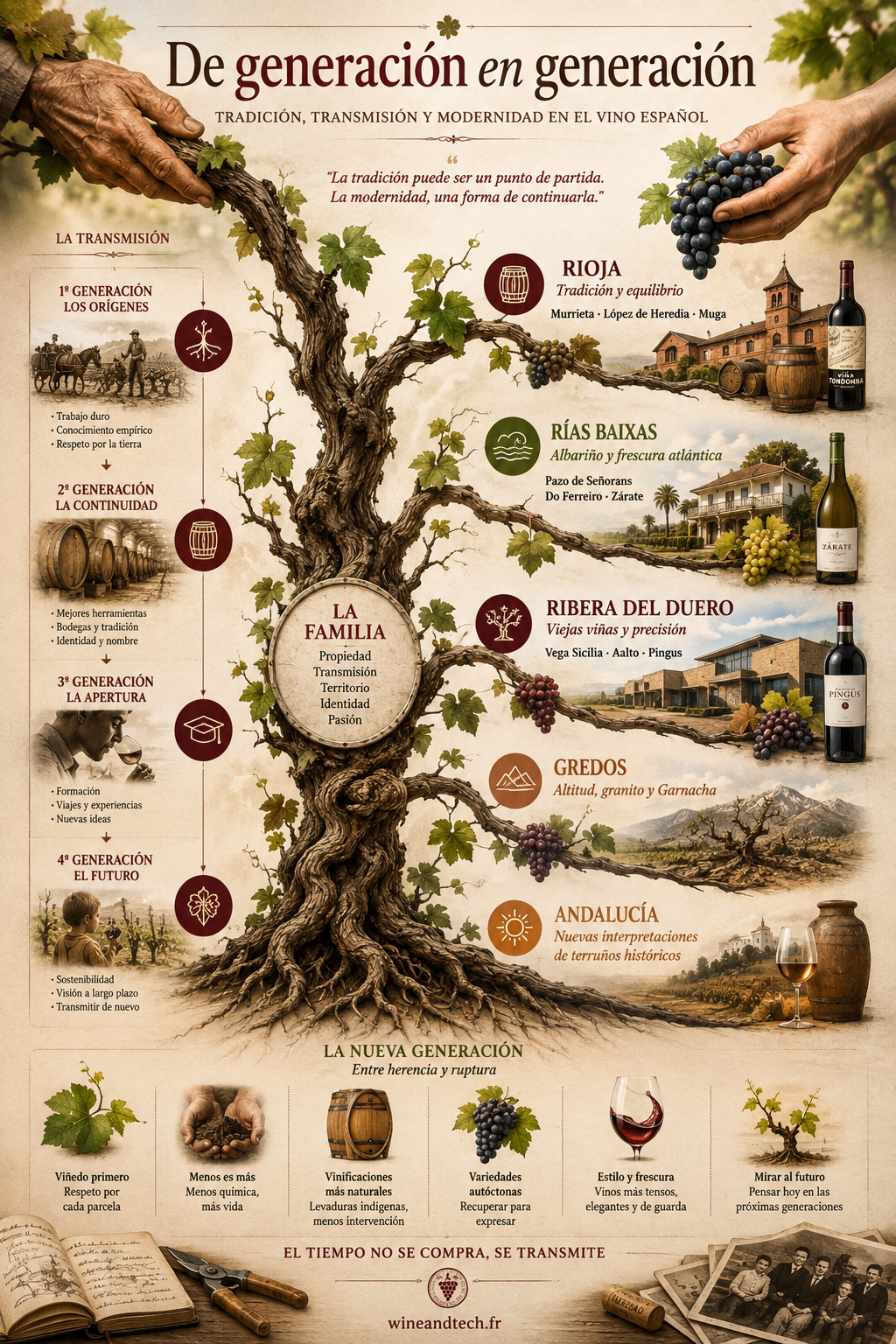
    In Spain, the family winery occupies a particular place in the viticultural landscape. Families cultivating the same plots for several generations, some of which have become international references, others working more discreetly, away from the spotlight.

    Between transmission, rootedness and the will to innovate, the Spanish vineyard also tells a story of families.

    🏠 The family winery: what sets it apart

    The Spanish family winery is built above all on a logic of ownership, transmission and territorial rootedness.

    Unlike large cooperatives that bring together numerous producers, or wine groups present across several regions, it is organised around a name, a family and a territory.

    The link with the vineyard is generally very direct. Generations follow each other, plots are passed on, practices evolve. Decisions taken today can have consequences well beyond a single harvest.

    This long-term vision is perhaps the true signature of these houses.

    🍷 Rioja: the great wine dynasties

    Rioja has given rise to some of Spain’s greatest viticultural dynasties.

    Marqués de Murrieta belongs to this ancient history. From the 19th century, Don Luciano de Murrieta introduced an approach inspired by the Bordeaux model, helping to lay the foundations of modern Rioja wine.

    López de Heredia, founded in Haro from 1877, represents another expression of this tradition. The house remains today one of the rare historic family wineries of the DOCa Rioja.

    More recent, Bodegas Muga, founded in 1932, embodies the same family continuity. Three generations of the Muga family have followed each other at the winery, with a philosophy seeking to combine artisan tradition and openness toward the future.

    Traditional Rioja remains associated with extended ageing and the use of oak, particularly American, with profiles that can develop notes of vanilla, leather and evolved fruit.

    But another Rioja has developed in parallel.

    Artadi, whose Lacalle y Laorden family took the helm in 1992, champions an approach based on plot identity and respect for the vineyard. Remírez de Ganuza, founded in 1989, has introduced various innovations in viticulture and winemaking.

    Two visions can coexist within the same appellation: fidelity to historic codes and the search for a more plot-based, contemporary expression.

    It is precisely this diversity that makes Rioja impossible to sum up in a single sentence.

    🌊 Galicia: the new Albarino families

    The Rías Baixas tells another story.

    In the Val do Salnés, small farms and family work have long occupied an essential place. The creation of the Rías Baixas Denominación de Origen in 1988 accompanied the region’s professionalisation and quality upgrade.

    Some families played a determining role in this evolution.

    Pazo de Señorans was acquired in 1979 by Marisol Bueno and Javier Mareque. The family subsequently contributed to gaining recognition for Albariño’s ageing potential and to the development of the new appellation.

    Do Ferreiro, founded by Gerardo Méndez, is another emblematic family story. The next generation continued work around old vines and the identity of the various Salnés terroirs. Some of its Albariños are capable of evolving for ten years or more in bottle.

    Zárate goes even further in this notion of transmission. The family has cultivated its own vineyards for several generations and works particularly with old plots. Eulogio Pomares, now at the head of the estate, represents this new generation of Galician winemakers trained outside before returning to work on the family heritage.

    Galicia is no longer associated solely with young, aromatic whites.

    Albariño can also be a wine for ageing, gaining in complexity and depth with time.

    🔴 Ribera del Duero: modernity and tradition

    Ribera del Duero is much more recent in its official organisation than Rioja, with the Denominación de Origen created in 1982.

    But its history already includes some mythical names.

    Vega Sicilia, founded in 1864, is the absolute reference. The winery has belonged to the Álvarez family since 1982 and remains one of the great benchmarks of Spanish wine. Its Único has become one of the iconic great wines of the peninsula.

    Around this monument, a new generation of producers has contributed to transforming the image of the region.

    Aalto, founded in 1999 by Mariano García and Javier Zaccagnini, was built around Tinto Fino and old vines spread across several municipalities. The Masaveu and Nozaleda families later joined the project in 2006.

    Dominio de Pingus, created by Peter Sisseck in 1995, belongs more to this generation of personal, high-precision projects than to the classic definition of a family winery.

    This distinction matters: Spanish renewal does not come solely from historic families. It also comes from winemakers who chose to settle in a region, understand its old vines and offer a new reading of them.

    🆕 The new generation: between heritage and rupture

    Across Spain, the same question is now being asked.

    What to do with the heritage received?

    Some heirs choose to continue exactly the work of their parents and grandparents. Others return after studying or working in Bordeaux, Dijon or other great wine regions and wish to progressively modify the estate’s practices.

    Less new wood, more plot-based work, a search for freshness, reduced inputs, a return to certain traditional methods or experimentation around yeasts and fermentations: the paths are numerous.

    There is no single definition of modernity.

    For some families, preserving tradition is already a form of innovation. For others, evolving practices is the best way to remain faithful to the terroir.

    ☀️ The South: forgotten families making a comeback

    Spanish renewal is not limited to the great historic appellations.

    In the Sierra de Gredos, in central Spain, young winemakers and small families are rediscovering old Garnacha vines planted on granite soils, often at high altitude.

    The region is characterised by small-scale viticulture, numerous plots of very small surface area and a new generation of family wineries working particularly with old Garnacha and Albillo Real vines.

    In Andalusia too, certain producers are seeking to move beyond traditional representations of the regional vineyard. Alongside the great historic wines of Jerez and Montilla-Moriles, new projects explore other expressions of the climate, soils and Andalusian varieties.

    The terroirs are there. The old vines too.

    Sometimes it simply took a different way of looking at them.


    A philosophy of the long term

    What ultimately unites these wineries is not their size, their prestige or even their wine style.

    It is their relationship with time.

    A vineyard that is transmitted.

    A plot that continues to be worked because the previous generations did so before us.

    A winery built to last.

    Decisions taken today with the conviction that their consequences will be visible in ten, twenty or thirty years.

    This logic is not that of a simple investment.

    It is closer to a living heritage.

    And it is perhaps there that the singularity of Spanish family wineries lies: they are not simply seeking to produce wine.

    They are seeking to transmit a story.

    A family winery is not measured in bottles produced. It is measured in generations transmitted.

  • Beyond Rioja: Spain’s new wine stars

    Beyond Rioja: Spain’s new wine stars

    🇬🇧 Series · The Vinous Trinity · Article 6/15 · Spain · ⏱ 5 min

    Rioja, Ribera del Duero, Rías Baixas. The three names international wine buyers know. The Spanish vineyard doesn’t stop there. Beyond these appellations, other regions are doing work that deserves attention: more confidential, with different priorities. Old terroirs, indigenous grape varieties, producers who have no interest in making wines that taste like anything else.

    🗺️ Regions explored in this article

    Priorat · Ribeira Sacra · Sierra de Gredos · Canary Islands · Txakoli · Montilla-Moriles

    Priorat · the power of llicorella

    Priorat (DOCa since 2000) built its reputation in the 1990s on something very specific: century-old Garnacha and Cariñena vines on llicorella, a crumbling black slate that gives wines their mineral grip and distinctive balsamic character. The result is concentrated, complex, long-lived. Among the top producers, prices have followed the reputation. But artisan winemakers here still craft remarkable bottles at prices that remain accessible.

    Ribeira Sacra · Galicia’s terraced vineyards

    In the gorges of the Sil and Miño in Galicia, Ribeira Sacra grows Mencía on vertiginous granite terraces that require entirely manual work. Fresh, floral, precise reds with a natural acidity that surprises anyone expecting southern Spanish weight. An appellation that was still little-known five years ago and is now on the radar of most serious sommeliers. Prices haven’t caught up yet.

    Sierra de Gredos · Garnacha rediscovered

    Between Madrid and Ávila, the Sierra de Gredos gave a handful of producers something they couldn’t find elsewhere: old Garnacha vines at 800 to 1,200 metres, on granite. Fresh, delicate, mineral reds. Producers like Comando G and Bernabeleva showed that Spanish Garnacha doesn’t have to mean extracted and heavy. The style they developed is now influencing producers across the country.

    Canary Islands · wines from lava

    The Canaries escaped phylloxera. The result is ungrafted vines, some over a century old, on black volcanic soils, with rare pre-phylloxera varieties: Listán Negro, Listán Blanco, Negramoll. Wines of mineral tension and freshness that are completely unexpected at these latitudes. Lanzarote and Tenerife both have serious producers. Prices are still reasonable.

    Txakoli · Atlantic Spain

    Txakoli is the Basques’ white wine: light (10-11% alcohol), often lightly sparkling, dry, very acidic, with a marine salinity that makes it an obvious match for pintxos and seafood. Three appellations: Getariako Txakolina, Bizkaiko Txakolina, Arabako Txakolina. Same philosophy throughout: a sharp, lively, genuine wine. Still affordable.

    Montilla-Moriles · Pedro Ximénez in its purest form

    Montilla-Moriles, in the Córdoba area, makes wine from Pedro Jiménez grapes dried in the sun until concentrated. The result: a dense, sweet wine full of raisins, fig, date, coffee and dark chocolate, with enough natural acidity to keep it balanced. Often available at lower prices than comparable wines from Jerez, for similar quality.


    What connects these regions

    It isn’t geography. It’s a certain stubbornness. Producers making wine from grape varieties nobody planted for decades, on terroirs nobody paid attention to. More sommeliers and wine merchants are noticing now. The prices haven’t fully caught up. That will change.

    Spain has shown the world its Rioja. The rest is only now becoming visible.