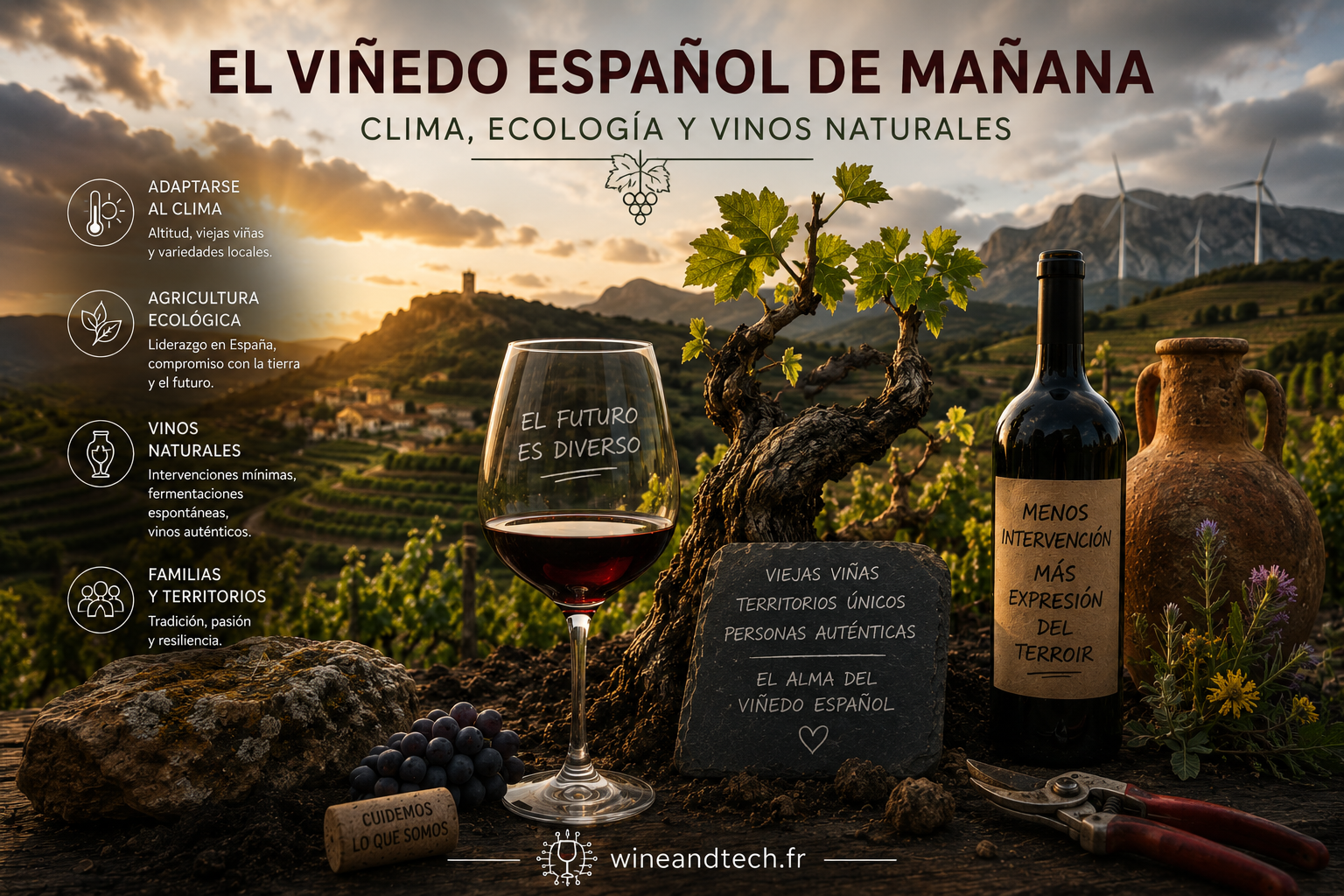
🇬🇧 Series · The Vinous Trinity · Article 15/15 · Spain · ⏱ 5 min
Three countries, fifteen articles, a series that ends. What Spain will have brought to The Vinous Trinity: a lesson on old vines, families holding on, terroirs once written off that are now revealing themselves. And now, a question: where is the Spanish vineyard heading?
🇰 What we take away
Spain has a reputation for being a vineyard easy to summarise. Rioja, Tempranillo, Albariño: three names will do, apparently.
This series will have shown otherwise. Spain is the country where you can still find century-old ungrafted vines on volcanic or granite terroirs that nobody knew twenty years ago. The country where families have defended for four or five generations varieties the rest of the world has forgotten. The country where the most interesting viticultural work is often done without a budget, in regions that still have no international name.
Priorat, Ribeira Sacra, Sierra de Gredos, the Canary Islands, Txakoli: places that did not appear on the world wine map thirty years ago and which now hold a recognised position on it.
🌡️ Climate change: Europe’s most acute challenge
Spain is among the European countries most exposed to the effects of climate warming. This is not an opinion: scientific projections show an intensification of heat episodes, drought and water stress across the Iberian Peninsula. In certain very hot areas of La Mancha, the Levant or Extremadura, high ripeness levels can lead to naturally very elevated alcohol content. Drought and increasing aridification are advancing across several regions of the Centre and South, adding pressure on water resources.
Spain’s response runs through altitude. Sierra de Gredos, where some old Garnacha vines are cultivated between 800 and 1,200 metres. Producers are also seeking solutions in forgotten local varieties: varieties selected and cultivated for centuries in demanding environments can represent a valuable resource for adaptation, particularly when they ripen late or show good tolerance to water stress.
Galicia, wetter and more Atlantic, still benefits from a climate that allows it to retain a certain freshness. But warming is already shifting the balances: Albariño more easily reaches higher ripeness levels and water management is becoming a topic there too. The Rías Baixas season is lengthening; Albariño is gaining in maturity.
🌿 Organic farming: Spain in the lead
Spain is by far Europe’s largest organic vineyard by surface area. In 2023, around 166,000 hectares of vines were managed organically, representing roughly one fifth of the national vineyard.
This figure deserves nuance. It covers very different realities: between a small family estate with a longstanding ecological commitment and a large structure certified to meet market demand, the motivations and practices can vary considerably.
The gap between an artisan producer in the Sierra de Gredos and a large certified organic cooperative in Extremadura is significant.
But the underlying trend is real. A new generation of family wineries is explicitly choosing organic or biodynamic conversion as both philosophy and identity.
🍷 Natural wine in Spain: a movement taking shape
The natural wine movement was slow to take hold in Spain. Spanish wine culture was traditionally oriented toward stabilised, technical wines designed to withstand transport and storage.
The 2000-2010 generation changed that. Producers such as Comando G in Gredos, Partida Creus in Catalonia or Envínate in the Canary Islands and Galicia helped popularise a low-intervention winemaking approach: spontaneous fermentations, reduced use of sulphur and limited cellar inputs.
These wines quickly found an audience among specialist wine merchants, sommeliers and importers internationally, before gradually gaining visibility on the Spanish market itself.
What the series will have shown, and what remains
A vineyard that had not yet said its last word. Terroirs once thought exhausted that are finding their purpose again. Families transmitting against all odds.
The future of the Spanish vineyard will not be built from Madrid. It will be built in the Sierra de Gredos, in the gorges of Ribeira Sacra, on the volcanic slopes of the Canary Islands, in the Galician granite. Where nobody expected much.
The end of The Vinous Trinity. Thank you for following along.
Tradition can be a starting point. Modernity, a way of continuing it.
Leave a Reply