Tag: vins nature

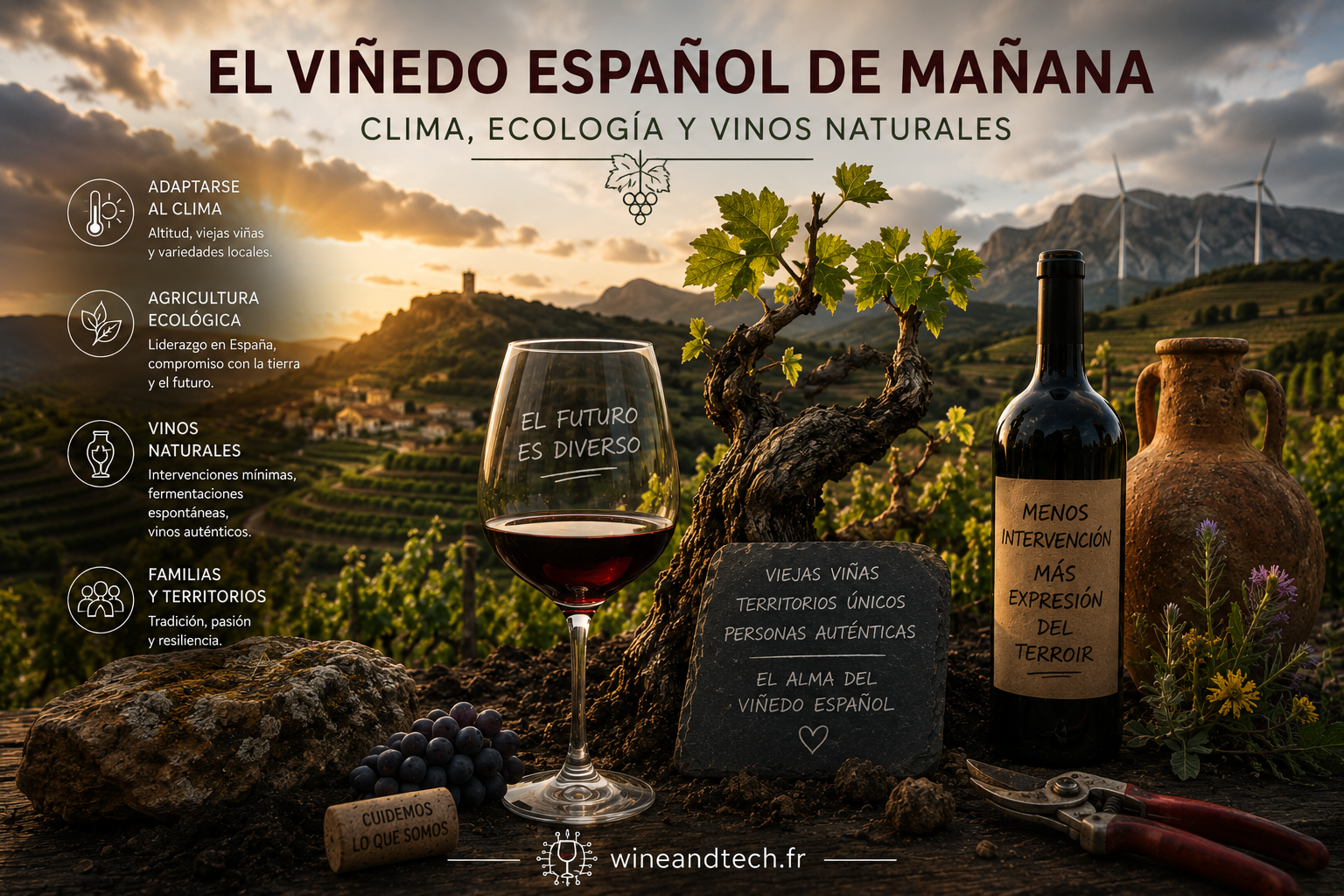
  • The Spanish vineyard of tomorrow: climate change, organic farming and natural wine

    The Spanish vineyard of tomorrow: climate change, organic farming and natural wine

    🇬🇧 Series · The Vinous Trinity · Article 15/15 · Spain · ⏱ 5 min

    Three countries, fifteen articles, a series that ends. What Spain will have brought to The Vinous Trinity: a lesson on old vines, families holding on, terroirs once written off that are now revealing themselves. And now, a question: where is the Spanish vineyard heading?

    🇰 What we take away

    Spain has a reputation for being a vineyard easy to summarise. Rioja, Tempranillo, Albariño: three names will do, apparently.

    This series will have shown otherwise. Spain is the country where you can still find century-old ungrafted vines on volcanic or granite terroirs that nobody knew twenty years ago. The country where families have defended for four or five generations varieties the rest of the world has forgotten. The country where the most interesting viticultural work is often done without a budget, in regions that still have no international name.

    Priorat, Ribeira Sacra, Sierra de Gredos, the Canary Islands, Txakoli: places that did not appear on the world wine map thirty years ago and which now hold a recognised position on it.

    🌡️ Climate change: Europe’s most acute challenge

    Spain is among the European countries most exposed to the effects of climate warming. This is not an opinion: scientific projections show an intensification of heat episodes, drought and water stress across the Iberian Peninsula. In certain very hot areas of La Mancha, the Levant or Extremadura, high ripeness levels can lead to naturally very elevated alcohol content. Drought and increasing aridification are advancing across several regions of the Centre and South, adding pressure on water resources.

    Spain’s response runs through altitude. Sierra de Gredos, where some old Garnacha vines are cultivated between 800 and 1,200 metres. Producers are also seeking solutions in forgotten local varieties: varieties selected and cultivated for centuries in demanding environments can represent a valuable resource for adaptation, particularly when they ripen late or show good tolerance to water stress.

    Galicia, wetter and more Atlantic, still benefits from a climate that allows it to retain a certain freshness. But warming is already shifting the balances: Albariño more easily reaches higher ripeness levels and water management is becoming a topic there too. The Rías Baixas season is lengthening; Albariño is gaining in maturity.

    🌿 Organic farming: Spain in the lead

    Spain is by far Europe’s largest organic vineyard by surface area. In 2023, around 166,000 hectares of vines were managed organically, representing roughly one fifth of the national vineyard.

    This figure deserves nuance. It covers very different realities: between a small family estate with a longstanding ecological commitment and a large structure certified to meet market demand, the motivations and practices can vary considerably.

    The gap between an artisan producer in the Sierra de Gredos and a large certified organic cooperative in Extremadura is significant.

    But the underlying trend is real. A new generation of family wineries is explicitly choosing organic or biodynamic conversion as both philosophy and identity.

    🍷 Natural wine in Spain: a movement taking shape

    The natural wine movement was slow to take hold in Spain. Spanish wine culture was traditionally oriented toward stabilised, technical wines designed to withstand transport and storage.

    The 2000-2010 generation changed that. Producers such as Comando G in Gredos, Partida Creus in Catalonia or Envínate in the Canary Islands and Galicia helped popularise a low-intervention winemaking approach: spontaneous fermentations, reduced use of sulphur and limited cellar inputs.

    These wines quickly found an audience among specialist wine merchants, sommeliers and importers internationally, before gradually gaining visibility on the Spanish market itself.


    What the series will have shown, and what remains

    A vineyard that had not yet said its last word. Terroirs once thought exhausted that are finding their purpose again. Families transmitting against all odds.

    The future of the Spanish vineyard will not be built from Madrid. It will be built in the Sierra de Gredos, in the gorges of Ribeira Sacra, on the volcanic slopes of the Canary Islands, in the Galician granite. Where nobody expected much.

    The end of The Vinous Trinity. Thank you for following along.

    Tradition can be a starting point. Modernity, a way of continuing it.
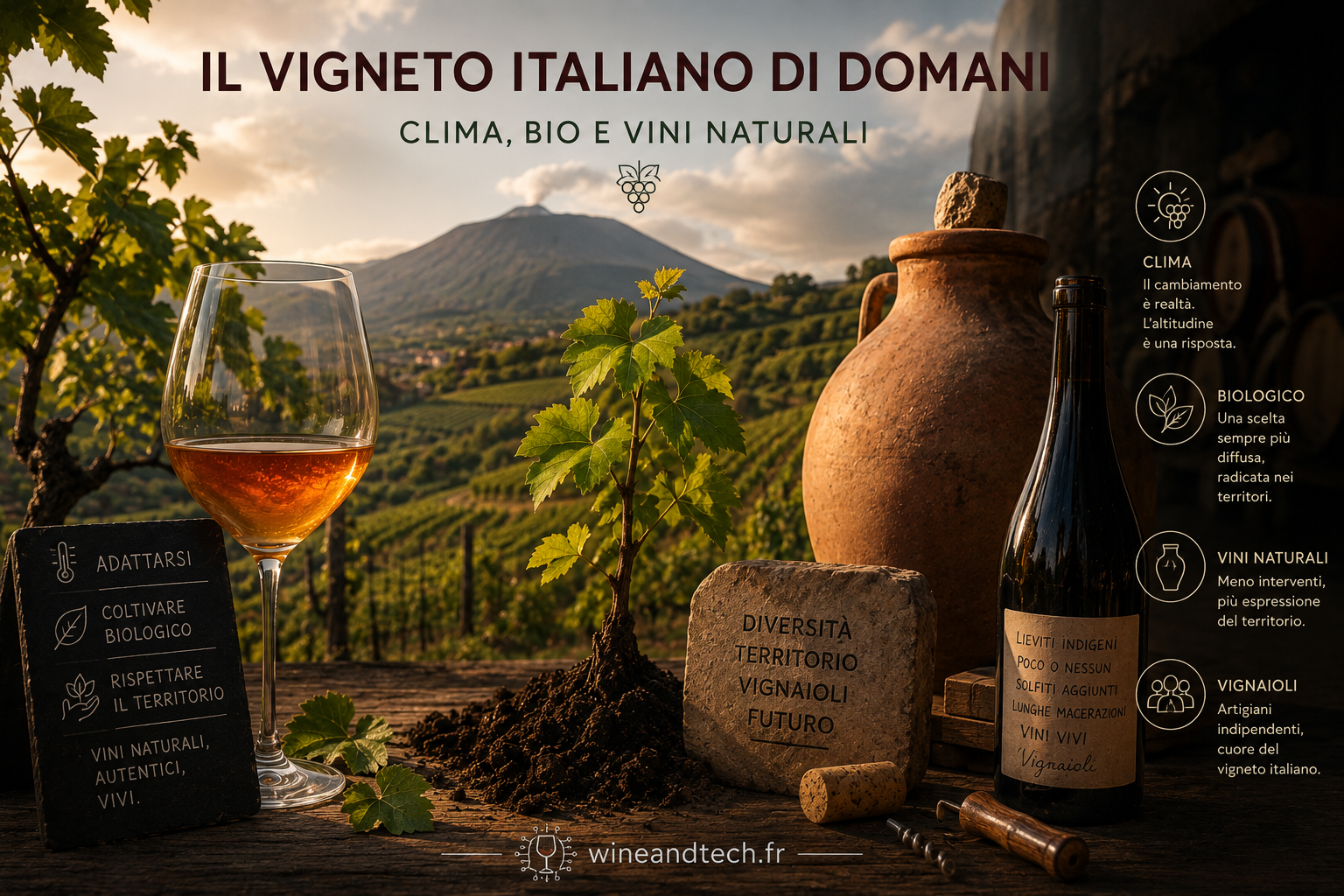
  • The Italian vineyard of tomorrow: climate change, organic and natural wine

    The Italian vineyard of tomorrow: climate change, organic and natural wine

    🇬🇧 Series · The Vinous Trinity · Article 14/15 · Italy · ⏱ 5 min

    🇫🇷+🇮🇹 Lire en français + italiano → [lien à ajouter] · Mon 🇫🇷 / Wed 🇮🇹 / Fri 🇪🇸

    Three countries, fourteen articles, and already time for a synthesis. What Italy will have brought to The Vinous Trinity: a lesson on diversity as strength, on inimitable grape varieties, on the vignaioli who do everything themselves. And now, a question: where is the Italian vineyard heading?

    🇰 What we take away

    Italy possesses one of the world’s greatest viticultural biodiversities, with more than 500 indigenous grape varieties officially recognised. This figure is not a footnote: it is the key to understanding everything the series has explored.

    Nebbiolo in the Langhe. Sangiovese on the Tuscan hills. Vermentino facing the winds of Gallura. Aglianico on the volcanic heights of Vulture or around Taurasi. Nerello Mascalese on the slopes of Etna. Each deeply marked by the territory in which it developed, capable of expressing very different profiles elsewhere.

    And behind these grape varieties, the vignaioli: artisans who grow, vinify and bottle. Often on just a few hectares. Often for several generations. This interlocking of variety, terroir and independent producer is the strength of the Italian vineyard.

    🌡️ Climate change: Etna as a model?

    Climate change is affecting Italy very unevenly. In the north-east and certain areas of Lombardy, harvests tend to come earlier and earlier. The South and Sicily, already warm, are facing record temperatures during harvest.

    Italy’s response runs in part through altitude. Etna is the most striking example: vineyards at 600, 800, 1,000 metres, with day-to-night temperature swings that preserve freshness even in the full heat of a Sicilian summer. This capacity to seek out freshness and altitude now represents an adaptation strategy observed across other Italian regions.

    In Campania and Basilicata, Aglianico, a late-ripening variety, is also finding renewed interest in the context of climate warming. In Sardinia, altitude and sea winds play a regulatory role. In Piedmont, producers are planting on cooler exposures that were once set aside.

    🌿 Organic farming: a movement rooted in the land

    Italy is among the European leaders in organic viticulture. Around 129,000 hectares of wine grape vines were managed organically or in conversion in 2023, accounting for roughly one fifth of the national vineyard. Sicily, Sardinia and Tuscany account for a significant share of certified operations.

    This is not simply a response to demand. In Italy, many winemakers have long worked in a thoughtful or organic way. For some, certification formalised practices that had already been in place for several years.

    Biodynamics is also progressing, carried by a new generation of vignaioli seeking total coherence between their philosophy and their practices.

    🍷 Natural wine, Italian style

    Italy has its own natural wine pioneers. Josko Gravner in Friuli, who from the 1990s explored long skin macerations before turning to Georgian amphorae at the start of the 2000s. Stanislao Radikon, his neighbour, who created an aesthetic of oxidative, slowly evolving white wine now recognised worldwide.

    These orange wines from Friuli-Venezia Giulia were first misunderstood, then marginal, then cult. This Italian renaissance helped bring skin-contact whites back to the international stage, and Friuli remains one of the world’s great references for maceration whites, now emblematic of the so-called natural wine revival.

    In Piedmont, Tuscany and Sicily, a new generation of vignaioli works with indigenous yeasts, reduced or zero added sulphur depending on the producer, long ageing in clay or old wood. No official label. But an approach that converges with what the world calls natural.


    What the series will have shown

    Italy has transformed its diversity into living heritage. More than 500 indigenous varieties, hundreds of territories, centuries of adaptation.

    Against climate change, this diversity is a resource. A grape variety selected and cultivated for centuries in a given environment can represent a valuable tool for adaptation, particularly when it ripens late or shows good tolerance to local conditions.

    The future of the Italian vineyard will not be written by the great houses. It will play out in the Langhe, on Etna, in the gorges of Campania, in the Sardinian granite. Where a vignaiolo decides, season after season, to keep going.

    Italy has not exhausted its surprises. It just needs people to keep looking for them.

    🇫🇷+🇮🇹 Lire cet article en français + italiano → [lien à ajouter après liaison Polylang]

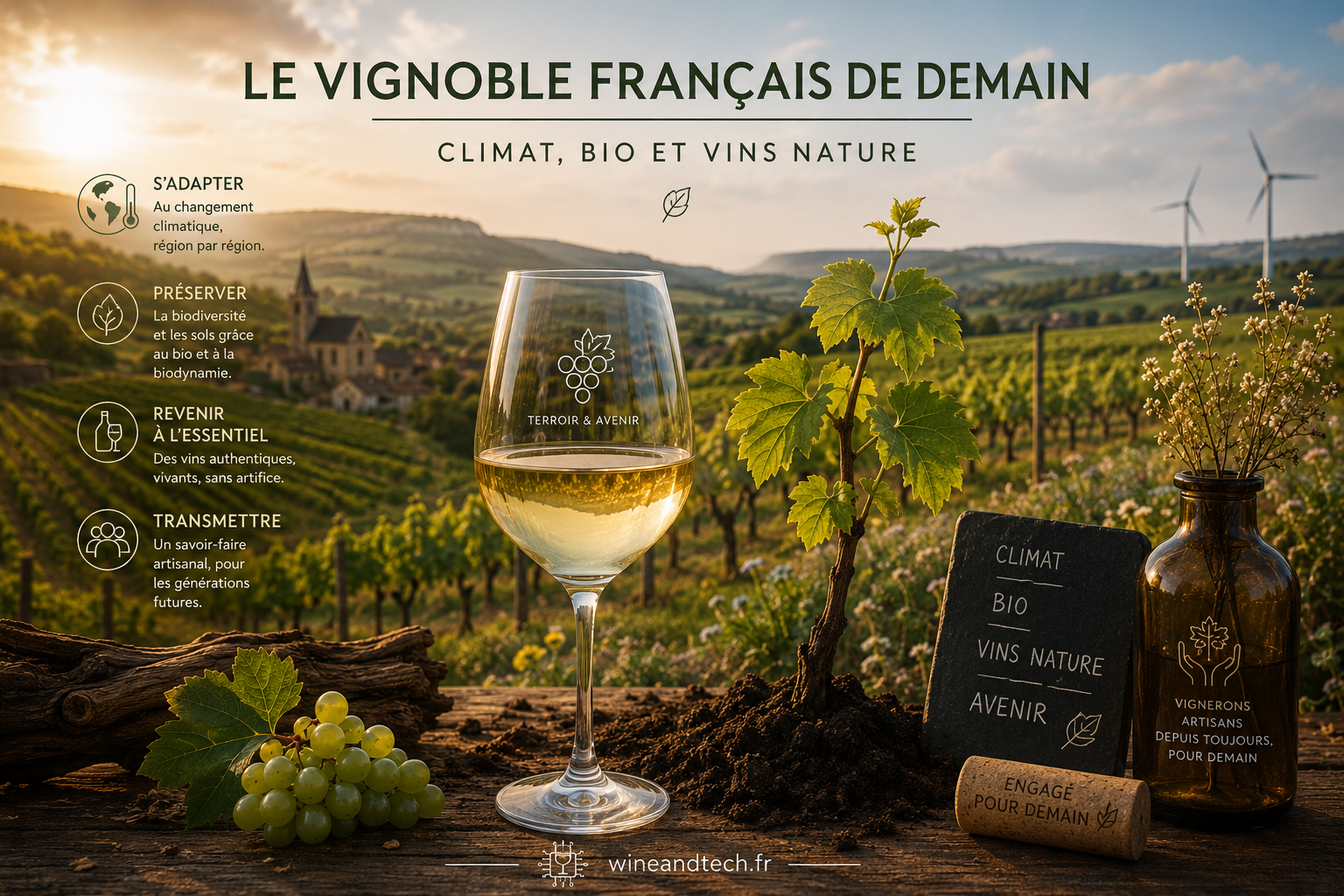
  • The French vineyard of tomorrow: climate change, organic wine and natural wine

    The French vineyard of tomorrow: climate change, organic wine and natural wine

    🇬🇧 Series · The Vinous Trinity · Article 13/15 · France · ⏱ 5 min

    🇫🇷 Lire en français → [lien à ajouter] · Mon 🇫🇷 / Wed 🇮🇹 / Fri 🇪🇸

    Three countries, twelve articles, fifteen weeks of The Vinous Trinity. Before arriving at the final chapter, a look back at what France has shown. And a glance at what lies ahead.

    What the French vineyard has that is exceptional is its diversity. Not only in terms of regions or grape varieties, but in its approach to wine: as an expression of a place, a history, a person. The future of this vineyard is now playing out on three fronts: climate change, the rise of organic farming and the natural wine movement.

    🇰 What we take away

    France has profoundly shaped modern wine culture. The concept of terroir, the hierarchy of appellations, the great blending models, barrel ageing and the promotion of emblematic grape varieties have all contributed to its worldwide influence.

    What the series will have shown: France is more diverse than its great names suggest. Beyond Bordeaux, Burgundy and Champagne, entire regions are working in relative obscurity, with grape varieties found almost nowhere else and wines that still sell at honest prices.

    Jura, Savoie, the Beaujolais crus, the Grand South-West, Corsica, the secret Loire, French Moselle: territories that prove the French vineyard is far from having revealed everything. Behind each appellation, artisans practising this trade with complete independence, often for several generations.

    🌡️ Climate change: a reality region by region

    In Alsace, harvests have moved forward by more than three weeks over recent decades. In Champagne, preserving the acidity and freshness that are part of the wines’ identity is becoming more complex in a warming climate. In Languedoc, episodes of intense heat can lead to high ripeness levels and significant alcohol content.

    The responses are diverse. Planting later-ripening varieties. Moving to higher altitudes. Rehabilitating forgotten local varieties, better adapted to current conditions. Irrigation, long tightly regulated in French appellations, is permitted in certain situations and is now the subject of new regulatory thinking.

    The paradox: certain regions once too cold to produce quality wines are now benefiting. French Moselle, Auvergne, Haute-Savoie: terroirs gaining in potential at the very moment their more southerly neighbours are seeking to preserve their freshness.

    🌿 Organic farming: a quiet transformation

    France has become one of Europe’s leading organic vineyards. In 2023, around 22% of the French vineyard was managed organically, including certified and under-conversion operations, with more than 131,000 hectares already fully certified. The progression has been remarkable.

    Behind this figure, a diverse reality. Some producers have been organic since the 1980s, often in pioneering regions: Alsace, Loire, Roussillon, Languedoc. Others have converted more recently, driven by demand or conviction.

    Biodynamics, a distinct approach from organic farming and generally more demanding in its practices, is also progressing. In Burgundy, Alsace and Champagne, emblematic estates have worked biodynamically for decades. These practices are often invisible on the label, but very real in the cellar.

    🍷 Natural wine: between Paris and the rest of the world

    The natural wine movement took particular shape in France from the 1980s-90s, notably in Beaujolais and the Loire, around winemakers such as Marcel Lapierre, Jo Pithon, Pierre Overnoy and Nicolas Joly.

    There is no single official definition of “natural wine”. The term generally refers to a production philosophy seeking minimal intervention, in both the vineyard and the cellar: grapes from low-intervention farming, spontaneous fermentations, limited oenological inputs and reduced use of sulphur, to varying degrees depending on the producer.

    Today the movement is worldwide, but France remains its symbolic epicentre. Paris has become one of the world’s great natural wine capitals, with a remarkable concentration of specialist wine shops, wine bars and restaurants.

    What was marginal in the 1990s has become, thirty years on, an underlying trend that influences even the most conventional producers.


    What the series will have shown

    French wine’s richness does not rest on its great names. It rests on the density of its artisan fabric. Thousands of small producers, dozens of lesser-known regions, hundreds of local grape varieties.

    The future does not depend on a grand plan. It is built plot by plot, family by family, harvest by harvest.

    France has not exhausted its surprises. It just needs people to keep looking for them.

    🇫🇷 Lire cet article en français → [lien à ajouter après liaison Polylang]