🇬🇧 Series · The Vinous Trinity · Article 14/15 · Italy · ⏱ 5 min
🇫🇷+🇮🇹 Lire en français + italiano → [lien à ajouter] · Mon 🇫🇷 / Wed 🇮🇹 / Fri 🇪🇸
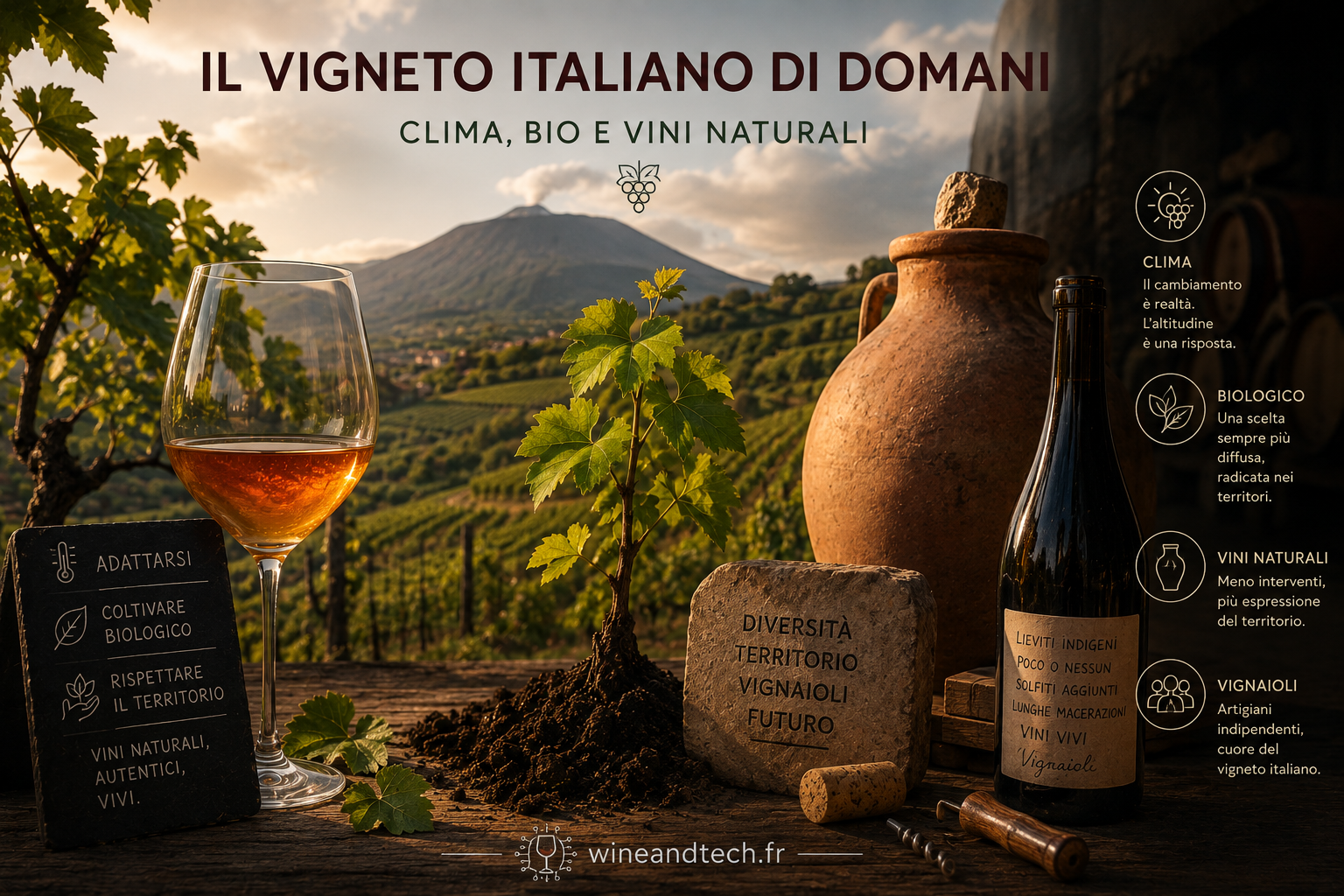
Three countries, fourteen articles, and already time for a synthesis. What Italy will have brought to The Vinous Trinity: a lesson on diversity as strength, on inimitable grape varieties, on the vignaioli who do everything themselves. And now, a question: where is the Italian vineyard heading?
🇰 What we take away
Italy possesses one of the world’s greatest viticultural biodiversities, with more than 500 indigenous grape varieties officially recognised. This figure is not a footnote: it is the key to understanding everything the series has explored.
Nebbiolo in the Langhe. Sangiovese on the Tuscan hills. Vermentino facing the winds of Gallura. Aglianico on the volcanic heights of Vulture or around Taurasi. Nerello Mascalese on the slopes of Etna. Each deeply marked by the territory in which it developed, capable of expressing very different profiles elsewhere.
And behind these grape varieties, the vignaioli: artisans who grow, vinify and bottle. Often on just a few hectares. Often for several generations. This interlocking of variety, terroir and independent producer is the strength of the Italian vineyard.
🌡️ Climate change: Etna as a model?
Climate change is affecting Italy very unevenly. In the north-east and certain areas of Lombardy, harvests tend to come earlier and earlier. The South and Sicily, already warm, are facing record temperatures during harvest.
Italy’s response runs in part through altitude. Etna is the most striking example: vineyards at 600, 800, 1,000 metres, with day-to-night temperature swings that preserve freshness even in the full heat of a Sicilian summer. This capacity to seek out freshness and altitude now represents an adaptation strategy observed across other Italian regions.
In Campania and Basilicata, Aglianico, a late-ripening variety, is also finding renewed interest in the context of climate warming. In Sardinia, altitude and sea winds play a regulatory role. In Piedmont, producers are planting on cooler exposures that were once set aside.
🌿 Organic farming: a movement rooted in the land
Italy is among the European leaders in organic viticulture. Around 129,000 hectares of wine grape vines were managed organically or in conversion in 2023, accounting for roughly one fifth of the national vineyard. Sicily, Sardinia and Tuscany account for a significant share of certified operations.
This is not simply a response to demand. In Italy, many winemakers have long worked in a thoughtful or organic way. For some, certification formalised practices that had already been in place for several years.
Biodynamics is also progressing, carried by a new generation of vignaioli seeking total coherence between their philosophy and their practices.
🍷 Natural wine, Italian style
Italy has its own natural wine pioneers. Josko Gravner in Friuli, who from the 1990s explored long skin macerations before turning to Georgian amphorae at the start of the 2000s. Stanislao Radikon, his neighbour, who created an aesthetic of oxidative, slowly evolving white wine now recognised worldwide.
These orange wines from Friuli-Venezia Giulia were first misunderstood, then marginal, then cult. This Italian renaissance helped bring skin-contact whites back to the international stage, and Friuli remains one of the world’s great references for maceration whites, now emblematic of the so-called natural wine revival.
In Piedmont, Tuscany and Sicily, a new generation of vignaioli works with indigenous yeasts, reduced or zero added sulphur depending on the producer, long ageing in clay or old wood. No official label. But an approach that converges with what the world calls natural.
What the series will have shown
Italy has transformed its diversity into living heritage. More than 500 indigenous varieties, hundreds of territories, centuries of adaptation.
Against climate change, this diversity is a resource. A grape variety selected and cultivated for centuries in a given environment can represent a valuable tool for adaptation, particularly when it ripens late or shows good tolerance to local conditions.
The future of the Italian vineyard will not be written by the great houses. It will play out in the Langhe, on Etna, in the gorges of Campania, in the Sardinian granite. Where a vignaiolo decides, season after season, to keep going.
Italy has not exhausted its surprises. It just needs people to keep looking for them.
🇫🇷+🇮🇹 Lire cet article en français + italiano → [lien à ajouter après liaison Polylang]
Leave a Reply