📚 Grape Varieties of the World · Episode 2 | ⏱ Reading time: 7 minutes
For this second episode of our Grape Varieties of the World series, we dive into the story of a chameleon grape that became the undisputed ambassador of the world’s white wines.
A Burgundian Birth, A Global Destiny
Contrary to a persistent misconception, Chardonnay does not take its name from a winemaker or an imaginary appellation. It comes from a very real village: Chardonnay, a small town in Saône-et-Loire, in the heart of southern Burgundy, not far from Mâcon. It was there, in all likelihood, that the variety first flourished, centuries before conquering the world.
The Cistercian monks of the Abbey of Cîteaux, great land-clearers and winemakers of genius, played a major role in selecting, spreading and understanding Burgundy’s finest terroirs as early as the Middle Ages. Their obsession with observing each terroir — plot by plot, vintage after vintage — helped shape the culture of Burgundian climats that remains unique in the world.

🔬 The Science Behind the Grape
In 1999, the same team of geneticists at the University of California, Davis, that had revealed the parentage of Cabernet Sauvignon three years earlier — led by Carole Meredith — demonstrated through DNA analysis that Chardonnay is a natural cross between Pinot Noir and Gouais Blanc, an old Central European variety now almost extinct. The discovery upended ampelography: researchers soon realised that this same cross had produced more than eighty identified descendants to date, including Gamay, Aligoté and Melon de Bourgogne. Chardonnay, then, is not an only child, but the eldest of an enormous family.
From Chablis to California: Four Faces of a Single Grape
Chardonnay has a rare characteristic: its natural aromatic profile is almost neutral. Where Riesling or Muscat assert themselves immediately through powerful varietal notes, Chardonnay plays the role of a terroir revealer. It is precisely this discretion that makes it such an exceptionally faithful interpreter.
Four major expressions illustrate the full range of its register:
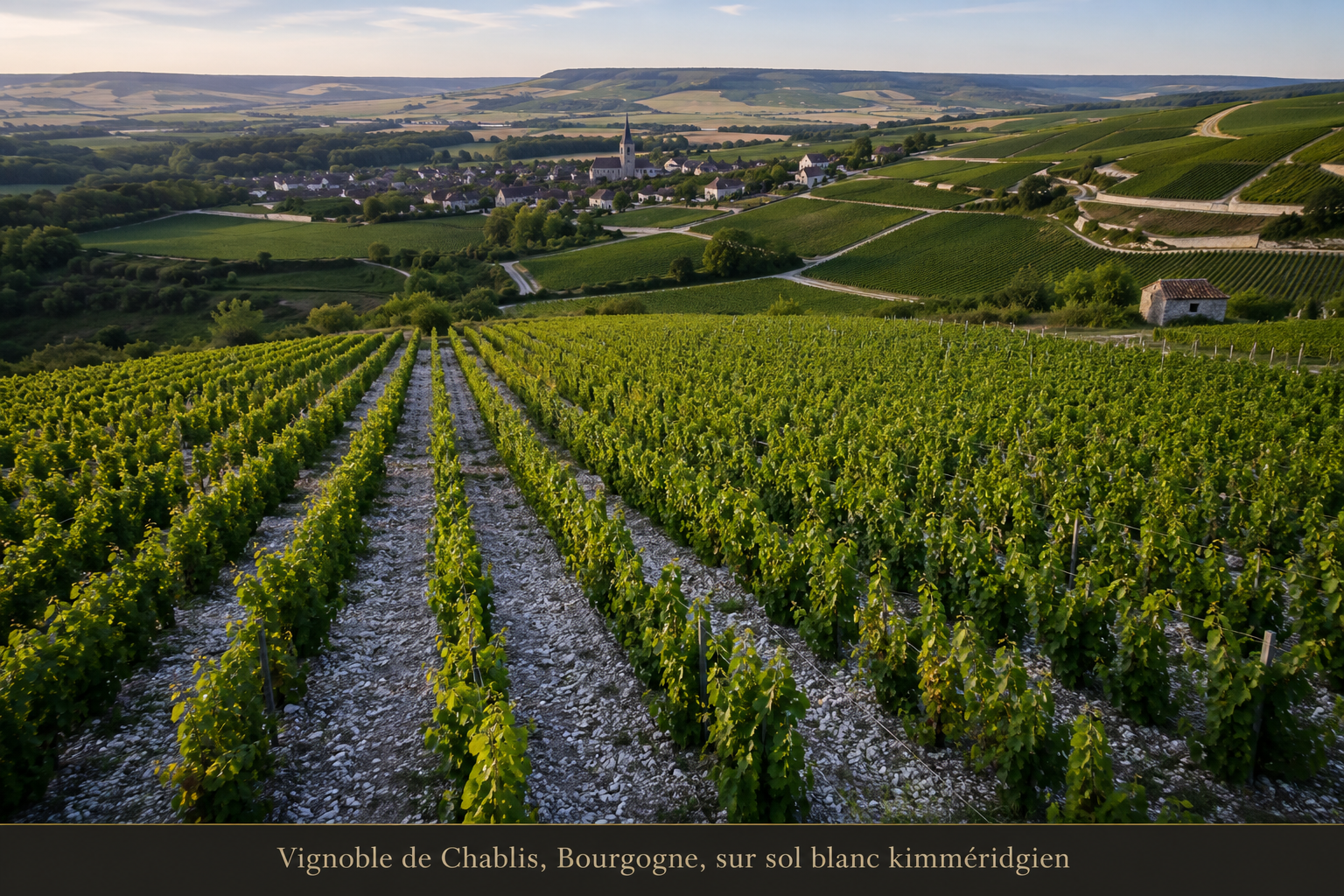
- 🇫🇷 Chablis, Burgundy — Kimmeridgian soils (Jurassic marine limestone), stainless-steel ageing, wines of razor-sharp minerality, remarkable acid tension, notes of oyster shell and flint. Chardonnay in its most stripped-back and, at the same time, most powerful form
- 🇫🇷 Côte de Beaune, Burgundy (Meursault, Puligny-Montrachet, Chassagne-Montrachet) — barrel ageing, fermentation and lees ageing, partial or full malolactic conversion, complex wines blending white orchard fruit, butter, hazelnut, honey and minerality. The most accomplished expression of Burgundian Chardonnay
- 🇫🇷 Champagne — the king grape of Blanc de Blancs, bringing lightness, freshness and finesse to sparkling wine. The great prestige cuvées (Salon, Krug’s Blanc de Blancs, Jacques Selosse) reveal its capacity to age with exceptional grace
- 🇺🇸 California (Sonoma, Santa Barbara, Carneros) — intensive oak ageing, full malolactic conversion, generous, opulent wines with notes of vanilla, melted butter and tropical fruit. A style that conquered the world in the 1980s and 1990s before diversifying toward greater freshness
The Wines That Built Its Legend
A few essential references that established Chardonnay as the world’s leading white grape variety:
- 🇫🇷 Le Montrachet, Grand Cru, produced notably by Domaine Leflaive, Domaine de la Romanée-Conti, Lafon and Ramonet. A grand cru shared between Puligny and Chassagne, of staggering complexity and longevity
- 🇫🇷 Chablis Grand Cru Les Clos, the ultimate expression of Chablis, age-worthy wines that can evolve for twenty years or more, perfect witnesses to the Kimmeridgian terroir
- 🇫🇷 Salon Blanc de Blancs (Le Mesnil-sur-Oger) — one of the most exclusive Champagnes in the world, produced only in the best years, 100% Chardonnay from the Côte des Blancs
- 🇺🇸 Kistler Cuvée Cathleen (Sonoma) — the Californian benchmark, aged in Burgundian barrels, a complexity and tension once thought impossible in this climate
- 🇦🇺 Leeuwin Estate Art Series (Margaret River) — proof that Australia can rival the world’s greatest Chardonnays
A Chameleon Style: The Art of Winemaking
What makes Chardonnay unique among the great white grape varieties is the sheer range of winemaking choices available to the winemaker. Every decision made in the cellar radically transforms the wine’s profile.
Malolactic fermentation — which converts sharp malic acid into softer lactic acid — brings the creamy, buttery texture characteristic of great Meursaults. Lees ageing with regular bâtonnage (lees stirring) adds roundness and complexity. New oak barrels, depending on their toast level and origin (Allier, Vosges, Tronçais), impart notes of vanilla, toast and spice. Depending on the length of ageing and the proportion of new oak used, the barrel progressively contributes notes of vanilla, roasted hazelnut, brioche or toasted bread. By contrast, stainless-steel tanks preserve the minerality and tension of Chablis.
This duality — minerality vs opulence, steel vs oak, tension vs roundness — lies at the heart of Chardonnay’s identity and its ability to win over very different audiences.
🍷 Classic Tasting Note
💃 Colour: Pale to golden yellow, green highlights in youth, amber gold with age
👃 Nose: Green apple, pear, citrus (fresh style) · butter, hazelnut, vanilla, white-fleshed fruit (oaked style) · flint, chalk, iodine (mineral style)
👄 Palate: Acidity varies by terroir, texture often broad and silky, long finish on fruit or minerality
🍽️ Food pairing: Fish in sauce, shellfish, roast poultry, soft cheeses (Brie, Camembert), risotto, lobster, scallops
Chardonnay and Climate Change
Chardonnay is one of the white grape varieties most affected by global warming, precisely because it is among the earliest to bud in spring. This early budding, which once allowed it to reach ripeness in cool-climate regions, now makes it particularly vulnerable to late spring frosts — as painfully illustrated by the devastating frosts of 2016 and 2021 in Burgundy and Chablis.
In addition, increasingly early harvests are reducing the wine’s natural acidity — a central element of its identity — while raising alcohol levels. To address this, winemakers are adapting their practices: cover cropping between rows to slow vine growth, night harvesting to preserve freshness, controlled irrigation in the driest regions.
Paradoxically, climate change is also opening up new geographical opportunities. Chardonnay is now producing remarkable wines in southern England, Denmark, Sweden and the high-altitude vineyards of Argentina’s Jura region or the Chilean Andes — regions that, twenty years ago, would not have allowed sufficient ripening. Today’s climate conditions in southern England increasingly resemble those Champagne offered several decades ago, favouring the production of great Chardonnay-based sparkling wines.

Why It Remains Essential
Neutral without being characterless, malleable without lacking personality, Chardonnay possesses a rare quality: it knows how to set its own ego aside and let the terroir speak. It is precisely this transparency that has made it the reference white grape variety for winemakers around the world. Where other varieties impose their own aromatic personality, Chardonnay holds up a faithful mirror to the land, the climate, and the hands that shape it.
It remains today the most widely planted quality white grape variety in the world, covering more than 200,000 hectares across some fifty countries. Its presence across the three most highly valued wine styles — great age-worthy whites, prestige Champagnes, and blended wines — gives it a versatility that no other white grape variety has yet managed to match.
From Chablis to Margaret River, by way of the hills of Champagne and the slopes of Sonoma, Chardonnay continues to write, vintage after vintage, the story of a grape that turned its own discretion into an extraordinary capacity for expression.
Did you know?
Despite its reputation as a “neutral” grape, Chardonnay is probably the white variety that most faithfully reveals differences in terroir and winemaking. The very same clone can produce a razor-sharp Chablis, a rich, unctuous Meursault, or a Champagne of great finesse — all without ever losing its identity.
📌 Key Takeaways
- Born in the village of Chardonnay, Saône-et-Loire, spread by Cistercian monks as early as the Middle Ages
- A natural cross of Pinot Noir × Gouais Blanc — confirmed by DNA analysis in 1999 (UC Davis)
- The world’s #1 white grape variety by planted area — more than 200,000 hectares across 50 countries
- 4 major expressions: Chablis · Côte de Beaune · Champagne · California
- Winemaking choices (oak, malolactic fermentation, lees ageing) radically transform the wine’s profile
- Vulnerable to early spring frosts — evolving in the face of climate change
➡️ Next Episode — 1st October
It is often said to be the most thankless grape to grow and the most rewarding to drink. Capricious, demanding, hypersensitive to terroir and climate, it nonetheless gives rise to some of the most enigmatic and sought-after wines in the world. In Burgundy as in Oregon, in New Zealand as in Germany, it speaks of a precise place with an eloquence that few grape varieties can claim.
Next up: Pinot Noir — why does the world’s most difficult grape variety fascinate winemakers and wine lovers alike?
Leave a Reply