Tag: Terroir

  • Pinot Noir: Why Does the World’s Most Difficult Grape Variety Fascinate Winemakers and Wine Lovers Alike?

    Pinot Noir: Why Does the World’s Most Difficult Grape Variety Fascinate Winemakers and Wine Lovers Alike?

    📚 Grape Varieties of the World · Episode 3  |  ⏱ Reading time: 7 minutes

    It’s often said to be the most thankless grape to grow and the most rewarding to drink. Thin-skinned, early-ripening, hypersensitive to the slightest shift in terroir or climate, Pinot Noir tests even the most seasoned winemakers. And yet it is precisely from this fragility that some of the most sought-after, most expensive and most enigmatic wines on the planet are born.

    For this third episode of our Grape Varieties of the World series, we dive into the history of a grape as old as European viticulture itself, incapable of lying about where it comes from.


    A Grape as Old as Rome, as Elusive as the Wind

    Unlike Cabernet Sauvignon or Chardonnay, born from an identifiable crossing at a relatively recent point in time, Pinot Noir has no known birth date. Ampelographers agree that it ranks among the oldest grape varieties cultivated in Europe, probably descended from successive crossings and mass selections carried out on wild vines (Vitis vinifera sylvestris) as far back as Roman times. Latin writings already attest to the presence of a fine, productive vine in Burgundy nearly two thousand years ago.

    It was later the Benedictine and then Cistercian monks who, from the Middle Ages onward, patiently mapped the best plots of the Côte-d’Or, laying the foundations of what are known today as the climats of Burgundy — inscribed on the UNESCO World Heritage list since 2015. A meticulous, plot-by-plot work of observation that revealed just how much Pinot Noir changes character over a shift of just a few metres.

    Drone flying over a vineyard plot in Burgundy

    🔬 The Science of Genetic Chaos

    Pinot Noir holds a rather unenviable record: it is one of the most genetically unstable grape varieties known. Its DNA structure favours the spontaneous appearance of somatic mutations, which explains the existence of hundreds of clones with differing characteristics (the famous clone 777 or the Pommard clone, for example). More surprising still: Pinot Gris and Pinot Blanc are not cousins born of a cross, but direct colour mutations of Pinot Noir — genetically almost the exact same plant, one pigmentation gene apart. Pinot Meunier, widely grown in Champagne, is another such variation. Where Chardonnay was born from a cross between two distinct varieties, Pinot Noir generates its own variants by mutating in place.

    From the Côte de Nuits to Oregon: Four Faces of a Fragile Grape

    Few red grape varieties are as transparent as Pinot Noir about their terroir of origin. Its colour is pale, its tannins discreet, but its ability to faithfully render a soil, an aspect or a climate is almost without equal. Four major expressions illustrate this diversity:

    • 🇫🇷 Côte de Nuits, Burgundy (Gevrey-Chambertin, Vosne-Romanée, Chambolle-Musigny) — limestone and marl soils, wines of great precision, fine tannic structure, exceptional ageing potential. The most revered expression of Pinot Noir in the world
    • 🇫🇷 Champagne — the region’s second most-planted grape, it brings structure, body and power to blends, and produces rare Blanc de Noirs of remarkable depth
    • 🇺🇸 Oregon (Willamette Valley) — a cool climate close to Burgundy’s, volcanic and sedimentary soils, silky and aromatic wines that became an American benchmark in barely forty years
    • 🇳🇿 New Zealand (Central Otago, Martinborough) — pronounced day/night temperature swings, vivid fruit and vibrant acidity, one of the most dynamic styles of the past decade

    To this list could be added Germany, where Pinot Noir — known locally as Spätburgunder — has seen considerable growth over the past twenty years, driven by terroirs such as the Ahr and Baden, long underrated outside Germany’s borders.

    The Wines That Built Its Legend

    A few landmark references that explain why Pinot Noir fascinates so many:

    • 🇫🇷 Romanée-Conti & La Tâche (Domaine de la Romanée-Conti) — the most highly valued red wines in the world, produced on a handful of hectares in Vosne-Romanée
    • 🇫🇷 Chambertin (Domaine Armand Rousseau) — power and depth, the grand cru Napoleon is said to have preferred above all others
    • 🇫🇷 Musigny (Domaine Comte Georges de Vogüé) — absolute finesse and elegance, often described as the most “feminine” grand cru of the Côte de Nuits
    • 🇫🇷 Bollinger Vieilles Vignes Françaises — a Champagne Blanc de Noirs made from ungrafted Pinot Noir vines that escaped phylloxera, of absolute rarity
    • 🇺🇸 Domaine Drouhin Oregon — proof that the Willamette Valley could produce Pinot Noir worthy of Burgundy
    • 🇳🇿 Felton Road (Central Otago) — New Zealand’s benchmark, carried by a spectacular high-altitude terroir

    A Style Built on Nuance

    Pinot Noir never chases power. Its colour is among the palest of the red grape varieties, its tannins fine and silky, its acidity naturally lively. It is a grape of nuance rather than force, capable of moving from crisp red fruit to notes of forest floor, leather and mushroom with age.

    This subtlety makes Pinot Noir extremely sensitive to winemaking decisions: full or partial destemming, the proportion of whole-cluster fermentation, maceration length, extraction level, choice of oak. Two neighbouring winemakers, on the same appellation, can produce radically different wines from the same grape — a trait that partly explains why enthusiasts are so fascinated by the differences in “hand” between producers.

    🍷 Classic Tasting Note

    👃 Colour: Pale to ruby red, garnet hues with age, characteristic transparency
    👃 Nose: Cherry, raspberry, wild strawberry, violet (youthful style) · forest floor, leather, mushroom, sweet spice (evolved style)
    👄 Palate: Fine, silky tannins, lively acidity, light to medium body, elegant, persistent finish
    🍽️ Food pairing: Roast poultry, duck, salmon, mushrooms, soft-rind cheeses, autumn cooking

    Pinot Noir and Climate Change

    Few grape varieties are as exposed to global warming as Pinot Noir. Early budbreak, thin skins, compact bunches prone to rot: every one of its historic traits is becoming a vulnerability in the face of today’s climate hazards. The spring frosts of 2016, 2017 and 2021 devastated entire swathes of the Burgundy vineyard, precisely because of this early budbreak.

    Increasingly early harvests also raise a stylistic challenge: Pinot Noir, a grape defined by finesse and freshness, risks losing precisely what makes it singular if alcohol levels keep climbing and acidity keeps falling. To preserve this balance, Burgundy winemakers are picking earlier in the morning, moving their plots to higher altitude and re-assessing their vineyards’ aspect.

    The grape is meanwhile conquering new territories once considered too cool: Kent in the south of England, Tasmania, certain high-altitude valleys of Argentine and Chilean Patagonia, and even promising trials in Sweden. All regions that could, in the coming decades, become new heartlands for a grape that has always needed coolness to fully express itself.

    Grape harvest in a Pinot Noir vineyard

    Why It Remains Essential

    Temperamental, demanding, at times exhausting for those who grow it: Pinot Noir sets its own terms rather than bending to the winemaker. But it is precisely this integrity that sets it apart. Where other grape varieties chase power or consistency, Pinot Noir chases the truth of a place, even when that truth is hard to obtain.

    From the Côte de Nuits to Oregon, via New Zealand and Germany, it continues to prove that a grape doesn’t need to be easy to be great — it simply has to stay faithful to where it comes from.

    Did you know?
    Pinot Gris, Pinot Blanc and Pinot Meunier are not different grape varieties from Pinot Noir: they are colour mutations of the very same plant. Genetically, they are almost the same grape — proof that Pinot Noir hasn’t finished surprising geneticists.

    📌 Key Takeaways

    • One of the oldest grape varieties in Europe, grown in Burgundy since Roman times
    • Extreme genetic instability — gave rise to Pinot Gris, Pinot Blanc and Pinot Meunier through mutation
    • 4 major expressions: Côte de Nuits · Champagne · Oregon · New Zealand
    • Climats of Burgundy listed as UNESCO World Heritage since 2015
    • Early budbreak and thin skin — highly vulnerable to spring frosts and climate change
    • Conquering new cool-climate territories: England, Tasmania, Patagonia, Sweden

    Sources: UNESCO — inscription of the Climats of the Burgundy vineyard as World Heritage (4 July 2015) · Vezzulli et al., “Pinot blanc and Pinot gris arose as independent somatic mutations of Pinot noir,” Journal of Experimental Botany, 2012 · BIVB and Réussir Vigne — spring frosts in Burgundy, 2016, 2017 and 2021.


    ➡️ Next Episode — 30th November

    For a long time, it was considered a second-tier grape, good for producing volume rather than emotion. Ripped out by the thousands of hectares in the 1980s, it is today experiencing one of the most beautiful revivals in Mediterranean viticulture, carried by old, forgotten vines and a remarkable resistance to drought.

    Next up: Carignan — how did a long-despised grape become one of viticulture’s great hopes in the face of climate change?
  • The Spanish vineyard of tomorrow: climate change, organic farming and natural wine

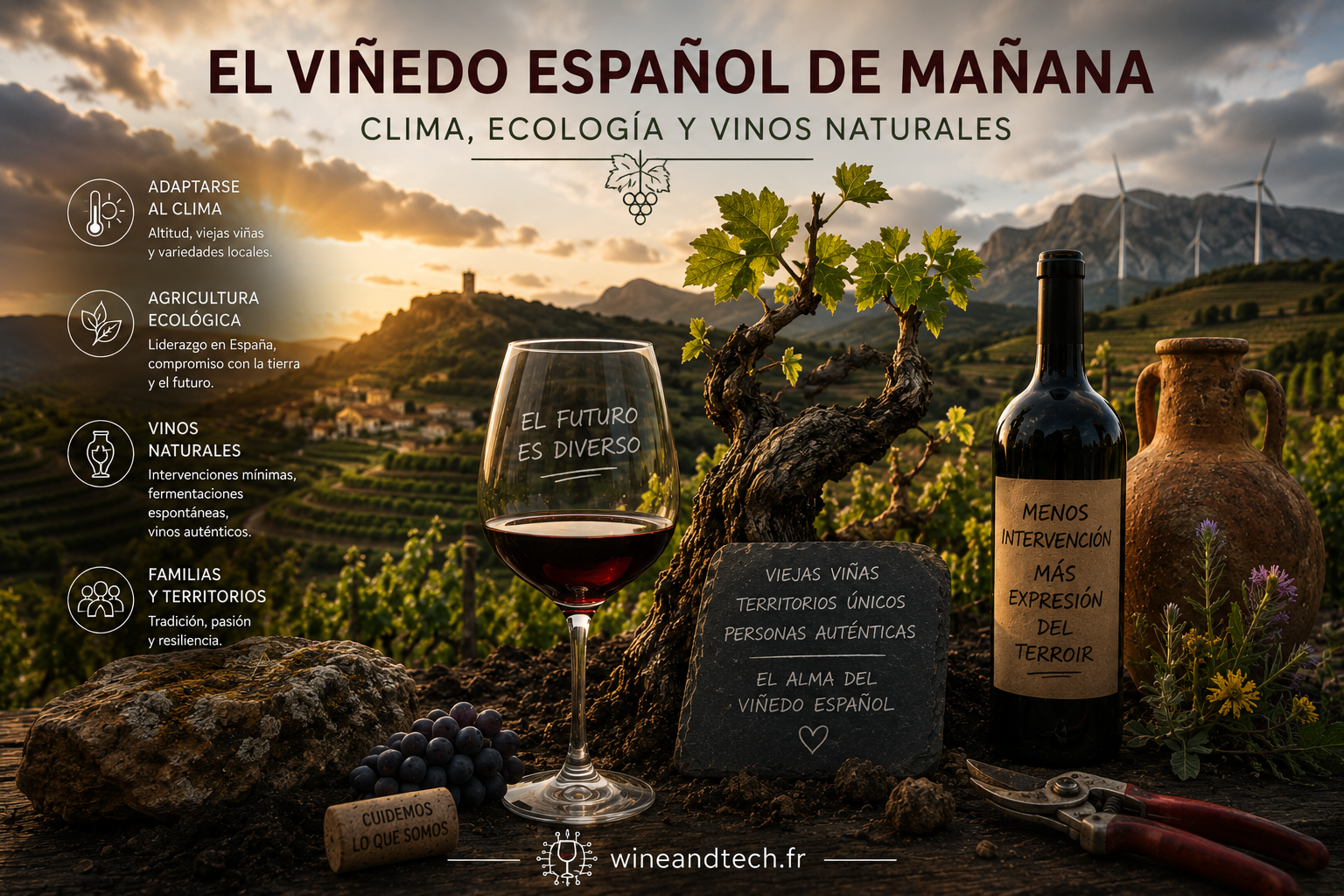
    The Spanish vineyard of tomorrow: climate change, organic farming and natural wine

    🇬🇧 Series · The Vinous Trinity · Article 15/15 · Spain · ⏱ 5 min

    Three countries, fifteen articles, a series that ends. What Spain will have brought to The Vinous Trinity: a lesson on old vines, families holding on, terroirs once written off that are now revealing themselves. And now, a question: where is the Spanish vineyard heading?

    🇰 What we take away

    Spain has a reputation for being a vineyard easy to summarise. Rioja, Tempranillo, Albariño: three names will do, apparently.

    This series will have shown otherwise. Spain is the country where you can still find century-old ungrafted vines on volcanic or granite terroirs that nobody knew twenty years ago. The country where families have defended for four or five generations varieties the rest of the world has forgotten. The country where the most interesting viticultural work is often done without a budget, in regions that still have no international name.

    Priorat, Ribeira Sacra, Sierra de Gredos, the Canary Islands, Txakoli: places that did not appear on the world wine map thirty years ago and which now hold a recognised position on it.

    🌡️ Climate change: Europe’s most acute challenge

    Spain is among the European countries most exposed to the effects of climate warming. This is not an opinion: scientific projections show an intensification of heat episodes, drought and water stress across the Iberian Peninsula. In certain very hot areas of La Mancha, the Levant or Extremadura, high ripeness levels can lead to naturally very elevated alcohol content. Drought and increasing aridification are advancing across several regions of the Centre and South, adding pressure on water resources.

    Spain’s response runs through altitude. Sierra de Gredos, where some old Garnacha vines are cultivated between 800 and 1,200 metres. Producers are also seeking solutions in forgotten local varieties: varieties selected and cultivated for centuries in demanding environments can represent a valuable resource for adaptation, particularly when they ripen late or show good tolerance to water stress.

    Galicia, wetter and more Atlantic, still benefits from a climate that allows it to retain a certain freshness. But warming is already shifting the balances: Albariño more easily reaches higher ripeness levels and water management is becoming a topic there too. The Rías Baixas season is lengthening; Albariño is gaining in maturity.

    🌿 Organic farming: Spain in the lead

    Spain is by far Europe’s largest organic vineyard by surface area. In 2023, around 166,000 hectares of vines were managed organically, representing roughly one fifth of the national vineyard.

    This figure deserves nuance. It covers very different realities: between a small family estate with a longstanding ecological commitment and a large structure certified to meet market demand, the motivations and practices can vary considerably.

    The gap between an artisan producer in the Sierra de Gredos and a large certified organic cooperative in Extremadura is significant.

    But the underlying trend is real. A new generation of family wineries is explicitly choosing organic or biodynamic conversion as both philosophy and identity.

    🍷 Natural wine in Spain: a movement taking shape

    The natural wine movement was slow to take hold in Spain. Spanish wine culture was traditionally oriented toward stabilised, technical wines designed to withstand transport and storage.

    The 2000-2010 generation changed that. Producers such as Comando G in Gredos, Partida Creus in Catalonia or Envínate in the Canary Islands and Galicia helped popularise a low-intervention winemaking approach: spontaneous fermentations, reduced use of sulphur and limited cellar inputs.

    These wines quickly found an audience among specialist wine merchants, sommeliers and importers internationally, before gradually gaining visibility on the Spanish market itself.


    What the series will have shown, and what remains

    A vineyard that had not yet said its last word. Terroirs once thought exhausted that are finding their purpose again. Families transmitting against all odds.

    The future of the Spanish vineyard will not be built from Madrid. It will be built in the Sierra de Gredos, in the gorges of Ribeira Sacra, on the volcanic slopes of the Canary Islands, in the Galician granite. Where nobody expected much.

    The end of The Vinous Trinity. Thank you for following along.

    Tradition can be a starting point. Modernity, a way of continuing it.

  • Chardonnay: The White Gold of Wine. How Did It Become the Most Planted White Grape in the World?

    Chardonnay: The White Gold of Wine. How Did It Become the Most Planted White Grape in the World?

    📚 Grape Varieties of the World · Episode 2  |  ⏱ Reading time: 7 minutes

    For this second episode of our Grape Varieties of the World series, we dive into the story of a chameleon grape that became the undisputed ambassador of the world’s white wines.


    A Burgundian Birth, A Global Destiny

    Contrary to a persistent misconception, Chardonnay does not take its name from a winemaker or an imaginary appellation. It comes from a very real village: Chardonnay, a small town in Saône-et-Loire, in the heart of southern Burgundy, not far from Mâcon. It was there, in all likelihood, that the variety first flourished, centuries before conquering the world.

    The Cistercian monks of the Abbey of Cîteaux, great land-clearers and winemakers of genius, played a major role in selecting, spreading and understanding Burgundy’s finest terroirs as early as the Middle Ages. Their obsession with observing each terroir — plot by plot, vintage after vintage — helped shape the culture of Burgundian climats that remains unique in the world.

    🔬 The Science Behind the Grape

    In 1999, the same team of geneticists at the University of California, Davis, that had revealed the parentage of Cabernet Sauvignon three years earlier — led by Carole Meredith — demonstrated through DNA analysis that Chardonnay is a natural cross between Pinot Noir and Gouais Blanc, an old Central European variety now almost extinct. The discovery upended ampelography: researchers soon realised that this same cross had produced more than eighty identified descendants to date, including Gamay, Aligoté and Melon de Bourgogne. Chardonnay, then, is not an only child, but the eldest of an enormous family.

    From Chablis to California: Four Faces of a Single Grape

    Chardonnay has a rare characteristic: its natural aromatic profile is almost neutral. Where Riesling or Muscat assert themselves immediately through powerful varietal notes, Chardonnay plays the role of a terroir revealer. It is precisely this discretion that makes it such an exceptionally faithful interpreter.

    Four major expressions illustrate the full range of its register:

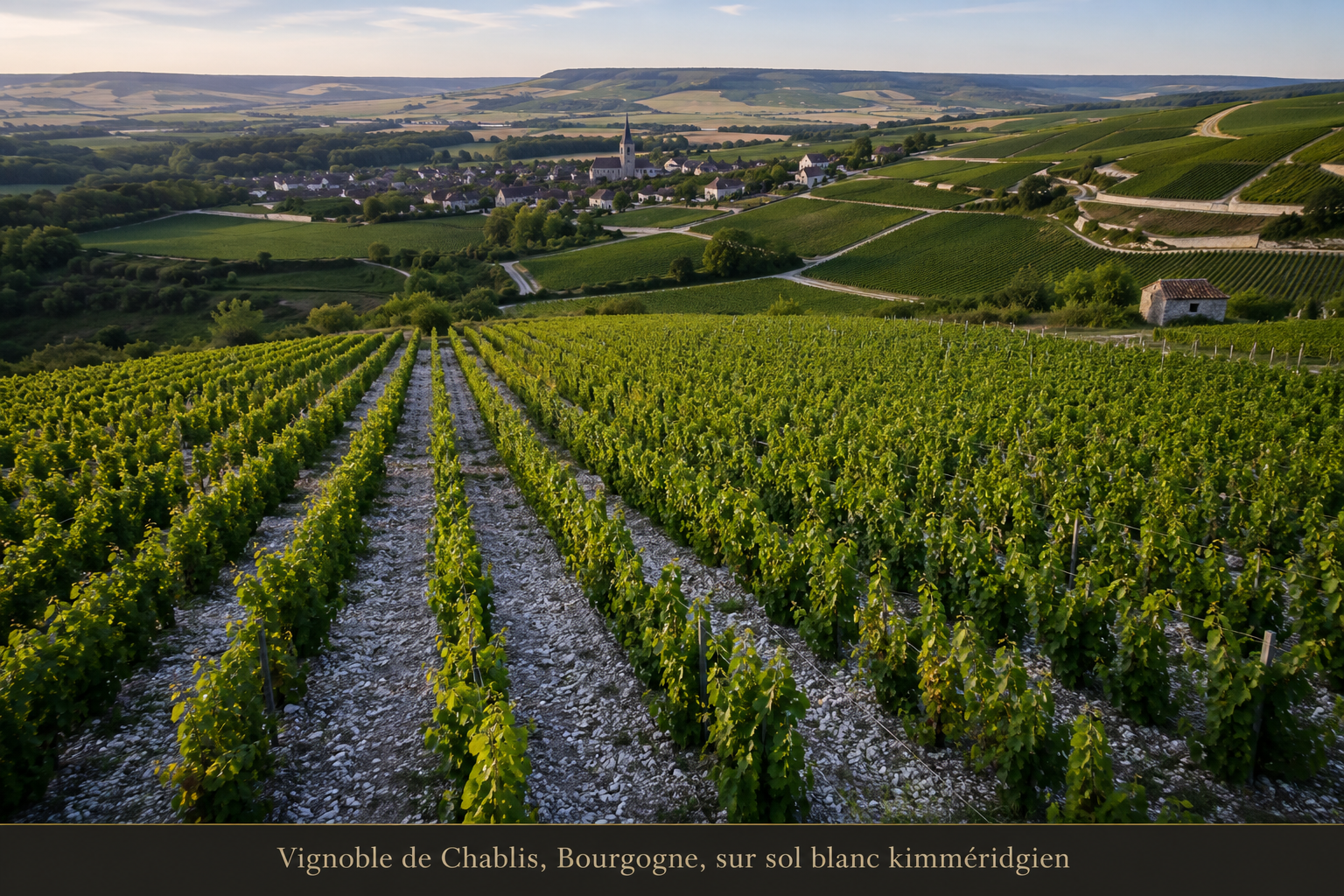
    • 🇫🇷 Chablis, Burgundy — Kimmeridgian soils (Jurassic marine limestone), stainless-steel ageing, wines of razor-sharp minerality, remarkable acid tension, notes of oyster shell and flint. Chardonnay in its most stripped-back and, at the same time, most powerful form
    • 🇫🇷 Côte de Beaune, Burgundy (Meursault, Puligny-Montrachet, Chassagne-Montrachet) — barrel ageing, fermentation and lees ageing, partial or full malolactic conversion, complex wines blending white orchard fruit, butter, hazelnut, honey and minerality. The most accomplished expression of Burgundian Chardonnay
    • 🇫🇷 Champagne — the king grape of Blanc de Blancs, bringing lightness, freshness and finesse to sparkling wine. The great prestige cuvées (Salon, Krug’s Blanc de Blancs, Jacques Selosse) reveal its capacity to age with exceptional grace
    • 🇺🇸 California (Sonoma, Santa Barbara, Carneros) — intensive oak ageing, full malolactic conversion, generous, opulent wines with notes of vanilla, melted butter and tropical fruit. A style that conquered the world in the 1980s and 1990s before diversifying toward greater freshness

    The Wines That Built Its Legend

    A few essential references that established Chardonnay as the world’s leading white grape variety:

    • 🇫🇷 Le Montrachet, Grand Cru, produced notably by Domaine Leflaive, Domaine de la Romanée-Conti, Lafon and Ramonet. A grand cru shared between Puligny and Chassagne, of staggering complexity and longevity
    • 🇫🇷 Chablis Grand Cru Les Clos, the ultimate expression of Chablis, age-worthy wines that can evolve for twenty years or more, perfect witnesses to the Kimmeridgian terroir
    • 🇫🇷 Salon Blanc de Blancs (Le Mesnil-sur-Oger) — one of the most exclusive Champagnes in the world, produced only in the best years, 100% Chardonnay from the Côte des Blancs
    • 🇺🇸 Kistler Cuvée Cathleen (Sonoma) — the Californian benchmark, aged in Burgundian barrels, a complexity and tension once thought impossible in this climate
    • 🇦🇺 Leeuwin Estate Art Series (Margaret River) — proof that Australia can rival the world’s greatest Chardonnays

    A Chameleon Style: The Art of Winemaking

    What makes Chardonnay unique among the great white grape varieties is the sheer range of winemaking choices available to the winemaker. Every decision made in the cellar radically transforms the wine’s profile.

    Malolactic fermentation — which converts sharp malic acid into softer lactic acid — brings the creamy, buttery texture characteristic of great Meursaults. Lees ageing with regular bâtonnage (lees stirring) adds roundness and complexity. New oak barrels, depending on their toast level and origin (Allier, Vosges, Tronçais), impart notes of vanilla, toast and spice. Depending on the length of ageing and the proportion of new oak used, the barrel progressively contributes notes of vanilla, roasted hazelnut, brioche or toasted bread. By contrast, stainless-steel tanks preserve the minerality and tension of Chablis.

    This duality — minerality vs opulence, steel vs oak, tension vs roundness — lies at the heart of Chardonnay’s identity and its ability to win over very different audiences.

    🍷 Classic Tasting Note

    💃 Colour: Pale to golden yellow, green highlights in youth, amber gold with age
    👃 Nose: Green apple, pear, citrus (fresh style) · butter, hazelnut, vanilla, white-fleshed fruit (oaked style) · flint, chalk, iodine (mineral style)
    👄 Palate: Acidity varies by terroir, texture often broad and silky, long finish on fruit or minerality
    🍽️ Food pairing: Fish in sauce, shellfish, roast poultry, soft cheeses (Brie, Camembert), risotto, lobster, scallops

    Chardonnay and Climate Change

    Chardonnay is one of the white grape varieties most affected by global warming, precisely because it is among the earliest to bud in spring. This early budding, which once allowed it to reach ripeness in cool-climate regions, now makes it particularly vulnerable to late spring frosts — as painfully illustrated by the devastating frosts of 2016 and 2021 in Burgundy and Chablis.

    In addition, increasingly early harvests are reducing the wine’s natural acidity — a central element of its identity — while raising alcohol levels. To address this, winemakers are adapting their practices: cover cropping between rows to slow vine growth, night harvesting to preserve freshness, controlled irrigation in the driest regions.

    Paradoxically, climate change is also opening up new geographical opportunities. Chardonnay is now producing remarkable wines in southern England, Denmark, Sweden and the high-altitude vineyards of Argentina’s Jura region or the Chilean Andes — regions that, twenty years ago, would not have allowed sufficient ripening. Today’s climate conditions in southern England increasingly resemble those Champagne offered several decades ago, favouring the production of great Chardonnay-based sparkling wines.

    Why It Remains Essential

    Neutral without being characterless, malleable without lacking personality, Chardonnay possesses a rare quality: it knows how to set its own ego aside and let the terroir speak. It is precisely this transparency that has made it the reference white grape variety for winemakers around the world. Where other varieties impose their own aromatic personality, Chardonnay holds up a faithful mirror to the land, the climate, and the hands that shape it.

    It remains today the most widely planted quality white grape variety in the world, covering more than 200,000 hectares across some fifty countries. Its presence across the three most highly valued wine styles — great age-worthy whites, prestige Champagnes, and blended wines — gives it a versatility that no other white grape variety has yet managed to match.

    From Chablis to Margaret River, by way of the hills of Champagne and the slopes of Sonoma, Chardonnay continues to write, vintage after vintage, the story of a grape that turned its own discretion into an extraordinary capacity for expression.

    Did you know?
    Despite its reputation as a “neutral” grape, Chardonnay is probably the white variety that most faithfully reveals differences in terroir and winemaking. The very same clone can produce a razor-sharp Chablis, a rich, unctuous Meursault, or a Champagne of great finesse — all without ever losing its identity.

    📌 Key Takeaways

    • Born in the village of Chardonnay, Saône-et-Loire, spread by Cistercian monks as early as the Middle Ages
    • A natural cross of Pinot Noir × Gouais Blanc — confirmed by DNA analysis in 1999 (UC Davis)
    • The world’s #1 white grape variety by planted area — more than 200,000 hectares across 50 countries
    • 4 major expressions: Chablis · Côte de Beaune · Champagne · California
    • Winemaking choices (oak, malolactic fermentation, lees ageing) radically transform the wine’s profile
    • Vulnerable to early spring frosts — evolving in the face of climate change

    ➡️ Next Episode — 1st October

    It is often said to be the most thankless grape to grow and the most rewarding to drink. Capricious, demanding, hypersensitive to terroir and climate, it nonetheless gives rise to some of the most enigmatic and sought-after wines in the world. In Burgundy as in Oregon, in New Zealand as in Germany, it speaks of a precise place with an eloquence that few grape varieties can claim.

    Next up: Pinot Noir — why does the world’s most difficult grape variety fascinate winemakers and wine lovers alike?

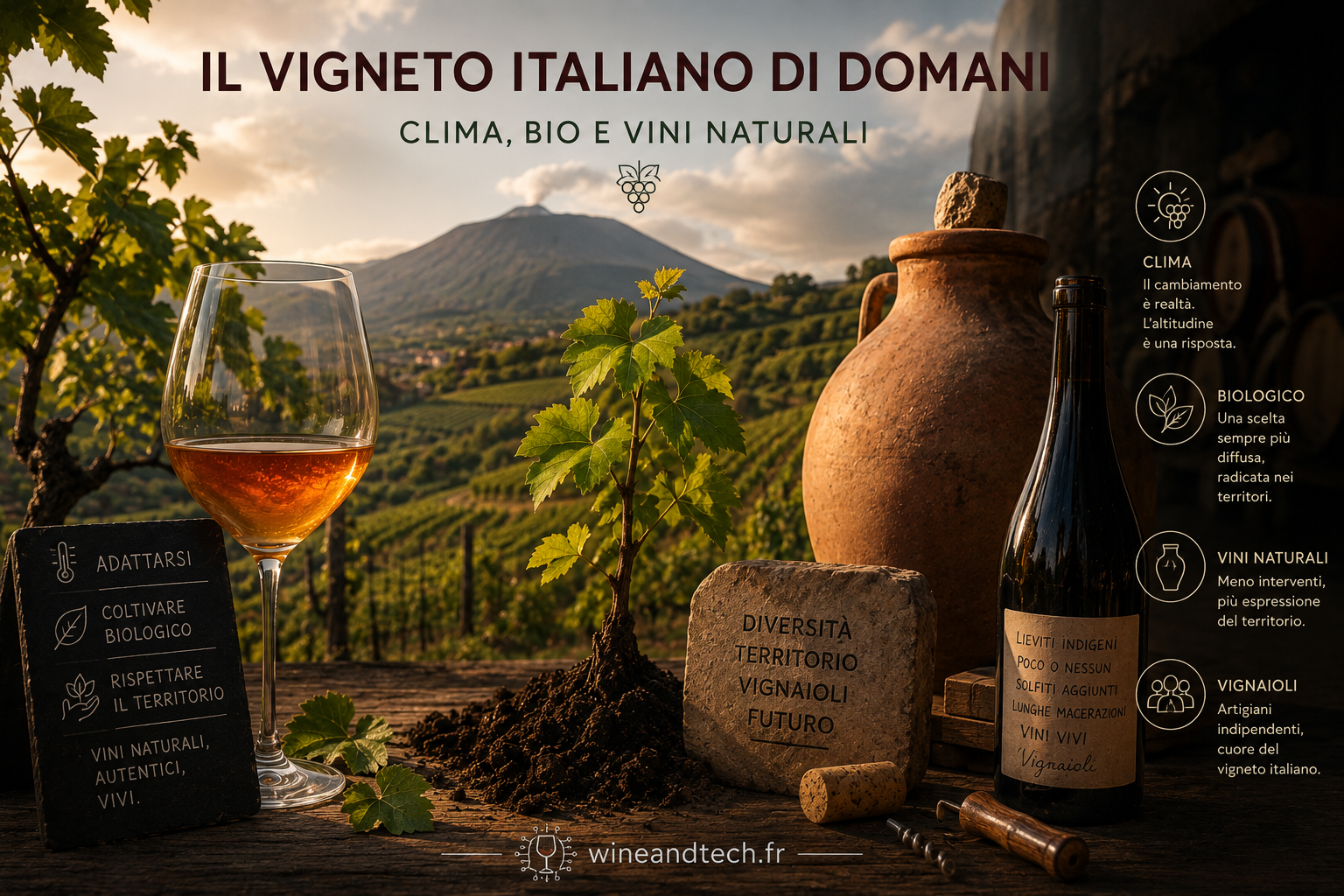
  • The Italian vineyard of tomorrow: climate change, organic and natural wine

    The Italian vineyard of tomorrow: climate change, organic and natural wine

    🇬🇧 Series · The Vinous Trinity · Article 14/15 · Italy · ⏱ 5 min

    🇫🇷+🇮🇹 Lire en français + italiano → [lien à ajouter] · Mon 🇫🇷 / Wed 🇮🇹 / Fri 🇪🇸

    Three countries, fourteen articles, and already time for a synthesis. What Italy will have brought to The Vinous Trinity: a lesson on diversity as strength, on inimitable grape varieties, on the vignaioli who do everything themselves. And now, a question: where is the Italian vineyard heading?

    🇰 What we take away

    Italy possesses one of the world’s greatest viticultural biodiversities, with more than 500 indigenous grape varieties officially recognised. This figure is not a footnote: it is the key to understanding everything the series has explored.

    Nebbiolo in the Langhe. Sangiovese on the Tuscan hills. Vermentino facing the winds of Gallura. Aglianico on the volcanic heights of Vulture or around Taurasi. Nerello Mascalese on the slopes of Etna. Each deeply marked by the territory in which it developed, capable of expressing very different profiles elsewhere.

    And behind these grape varieties, the vignaioli: artisans who grow, vinify and bottle. Often on just a few hectares. Often for several generations. This interlocking of variety, terroir and independent producer is the strength of the Italian vineyard.

    🌡️ Climate change: Etna as a model?

    Climate change is affecting Italy very unevenly. In the north-east and certain areas of Lombardy, harvests tend to come earlier and earlier. The South and Sicily, already warm, are facing record temperatures during harvest.

    Italy’s response runs in part through altitude. Etna is the most striking example: vineyards at 600, 800, 1,000 metres, with day-to-night temperature swings that preserve freshness even in the full heat of a Sicilian summer. This capacity to seek out freshness and altitude now represents an adaptation strategy observed across other Italian regions.

    In Campania and Basilicata, Aglianico, a late-ripening variety, is also finding renewed interest in the context of climate warming. In Sardinia, altitude and sea winds play a regulatory role. In Piedmont, producers are planting on cooler exposures that were once set aside.

    🌿 Organic farming: a movement rooted in the land

    Italy is among the European leaders in organic viticulture. Around 129,000 hectares of wine grape vines were managed organically or in conversion in 2023, accounting for roughly one fifth of the national vineyard. Sicily, Sardinia and Tuscany account for a significant share of certified operations.

    This is not simply a response to demand. In Italy, many winemakers have long worked in a thoughtful or organic way. For some, certification formalised practices that had already been in place for several years.

    Biodynamics is also progressing, carried by a new generation of vignaioli seeking total coherence between their philosophy and their practices.

    🍷 Natural wine, Italian style

    Italy has its own natural wine pioneers. Josko Gravner in Friuli, who from the 1990s explored long skin macerations before turning to Georgian amphorae at the start of the 2000s. Stanislao Radikon, his neighbour, who created an aesthetic of oxidative, slowly evolving white wine now recognised worldwide.

    These orange wines from Friuli-Venezia Giulia were first misunderstood, then marginal, then cult. This Italian renaissance helped bring skin-contact whites back to the international stage, and Friuli remains one of the world’s great references for maceration whites, now emblematic of the so-called natural wine revival.

    In Piedmont, Tuscany and Sicily, a new generation of vignaioli works with indigenous yeasts, reduced or zero added sulphur depending on the producer, long ageing in clay or old wood. No official label. But an approach that converges with what the world calls natural.


    What the series will have shown

    Italy has transformed its diversity into living heritage. More than 500 indigenous varieties, hundreds of territories, centuries of adaptation.

    Against climate change, this diversity is a resource. A grape variety selected and cultivated for centuries in a given environment can represent a valuable tool for adaptation, particularly when it ripens late or shows good tolerance to local conditions.

    The future of the Italian vineyard will not be written by the great houses. It will play out in the Langhe, on Etna, in the gorges of Campania, in the Sardinian granite. Where a vignaiolo decides, season after season, to keep going.

    Italy has not exhausted its surprises. It just needs people to keep looking for them.

    🇫🇷+🇮🇹 Lire cet article en français + italiano → [lien à ajouter après liaison Polylang]

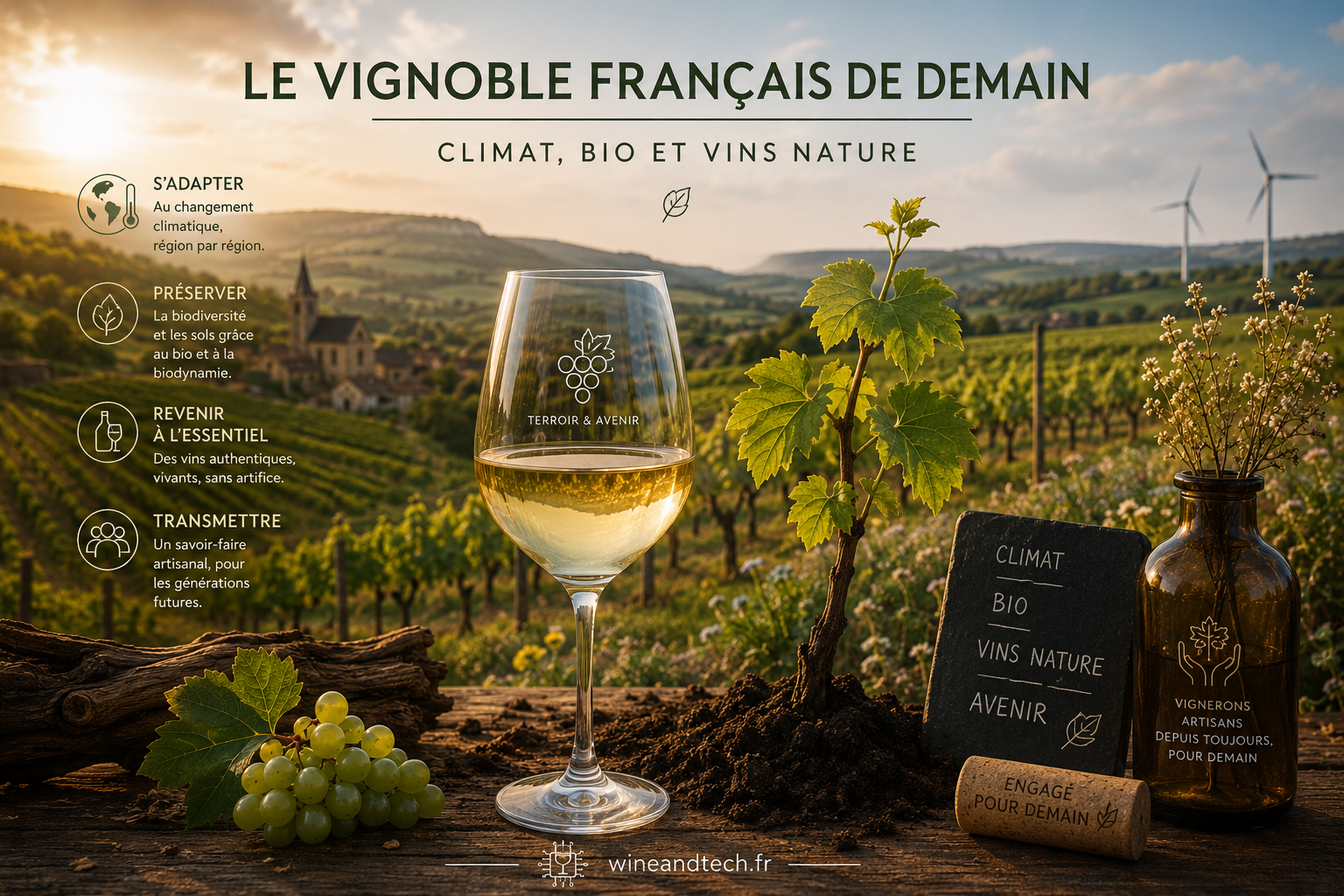
  • The French vineyard of tomorrow: climate change, organic wine and natural wine

    The French vineyard of tomorrow: climate change, organic wine and natural wine

    🇬🇧 Series · The Vinous Trinity · Article 13/15 · France · ⏱ 5 min

    🇫🇷 Lire en français → [lien à ajouter] · Mon 🇫🇷 / Wed 🇮🇹 / Fri 🇪🇸

    Three countries, twelve articles, fifteen weeks of The Vinous Trinity. Before arriving at the final chapter, a look back at what France has shown. And a glance at what lies ahead.

    What the French vineyard has that is exceptional is its diversity. Not only in terms of regions or grape varieties, but in its approach to wine: as an expression of a place, a history, a person. The future of this vineyard is now playing out on three fronts: climate change, the rise of organic farming and the natural wine movement.

    🇰 What we take away

    France has profoundly shaped modern wine culture. The concept of terroir, the hierarchy of appellations, the great blending models, barrel ageing and the promotion of emblematic grape varieties have all contributed to its worldwide influence.

    What the series will have shown: France is more diverse than its great names suggest. Beyond Bordeaux, Burgundy and Champagne, entire regions are working in relative obscurity, with grape varieties found almost nowhere else and wines that still sell at honest prices.

    Jura, Savoie, the Beaujolais crus, the Grand South-West, Corsica, the secret Loire, French Moselle: territories that prove the French vineyard is far from having revealed everything. Behind each appellation, artisans practising this trade with complete independence, often for several generations.

    🌡️ Climate change: a reality region by region

    In Alsace, harvests have moved forward by more than three weeks over recent decades. In Champagne, preserving the acidity and freshness that are part of the wines’ identity is becoming more complex in a warming climate. In Languedoc, episodes of intense heat can lead to high ripeness levels and significant alcohol content.

    The responses are diverse. Planting later-ripening varieties. Moving to higher altitudes. Rehabilitating forgotten local varieties, better adapted to current conditions. Irrigation, long tightly regulated in French appellations, is permitted in certain situations and is now the subject of new regulatory thinking.

    The paradox: certain regions once too cold to produce quality wines are now benefiting. French Moselle, Auvergne, Haute-Savoie: terroirs gaining in potential at the very moment their more southerly neighbours are seeking to preserve their freshness.

    🌿 Organic farming: a quiet transformation

    France has become one of Europe’s leading organic vineyards. In 2023, around 22% of the French vineyard was managed organically, including certified and under-conversion operations, with more than 131,000 hectares already fully certified. The progression has been remarkable.

    Behind this figure, a diverse reality. Some producers have been organic since the 1980s, often in pioneering regions: Alsace, Loire, Roussillon, Languedoc. Others have converted more recently, driven by demand or conviction.

    Biodynamics, a distinct approach from organic farming and generally more demanding in its practices, is also progressing. In Burgundy, Alsace and Champagne, emblematic estates have worked biodynamically for decades. These practices are often invisible on the label, but very real in the cellar.

    🍷 Natural wine: between Paris and the rest of the world

    The natural wine movement took particular shape in France from the 1980s-90s, notably in Beaujolais and the Loire, around winemakers such as Marcel Lapierre, Jo Pithon, Pierre Overnoy and Nicolas Joly.

    There is no single official definition of “natural wine”. The term generally refers to a production philosophy seeking minimal intervention, in both the vineyard and the cellar: grapes from low-intervention farming, spontaneous fermentations, limited oenological inputs and reduced use of sulphur, to varying degrees depending on the producer.

    Today the movement is worldwide, but France remains its symbolic epicentre. Paris has become one of the world’s great natural wine capitals, with a remarkable concentration of specialist wine shops, wine bars and restaurants.

    What was marginal in the 1990s has become, thirty years on, an underlying trend that influences even the most conventional producers.


    What the series will have shown

    French wine’s richness does not rest on its great names. It rests on the density of its artisan fabric. Thousands of small producers, dozens of lesser-known regions, hundreds of local grape varieties.

    The future does not depend on a grand plan. It is built plot by plot, family by family, harvest by harvest.

    France has not exhausted its surprises. It just needs people to keep looking for them.

    🇫🇷 Lire cet article en français → [lien à ajouter après liaison Polylang]

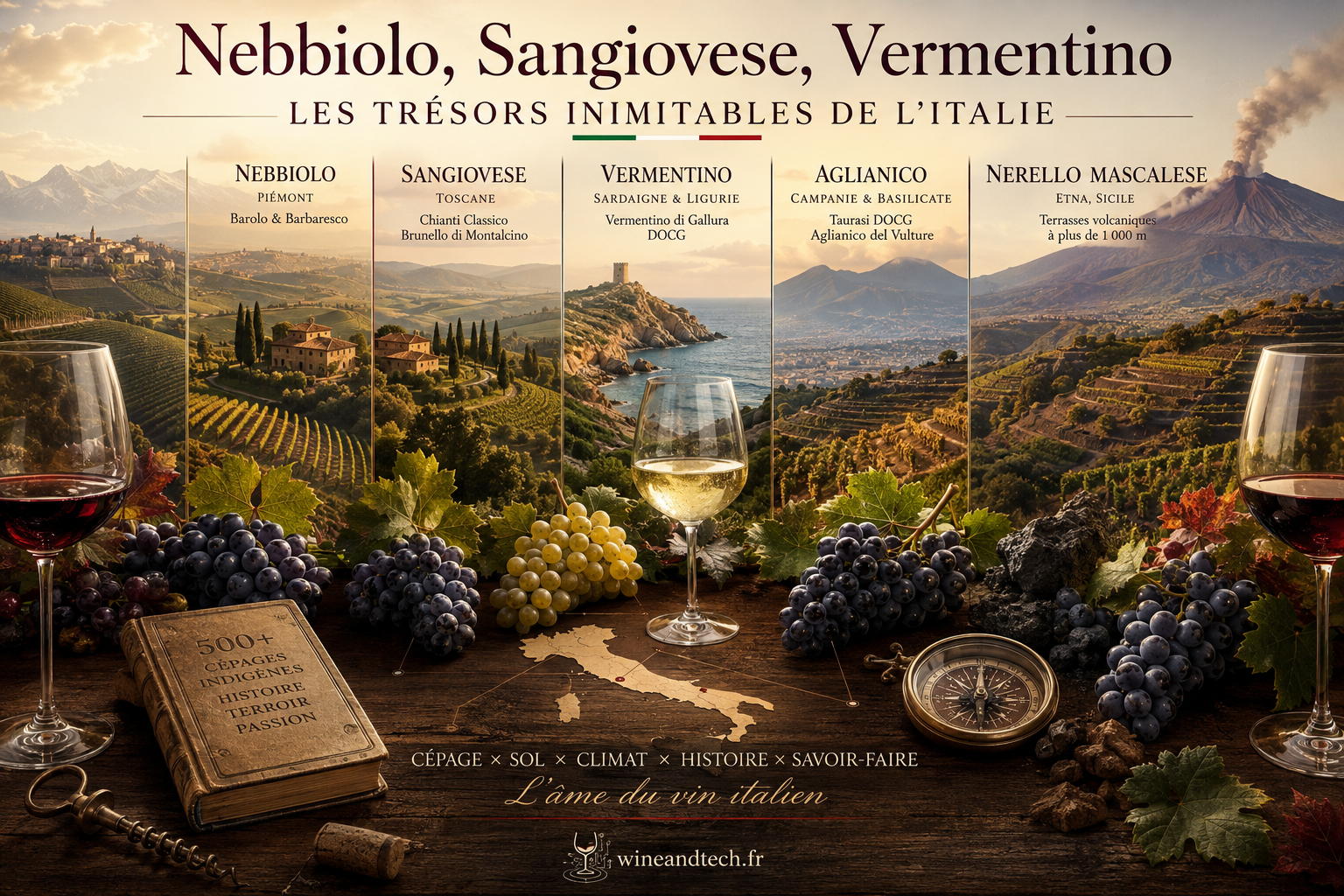
  • Nebbiolo, Sangiovese, Vermentino: Italy’s inimitable treasures

    Nebbiolo, Sangiovese, Vermentino: Italy’s inimitable treasures

    🇬🇧 Series · The Vinous Trinity · Article 8/15 · Italy · ⏱ 5 min

    🇫🇷+🇮🇹 Lire en français + italiano → [lien à ajouter] · Mon 🇫🇷 / Wed 🇮🇹 / Fri 🇪🇸

    Italy officially catalogues more than 500 indigenous grape varieties. Among them, some stand apart for a rare quality: their capacity to express with particular force the territory that shaped them.

    Grown far from their home ground, they can produce excellent wines, but their expression changes. Vinified differently, they reveal other facets. Nebbiolo, Sangiovese, Vermentino, Aglianico, Nerello Mascalese: these names are deeply bound to a soil, a climate, a history and craftsmanship passed down through the generations.

    🍇 Grape varieties explored in this article

    Nebbiolo · Sangiovese · Vermentino · Barbera and Dolcetto · Aglianico · Nerello Mascalese

    🔴 Nebbiolo · the king of the Langhe

    Nebbiolo is one of Italy’s most emblematic grape varieties. Its most prestigious home is the Piedmontese Langhe, where it gives rise to the two great DOCGs, Barolo and Barbaresco. It is also present in other Alpine and Piedmontese territories, notably Valtellina in Lombardy, and at Gattinara and Ghemme in northern Piedmont.

    Its signature is immediately recognisable: a colour often relatively pale despite an important tannic structure, high acidity and a remarkable capacity for ageing.

    In youth, its tannins can be particularly firm. Over the years, the wine gains complexity and develops aromas of faded rose, cherry, liquorice, tar, undergrowth and truffle.

    This alliance of aromatic finesse, structure and ageing potential puts Nebbiolo among the world’s great long-lived grape varieties.

    Its expression varies considerably according to soils, exposures and altitude. In the Langhe, the combination of marl, hillsides, microclimates and winemaking tradition has forged an identity difficult to reproduce anywhere else.

    🔴 Sangiovese · the soul of Tuscany

    Sangiovese is the most widely planted grape variety in Italy and arguably one of the most polymorphic on the peninsula. Its most celebrated expression remains deeply linked to Tuscany.

    In Chianti Classico, it produces wines characterised by bright acidity, structured tannins and aromas of cherry, violet, herbs and spice, to which notes of leather and tobacco can be added with age.

    In Montalcino, under the name Brunello, it reaches an expression of particular depth and longevity. In Montepulciano, it forms the heart of Vino Nobile di Montepulciano, in a generally softer and more accessible style.

    This should not be confused with Montepulciano d’Abruzzo, made from the Montepulciano grape variety and not from Sangiovese.

    The strength of Sangiovese lies precisely in its capacity to change face according to its environment. But in central Tuscany, on the soils of galestro and alberese, it finds a particularly emblematic expression, where acidity, structure and freshness balance with remarkable precision.

    🟡 Vermentino · the white of the shores

    Vermentino is one of the Mediterranean’s great white grape varieties.

    It is found in Sardinia, Liguria and Tuscany, as well as in Corsica, where it is traditionally called Rolle.

    In Sardinia, its most prestigious expression is found in Vermentino di Gallura DOCG, the emblematic appellation of the island’s north-east. The regulations require a minimum of 95% Vermentino.

    In the glass, it generally offers dry, fresh and aromatic whites, with notes of white flowers, citrus, peach, white-fleshed fruits and almond, accompanied by a sometimes slightly bitter finish that adds length.

    In Gallura, the granite soils, the wind and the Mediterranean climate contribute strongly to its identity.

    The result is a wine that combines freshness, salinity and elegance. A bottle of Vermentino di Gallura around €12-18 offers a remarkable pleasure-to-price ratio, particularly at table with fish, seafood or Mediterranean cuisine.

    🔴 Barbera and Dolcetto · everyday elegance in Piedmont

    In Piedmont, two other grape varieties occupy an essential place in everyday wine culture: Barbera and Dolcetto.

    Barbera, with its bright acidity, moderate tannins and generous fruit, produces wines that are particularly easy to pair at table. Young and fruity or aged to greater depth, it remains one of Piedmont’s great convivial wines.

    Dolcetto, despite its name, is not a sweet wine. Its name refers to the sweetness of its grapes rather than the sweetness of the wine produced.

    It generally yields soft, fruity and accessible reds, with tannins more present than one might expect and characteristic notes of dark fruits, cherry and almond.

    Barbera and Dolcetto represent another face of Piedmont: less aristocratic than Barolo or Barbaresco, but deeply rooted in everyday life and regional gastronomy.

    🔴 Aglianico · the power of the South

    Aglianico is one of southern Italy’s great red grape varieties and remains relatively underrated internationally.

    Its two most celebrated expressions are found in Campania, with Taurasi DOCG, and in Basilicata, with Aglianico del Vulture.

    It produces structured, deep wines well-suited to ageing: firm tannins, high acidity, dark fruits, spice, balsamic notes and touches of tobacco and undergrowth with development.

    At Taurasi, its keeping potential can be extraordinary. The altitude and relatively cool conditions of some vineyards help preserve its freshness despite the southern latitudes.

    Its late ripening cycle also shapes its identity. Aglianico can reach full maturity late in the season, sometimes into October in certain areas, which builds concentration and complexity in its wines.

    Austere in youth, but capable of becoming spectacular with time.

    🔴 Nerello Mascalese · the child of Etna

    Nerello Mascalese is inseparable from Etna, in eastern Sicily.

    Long used mainly in regional blends, it has undergone a genuine qualitative renaissance over several decades. The rise of Etna wines has revealed its full potential when vinified with precision and drawn from carefully selected parcels.

    On the slopes of the volcano, it produces wines of astonishing finesse: high natural acidity, fine tannins, red fruits, pomegranate, flowers, spice and notes evoking rock or smoke.

    One of its distinctive qualities lies in Etna’s exceptional environment. The vineyards are planted on soils derived from successive lava flows and at sometimes considerable altitude, with significant thermal variation between day and night.

    This combination of volcano, altitude, exposure, Mediterranean climate and the diversity of lava flows creates a mosaic of particularly expressive terroirs.

    The result can evoke, in its finesse and freshness, some of the great reds of northern Italy or Burgundy, while retaining a profoundly Sicilian identity.

    Etna is not just a dramatic backdrop. It’s a genuine winegrowing matrix.


    Inimitable by nature

    Italian wine’s real strength isn’t the number of its grape varieties. It’s the organic bond that links them to their territories.

    Nebbiolo in the Langhe.
    Sangiovese on the Tuscan hills.
    Vermentino facing the winds of Gallura.
    Aglianico on the volcanic heights of Vulture or around Taurasi.
    Nerello Mascalese on the slopes of Etna.

    Elsewhere, these grape varieties can produce excellent wines. But their identity changes when the environment that shaped them disappears.

    This is the full magic of Italian terroir: grape variety × soil × climate × history × craftsmanship.

    More than 500 indigenous grape varieties, hundreds of territories, centuries of adaptation. Italy hasn’t simply preserved this diversity.

    It has transformed it into living heritage.

    And it is perhaps there that its greatest treasure lies: grape varieties the whole world can plant, but whose soul no one can totally reproduce.

    A grape variety doesn’t lie. Separate it from its land, and it tells a different story, or stops telling any at all.

    🇫🇷+🇮🇹 Lire cet article en français + italiano → [lien à ajouter après liaison Polylang]

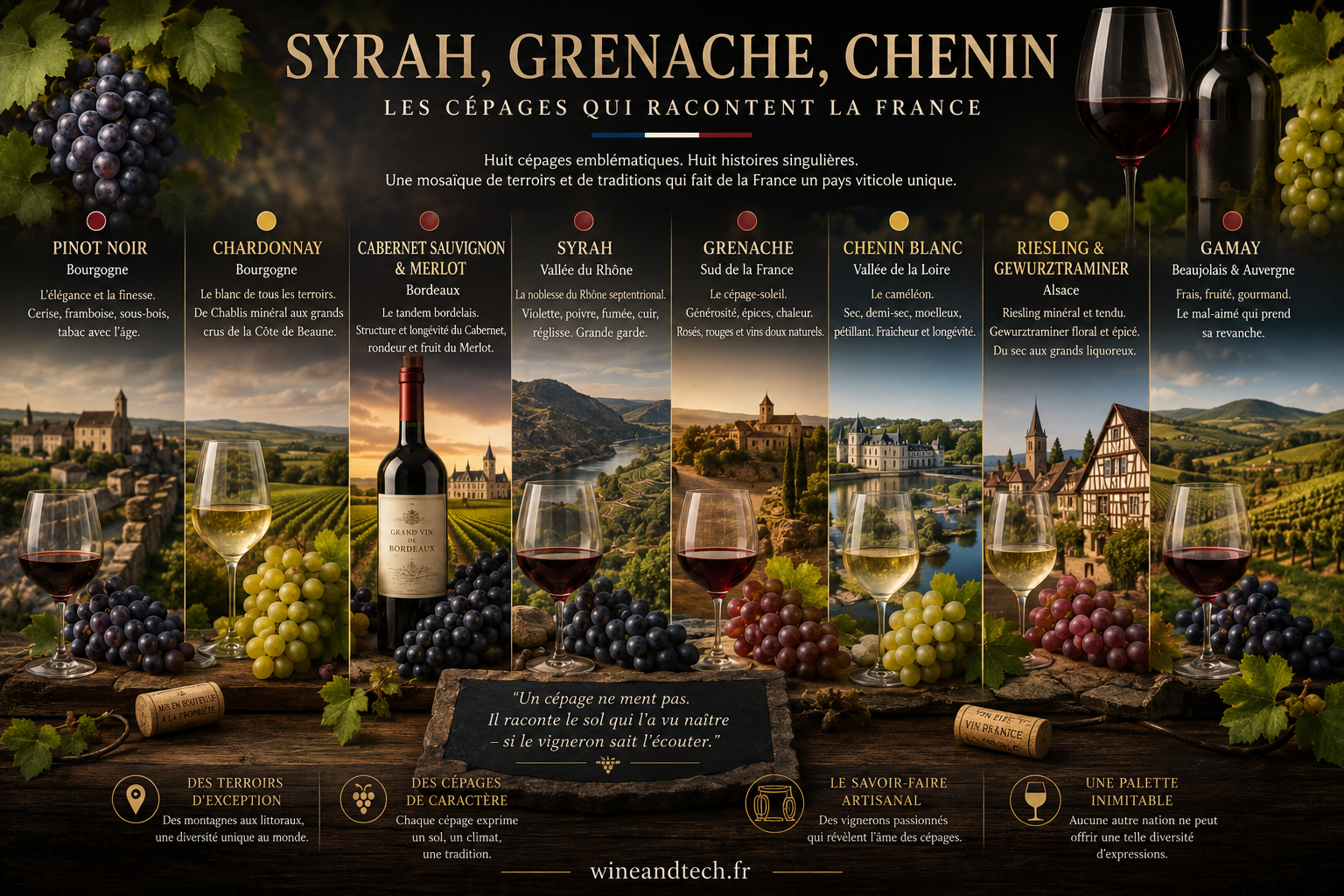
  • Syrah, Grenache, Chenin: the grape varieties that tell France’s story

    Syrah, Grenache, Chenin: the grape varieties that tell France’s story

    🇬🇧 Series · The Vinous Trinity · Article 7/15 · France · ⏱ 5 min

    In France, grape varieties are not simply types of grape. They are characters, each with its own personality, its preferred soils, its infinite variations depending on the land and the winemaker. Syrah, Grenache, Chenin Blanc, Pinot Noir, Chardonnay, Riesling, Gamay: every one of these names tells a story of soil, climate and tradition. Together, they form a palette no other wine nation can match.

    🍇 Grape varieties explored in this article

    Pinot Noir · Chardonnay · Cabernet Sauvignon & Merlot · Syrah · Grenache · Chenin Blanc · Riesling · Gamay

    🔴 Pinot Noir · the soul of Burgundy

    Pinot Noir is perhaps the most difficult grape variety in the world to master. Thin skin, light tannins, extraordinary sensitivity to terroir: it expresses with remarkable precision the differences between parcels sometimes separated by just a few dozen metres. In Burgundy, it produces wines of finesse, elegance and aromatic complexity (cherry, raspberry, flowers, undergrowth, tobacco with age) that have forged its worldwide reputation. But Burgundian Pinot Noir is not limited to inaccessible grands crus: a village Bourgogne or a Côte de Nuits-Villages from an artisan winemaker between €18 and €30 can deliver a remarkable experience. It also thrives in Alsace, Champagne and Savoie.

    🟡 Chardonnay · the white of all terroirs

    Chardonnay is the most widely planted white grape variety in the world, but it is in Burgundy that it reaches its highest expression. From the Côte de Beaune (Meursault, Puligny-Montrachet, Chassagne-Montrachet) to taut, mineral Chablis, from fruity, affordable Mâcon-Villages to Champagne where it forms the base of Blancs de Blancs, Chardonnay covers an extraordinary range of styles. Its initial neutrality makes it a chameleon grape: it takes on the imprint of terroir and winemaker with remarkable fidelity. A Chablis Premier Cru or a Mâcon-Uchizy from an artisan producer between €12 and €22: wines of real class at reasonable prices.

    🔴 Cabernet Sauvignon & Merlot · the Bordeaux tandem

    In Bordeaux, blending is never accidental. Cabernet Sauvignon (structure, firm tannins, longevity, blackcurrant, cedar) and Merlot (roundness, ripe red fruits, earlier accessibility) complement each other with a logic that defined the concept of fine wine for the entire world. The left bank (Médoc, Graves) favours Cabernet Sauvignon on its well-drained gravels. The right bank (Saint-Émilion, Pomerol) favours Merlot on its cooler clays. The real secret: hundreds of artisan estates produce increasingly high-quality Bordeaux at €10-18, often from old vines on remarkable terroirs.

    🔴 Syrah · the nobility of the northern Rhône

    On the steep granites of Côte-Rôtie, Hermitage or Cornas, Syrah reaches a level of expression that few grape varieties in the world can match: violet, black olive, white pepper, smoke, leather, liquorice. Wines of striking power and depth, capable of ageing 20 to 30 years. What makes Rhône Syrah unique is a long winemaking history, a marked climate and particularly demanding granite terroirs. In Crozes-Hermitage or Saint-Joseph, more accessible neighbours, remarkable Syrahs can be found between €12 and €20. It also succeeds in Languedoc and Provence, with looser, fruitier expressions.

    🔴 Grenache · the generosity of the deep South

    Originally from Spain (Garnacha), naturalised French in the southern Rhône and Languedoc, Grenache is the sunshine grape. It finds in Châteauneuf-du-Pape, on its terraces of rounded stones, one of its most emblematic French expressions, producing wines of remarkable generosity, warmth and spiced complexity. But it appears everywhere across the south of France: in rosé in Provence, in sweet natural wines (Banyuls, Maury, Rasteau), in Languedoc where century-old vines often yield the country’s best value-for-money. A Rasteau or Gigondas from an artisan winemaker at €12-18: southern generosity at an honest price.

    🟡 Chenin Blanc · the Loire’s chameleon

    Chenin Blanc is perhaps one of the most versatile white grape varieties in France. From the Loire Valley, it produces dry wines of striking tension and minerality (Savannières), fresh and complex off-dry wines (Vouvray), sweet wines of astonishing aromatic richness (Coteaux du Layon, Bonnezeaux) and remarkable sparkling wines (Vouvray pétillant, Crémant de Loire). Its naturally high acidity allows it to age 30, 40, even 50 years while retaining intact freshness. A dry Vouvray or an Anjou blanc from a winemaker between €10 and €16 can reveal astonishing complexity with a few years in the cellar.

    🟡 Riesling & Gewurztraminer · two of Alsace’s great grape varieties

    Alsace has the rare distinction of labelling wines by grape variety, and two dominate. Riesling, mineral, taut, citrus with petrol notes emerging with age, is one of France’s greatest dry whites, capable of exceptional longevity on the finest terroirs of the wine route. Gewurztraminer, at the opposite extreme, is flamboyant and opulent: rose, lychee, spice, ginger. Both can range from bone-dry to late harvest, up to Sélections de Grains Nobles, the equivalent of the world’s greatest sweet wines. Exceptional wines, often undervalued relative to their quality.

    🔴 Gamay · the unloved grape having its moment

    Long confined to the image of Beaujolais Nouveau, a marketing product drunk in November and forgotten by December, Gamay is now at the heart of a worldwide enthusiasm for light, fresh, easy-drinking wines. On the granites of Beaujolais, it produces the 10 crus explored in the previous article. But Gamay also grows in Touraine (Touraine Gamay, fresh and fruity), in Auvergne (Côtes d’Auvergne, often remarkable at under €10), in Savoie. A new generation of winemakers vinifies it with renewed finesse, gentler extraction, more precise ageing. A grape that turns out to have real depth.


    The inimitable · what these grape varieties share

    What sets many French grape varieties apart, including some now planted worldwide like Chardonnay, Cabernet Sauvignon or Merlot, is their capacity to produce profoundly different expressions depending on their territory. Savagnin from Jura, Mondeuse from Savoie, Romorantin from the Loire, Nielluccio from Corsica, Mourvèdre from Bandol: grape varieties that cannot be reproduced anywhere else with the same results. This combination, grape variety × terroir × tradition, is what makes France a unique wine country. Not because its wines are systematically the best in the world, but because they are irreplaceable.

    A grape variety doesn’t lie. It tells the story of the soil that gave it birth, if the winemaker knows how to listen.

  • France’s overlooked wine regions: where excellence goes unnoticed

    France’s overlooked wine regions: where excellence goes unnoticed

    🇬🇧 Series · The Vinous Trinity · Article 4/15 · France · ⏱ 4 min

    Bordeaux, Burgundy, Champagne have occupied the spotlight for decades. But one of the deeper pleasures of the French vineyard is what’s happening just outside the lights. Entire regions, sometimes invisible to the general public, produce wines of an originality and value-for-money their celebrated neighbours struggle to match. A journey through the France that surprises, even the most experienced drinkers.

    🗺️ Regions explored in this article

    Jura · Savoie · Beaujolais · Grand South-West · Corsica · Secret Loire · French Moselle

    🏔️ Jura & Savoie: two Alpine treasures

    Jura is perhaps the most singular wine region in France. Its vins jaunes, aged under a yeast veil for at least 6 years and 3 months in unsealed barrels, are like nothing else in the world: walnut, curry, spice, fresh nut and dried fruit… a tasting experience without equivalent. Its other wines, ouillé Savagnin, Poulsard (a light red with barely perceptible tannins) and the more structured Trousseau, have won over a community of drinkers in search of authenticity and character. A Jura white from an artisan winemaker between €12 and €18: one of the best surprises you can put in a glass.

    Savoie produces high-altitude wines of mineral freshness that seem made for mountain tables, but not exclusively. Altesse (Roussette de Savoie) in white, Mondeuse in red (a parent grape of Syrah) and the sparkling wines of Seyssel: a confidential region that rewards curiosity well beyond fondues and raclettes.

    🍇 Beaujolais: far beyond the Nouveau

    Beaujolais has long suffered from the image of Beaujolais Nouveau, a marketing product drunk in November and forgotten by December. But the 10 Beaujolais crus (Moulin-à-Vent, Morgon, Fleurie, Côte de Brouilly, Brouilly, Régnié, Chiroubles, Juliénas, Chénas, Saint-Amour) tell a completely different story: terroir wines on granite, schist and volcanic rock, with Gamay that can age ten years, sometimes longer from the best producers, developing a complexity that regularly trips up blind tasters convinced they are drinking Burgundy. A Morgon or Moulin-à-Vent from an artisan producer between €12 and €20: hard to find better in France for a red built to keep.

    🌄 The Grand South-West: the great overlooked

    Wedged between Bordeaux and the Pyrenees, the South-West wine country is a constellation of small appellations that never had the geographical luck to become well known. Cahors with its original Malbec, dense, structured, built for long ageing, long predating the grape’s Argentine glory. Madiran with its Tannat, among the richest red wines in polyphenols. Jurançon with its dry whites and Petit Manseng sweet wines of unexpected complexity. Irouléguy, the small Basque appellation with characterful reds on slate terraces. Marcillac and its Fer Servadou, all violet and liquorice. Passionate winemakers, often farming organically, at prices that seem almost too honest.

    🏝️ Corsica: grape varieties from the edge of the world

    Corsica deserves a mention of its own. Its grape varieties, Nielluccio (closely related to Tuscan Sangiovese), Sciacarello and insular Vermentino, are found almost nowhere else in the world. The island produces whites of striking aromatic freshness, rosés with far more character than those of Provence, spiced and sunny reds. And Muscat du Cap Corse, a protected natural sweet wine, is one of the great French Muscats: confidential, remarkable, still accessible. Prices that haven’t caught up with what’s in the bottle.

    💎 The Loire beyond Sancerre

    The Loire was introduced in our panorama. But beyond the Sancerre and Muscadet everyone knows, there is a secret Loire. The Coteaux du Layon and their Chenin Blanc sweet wines offer remarkable quality at a fraction of the price of the great Bordeaux liquoreux. Bonnezeaux and Quarts de Chaume, two tiny appellations producing exceptional liquoreux. Cour-Cheverny and its Romorantin grape, unique in the world, planted only here, with aromas of beeswax and acacia that are distinctly its own. Fiefs Vendéens with their coastal Pinot Noir. The secret Loire rewards those who take the time to venture in.

    🏺 French Moselle: a region being born

    Already mentioned in our 16-region panorama, French Moselle deserves a special note here. Long in the shadow of neighbouring Alsace and Luxembourg’s Moselle, it has been carried in recent years by a new generation of demanding, passionate winemakers. While its dry whites and gris on limestone soils, taut, mineral, precise, are winning over more and more enthusiasts, the region is also revealing a Pinot Noir of real elegance. Made with care by several of the region’s leading estates, it has a freshness, delicacy and precision that hint at everything this northern terroir is capable of. These wines are finding their way onto wine lists across the Grand Est, championed by sommeliers looking for authentic terroirs and new signatures. A region to watch… before the prices follow suit.


    The paradox of the unknown wine

    What all these regions have in common: they are not yet fashionable. Which means winemakers haven’t yet raised prices under demand pressure, labels don’t carry the weight of speculation, and the curious buyer can make remarkable finds for €10 to €18. The great secret of French wine: its most singular treasures are often hidden where no one is looking yet. The best sommeliers have known this for a long time. It’s time everyone else did too.

    The wines that surprise most in blind tastings don’t always come from where you’d expect.

  • Cabernet Sauvignon: The King of Grape Varieties — Why Does It Dominate the World?

    Cabernet Sauvignon: The King of Grape Varieties — Why Does It Dominate the World?

    📚 Grape Varieties of the World · Episode 1  |  ⏱ Reading time: 7 minutes

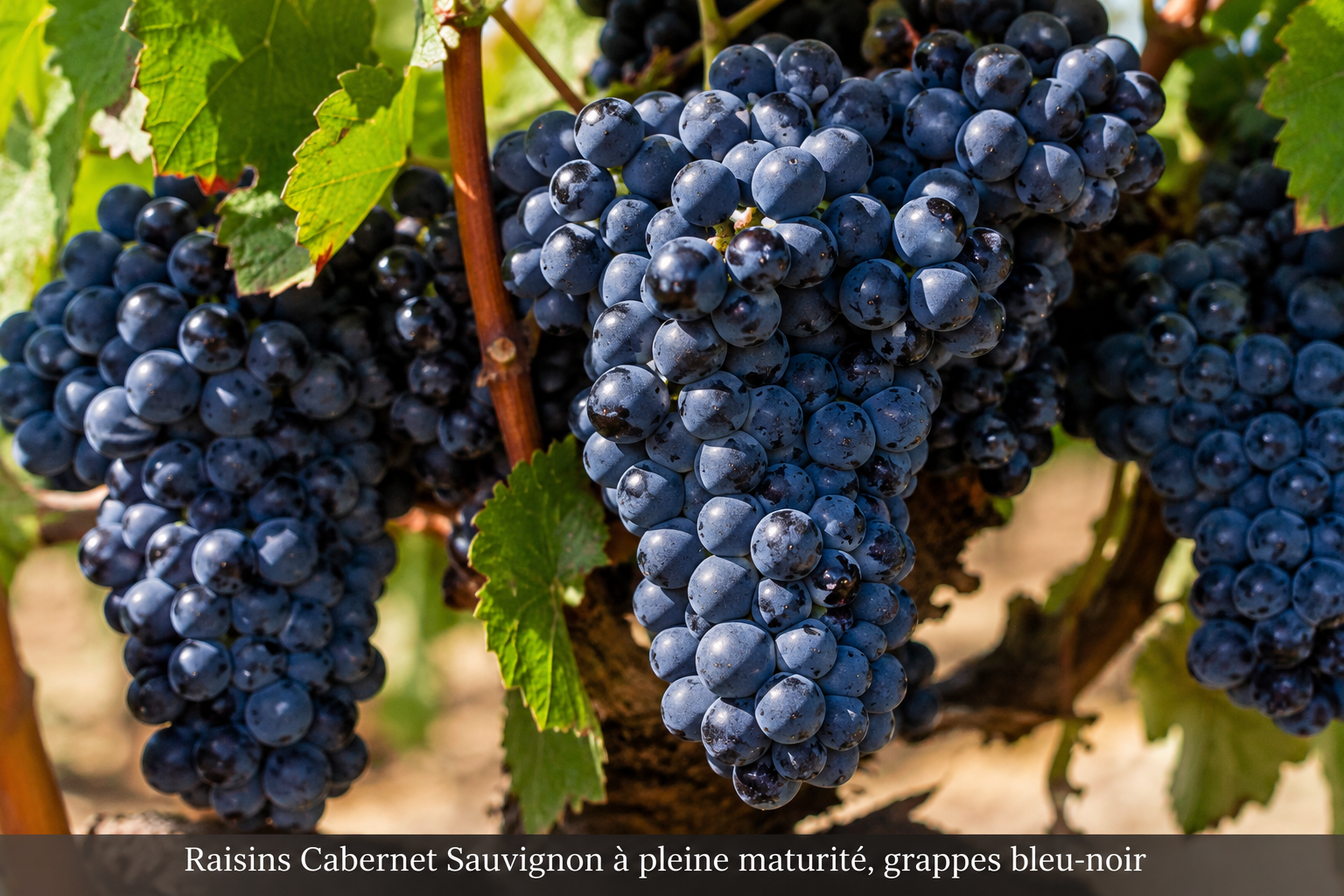
    Every year, millions of bottles of Cabernet Sauvignon are opened across the globe. From the great châteaux of Bordeaux to Californian estates, from Chilean vineyards to Australian terroirs, few grape varieties have conquered so many territories while retaining such a recognisable identity. Robust, built for ageing and capable of producing some of the planet’s greatest wines, Cabernet Sauvignon has established itself as the undisputed king of red grape varieties.

    In this first episode of our Grape Varieties of the World series, we unpack a global dominance that has lasted for more than three centuries.


    A Botanical Accident Turned Global Superstar

    Cabernet Sauvignon was not created by a visionary winemaker, nor selected in a laboratory. It was born from a botanical accident. Probably in the 17th century, in the Bordeaux region, two grape varieties growing in close proximity crossed naturally: Cabernet Franc, already well established in south-west France, and Sauvignon Blanc, celebrated for its aromatic expression. From this chance encounter came a vigorous, late-ripening variety particularly rich in tannins.

    For a long time, this origin remained nothing more than a hypothesis passed down from generation to generation.

    🔬 The Science Behind the Grape

    In 1996, a team of geneticists at the University of California, Davis, led by John Bowers and Carole Meredith, scientifically confirmed the parentage of Cabernet Sauvignon through DNA analysis. This discovery explained why the variety inherits the structure of Cabernet Franc while exhibiting specific aromatic compounds: methoxypyrazines, responsible for the green pepper notes that appear when grapes are harvested before full maturity. Molecular biology at the service of the sommelier.

    From Bordeaux to Napa: A Grape That Travels Remarkably Well

    The Bordeaux region is the historical birthplace of Cabernet Sauvignon. It is in the Médoc that it found its most iconic expression. The gravelly soils, made up of pebbles deposited by the Garonne river during the Quaternary period, provide exceptional drainage. The vine is forced to send its roots deep in search of water, encouraging slow ripening and a remarkable concentration of tannins and aromas. This combination shaped the reputation of Pauillac, Margaux and Saint-Julien.

    Its extraordinary capacity for adaptation is one of its greatest strengths. Four major expressions illustrate this versatility:

    • 🇫🇷 Médoc, Bordeaux — elegance and slow ageing, blended with Merlot and Cabernet Franc, complexity that reveals itself over decades
    • 🇺🇸 Napa Valley (Rutherford, Oakville) — more generous and sun-drenched wines, powerful structure, pronounced fruit maturity
    • 🇨🇱 Maipo Valley, Chile — fresh expression, characteristic minty notes, the signature of large day-to-night temperature swings
    • 🇦🇺 Coonawarra, Australia — terra rossa (red clay over limestone), dense, spiced wines of remarkable longevity
    Carte des principaux vignobles de Cabernet Sauvignon dans le monde ✦ VITICULTURE MONDIALE ✦ Carte des principaux vignobles de Cabernet Sauvignon dans le monde Les 4 grands terroirs mondiaux · Ancien & Nouveau Monde Bordeaux — Médoc · Pauillac (France) ★ Bordeaux France Ribera del Duero — Castille-et-León (Espagne) Ribera del Duero Espagne Toscane — Bolgheri · Super Toscans (Italie) Toscane Italie Napa Valley — Oakville · Rutherford (Californie, USA) ★ Napa Valley Californie, USA Washington State — Columbia Valley (USA) Washington State USA Maipo Valley — Puente Alto (Chili) ★ Maipo Valley Chili Mendoza — Luján de Cuyo (Argentine) Mendoza Argentine Coonawarra — Terra Rossa (Australie) ★ Coonawarra Australie Margaret River — Australie-Occidentale (Australie) Margaret River Australie Stellenbosch — Cap-Occidental (Afrique du Sud) Stellenbosch Afrique du Sud Équateur 50°N 30°N 30°S 50°S ★ Terroir emblématique Vignoble reconnu Europe · Ancien Monde Bordeaux · Ribera del Duero · Toscane Amérique du Nord Napa Valley · Washington State Amérique du Sud Maipo Valley · Mendoza Hémisphère Sud Coonawarra · Margaret River · Stellenbosch Le Cabernet Sauvignon s’épanouit entre 30° et 50° de latitude Nord et Sud · wineandtech.fr
    Carte des principaux vignobles de Cabernet Sauvignon dans le monde — wineandtech.fr

    The Wines That Built Its Legend

    No discussion of Cabernet Sauvignon would be complete without the wines that forged its worldwide reputation:

    • 🇫🇷 Château Latour & Château Mouton Rothschild — the mastered power of the Médoc, wines capable of evolving over several decades
    • 🇺🇸 Opus One (1979, Robert Mondavi × Baron Philippe de Rothschild) — proof that the New World could rival the finest Bordeaux classified growths
    • 🇨🇱 Almaviva — the successful alliance of Bordeaux expertise and Andean terroirs
    • 🇦🇺 Penfolds Bin 707 — Australia’s benchmark Cabernet, known for its intensity, aromatic richness and immense ageing potential

    One Style, A Thousand Faces

    On the palate, Cabernet Sauvignon is immediately recognisable by its assertive tannic structure and aromas of blackcurrant, blackberry and dark fruit. Depending on climate and ripeness level, notes of cedar, graphite, tobacco, green pepper, eucalyptus or mint can enrich its aromatic profile.

    In Bordeaux, it is rarely vinified alone — it typically forms the backbone of blends with Merlot, Cabernet Franc or Petit Verdot. In warmer climates such as California or Australia, it is more often crafted as a single variety: wines gain in breadth, fruit maturity and richness, with a more pronounced oak influence.

    🍷 Classic Tasting Note

    💃 Colour: Deep red, purple hues in youth, brick tones with age
    👃 Nose: Blackcurrant, blackberry, plum · cedar, graphite, tobacco, leather at maturity
    👄 Palate: Firm yet silky tannins, good acidity, long and persistent finish
    🍽️ Food pairing: Roast lamb, rib-eye steak, aged cheeses, rich meat dishes

    Cabernet Sauvignon and Climate Change

    Long regarded as a natural ally of global warming due to its late-ripening nature, Cabernet Sauvignon is now seeing its equilibrium shift. Increasingly early harvests are driving up alcohol levels while progressively reducing acidity. In the warmest vintages, this evolution can diminish the freshness that forms a key part of the variety’s identity.

    Faced with these new conditions, winemakers are adapting their practices: rebalancing blends, seeking out cooler plots, and experimenting with newly authorised varieties. At the same time, Cabernet Sauvignon is conquering new territories — southern England, British Columbia, high-altitude vineyards in Argentina and Chile. Its world geography is in full transformation.

    Why It Remains Unbeatable

    Sunset grape harvest, adaptation to viticultural climate change (Kent Porter / The Press Democrat)

    Resilient, adaptable, equally comfortable in a blend or as a single variety, gifted with an exceptional ageing potential and able to express the character of a terroir with rare precision: Cabernet Sauvignon brings together all the qualities that explain its enduring success. It remains today the most widely planted red grape variety in the world, ahead of Merlot and Syrah.

    From Bordeaux to Coonawarra, via Napa and the Maipo, it continues to write the story of a botanical accident that became one of wine’s greatest ambassadors.

    📌 Key Takeaways

    • Born from a natural cross between Cabernet Franc × Sauvignon Blanc (17th century, Bordeaux)
    • Parentage confirmed by DNA analysis in 1996 — University of California, Davis
    • The world’s most planted red grape variety
    • 4 major expressions: Bordeaux · Napa Valley · Chile · Australia
    • High tannic structure → ideal for ageing (10 to 30+ years)
    • Evolving in the face of climate change

    ➡️ Next Episode — 1st September

    Its aromatic identity is surprisingly understated — and that is precisely what allows it to reveal, with rare faithfulness, the terroirs from which it comes. Mineral in Chablis, rich and generous in California, taut in Champagne or complex in Burgundy, it shifts character without ever losing its elegance.

    Next up: Chardonnay — how did such a versatile grape become the most planted white variety in the world?