📚 Grape Varieties of the World · Episode 1 | ⏱ Reading time: 7 minutes
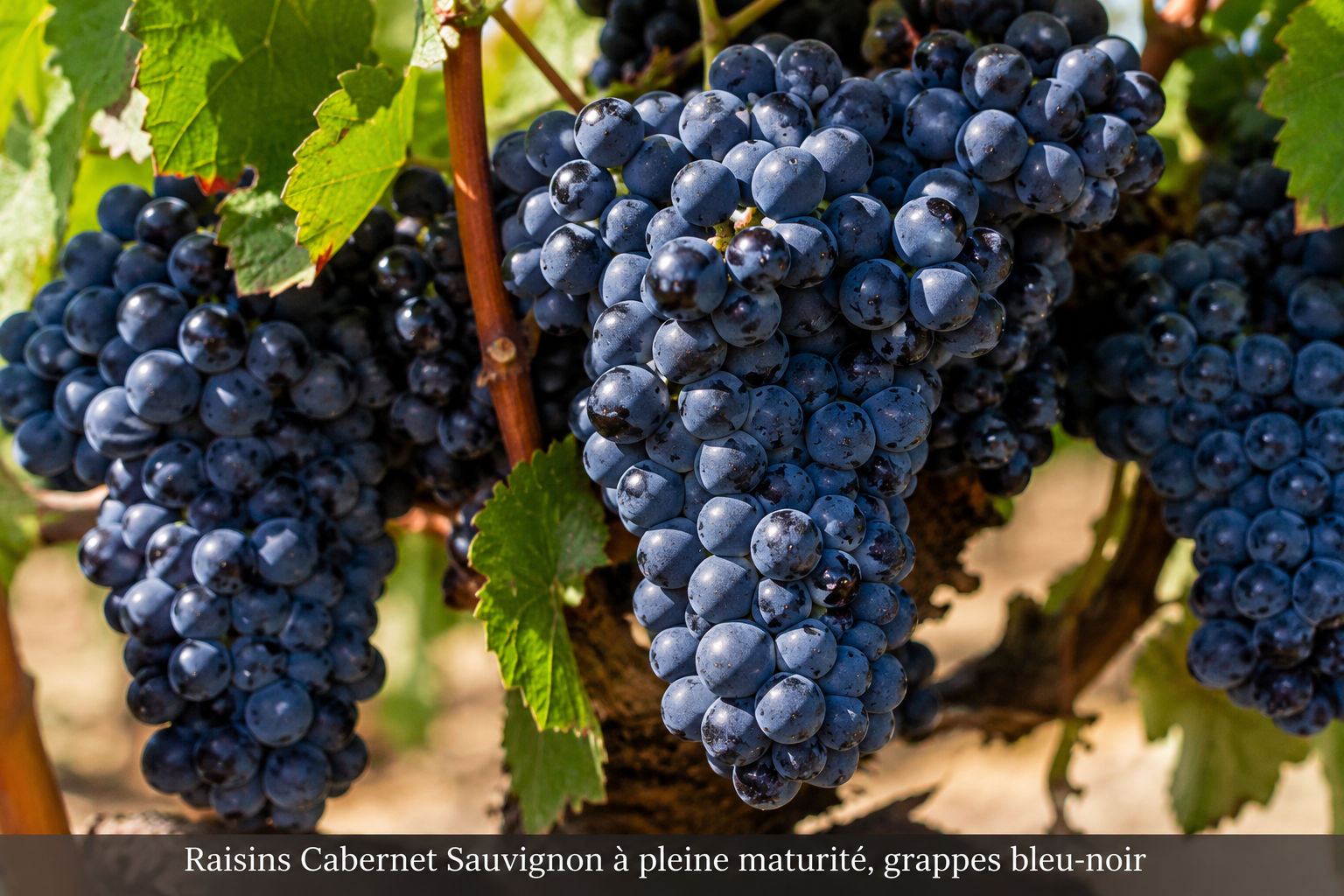
Every year, millions of bottles of Cabernet Sauvignon are opened across the globe. From the great châteaux of Bordeaux to Californian estates, from Chilean vineyards to Australian terroirs, few grape varieties have conquered so many territories while retaining such a recognisable identity. Robust, built for ageing and capable of producing some of the planet’s greatest wines, Cabernet Sauvignon has established itself as the undisputed king of red grape varieties.
In this first episode of our Grape Varieties of the World series, we unpack a global dominance that has lasted for more than three centuries.
A Botanical Accident Turned Global Superstar
Cabernet Sauvignon was not created by a visionary winemaker, nor selected in a laboratory. It was born from a botanical accident. Probably in the 17th century, in the Bordeaux region, two grape varieties growing in close proximity crossed naturally: Cabernet Franc, already well established in south-west France, and Sauvignon Blanc, celebrated for its aromatic expression. From this chance encounter came a vigorous, late-ripening variety particularly rich in tannins.
For a long time, this origin remained nothing more than a hypothesis passed down from generation to generation.
🔬 The Science Behind the Grape
In 1996, a team of geneticists at the University of California, Davis, led by John Bowers and Carole Meredith, scientifically confirmed the parentage of Cabernet Sauvignon through DNA analysis. This discovery explained why the variety inherits the structure of Cabernet Franc while exhibiting specific aromatic compounds: methoxypyrazines, responsible for the green pepper notes that appear when grapes are harvested before full maturity. Molecular biology at the service of the sommelier.

From Bordeaux to Napa: A Grape That Travels Remarkably Well
The Bordeaux region is the historical birthplace of Cabernet Sauvignon. It is in the Médoc that it found its most iconic expression. The gravelly soils, made up of pebbles deposited by the Garonne river during the Quaternary period, provide exceptional drainage. The vine is forced to send its roots deep in search of water, encouraging slow ripening and a remarkable concentration of tannins and aromas. This combination shaped the reputation of Pauillac, Margaux and Saint-Julien.
Its extraordinary capacity for adaptation is one of its greatest strengths. Four major expressions illustrate this versatility:
- 🇫🇷 Médoc, Bordeaux — elegance and slow ageing, blended with Merlot and Cabernet Franc, complexity that reveals itself over decades
- 🇺🇸 Napa Valley (Rutherford, Oakville) — more generous and sun-drenched wines, powerful structure, pronounced fruit maturity
- 🇨🇱 Maipo Valley, Chile — fresh expression, characteristic minty notes, the signature of large day-to-night temperature swings
- 🇦🇺 Coonawarra, Australia — terra rossa (red clay over limestone), dense, spiced wines of remarkable longevity
The Wines That Built Its Legend
No discussion of Cabernet Sauvignon would be complete without the wines that forged its worldwide reputation:
- 🇫🇷 Château Latour & Château Mouton Rothschild — the mastered power of the Médoc, wines capable of evolving over several decades
- 🇺🇸 Opus One (1979, Robert Mondavi × Baron Philippe de Rothschild) — proof that the New World could rival the finest Bordeaux classified growths
- 🇨🇱 Almaviva — the successful alliance of Bordeaux expertise and Andean terroirs
- 🇦🇺 Penfolds Bin 707 — Australia’s benchmark Cabernet, known for its intensity, aromatic richness and immense ageing potential
One Style, A Thousand Faces
On the palate, Cabernet Sauvignon is immediately recognisable by its assertive tannic structure and aromas of blackcurrant, blackberry and dark fruit. Depending on climate and ripeness level, notes of cedar, graphite, tobacco, green pepper, eucalyptus or mint can enrich its aromatic profile.
In Bordeaux, it is rarely vinified alone — it typically forms the backbone of blends with Merlot, Cabernet Franc or Petit Verdot. In warmer climates such as California or Australia, it is more often crafted as a single variety: wines gain in breadth, fruit maturity and richness, with a more pronounced oak influence.
🍷 Classic Tasting Note
💃 Colour: Deep red, purple hues in youth, brick tones with age
👃 Nose: Blackcurrant, blackberry, plum · cedar, graphite, tobacco, leather at maturity
👄 Palate: Firm yet silky tannins, good acidity, long and persistent finish
🍽️ Food pairing: Roast lamb, rib-eye steak, aged cheeses, rich meat dishes
Cabernet Sauvignon and Climate Change
Long regarded as a natural ally of global warming due to its late-ripening nature, Cabernet Sauvignon is now seeing its equilibrium shift. Increasingly early harvests are driving up alcohol levels while progressively reducing acidity. In the warmest vintages, this evolution can diminish the freshness that forms a key part of the variety’s identity.
Faced with these new conditions, winemakers are adapting their practices: rebalancing blends, seeking out cooler plots, and experimenting with newly authorised varieties. At the same time, Cabernet Sauvignon is conquering new territories — southern England, British Columbia, high-altitude vineyards in Argentina and Chile. Its world geography is in full transformation.
Why It Remains Unbeatable

Resilient, adaptable, equally comfortable in a blend or as a single variety, gifted with an exceptional ageing potential and able to express the character of a terroir with rare precision: Cabernet Sauvignon brings together all the qualities that explain its enduring success. It remains today the most widely planted red grape variety in the world, ahead of Merlot and Syrah.
From Bordeaux to Coonawarra, via Napa and the Maipo, it continues to write the story of a botanical accident that became one of wine’s greatest ambassadors.
📌 Key Takeaways
- Born from a natural cross between Cabernet Franc × Sauvignon Blanc (17th century, Bordeaux)
- Parentage confirmed by DNA analysis in 1996 — University of California, Davis
- The world’s most planted red grape variety
- 4 major expressions: Bordeaux · Napa Valley · Chile · Australia
- High tannic structure → ideal for ageing (10 to 30+ years)
- Evolving in the face of climate change
➡️ Next Episode — 1st September
Its aromatic identity is surprisingly understated — and that is precisely what allows it to reveal, with rare faithfulness, the terroirs from which it comes. Mineral in Chablis, rich and generous in California, taut in Champagne or complex in Burgundy, it shifts character without ever losing its elegance.
Next up: Chardonnay — how did such a versatile grape become the most planted white variety in the world?
Leave a Reply