WineAndTech’

Tag: Tanins

  • Pinot Noir: Why Does the World’s Most Difficult Grape Variety Fascinate Winemakers and Wine Lovers Alike?

    Pinot Noir: Why Does the World’s Most Difficult Grape Variety Fascinate Winemakers and Wine Lovers Alike?

    📚 Grape Varieties of the World · Episode 3  |  ⏱ Reading time: 7 minutes

    It’s often said to be the most thankless grape to grow and the most rewarding to drink. Thin-skinned, early-ripening, hypersensitive to the slightest shift in terroir or climate, Pinot Noir tests even the most seasoned winemakers. And yet it is precisely from this fragility that some of the most sought-after, most expensive and most enigmatic wines on the planet are born.

    For this third episode of our Grape Varieties of the World series, we dive into the history of a grape as old as European viticulture itself, incapable of lying about where it comes from.


    A Grape as Old as Rome, as Elusive as the Wind

    Unlike Cabernet Sauvignon or Chardonnay, born from an identifiable crossing at a relatively recent point in time, Pinot Noir has no known birth date. Ampelographers agree that it ranks among the oldest grape varieties cultivated in Europe, probably descended from successive crossings and mass selections carried out on wild vines (Vitis vinifera sylvestris) as far back as Roman times. Latin writings already attest to the presence of a fine, productive vine in Burgundy nearly two thousand years ago.

    It was later the Benedictine and then Cistercian monks who, from the Middle Ages onward, patiently mapped the best plots of the Côte-d’Or, laying the foundations of what are known today as the climats of Burgundy — inscribed on the UNESCO World Heritage list since 2015. A meticulous, plot-by-plot work of observation that revealed just how much Pinot Noir changes character over a shift of just a few metres.

    Drone flying over a vineyard plot in Burgundy

    🔬 The Science of Genetic Chaos

    Pinot Noir holds a rather unenviable record: it is one of the most genetically unstable grape varieties known. Its DNA structure favours the spontaneous appearance of somatic mutations, which explains the existence of hundreds of clones with differing characteristics (the famous clone 777 or the Pommard clone, for example). More surprising still: Pinot Gris and Pinot Blanc are not cousins born of a cross, but direct colour mutations of Pinot Noir — genetically almost the exact same plant, one pigmentation gene apart. Pinot Meunier, widely grown in Champagne, is another such variation. Where Chardonnay was born from a cross between two distinct varieties, Pinot Noir generates its own variants by mutating in place.

    From the Côte de Nuits to Oregon: Four Faces of a Fragile Grape

    Few red grape varieties are as transparent as Pinot Noir about their terroir of origin. Its colour is pale, its tannins discreet, but its ability to faithfully render a soil, an aspect or a climate is almost without equal. Four major expressions illustrate this diversity:

    • 🇫🇷 Côte de Nuits, Burgundy (Gevrey-Chambertin, Vosne-Romanée, Chambolle-Musigny) — limestone and marl soils, wines of great precision, fine tannic structure, exceptional ageing potential. The most revered expression of Pinot Noir in the world
    • 🇫🇷 Champagne — the region’s second most-planted grape, it brings structure, body and power to blends, and produces rare Blanc de Noirs of remarkable depth
    • 🇺🇸 Oregon (Willamette Valley) — a cool climate close to Burgundy’s, volcanic and sedimentary soils, silky and aromatic wines that became an American benchmark in barely forty years
    • 🇳🇿 New Zealand (Central Otago, Martinborough) — pronounced day/night temperature swings, vivid fruit and vibrant acidity, one of the most dynamic styles of the past decade

    To this list could be added Germany, where Pinot Noir — known locally as Spätburgunder — has seen considerable growth over the past twenty years, driven by terroirs such as the Ahr and Baden, long underrated outside Germany’s borders.

    The Wines That Built Its Legend

    A few landmark references that explain why Pinot Noir fascinates so many:

    • 🇫🇷 Romanée-Conti & La Tâche (Domaine de la Romanée-Conti) — the most highly valued red wines in the world, produced on a handful of hectares in Vosne-Romanée
    • 🇫🇷 Chambertin (Domaine Armand Rousseau) — power and depth, the grand cru Napoleon is said to have preferred above all others
    • 🇫🇷 Musigny (Domaine Comte Georges de Vogüé) — absolute finesse and elegance, often described as the most “feminine” grand cru of the Côte de Nuits
    • 🇫🇷 Bollinger Vieilles Vignes Françaises — a Champagne Blanc de Noirs made from ungrafted Pinot Noir vines that escaped phylloxera, of absolute rarity
    • 🇺🇸 Domaine Drouhin Oregon — proof that the Willamette Valley could produce Pinot Noir worthy of Burgundy
    • 🇳🇿 Felton Road (Central Otago) — New Zealand’s benchmark, carried by a spectacular high-altitude terroir

    A Style Built on Nuance

    Pinot Noir never chases power. Its colour is among the palest of the red grape varieties, its tannins fine and silky, its acidity naturally lively. It is a grape of nuance rather than force, capable of moving from crisp red fruit to notes of forest floor, leather and mushroom with age.

    This subtlety makes Pinot Noir extremely sensitive to winemaking decisions: full or partial destemming, the proportion of whole-cluster fermentation, maceration length, extraction level, choice of oak. Two neighbouring winemakers, on the same appellation, can produce radically different wines from the same grape — a trait that partly explains why enthusiasts are so fascinated by the differences in “hand” between producers.

    🍷 Classic Tasting Note

    👃 Colour: Pale to ruby red, garnet hues with age, characteristic transparency
    👃 Nose: Cherry, raspberry, wild strawberry, violet (youthful style) · forest floor, leather, mushroom, sweet spice (evolved style)
    👄 Palate: Fine, silky tannins, lively acidity, light to medium body, elegant, persistent finish
    🍽️ Food pairing: Roast poultry, duck, salmon, mushrooms, soft-rind cheeses, autumn cooking

    Pinot Noir and Climate Change

    Few grape varieties are as exposed to global warming as Pinot Noir. Early budbreak, thin skins, compact bunches prone to rot: every one of its historic traits is becoming a vulnerability in the face of today’s climate hazards. The spring frosts of 2016, 2017 and 2021 devastated entire swathes of the Burgundy vineyard, precisely because of this early budbreak.

    Increasingly early harvests also raise a stylistic challenge: Pinot Noir, a grape defined by finesse and freshness, risks losing precisely what makes it singular if alcohol levels keep climbing and acidity keeps falling. To preserve this balance, Burgundy winemakers are picking earlier in the morning, moving their plots to higher altitude and re-assessing their vineyards’ aspect.

    The grape is meanwhile conquering new territories once considered too cool: Kent in the south of England, Tasmania, certain high-altitude valleys of Argentine and Chilean Patagonia, and even promising trials in Sweden. All regions that could, in the coming decades, become new heartlands for a grape that has always needed coolness to fully express itself.

    Grape harvest in a Pinot Noir vineyard

    Why It Remains Essential

    Temperamental, demanding, at times exhausting for those who grow it: Pinot Noir sets its own terms rather than bending to the winemaker. But it is precisely this integrity that sets it apart. Where other grape varieties chase power or consistency, Pinot Noir chases the truth of a place, even when that truth is hard to obtain.

    From the Côte de Nuits to Oregon, via New Zealand and Germany, it continues to prove that a grape doesn’t need to be easy to be great — it simply has to stay faithful to where it comes from.

    Did you know?
    Pinot Gris, Pinot Blanc and Pinot Meunier are not different grape varieties from Pinot Noir: they are colour mutations of the very same plant. Genetically, they are almost the same grape — proof that Pinot Noir hasn’t finished surprising geneticists.

    📌 Key Takeaways

    • One of the oldest grape varieties in Europe, grown in Burgundy since Roman times
    • Extreme genetic instability — gave rise to Pinot Gris, Pinot Blanc and Pinot Meunier through mutation
    • 4 major expressions: Côte de Nuits · Champagne · Oregon · New Zealand
    • Climats of Burgundy listed as UNESCO World Heritage since 2015
    • Early budbreak and thin skin — highly vulnerable to spring frosts and climate change
    • Conquering new cool-climate territories: England, Tasmania, Patagonia, Sweden

    Sources: UNESCO — inscription of the Climats of the Burgundy vineyard as World Heritage (4 July 2015) · Vezzulli et al., “Pinot blanc and Pinot gris arose as independent somatic mutations of Pinot noir,” Journal of Experimental Botany, 2012 · BIVB and Réussir Vigne — spring frosts in Burgundy, 2016, 2017 and 2021.


    ➡️ Next Episode — 1st November

    For a long time, it was considered a second-tier grape, good for producing volume rather than emotion. Ripped out by the thousands of hectares in the 1980s, it is today experiencing one of the most beautiful revivals in Mediterranean viticulture, carried by old, forgotten vines and a remarkable resistance to drought.

    Next up: Carignan — how did a long-despised grape become one of viticulture’s great hopes in the face of climate change?
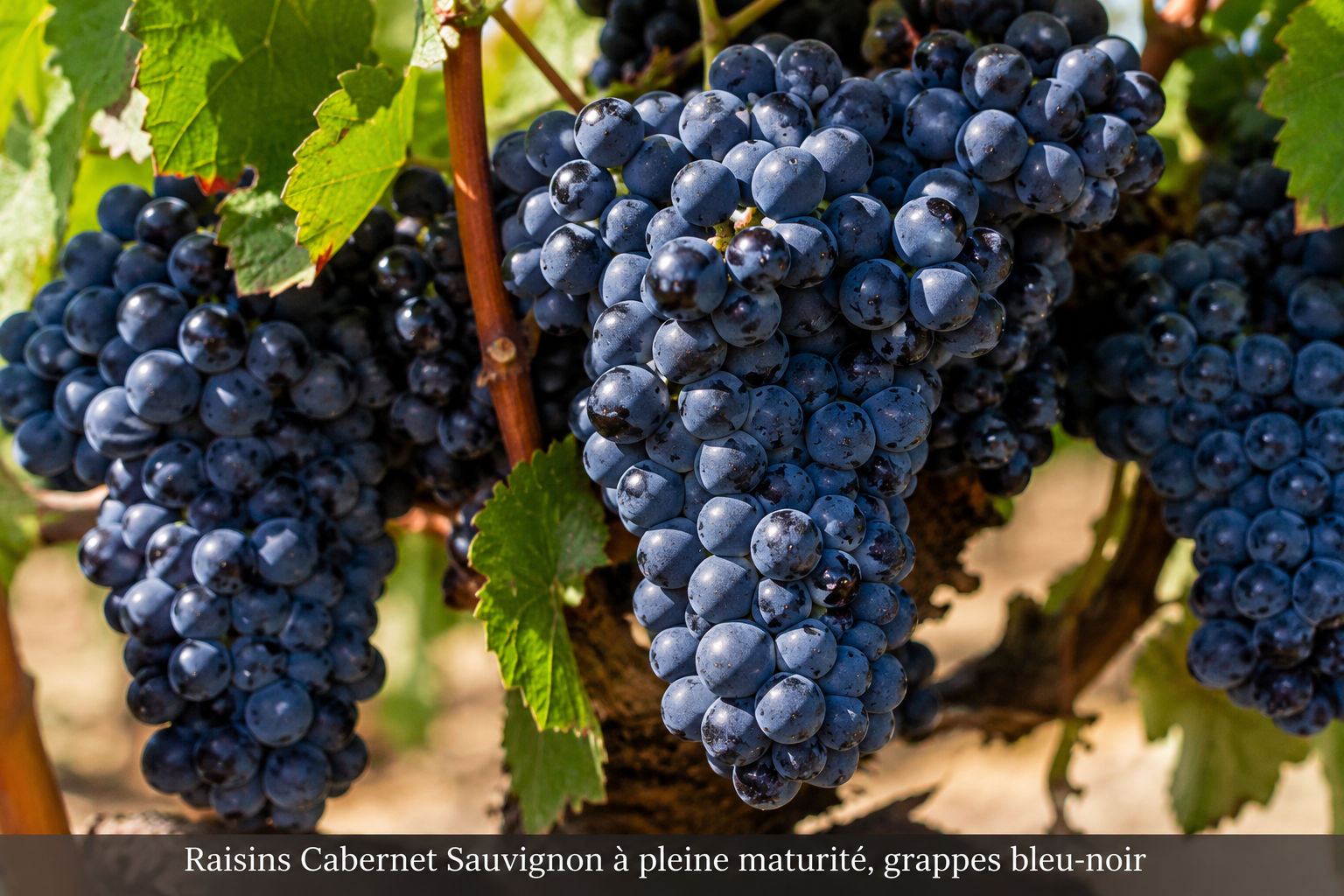
  • Cabernet Sauvignon: The King of Grape Varieties — Why Does It Dominate the World?

    Cabernet Sauvignon: The King of Grape Varieties — Why Does It Dominate the World?

    📚 Grape Varieties of the World · Episode 1  |  ⏱ Reading time: 7 minutes

    Every year, millions of bottles of Cabernet Sauvignon are opened across the globe. From the great châteaux of Bordeaux to Californian estates, from Chilean vineyards to Australian terroirs, few grape varieties have conquered so many territories while retaining such a recognisable identity. Robust, built for ageing and capable of producing some of the planet’s greatest wines, Cabernet Sauvignon has established itself as the undisputed king of red grape varieties.

    In this first episode of our Grape Varieties of the World series, we unpack a global dominance that has lasted for more than three centuries.


    A Botanical Accident Turned Global Superstar

    Cabernet Sauvignon was not created by a visionary winemaker, nor selected in a laboratory. It was born from a botanical accident. Probably in the 17th century, in the Bordeaux region, two grape varieties growing in close proximity crossed naturally: Cabernet Franc, already well established in south-west France, and Sauvignon Blanc, celebrated for its aromatic expression. From this chance encounter came a vigorous, late-ripening variety particularly rich in tannins.

    For a long time, this origin remained nothing more than a hypothesis passed down from generation to generation.

    🔬 The Science Behind the Grape

    In 1996, a team of geneticists at the University of California, Davis, led by John Bowers and Carole Meredith, scientifically confirmed the parentage of Cabernet Sauvignon through DNA analysis. This discovery explained why the variety inherits the structure of Cabernet Franc while exhibiting specific aromatic compounds: methoxypyrazines, responsible for the green pepper notes that appear when grapes are harvested before full maturity. Molecular biology at the service of the sommelier.

    From Bordeaux to Napa: A Grape That Travels Remarkably Well

    The Bordeaux region is the historical birthplace of Cabernet Sauvignon. It is in the Médoc that it found its most iconic expression. The gravelly soils, made up of pebbles deposited by the Garonne river during the Quaternary period, provide exceptional drainage. The vine is forced to send its roots deep in search of water, encouraging slow ripening and a remarkable concentration of tannins and aromas. This combination shaped the reputation of Pauillac, Margaux and Saint-Julien.

    Its extraordinary capacity for adaptation is one of its greatest strengths. Four major expressions illustrate this versatility:

    • 🇫🇷 Médoc, Bordeaux — elegance and slow ageing, blended with Merlot and Cabernet Franc, complexity that reveals itself over decades
    • 🇺🇸 Napa Valley (Rutherford, Oakville) — more generous and sun-drenched wines, powerful structure, pronounced fruit maturity
    • 🇨🇱 Maipo Valley, Chile — fresh expression, characteristic minty notes, the signature of large day-to-night temperature swings
    • 🇦🇺 Coonawarra, Australia — terra rossa (red clay over limestone), dense, spiced wines of remarkable longevity
    Carte des principaux vignobles de Cabernet Sauvignon dans le monde ✦ VITICULTURE MONDIALE ✦ Carte des principaux vignobles de Cabernet Sauvignon dans le monde Les 4 grands terroirs mondiaux · Ancien & Nouveau Monde Bordeaux — Médoc · Pauillac (France) ★ Bordeaux France Ribera del Duero — Castille-et-León (Espagne) Ribera del Duero Espagne Toscane — Bolgheri · Super Toscans (Italie) Toscane Italie Napa Valley — Oakville · Rutherford (Californie, USA) ★ Napa Valley Californie, USA Washington State — Columbia Valley (USA) Washington State USA Maipo Valley — Puente Alto (Chili) ★ Maipo Valley Chili Mendoza — Luján de Cuyo (Argentine) Mendoza Argentine Coonawarra — Terra Rossa (Australie) ★ Coonawarra Australie Margaret River — Australie-Occidentale (Australie) Margaret River Australie Stellenbosch — Cap-Occidental (Afrique du Sud) Stellenbosch Afrique du Sud Équateur 50°N 30°N 30°S 50°S ★ Terroir emblématique Vignoble reconnu Europe · Ancien Monde Bordeaux · Ribera del Duero · Toscane Amérique du Nord Napa Valley · Washington State Amérique du Sud Maipo Valley · Mendoza Hémisphère Sud Coonawarra · Margaret River · Stellenbosch Le Cabernet Sauvignon s’épanouit entre 30° et 50° de latitude Nord et Sud · wineandtech.fr
    Carte des principaux vignobles de Cabernet Sauvignon dans le monde — wineandtech.fr

    The Wines That Built Its Legend

    No discussion of Cabernet Sauvignon would be complete without the wines that forged its worldwide reputation:

    • 🇫🇷 Château Latour & Château Mouton Rothschild — the mastered power of the Médoc, wines capable of evolving over several decades
    • 🇺🇸 Opus One (1979, Robert Mondavi × Baron Philippe de Rothschild) — proof that the New World could rival the finest Bordeaux classified growths
    • 🇨🇱 Almaviva — the successful alliance of Bordeaux expertise and Andean terroirs
    • 🇦🇺 Penfolds Bin 707 — Australia’s benchmark Cabernet, known for its intensity, aromatic richness and immense ageing potential

    One Style, A Thousand Faces

    On the palate, Cabernet Sauvignon is immediately recognisable by its assertive tannic structure and aromas of blackcurrant, blackberry and dark fruit. Depending on climate and ripeness level, notes of cedar, graphite, tobacco, green pepper, eucalyptus or mint can enrich its aromatic profile.

    In Bordeaux, it is rarely vinified alone — it typically forms the backbone of blends with Merlot, Cabernet Franc or Petit Verdot. In warmer climates such as California or Australia, it is more often crafted as a single variety: wines gain in breadth, fruit maturity and richness, with a more pronounced oak influence.

    🍷 Classic Tasting Note

    💃 Colour: Deep red, purple hues in youth, brick tones with age
    👃 Nose: Blackcurrant, blackberry, plum · cedar, graphite, tobacco, leather at maturity
    👄 Palate: Firm yet silky tannins, good acidity, long and persistent finish
    🍽️ Food pairing: Roast lamb, rib-eye steak, aged cheeses, rich meat dishes

    Cabernet Sauvignon and Climate Change

    Long regarded as a natural ally of global warming due to its late-ripening nature, Cabernet Sauvignon is now seeing its equilibrium shift. Increasingly early harvests are driving up alcohol levels while progressively reducing acidity. In the warmest vintages, this evolution can diminish the freshness that forms a key part of the variety’s identity.

    Faced with these new conditions, winemakers are adapting their practices: rebalancing blends, seeking out cooler plots, and experimenting with newly authorised varieties. At the same time, Cabernet Sauvignon is conquering new territories — southern England, British Columbia, high-altitude vineyards in Argentina and Chile. Its world geography is in full transformation.

    Why It Remains Unbeatable

    Sunset grape harvest, adaptation to viticultural climate change (Kent Porter / The Press Democrat)

    Resilient, adaptable, equally comfortable in a blend or as a single variety, gifted with an exceptional ageing potential and able to express the character of a terroir with rare precision: Cabernet Sauvignon brings together all the qualities that explain its enduring success. It remains today the most widely planted red grape variety in the world, ahead of Merlot and Syrah.

    From Bordeaux to Coonawarra, via Napa and the Maipo, it continues to write the story of a botanical accident that became one of wine’s greatest ambassadors.

    📌 Key Takeaways

    • Born from a natural cross between Cabernet Franc × Sauvignon Blanc (17th century, Bordeaux)
    • Parentage confirmed by DNA analysis in 1996 — University of California, Davis
    • The world’s most planted red grape variety
    • 4 major expressions: Bordeaux · Napa Valley · Chile · Australia
    • High tannic structure → ideal for ageing (10 to 30+ years)
    • Evolving in the face of climate change

    ➡️ Next Episode — 1st September

    Its aromatic identity is surprisingly understated — and that is precisely what allows it to reveal, with rare faithfulness, the terroirs from which it comes. Mineral in Chablis, rich and generous in California, taut in Champagne or complex in Burgundy, it shifts character without ever losing its elegance.

    Next up: Chardonnay — how did such a versatile grape become the most planted white variety in the world?