30 August is International Cabernet Sauvignon Day.
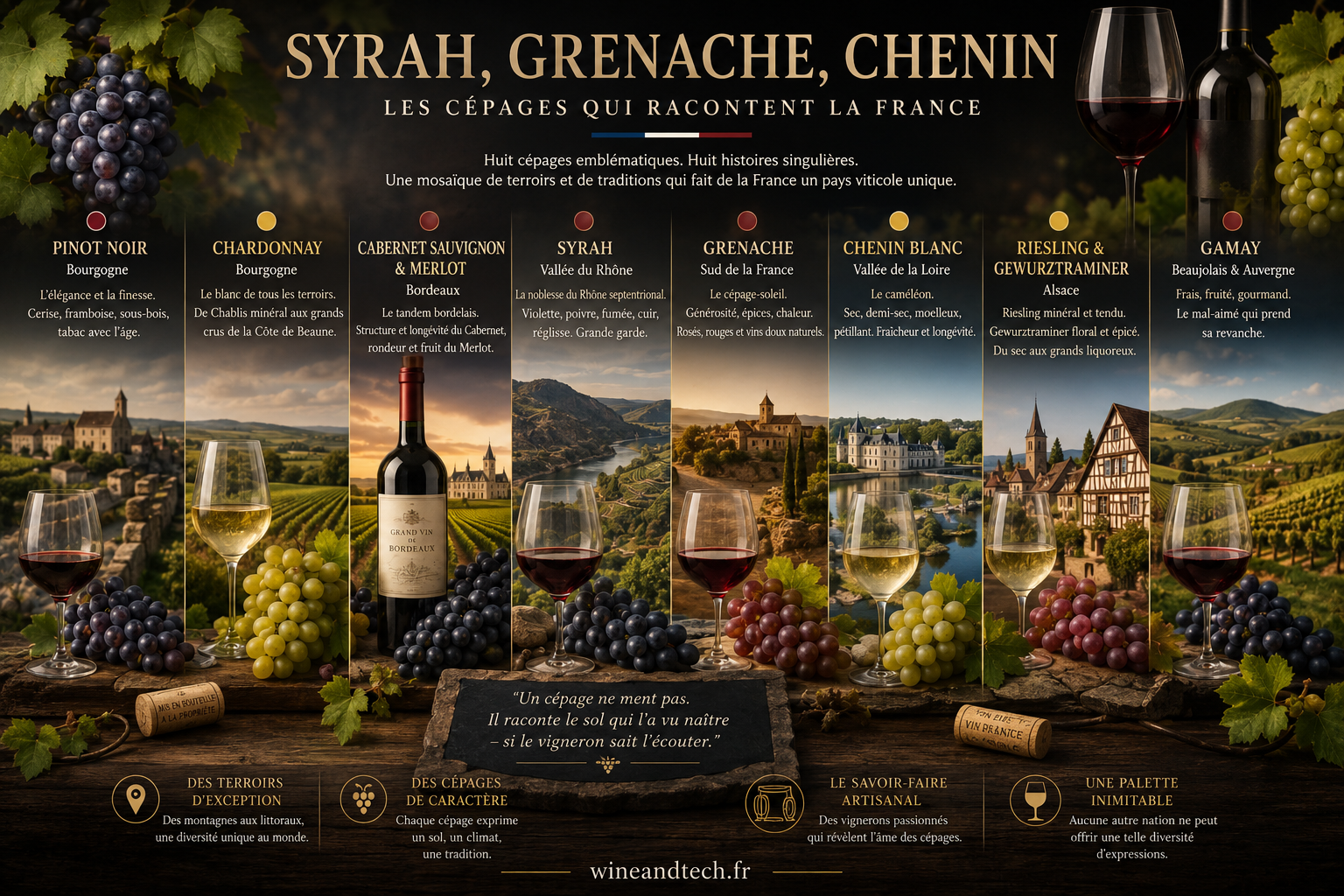
Cabernet Sauvignon is one of the most famous and widely grown red varieties in the world. Originating in the Bordeaux region of France, it’s prized for its ability to produce full-bodied, complex red wines.
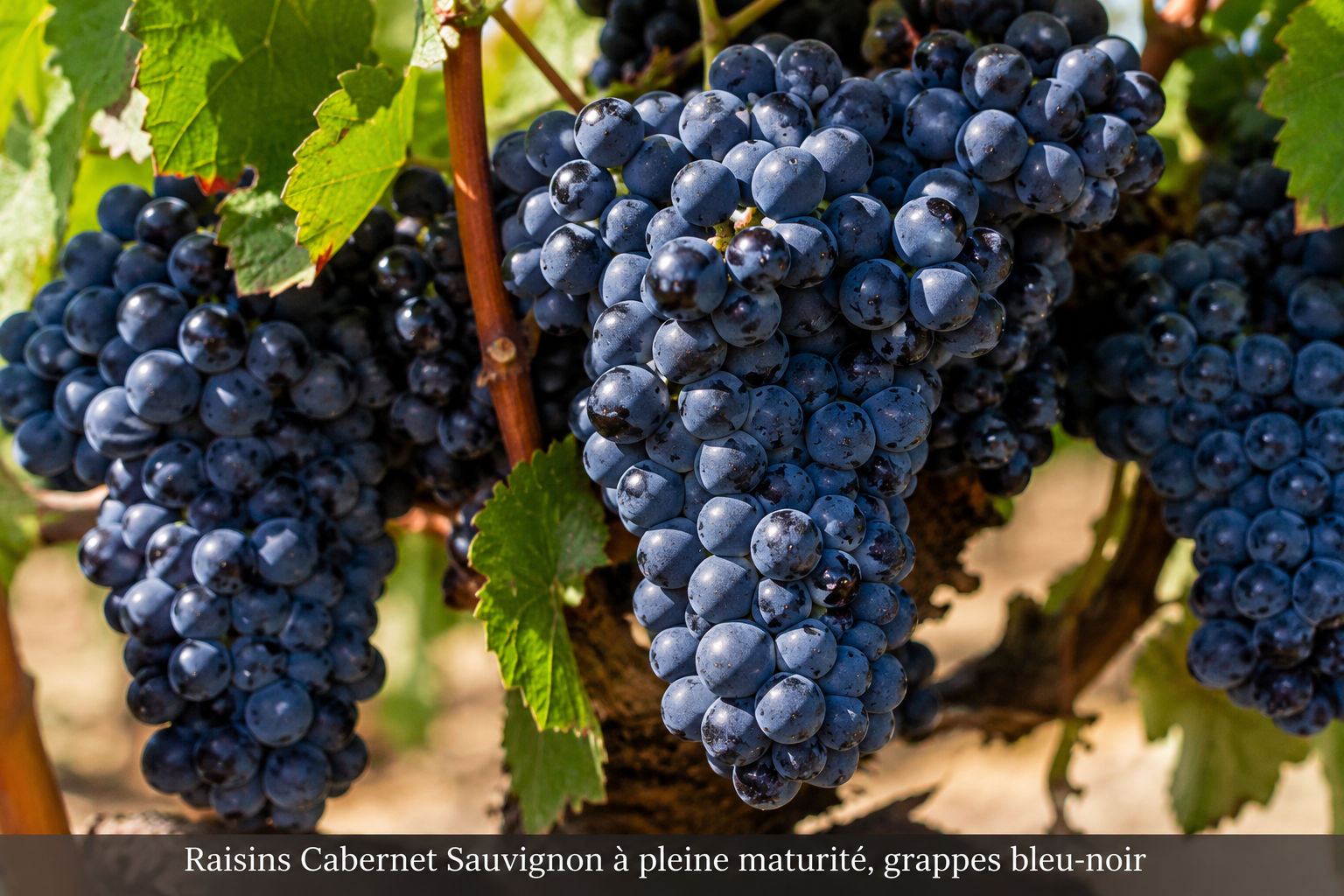
Cabernet Sauvignon grapes are characterised by their thick skin, which gives them a deep colour and a high concentration of tannins. Wines from this variety often have aromas of blackcurrant, black cherry, tobacco, mint and sometimes herbaceous notes. The pronounced tannins make Cabernet Sauvignon wines well suited to ageing in oak barrels and in bottle.
Cabernet Sauvignon is often used in blends with other varieties, notably Merlot, to create balanced wines. Outside Bordeaux, it’s widely planted in California, Australia, Chile and many other wine regions.
All in all, Cabernet Sauvignon is prized for its robust structure, its aromatic complexity and its ability to produce quality wines that can age well.
Cabernet Sauvignon arrived in France several centuries ago. It’s generally reckoned that this variety originates in the Bordeaux region, though its exact origin is open to debate. The first historical mentions of Cabernet Sauvignon go back to the 18th century in France.
The botanist Jean-Baptiste de Secondat, in his Mémoire sur la culture des vignes de Guyenne (published in 1785), mentions the vidure or bidure as a “hard vine”. But that same year, the intendant of Guyenne, Nicolas Dupré de Saint-Maur, speaks of this same variety as “petit cabernet sauvignon”. That’s the earliest known trace of the term being used.
Cabernet Sauvignon is the result of a cross between Cabernet Franc and Sauvignon Blanc, hence its name. This cross could have occurred naturally, but it’s also possible it was intentionally created by winegrowers to combine the qualities of the two varieties.
Whatever its precise origin, Cabernet Sauvignon has since won worldwide recognition for the quality of the wines it produces, and it’s now widely grown in many wine regions across the globe.
Cabernet Sauvignon is widely grown in many countries around the world thanks to its popularity and its ability to adapt to different climates and terroirs. Here are some of the countries best known for their Cabernet Sauvignon-based wines:
France: Cabernet Sauvignon is a key component of Bordeaux’s red wines, particularly in the regions of Pauillac, Margaux, Saint-Julien and Saint-Estèphe. It’s also grown in the Loire Valley region.
United States: California, and Napa Valley in particular, is famous for its high-quality Cabernet Sauvignon wines. The Sonoma and Paso Robles regions also produce excellent examples of this variety.
Australia: Cabernet Sauvignon is grown mainly in South Australia, notably in the Coonawarra region. Penfolds Grange is one of the emblematic wines of this region.
Chile: Cabernet Sauvignon is widely grown in central Chile, notably in the Maipo Valley. The country is renowned for its full-bodied, fruity Cabernet Sauvignon wines.
Argentina: The variety is grown in the Mendoza wine region, where it gives rise to powerful, expressive wines.
Italy: Though less common, Cabernet Sauvignon is grown in Italy, mainly in northern regions such as Tuscany and Friuli.
South Africa: The wine regions of Stellenbosch and Paarl in South Africa also produce quality Cabernet Sauvignon wines.
Spain: Some Spanish regions, such as Catalonia, also produce Cabernet Sauvignon-based wines.
There are several emblematic wines produced from Cabernet Sauvignon around the world. Here are the most famous:
France:
Château Lafite Rothschild (Bordeaux)
Château Margaux (Bordeaux)
Château Mouton Rothschild (Bordeaux)
Château Latour (Bordeaux)
United States:
Opus One (Napa Valley, California)
Screaming Eagle (Napa Valley, California)
Caymus Vineyards (Napa Valley, California)
Silver Oak Cellars (Napa Valley and Alexander Valley, California)
Australia:
Penfolds Grange (South Australia)
Wynns Coonawarra Estate (Coonawarra, South Australia)
Henschke Hill of Grace (Barossa Valley, South Australia)
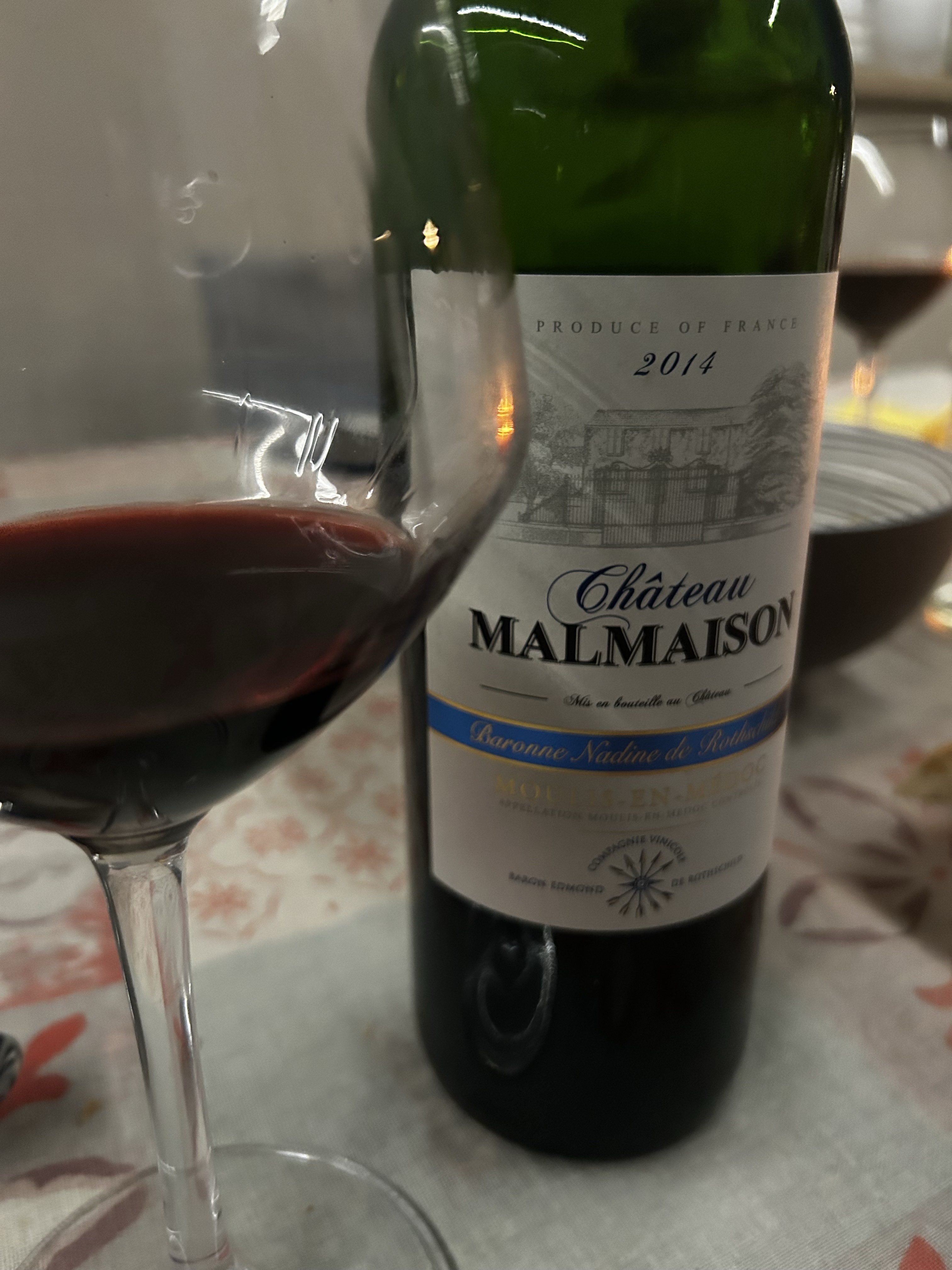
Château Malmaison is a historic wine estate whose origins go back to the 17th century. It has belonged to the Rothschild family since 1978. The vineyard covers around 30 hectares and is planted mainly with the classic Bordeaux varieties: Cabernet Sauvignon, Merlot, Cabernet Franc and Petit Verdot.
As a Moulis wine, Château Malmaison is prized for its quality and its value for money. It’s recommended to taste these wines after a few years of bottle ageing, to allow their full aromatic expression and the integration of their tannins.
“This wine came from the Baron’s wish to express his love for his wife, Baroness Nadine de Rothschild. Passionate about the art of gardens, she created here an enchanting garden in which the rose and the jacaranda play the leading roles.“
Source text – Image
We had the chance to taste the 2014 vintage.
The nose is very representative of these Moulis wines: red fruit and blackcurrant, lightly spiced over an aroma of leather. It’s beautiful, pleasant and very balanced. The nose test is a success!
The robe is elegant, a ruby red — another characteristic hallmark that announces a lovely wine.
On the palate it’s ample and generous; the tannins are powerful but respectful of the other aromas — they fill the space nicely, yet let wood and blackcurrant express themselves.
Another test passed, with great elegance.
With a length that’s a little quick and no acidity, you hurry to taste it again — but with great moderation.
This 2014 is without doubt ready to drink, but it can also stay a while longer in your cellar. At a little over €30 depending on the vintage, this wine remains exceptional, with interesting value for money.
For some time now, the Bordeaux grands crus have decided to ride the white-wine wave. Yet the market is already well stocked:
Pinot Blanc and Pinot Gris, Gewürztraminer, Chardonnay, Chablis, Sauvignon Blanc, Auxerrois, Savoie, Burgundy, Alsace, but also the Jura and Touraine — not forgetting my beloved Luxembourg Moselle. In short, you’ll have gathered that it’s hard to carve out a place among these regions and vineyards that have become expert in crafting these lighter vintages.
All the same, the Entre-Deux-Mers wines — unmissable around the Arcachon basin — had managed to stand out through their freshness. Paired with the white Graves and Pessac-Léognan, the offering is enticing:
In Pessac-Léognan, Château Haut-Brion in Graves, and Château La Mission Haut-Brion in Pessac-Léognan, as well as Château Smith Haut Lafitte, are “signature” wines of these terroirs. In the Entre-Deux-Mers region, Château de Chantegrive and Château Ferran close out this prestigious parade. But that wasn’t enough for the Bordeaux King — more was needed.
In the end, it’s to its lords of the Médoc that Bordeaux turns in order to shake up the hierarchy and bang the table!
With a bottle under €10, we start with some safe bets:
Dourthe N1 Sauvignon Blanc
This very affordable dry white is no less pleasant for it, centred on citrus.
Blanc de Maucaillou
As good in white as in red, Maucaillou delivers woody aromas with this Sauvignon Blanc and its golden-yellow robe.
BlancdeChasse-Spleen:
This “Blanc de Chasse-Spleen” is a white that leans towards the mineral and towards citrus.
At more than €20 a bottle, it’s a bold gamble, because that’s a higher price bracket which demands a quality result. There’s no doubt Chasse-Spleen is capable of it, but the competition at that price level will be relentless.
Alto, the white of Cantenac Brown
This 90% Sauvignon Blanc stands out with a distinctive golden robe. Its floral and citrus aromas are synonymous with freshness. At a price above €25, there’s no doubt that here too perfection is an obligation.
And the grands crus decide to speak up, to put Bordeaux definitively among the world’s elite of white wines
Mouton Rothschild – Aile d’Argent
“Aile d’Argent” is the second white wine of the famous Château Mouton Rothschild, one of Bordeaux’s five Premiers Grands Crus Classés. Château Mouton Rothschild is mainly known for its reds, but it has also produced this exceptional white since 1991.
“Aile d’Argent” is made from various white varieties, mainly Sauvignon Blanc and Sémillon like all the others, which come from vineyards on the Château Mouton Rothschild estate. The name “Aile d’Argent” refers to the silver wings that have adorned the Château Mouton Rothschild label since 1924.
It often offers notes of tropical fruit, citrus and white flowers, with a lovely freshness on the palate. Though less famous than Château Mouton Rothschild’s reds, “Aile d’Argent” remains an exceptional wine, at more than €120 a bottle.
Château Margaux – Pavillon Blanc
“Pavillon Blanc” is made from white varieties, mainly Sauvignon Blanc, sometimes with a small proportion of Sémillon. The grapes come from vines specially dedicated to producing this white wine on the Château Margaux estate. The winemaking is carried out with the same concern for excellence and attention to detail as for the estate’s reds.
The result is a refined, elegant and complex white, offering subtle aromas of white fruit, citrus, flowers and sometimes mineral notes. Because of its rarity and Château Margaux’s renown, “Pavillon Blanc” is highly prized by collectors and connoisseurs of fine wines; you’ll struggle to find it below €350.
Château Talbot – Caillou Blanc
“Caillou Blanc de Château Talbot” is made from white varieties, mainly Sauvignon Blanc and Sémillon, sometimes with a small proportion of Muscadelle. “Caillou Blanc” is aged in barrel on its lees with Burgundian-style bâtonnage, which gives it a distinctive quality on the palate, favouring its silkiness. You’ll need to count on at least €35 to have it in your cellar.
Blanc de Lynch-Bages
Born in 1990, “Blanc de Lynch-Bages” is the result of blending the three traditional white varieties of the Bordeaux appellation, planted on some eight plots of Lynch-Bages’s historic terroir.
These lines are taken from the link below; I’ll let you complete your reading, but you’ll need to spend at least €60 to taste it.
Château Poujeaux is a wine estate located in the Moulis-en-Médoc appellation, in the Bordeaux region of France. It’s renowned for its high-quality red wines, mainly from the Merlot, Cabernet Sauvignon, Cabernet Franc and Petit Verdot varieties.
This property has a long history going back to the 16th century, but its reputation as a wine estate was cemented over the course of the 20th century, under the management of the Theil family. Today it belongs to the Cuvelier family, who also own other great châteaux in Bordeaux.
I can already see you giving me a funny look, and I can guess your thoughts: “another Moulis!”. Naturally, my recent trip to the area gave me another chance to plunge back into this terroir that binds us by blood. So yes, another Moulis — but not just any one! A lord bearing the number 2018, showing a dark, thick red robe.
A first nose that’s woody and lightly spiced; I love it, I’m used to it, I find familiar sensations anchored in my subconscious.
With a little dance, the alcohol comes to tickle your nose — you have to be gentle with this grand gentleman.
It isn’t easy to make out the flavours, but the red fruits quickly stand out.
On the palate, the wood is omnipresent, along with spice and leather. It’s a generous, very round wine; it’s powerful, but you sense a slight restraint, a freshness that isn’t unpleasant. The length on the palate is agreeable and persistent — we’re in for a while — and you’ll note a lovely taste of caramel through the length.
Blackcurrant and raspberry broadly stand out.
A price around €30, and you can keep it another 4-5 years without any problem. It will only be better for it.
What boldness, to marry art with the ancestral — even biblical — practice of wine! And in the end, walking through these gardens, you notice a balance and a craftsmanship entirely in the image of this terroir.
This work, Lilian Bourgeat’s boots, is now an integral part of the Chasse-Spleen identity. Its incorporation into the label is the absolute recognition of that.
But the art doesn’t stop at the garden. A quick tour of the cellars and a disconcerting work intrigues us all over again. Felice Varini’s anamorphosis brings out the “Triangles” — but to make them out, you’ll have to find the ideal spot inside the cellar. Here, we’ll help you a little:
Since we’re in the cellars, let’s take the opportunity to taste a little wine.
Gressier 2015
This Moulis is fresh on the nose; the red fruit is secondary and you can sense a touch of youth. On the palate, a little acidity comes right from the start to revive your palate. I really do find it holding back — no doubt opening it earlier would have let us appreciate it better. Without any doubt, it needs a while longer in the cellar.
Chasse-Spleen 2015
The nose is very pleasant — red fruit, wood and hints of spice. No doubt about it, we’re no longer in the same dimension.
On the palate it’s round, enveloping, fresh and very balanced. The aromas detected on the nose confirm their presence without any trouble. This 2015 is already very good to discuss.
L’Héritage de Chasse-Spleen 2011
The nose is light; wood and tobacco, over a brownish-red colour.
On the palate, the red fruit is well present, and the length shifts to hand leadership back to the wood. It’s perfect to drink!
Château Chasse-Spleen is a wine estate located in the Moulis-en-Médoc appellation, in the Médoc wine region of France. It’s renowned for producing wines of great quality, mainly from Cabernet Sauvignon, Merlot and Petit Verdot.
The boots in front of the château are especially loved, but I’ll tell you about them soon 😉
The château’s name, “Chasse-Spleen”, has a poetic origin. We’ll come to it a little further down the article, but I love using the phrase “chasing away the spleen” and the idea that tasting its wines brings real joy and drives away melancholy — always in moderation, of course.
In 1820, the estate was divided in two: one half went to M. Gressier and the other to his sister, Madame Castaing, who then gave rise, in 1863, to the name Chasse-Spleen.
Two origins are put forward for the name Chasse-Spleen. The first is attributed to Charles Baudelaire, referring to his collection “Les Fleurs du Mal”, which the Bordeaux painter Odilon Redon, a neighbour of the château, illustrated.
The second would be to the credit of Lord Byron, a great wine lover who, during a visit to Chasse-Spleen in 1821, is said to have remarked that this wine had no equal for chasing away dark thoughts.
The Castaing family remained owners until 1909, when the German merchant Segnitz took over in turn; the estate was then bought in 1920 by the Lahary family, before being sold on in 1976 to Jacques Merlaut. Céline Villars-Foubet, Jacques Merlaut’s granddaughter, has run Château Chasse-Spleen since 2000. Château Chasse-Spleen has been classified Grand Cru Exceptionnel in the Moulis appellation since 1932.
The land on which Chasse-Spleen stretches today has been planted with vines for more than 400 years.
The great witnesses of that era still keep watch — and it’s hard not to notice them at the corner of the property:
In 1820, Gressier Grand Poujeaux was one of the first Crus Bourgeois of the Médoc and, up to a certain point in time, one of the jewels of the Moulis appellation. Château Gressier Grand Poujeaux always belonged to the same family, the Saint Affrique/Gressiers, from its creation until its sale to its neighbours at Chasse-Spleen in 2003.
Walking through the vines, you can in fact spot this tribute and this echo of history, thanks to the names of certain plots on the estate.
If you have the chance to taste a wine from Château Chasse-Spleen, I encourage you to do so and discover for yourself the quality and beauty of its wines.
The estate produces 5 wines:
Château Chasse-Spleen
Oratoire de Chasse-Spleen, the second wine
Héritage de Chasse-Spleen, previously called Ermitage de Chasse-Spleen, in the Haut-Médoc appellation
Blanc de Chasse-Spleen
Château Gressier Grand Poujeaux
I looked for the most complete site at competitive prices to buy this wine, and here it is here
That said, the first wine remains exceptional and of great quality, so it will be hard to find below €35 a bottle. The second wines, however — also of very great quality — start at around €15.
In a future post I’ll take you inside the cellars and we’ll taste a little wine.
“Côte-Rôtie is the balance between finesse and power, a symphony of flavours that awakens the senses.” Gérard Gauby
The French vineyards of Côte-Rôtie are nestled on the steep, narrow slopes of the hillsides on the right bank of the Rhône. The soils are mainly composed of schist and mica schist, which give the wines their distinctive character. Syrah is the main variety used in Côte-Rôtie wines, bringing deep aromas of black fruit, spice and violet. A small proportion of Viognier, a white variety, can be blended with the Syrah to add complexity and finesse to the wines.
The Côte-Rôtie appellation has no official classification system. However, the vineyards are often divided into two distinct zones: the Côte Brune to the north, where the soils are richer in iron oxide, and the Côte Blonde to the south, characterised by sandier soils.
Guigal produces a specific wine called “Brune et Blonde de Guigal” in reference to the two distinct zones of the Côte-Rôtie appellation, the Côte Brune and the Côte Blonde.
“Brune et Blonde de Guigal” is a cuvée that represents the blending of grapes from these two terroirs. It’s a wine that seeks to capture the qualities of Côte-Rôtie wines that are at once powerful and elegant.
I’d warned you in previous posts: I’m a fan of this estate, so I’m on the lookout for every good opportunity to discover all the E. Guigal wines.
Let’s talk a little about this 2019: a deep, thick robe, of a streaming red; on the nose it’s lightly spiced with a leather/tobacco blend, and you can feel it holding back, not wanting to reveal everything to us.
Softness and depth, but it doesn’t give everything away; it’s decidedly a little young, though the aromas of leather and spice are interesting. The tannins aren’t strong — they’re in balance and don’t make this wine too powerful.
A length of persistent red fruit; a very light acidity makes way for the fruit, and towards the end I think I detect a little banana.
The subtlety and complexity of this wine make it very good; it won’t leave anyone indifferent. That said, its price comfortably exceeds €50, which makes it an exceptional wine. But it’s a safe bet, and none of your friends will be left indifferent.
“The Haut-Médoc represents a safe bet in the world of wine, with its rich, full-bodied and well-balanced wines that perfectly express the region’s exceptional terroir.” – Robert Parker
Château d’Arcins is a wine estate located in the Haut-Médoc appellation, in the Bordeaux wine region of France. It’s renowned for producing quality red wines.
Château d’Arcins has a long history going back to the 18th century.
The varieties grown on the estate are mainly Cabernet Sauvignon, Merlot and Petit Verdot, which are typical of the Haut-Médoc appellation.
The wines produced by Château d’Arcins are known for their elegance and their structure. They often offer aromas of black fruit, blackcurrant and cherry, along with notes of spice and cedar from their ageing in oak barrels. Château d’Arcins wines can benefit from bottle ageing to develop more complexity and maturity.
As a Bordeaux wine estate, Château d’Arcins is subject to the region’s own regulations and classifications, such as the Haut-Médoc Appellation d’Origine Contrôlée (AOC), which guarantees the origin and quality of the wines produced in this area.
The robe is magnificent, a graduated but vivid red. A woody but light nose that comes to tickle your nose gently.
On the palate it’s long and balanced, with no acidity or aggressiveness; the red fruit isn’t dominant, but it’s present.
The length is light but persistent.
Good value for money, for a wine I’d sum up in one word: “lightness”.
But it’s also a chance for me to tell you about the “Cru Bourgeois” classification that Château d’Arcins holds.
The Crus Bourgeois classification is a separate system covering the wines of the Médoc region, in particular those not included in the official 1855 Bordeaux classification. This classification has gone through several revisions and controversies over the years. Here’s an overview of how it has evolved:
1932: The first Crus Bourgeois classification is created to identify quality wines in the Médoc region.
2003: A major revision is undertaken, but it is ultimately annulled in 2007 because of legal disputes.
2009: A new classification is introduced, with three levels: Crus Bourgeois Exceptionnels, Crus Bourgeois Supérieurs and Crus Bourgeois.
2010: The 2009 classification is annulled after a legal challenge, and the Crus Bourgeois system is reformed.
2018: A new classification is put in place, with two levels: Crus Bourgeois and Crus Bourgeois Supérieurs. The wines must meet strict quality and traceability criteria, assessed in regular tastings.
It aims to showcase talented producers and to give consumers a reliable reference for choosing quality wines at more affordable prices.
The classification is based on a rigorous selection process and on established quality criteria. Here are the main elements to bear in mind:
Application: Médoc wine properties may submit their application to be considered in the classification process. This is done through a formal request to the Alliance des Crus Bourgeois.
Quality assessment: The wines are assessed in blind tastings conducted by a panel of independent experts. The tasters take into account criteria such as balance, structure, aromatic expression and regional typicity.
Classification decision: The wines are ranked in two distinct categories:
Crus Bourgeois: Properties that meet the established quality criteria are permitted to use the term “Crus Bourgeois” on their labels.
Crus Bourgeois Supérieurs: Among the Crus Bourgeois, a subgroup of properties that stand out still further in terms of quality is raised to the status of “Crus Bourgeois Supérieurs”.
Validity and reassessment: The Crus Bourgeois classification is granted for a period of five years. At the end of that period, properties must submit their wine for a new assessment to maintain or improve their classification status.
The Crus Bourgeois classification is overseen by the Alliance des Crus Bourgeois, which is responsible for organising the selection process, managing the quality criteria and promoting the Crus Bourgeois to consumers.