WineAndTech’

Author: Jean-Sébastien LASSERE

  • Vivino and the Battle of the Rating Apps — Who Really Owns Wine Data?

    Vivino and the Battle of the Rating Apps — Who Really Owns Wine Data?

    ⏱️ Reading time: 7 minutes

    There’s something strange about pulling out your phone in front of a bottle of wine. A trivial gesture for sixty million users — and yet it raises a question few people put into words: who, ultimately, owns the opinion you’ve just left?

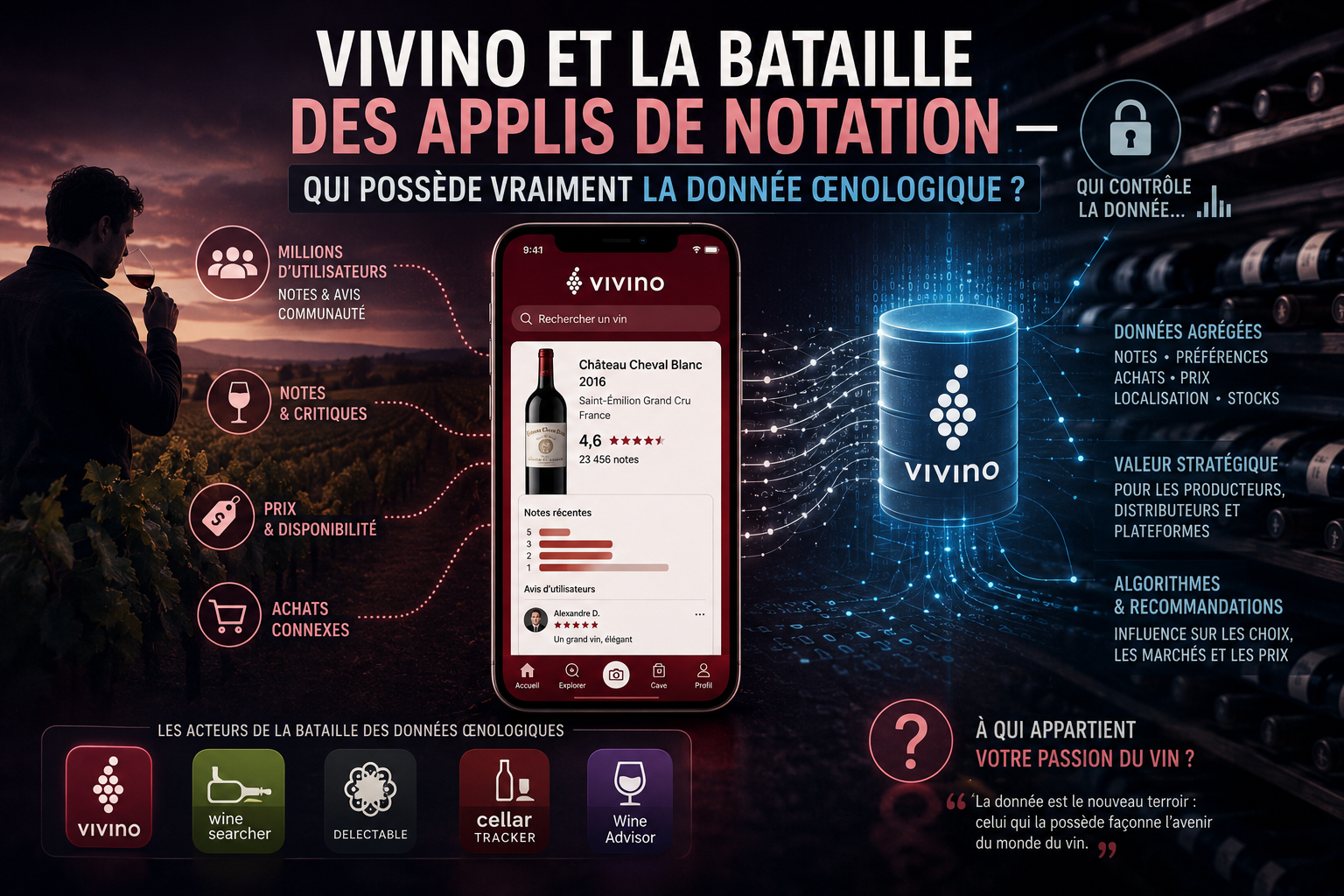
    We’ve grown used to scanning labels, rating wines between two mouthfuls, following the recommendations of an algorithm that knows us better than our wine merchant. Vivino has slipped into our evenings with remarkable discretion, to the point of becoming an invisible infrastructure of taste. Behind that simplicity, however, lies a more complex reality: a silent battle for ownership of the world’s wine data. Who rates, who collects, who monetises, who decides? The question isn’t only economic. It touches on what we take to be expertise, trust, and the memory of wine.

    A DANE WHO KNEW NOTHING ABOUT WINE BUILT THE WORLD’S LARGEST WINE DATABASE

    The empire of the scan

    Heini Zachariassen didn’t understand wine. A Faroese entrepreneur who came from cybersecurity, he often recounts that founding moment: finding himself lost in front of a supermarket shelf, unable to choose between one elegant label and another. “I didn’t know what to buy. There were only sophisticated labels and prices.” In 2010, with Theis Søndergaard, he co-founded Vivino in Copenhagen. The idea fits in one line: photograph a label to instantly get reviews from the community. A Shazam for wine.

    Screenshot of the Vivino app's label-scanning interface
    The gesture that became universal: scanning before choosing.

    Fourteen years later, the app boasts more than 60 million downloads, a database of 16 million wines catalogued, 200 million ratings and 1.5 billion label photos collected by its users. Vivino is today regarded as the largest online wine marketplace in the world — and the largest wine database ever built, fed free of charge by its own community. The company has raised more than $220 million in venture capital, including $155 million in a round led by the Swedish fund Kinnevik in 2021.

    “No one else can do what we do, because no one else has access to the kind of data we own.”

    Heini Zachariassen, founder of Vivino, at the opening of the first physical shop in Singapore, September 2024

    YOU ARE THE USER, THE COMMUNITY — AND THE RAW MATERIAL

    The question no one asks

    Close-up of wine bottle labels lined up on a shelf
    © Unsplash — Behind every scanned label, a data point joins a proprietary database.

    Every rating you leave, every bottle you scan, every preference you express: all of it feeds a proprietary database, owned by a private company, financed by venture capital. You are at once the customer, the contributor and the resource. This isn’t a criticism in itself — Wikipedia runs on a comparable model. But the essential difference is that Vivino monetises that contribution.

    The recommendation algorithm, the “Match for You” feature that calculates your personal affinity with a wine based on your tasting history, the recently launched AI Sommelier — everything rests on the data users have generated without pay. In 2024, Vivino opened its first physical shop in Singapore, whose selection was built entirely from the behavioural data of its local users. As Zachariassen himself puts it: “No one else can do that.”

    The question of data ownership becomes even sharper for winemakers. A producer can find themselves rated by thousands of users without having been consulted, with no access to those aggregated ratings, and with no lever to influence their score — other than persuading their buyers to download the app and leave a good review. On wineandtech.fr, we’ve already explored how blockchain can give traceability and power back to producers — participatory rating poses a symmetrical but opposite problem: here it’s the consumption data that slips away from those who make the wine.

    “If a wine drops below 4 stars on Vivino, people no longer give it a chance. It doesn’t matter what your reference guide or your wine merchant says.”

    A French importer, in Bordeaux trade circles

    THE CROWD VERSUS THE EXPERT: A BATTLE REDRAWING AUTHORITY IN THE WINE WORLD

    Two hundred million ratings against five recognised palates

    Traditional wine criticism rests on an aristocratic model: a handful of palates trained over decades define what deserves to be drunk. Robert Parker, Wine Spectator, Jancis Robinson, Decanter — these institutions rate perhaps 20,000 to 30,000 wines a year. Vivino handles two million scans a day. The argument of scale is real. A Polish Riesling or an emerging English wine can rack up hundreds of ratings on Vivino before a specialist critic has ever gone near them.

    Professional wine tasting, glasses lined up on a white table
    © Unsplash — Professional tasting versus the verdict of the connected crowd.

    But the system’s limits are just as real. A Vivino rating carries the same weight from the palate of a beginner who has only ever drunk sweet wines as from that of a seasoned enthusiast who has been tasting for twenty years. The algorithm favours immediately pleasing wines — round, accessible, generous with fruit — at the expense of wines built to age, often austere in their youth and revealing their greatness after ten years in the cellar. A Barolo or a Chablis premier cru will be mechanically penalised if opened too early. It’s a structural bias that the crowd, by its very nature, cannot correct.

    VIVINO, CELLARTRACKER, WINE-SEARCHER: THREE PHILOSOPHIES OF DATA, THREE VISIONS OF WINE

    The ecosystem of challengers

    Wine cellar with digital inventory-management tablets
    © Unsplash — Managing your cellar also means choosing who to entrust your data to.

    CellarTracker, founded in 2003, is built on a radically different philosophy. Detailed technical notes, contributions from serious collectors, vintage sheets documented over decades — it’s the Wikipedia of wine, deep rather than broad. Its quasi-collaborative model keeps the data accessible to the community without monetising it in the same way. Wine-Searcher plays yet another tune: a global price engine, it covers nine million wines and their availability at thousands of merchants. The data here isn’t affective, it’s transactional.

    Delectable, bought by critic Antonio Galloni’s Vinous group, bets on the quality of its notes rather than their quantity, with a community of recognised sommeliers and critics. In France, apps such as Wine Advisor (E.Leclerc) or Raisin (a natural-wine specialist) seek their niches from angles Vivino doesn’t cover. Each of these players aspires to become the infrastructure layer of the wine decision — but none yet has Vivino’s critical mass.

    The advantage is self-reinforcing: the more users, the more precise the database; the more precise the database, the more users it attracts. It’s what platform economists call a data moat — a near-impassable moat of data. With 2 million daily scans, Vivino is fifty times bigger than its nearest competitor in this segment, according to Zachariassen himself.

    THE ARTIFICIAL SOMMELIER WON’T REPLACE THE WINEMAKER — BUT IT HAS ALREADY CHANGED THE BUYER

    AI moves into the cellar

    Vivino recently launched its AI Sommelier — a conversational assistant that knows your scan history, your ratings, your preferences, and answers questions in natural language. It knows you’ve liked three Burgundy Pinot Noirs and that a heavily dosed Champagne doesn’t win you over. On the iPhone 16, integration with Apple Visual Intelligence even lets you scan a label directly via the Camera Control button, without opening the app — with Vivino’s data working in the background.

    Artificial-intelligence interface on a smartphone applied to wine
    © Unsplash — The AI sommelier: your palate digitised, in the service of a proprietary algorithm.

    This shift isn’t neutral. It means that the wine data you produce — your tastes, your purchases, your personal palate — is now a commercial asset of the first importance, refined in real time by artificial intelligence. In our article on drones and AI in viticulture, we explored how technology is transforming the production side of wine; Vivino is carrying out the same transformation on the consumption side, with the same instrument — data — but in very different hands.

    Vivino has undeniably democratised access to information about wine. It has given a voice to millions of enthusiasts who didn’t have one, shone a light on regions ignored by the specialist press, and made choosing a bottle less intimidating. But by consolidating that information into a proprietary architecture, it has also centralised a power that was once diffuse: the power to decide what deserves to be drunk — and what doesn’t.

    Do you use Vivino or another app to choose your wines? Do you still trust your own palate — or have you delegated that decision to your phone? Share your experience in the comments.

    Sources: Wikipedia — Vivino · A+ Singapore — Interview with Heini Zachariassen (2024) · Locals Insider — Vivino App Review (2026) · The Drinks Business — Vivino and the future of wine retail · InVintory — Best Wine Apps 2026 · Petit Vin Entre Copains — Wine-rating apps compared · SommelierX — Alternatives to Vivino (2026)

  • The AI Sommelier: Can You Recommend the Right Wine Without a Palate?

    The AI Sommelier: Can You Recommend the Right Wine Without a Palate?

    ⏱️ Reading time: 7 minutes

    Thirty percent of French people say they have already consulted an artificial intelligence to choose a wine or a spirit. Among 18-to-25-year-olds, the figure climbs to 58%. That number, drawn from the latest SOWINE/Dynata barometer, marks a turning point: for the first time, the machine has officially invited itself into the French drinker’s purchase journey. We ask it for a pairing for tonight’s dinner, an opinion on a bottle received as a gift, an idea for breaking out of our habits. And it answers — quickly, politely, with disarming self-assurance.

    One question, however, hangs in the air — one the surrounding enthusiasm carefully avoids: what, exactly, is that recommendation based on? When a sommelier advises you on a wine, they draw on years of tastings, of aromas, of memory. The AI, for its part, has never tasted anything. Can you really recommend the right wine without a palate?

    THREE WAYS TO ADVISE ON A WINE WITHOUT HAVING DRUNK A DROP

    Behind the “AI sommelier,” three engines

    The most widespread recommendation engine doesn’t analyse the wine: it analyses the drinkers. This is collaborative filtering — Vivino’s method, borrowed from Netflix and Amazon. Its principle fits in a single sentence: people who liked the same wines as you also liked this one. The suggestion is born of a statistical correlation between millions of ratings, not of any understanding of the liquid. Effective at guessing what will please you, blind to what is actually in the glass.

    A second family reasons about the wine itself — or rather about its technical sheet. Apps such as WineRing or the iAlacarte sommelier match an aromatic profile (tannic structure, acidity, residual sugar, intensity) against that of a dish (cooking method, sauce, garnish). It’s the classic logic of food-and-wine pairing, encoded in a database. Finer than collaborative filtering, it still depends on descriptors entered, upstream, by humans.

    The third family, the most recent and the most spectacular, rests on large language models. Queried in natural language — “I’ve got a duck breast with cherries and three bottles in my cellar, what would you suggest?” — the model produces a reasoned, often startling answer. But all it does is reassemble, on the fly, what thousands of tasters have written on the web. It compiles; it does not experiment.

    These three approaches share one blind spot. None of them tastes. They predict from proxies — co-occurrences of ratings, sheets of descriptors, scraped text. Wine, as a sensory object, remains strictly inaccessible to them. And that is precisely where the science of the palate becomes illuminating.

    THE PALATE ISN’T IN THE MOUTH — IT’S IN THE BRAIN

    What brain imaging reveals about the sommelier

    In 2005, a team published in NeuroImage the first functional magnetic resonance imaging study devoted to sommeliers. Seven experts, seven novices, the same wine. The result: in the experts, tasting activates a particular network — the left insula and the orbitofrontal cortex, two regions dedicated to integrating taste and smell. The researchers’ conclusion is counter-intuitive: that difference reflects not finer taste buds, but a learned ability to connect sensations to memory.

    The studies that followed confirm and refine this. In 2014, a Besançon team (Pazart et al.) showed that the expert reacts more immediately and more “economically” than the novice, drawing heavily on memory structures — the hippocampus, the temporal pole. Where the beginner gropes through diffuse associative areas, the professional evaluates the wine and recognises its type in a single movement. In 2016, a study of Master Sommeliers observed a reinforced memory network; in 2024, researchers at the Basque Center on Cognition measured, in sommeliers, more intact white matter in the tracts linking perception, memory and language. Training, quite literally, reshapes the brain.

    Taste isn’t on the plate; it is built inside our heads.

    Gabriel Lepousez, neurobiologist at the Institut Pasteur

    For this specialist in sensory perception, tasting is an operation of formidable complexity: the brain must rank information arriving through the eyes, through the nose (directly and by retronasal olfaction), through the mouth and through touch, synthesise it, compare it against memory, then translate it into words. One detail illuminates all the rest: sight alone occupies 15 to 17% of the cortex, against barely 1% for smell. Faced with uncertainty between an odour and a colour, the brain almost always rules in favour of what it sees.

    The human expert, fallible by design

    This primacy of the brain has a flip side: it makes perception manipulable. The most famous experiment is that of Frédéric Brochet, Gil Morrot and Denis Dubourdieu, conducted in Bordeaux in 2001. Fifty-four oenology students were given a white wine to taste, then the same white wine dyed red with a neutral colourant. The verdict: the students described the second using the vocabulary of red wines — black fruit, tannins — as if the colour had rewritten their sense of smell.

    A second experiment by the same researcher is just as cruel: a single Bordeaux, presented two weeks apart under the label “table wine” and then “grand cru,” drew radically opposite judgements. In other words, even the most seasoned taster remains subject to expectation, context and price. Their strength — a brain that integrates everything — is also their weakness.

    SOMMELLERIE: AUGMENTED OR REPLACED?

    What the machine gets right — genuinely

    Against this backdrop, the AI has real strengths it would be dishonest to brush aside. First, it democratises: a sommelier’s advice is expensive and intimidating; an assistant available around the clock, free in its basic versions, lifts that barrier. Next, on everyday food-and-wine pairing, reasoning by aromatic profile is solid — it applies, without faltering, principles the average drinker doesn’t know. Finally, in a twist of irony, the AI escapes Brochet’s traps: neither colour, nor label, nor price throws off a machine that sees nothing. But that is precisely because it perceives nothing at all.

    What it will not do

    For that is where its competence ends. The AI will not taste the bottle opened in front of you: it cannot tell you that it’s corked, that it cooked in a car boot over the summer, that it’s going through a dumb phase. It reasons about an abstract, average, statistical wine — never about the real wine in the glass. It doesn’t read the table, doesn’t sense that a guest would rather avoid red or that the mood calls instead for something sparkling. And when it promises to choose a wine “to match your mood,” that is where it is most helpless: pairing to a dish can be encoded; pairing to a state of mind remains, for now, pure marketing.

    A librarian, not a taster

    Perhaps we’re simply reaching for the wrong metaphor. The AI sommelier is not a sommelier: it is a librarian of wine, prodigious at retrieving, cross-referencing and serving up information scattered across millions of bottles and reviews. On that ground — “what is a Crozes-Hermitage?”, “is this Pomerol any good?”, “which red with an osso buco?” — it renders a real and democratic service. But recommending the right wine remains, in an irreducible part, an act of embodied sensory memory that the machine cannot perform. The SOWINE barometer puts it in its own way: AI enters the picture not as a substitute, but as a new tool for guidance. The palate, meanwhile, stays between the two ears.

    Would you trust an AI to choose the wine for your next dinner — or do you keep the final word? Tell us in the comments, and find our by-the-glass tastings on Instagram @wineandtech.

    Sources: SOWINE/Dynata Barometer 2026 · Castriota-Scanderbeg et al., NeuroImage, 2005 · Pazart et al., Frontiers in Behavioral Neuroscience, 2014 · Banks et al., Frontiers in Human Neuroscience, 2016 · Basque Center on Cognition, Human Brain Mapping, 2024 · Morrot, Brochet & Dubourdieu, “The Color of Odors,” Brain and Language, 2001 · Gabriel Lepousez, Institut Pasteur (interviews in Le Figaro and Le Rouge & Le Blanc).

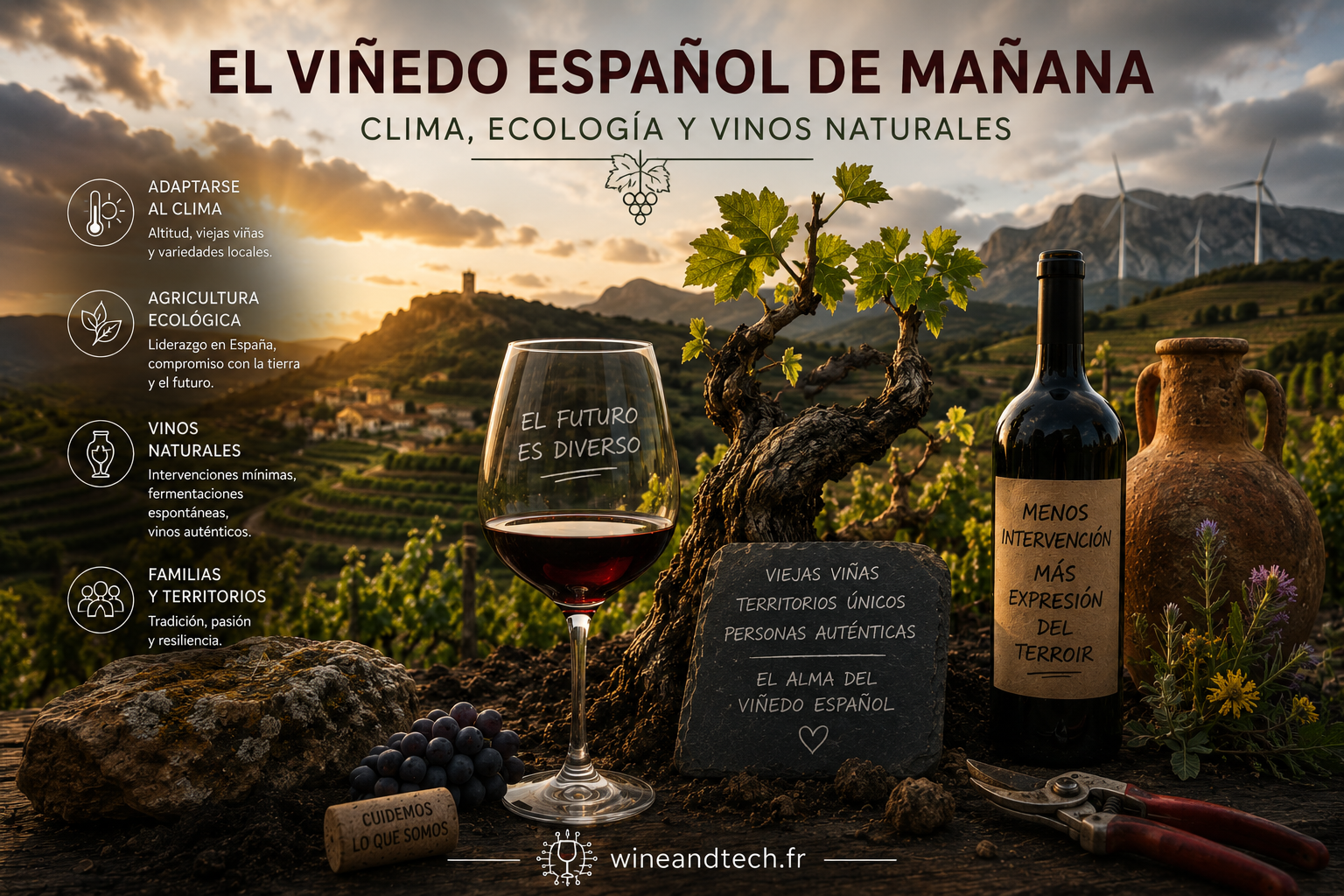
  • The Spanish vineyard of tomorrow: climate change, organic farming and natural wine

    The Spanish vineyard of tomorrow: climate change, organic farming and natural wine

    🇬🇧 Series · The Vinous Trinity · Article 15/15 · Spain · ⏱ 5 min

    Three countries, fifteen articles, a series that ends. What Spain will have brought to The Vinous Trinity: a lesson on old vines, families holding on, terroirs once written off that are now revealing themselves. And now, a question: where is the Spanish vineyard heading?

    🇰 What we take away

    Spain has a reputation for being a vineyard easy to summarise. Rioja, Tempranillo, Albariño: three names will do, apparently.

    This series will have shown otherwise. Spain is the country where you can still find century-old ungrafted vines on volcanic or granite terroirs that nobody knew twenty years ago. The country where families have defended for four or five generations varieties the rest of the world has forgotten. The country where the most interesting viticultural work is often done without a budget, in regions that still have no international name.

    Priorat, Ribeira Sacra, Sierra de Gredos, the Canary Islands, Txakoli: places that did not appear on the world wine map thirty years ago and which now hold a recognised position on it.

    🌡️ Climate change: Europe’s most acute challenge

    Spain is among the European countries most exposed to the effects of climate warming. This is not an opinion: scientific projections show an intensification of heat episodes, drought and water stress across the Iberian Peninsula. In certain very hot areas of La Mancha, the Levant or Extremadura, high ripeness levels can lead to naturally very elevated alcohol content. Drought and increasing aridification are advancing across several regions of the Centre and South, adding pressure on water resources.

    Spain’s response runs through altitude. Sierra de Gredos, where some old Garnacha vines are cultivated between 800 and 1,200 metres. Producers are also seeking solutions in forgotten local varieties: varieties selected and cultivated for centuries in demanding environments can represent a valuable resource for adaptation, particularly when they ripen late or show good tolerance to water stress.

    Galicia, wetter and more Atlantic, still benefits from a climate that allows it to retain a certain freshness. But warming is already shifting the balances: Albariño more easily reaches higher ripeness levels and water management is becoming a topic there too. The Rías Baixas season is lengthening; Albariño is gaining in maturity.

    🌿 Organic farming: Spain in the lead

    Spain is by far Europe’s largest organic vineyard by surface area. In 2023, around 166,000 hectares of vines were managed organically, representing roughly one fifth of the national vineyard.

    This figure deserves nuance. It covers very different realities: between a small family estate with a longstanding ecological commitment and a large structure certified to meet market demand, the motivations and practices can vary considerably.

    The gap between an artisan producer in the Sierra de Gredos and a large certified organic cooperative in Extremadura is significant.

    But the underlying trend is real. A new generation of family wineries is explicitly choosing organic or biodynamic conversion as both philosophy and identity.

    🍷 Natural wine in Spain: a movement taking shape

    The natural wine movement was slow to take hold in Spain. Spanish wine culture was traditionally oriented toward stabilised, technical wines designed to withstand transport and storage.

    The 2000-2010 generation changed that. Producers such as Comando G in Gredos, Partida Creus in Catalonia or Envínate in the Canary Islands and Galicia helped popularise a low-intervention winemaking approach: spontaneous fermentations, reduced use of sulphur and limited cellar inputs.

    These wines quickly found an audience among specialist wine merchants, sommeliers and importers internationally, before gradually gaining visibility on the Spanish market itself.


    What the series will have shown, and what remains

    A vineyard that had not yet said its last word. Terroirs once thought exhausted that are finding their purpose again. Families transmitting against all odds.

    The future of the Spanish vineyard will not be built from Madrid. It will be built in the Sierra de Gredos, in the gorges of Ribeira Sacra, on the volcanic slopes of the Canary Islands, in the Galician granite. Where nobody expected much.

    The end of The Vinous Trinity. Thank you for following along.

    Tradition can be a starting point. Modernity, a way of continuing it.

  • Chardonnay: The White Gold of Wine. How Did It Become the Most Planted White Grape in the World?

    Chardonnay: The White Gold of Wine. How Did It Become the Most Planted White Grape in the World?

    📚 Grape Varieties of the World · Episode 2  |  ⏱ Reading time: 7 minutes

    For this second episode of our Grape Varieties of the World series, we dive into the story of a chameleon grape that became the undisputed ambassador of the world’s white wines.


    A Burgundian Birth, A Global Destiny

    Contrary to a persistent misconception, Chardonnay does not take its name from a winemaker or an imaginary appellation. It comes from a very real village: Chardonnay, a small town in Saône-et-Loire, in the heart of southern Burgundy, not far from Mâcon. It was there, in all likelihood, that the variety first flourished, centuries before conquering the world.

    The Cistercian monks of the Abbey of Cîteaux, great land-clearers and winemakers of genius, played a major role in selecting, spreading and understanding Burgundy’s finest terroirs as early as the Middle Ages. Their obsession with observing each terroir — plot by plot, vintage after vintage — helped shape the culture of Burgundian climats that remains unique in the world.

    🔬 The Science Behind the Grape

    In 1999, the same team of geneticists at the University of California, Davis, that had revealed the parentage of Cabernet Sauvignon three years earlier — led by Carole Meredith — demonstrated through DNA analysis that Chardonnay is a natural cross between Pinot Noir and Gouais Blanc, an old Central European variety now almost extinct. The discovery upended ampelography: researchers soon realised that this same cross had produced more than eighty identified descendants to date, including Gamay, Aligoté and Melon de Bourgogne. Chardonnay, then, is not an only child, but the eldest of an enormous family.

    From Chablis to California: Four Faces of a Single Grape

    Chardonnay has a rare characteristic: its natural aromatic profile is almost neutral. Where Riesling or Muscat assert themselves immediately through powerful varietal notes, Chardonnay plays the role of a terroir revealer. It is precisely this discretion that makes it such an exceptionally faithful interpreter.

    Four major expressions illustrate the full range of its register:

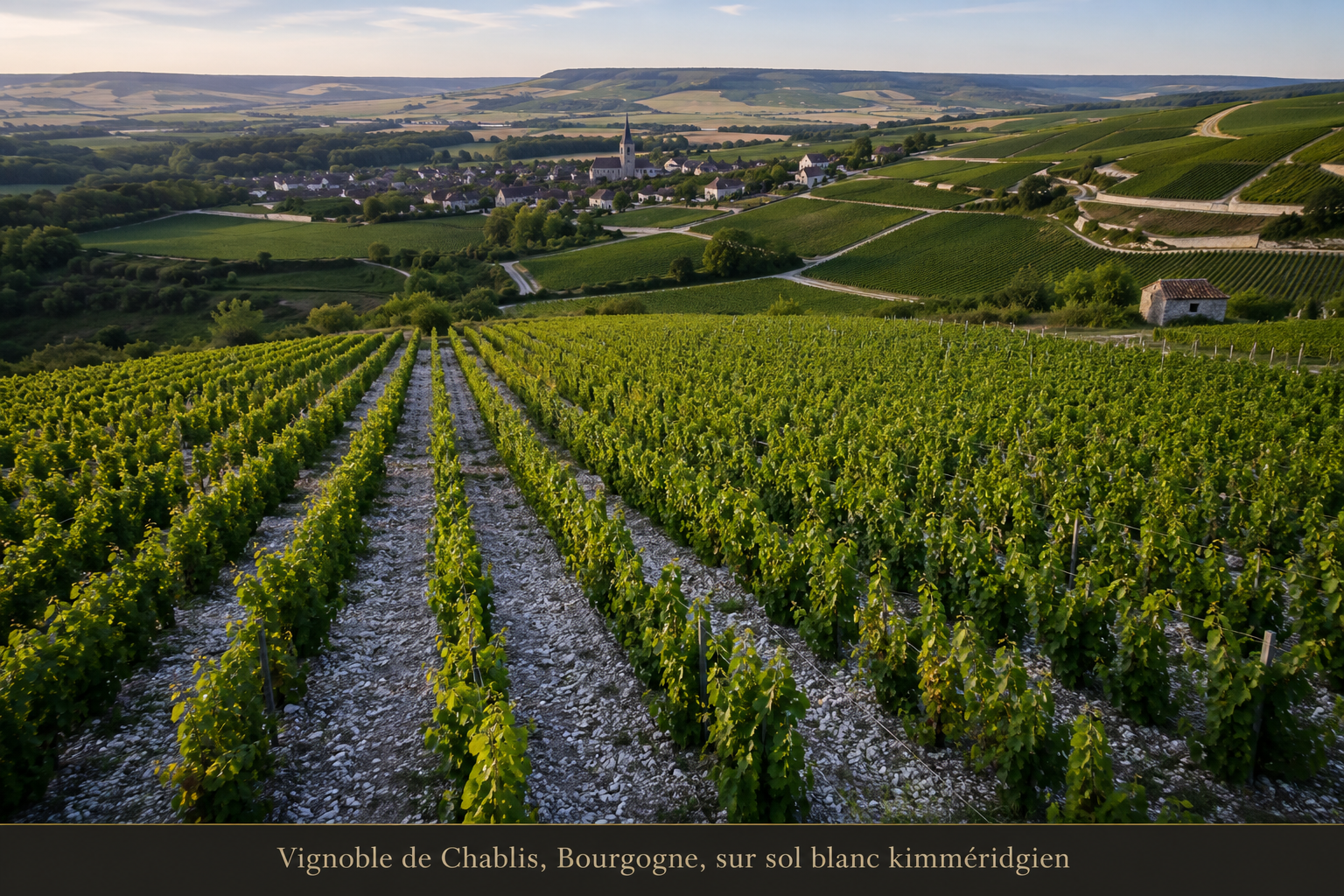
    • 🇫🇷 Chablis, Burgundy — Kimmeridgian soils (Jurassic marine limestone), stainless-steel ageing, wines of razor-sharp minerality, remarkable acid tension, notes of oyster shell and flint. Chardonnay in its most stripped-back and, at the same time, most powerful form
    • 🇫🇷 Côte de Beaune, Burgundy (Meursault, Puligny-Montrachet, Chassagne-Montrachet) — barrel ageing, fermentation and lees ageing, partial or full malolactic conversion, complex wines blending white orchard fruit, butter, hazelnut, honey and minerality. The most accomplished expression of Burgundian Chardonnay
    • 🇫🇷 Champagne — the king grape of Blanc de Blancs, bringing lightness, freshness and finesse to sparkling wine. The great prestige cuvées (Salon, Krug’s Blanc de Blancs, Jacques Selosse) reveal its capacity to age with exceptional grace
    • 🇺🇸 California (Sonoma, Santa Barbara, Carneros) — intensive oak ageing, full malolactic conversion, generous, opulent wines with notes of vanilla, melted butter and tropical fruit. A style that conquered the world in the 1980s and 1990s before diversifying toward greater freshness

    The Wines That Built Its Legend

    A few essential references that established Chardonnay as the world’s leading white grape variety:

    • 🇫🇷 Le Montrachet, Grand Cru, produced notably by Domaine Leflaive, Domaine de la Romanée-Conti, Lafon and Ramonet. A grand cru shared between Puligny and Chassagne, of staggering complexity and longevity
    • 🇫🇷 Chablis Grand Cru Les Clos, the ultimate expression of Chablis, age-worthy wines that can evolve for twenty years or more, perfect witnesses to the Kimmeridgian terroir
    • 🇫🇷 Salon Blanc de Blancs (Le Mesnil-sur-Oger) — one of the most exclusive Champagnes in the world, produced only in the best years, 100% Chardonnay from the Côte des Blancs
    • 🇺🇸 Kistler Cuvée Cathleen (Sonoma) — the Californian benchmark, aged in Burgundian barrels, a complexity and tension once thought impossible in this climate
    • 🇦🇺 Leeuwin Estate Art Series (Margaret River) — proof that Australia can rival the world’s greatest Chardonnays

    A Chameleon Style: The Art of Winemaking

    What makes Chardonnay unique among the great white grape varieties is the sheer range of winemaking choices available to the winemaker. Every decision made in the cellar radically transforms the wine’s profile.

    Malolactic fermentation — which converts sharp malic acid into softer lactic acid — brings the creamy, buttery texture characteristic of great Meursaults. Lees ageing with regular bâtonnage (lees stirring) adds roundness and complexity. New oak barrels, depending on their toast level and origin (Allier, Vosges, Tronçais), impart notes of vanilla, toast and spice. Depending on the length of ageing and the proportion of new oak used, the barrel progressively contributes notes of vanilla, roasted hazelnut, brioche or toasted bread. By contrast, stainless-steel tanks preserve the minerality and tension of Chablis.

    This duality — minerality vs opulence, steel vs oak, tension vs roundness — lies at the heart of Chardonnay’s identity and its ability to win over very different audiences.

    🍷 Classic Tasting Note

    💃 Colour: Pale to golden yellow, green highlights in youth, amber gold with age
    👃 Nose: Green apple, pear, citrus (fresh style) · butter, hazelnut, vanilla, white-fleshed fruit (oaked style) · flint, chalk, iodine (mineral style)
    👄 Palate: Acidity varies by terroir, texture often broad and silky, long finish on fruit or minerality
    🍽️ Food pairing: Fish in sauce, shellfish, roast poultry, soft cheeses (Brie, Camembert), risotto, lobster, scallops

    Chardonnay and Climate Change

    Chardonnay is one of the white grape varieties most affected by global warming, precisely because it is among the earliest to bud in spring. This early budding, which once allowed it to reach ripeness in cool-climate regions, now makes it particularly vulnerable to late spring frosts — as painfully illustrated by the devastating frosts of 2016 and 2021 in Burgundy and Chablis.

    In addition, increasingly early harvests are reducing the wine’s natural acidity — a central element of its identity — while raising alcohol levels. To address this, winemakers are adapting their practices: cover cropping between rows to slow vine growth, night harvesting to preserve freshness, controlled irrigation in the driest regions.

    Paradoxically, climate change is also opening up new geographical opportunities. Chardonnay is now producing remarkable wines in southern England, Denmark, Sweden and the high-altitude vineyards of Argentina’s Jura region or the Chilean Andes — regions that, twenty years ago, would not have allowed sufficient ripening. Today’s climate conditions in southern England increasingly resemble those Champagne offered several decades ago, favouring the production of great Chardonnay-based sparkling wines.

    Why It Remains Essential

    Neutral without being characterless, malleable without lacking personality, Chardonnay possesses a rare quality: it knows how to set its own ego aside and let the terroir speak. It is precisely this transparency that has made it the reference white grape variety for winemakers around the world. Where other varieties impose their own aromatic personality, Chardonnay holds up a faithful mirror to the land, the climate, and the hands that shape it.

    It remains today the most widely planted quality white grape variety in the world, covering more than 200,000 hectares across some fifty countries. Its presence across the three most highly valued wine styles — great age-worthy whites, prestige Champagnes, and blended wines — gives it a versatility that no other white grape variety has yet managed to match.

    From Chablis to Margaret River, by way of the hills of Champagne and the slopes of Sonoma, Chardonnay continues to write, vintage after vintage, the story of a grape that turned its own discretion into an extraordinary capacity for expression.

    Did you know?
    Despite its reputation as a “neutral” grape, Chardonnay is probably the white variety that most faithfully reveals differences in terroir and winemaking. The very same clone can produce a razor-sharp Chablis, a rich, unctuous Meursault, or a Champagne of great finesse — all without ever losing its identity.

    📌 Key Takeaways

    • Born in the village of Chardonnay, Saône-et-Loire, spread by Cistercian monks as early as the Middle Ages
    • A natural cross of Pinot Noir × Gouais Blanc — confirmed by DNA analysis in 1999 (UC Davis)
    • The world’s #1 white grape variety by planted area — more than 200,000 hectares across 50 countries
    • 4 major expressions: Chablis · Côte de Beaune · Champagne · California
    • Winemaking choices (oak, malolactic fermentation, lees ageing) radically transform the wine’s profile
    • Vulnerable to early spring frosts — evolving in the face of climate change

    ➡️ Next Episode — 1st October

    It is often said to be the most thankless grape to grow and the most rewarding to drink. Capricious, demanding, hypersensitive to terroir and climate, it nonetheless gives rise to some of the most enigmatic and sought-after wines in the world. In Burgundy as in Oregon, in New Zealand as in Germany, it speaks of a precise place with an eloquence that few grape varieties can claim.

    Next up: Pinot Noir — why does the world’s most difficult grape variety fascinate winemakers and wine lovers alike?

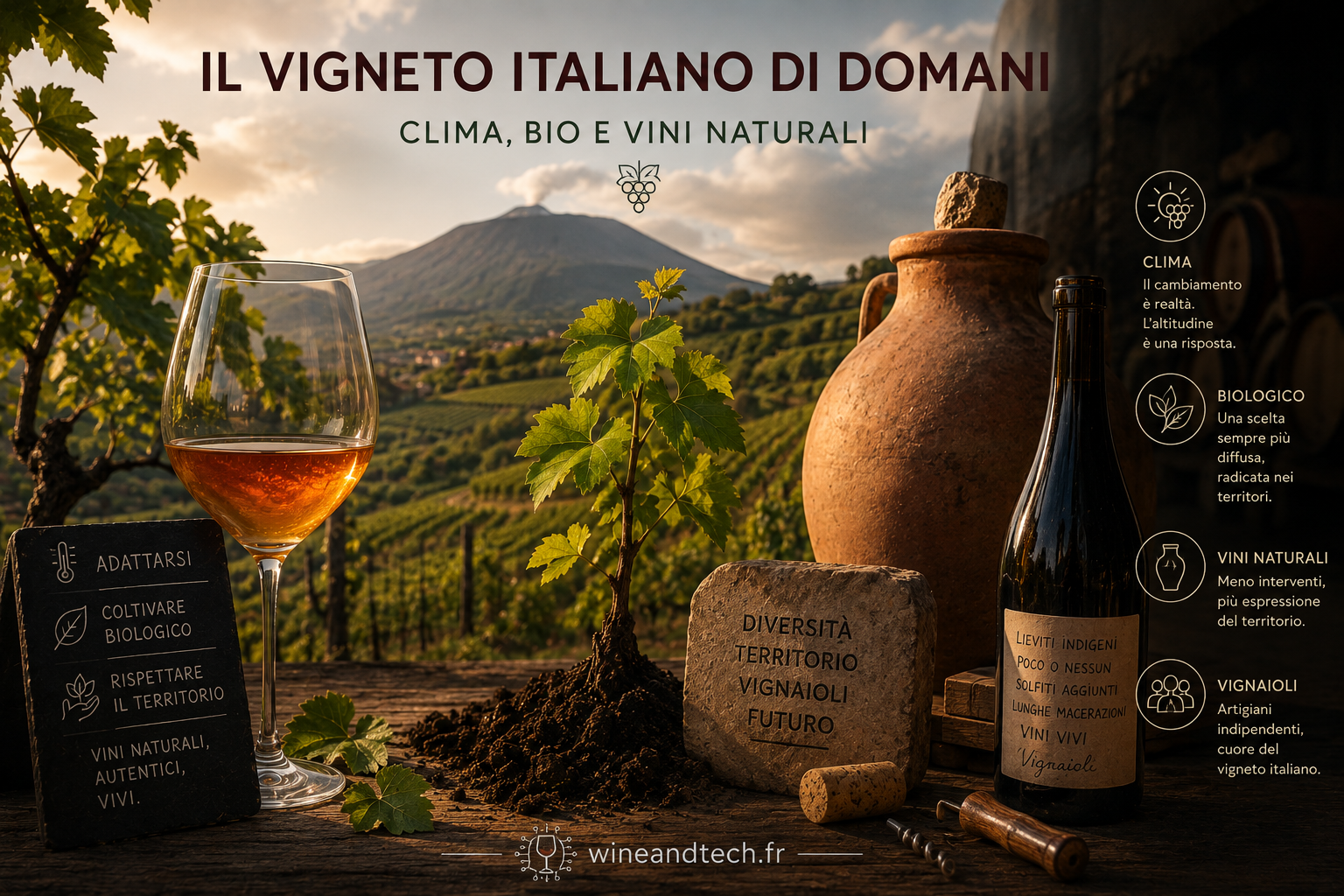
  • The Italian vineyard of tomorrow: climate change, organic and natural wine

    The Italian vineyard of tomorrow: climate change, organic and natural wine

    🇬🇧 Series · The Vinous Trinity · Article 14/15 · Italy · ⏱ 5 min

    🇫🇷+🇮🇹 Lire en français + italiano → [lien à ajouter] · Mon 🇫🇷 / Wed 🇮🇹 / Fri 🇪🇸

    Three countries, fourteen articles, and already time for a synthesis. What Italy will have brought to The Vinous Trinity: a lesson on diversity as strength, on inimitable grape varieties, on the vignaioli who do everything themselves. And now, a question: where is the Italian vineyard heading?

    🇰 What we take away

    Italy possesses one of the world’s greatest viticultural biodiversities, with more than 500 indigenous grape varieties officially recognised. This figure is not a footnote: it is the key to understanding everything the series has explored.

    Nebbiolo in the Langhe. Sangiovese on the Tuscan hills. Vermentino facing the winds of Gallura. Aglianico on the volcanic heights of Vulture or around Taurasi. Nerello Mascalese on the slopes of Etna. Each deeply marked by the territory in which it developed, capable of expressing very different profiles elsewhere.

    And behind these grape varieties, the vignaioli: artisans who grow, vinify and bottle. Often on just a few hectares. Often for several generations. This interlocking of variety, terroir and independent producer is the strength of the Italian vineyard.

    🌡️ Climate change: Etna as a model?

    Climate change is affecting Italy very unevenly. In the north-east and certain areas of Lombardy, harvests tend to come earlier and earlier. The South and Sicily, already warm, are facing record temperatures during harvest.

    Italy’s response runs in part through altitude. Etna is the most striking example: vineyards at 600, 800, 1,000 metres, with day-to-night temperature swings that preserve freshness even in the full heat of a Sicilian summer. This capacity to seek out freshness and altitude now represents an adaptation strategy observed across other Italian regions.

    In Campania and Basilicata, Aglianico, a late-ripening variety, is also finding renewed interest in the context of climate warming. In Sardinia, altitude and sea winds play a regulatory role. In Piedmont, producers are planting on cooler exposures that were once set aside.

    🌿 Organic farming: a movement rooted in the land

    Italy is among the European leaders in organic viticulture. Around 129,000 hectares of wine grape vines were managed organically or in conversion in 2023, accounting for roughly one fifth of the national vineyard. Sicily, Sardinia and Tuscany account for a significant share of certified operations.

    This is not simply a response to demand. In Italy, many winemakers have long worked in a thoughtful or organic way. For some, certification formalised practices that had already been in place for several years.

    Biodynamics is also progressing, carried by a new generation of vignaioli seeking total coherence between their philosophy and their practices.

    🍷 Natural wine, Italian style

    Italy has its own natural wine pioneers. Josko Gravner in Friuli, who from the 1990s explored long skin macerations before turning to Georgian amphorae at the start of the 2000s. Stanislao Radikon, his neighbour, who created an aesthetic of oxidative, slowly evolving white wine now recognised worldwide.

    These orange wines from Friuli-Venezia Giulia were first misunderstood, then marginal, then cult. This Italian renaissance helped bring skin-contact whites back to the international stage, and Friuli remains one of the world’s great references for maceration whites, now emblematic of the so-called natural wine revival.

    In Piedmont, Tuscany and Sicily, a new generation of vignaioli works with indigenous yeasts, reduced or zero added sulphur depending on the producer, long ageing in clay or old wood. No official label. But an approach that converges with what the world calls natural.


    What the series will have shown

    Italy has transformed its diversity into living heritage. More than 500 indigenous varieties, hundreds of territories, centuries of adaptation.

    Against climate change, this diversity is a resource. A grape variety selected and cultivated for centuries in a given environment can represent a valuable tool for adaptation, particularly when it ripens late or shows good tolerance to local conditions.

    The future of the Italian vineyard will not be written by the great houses. It will play out in the Langhe, on Etna, in the gorges of Campania, in the Sardinian granite. Where a vignaiolo decides, season after season, to keep going.

    Italy has not exhausted its surprises. It just needs people to keep looking for them.

    🇫🇷+🇮🇹 Lire cet article en français + italiano → [lien à ajouter après liaison Polylang]

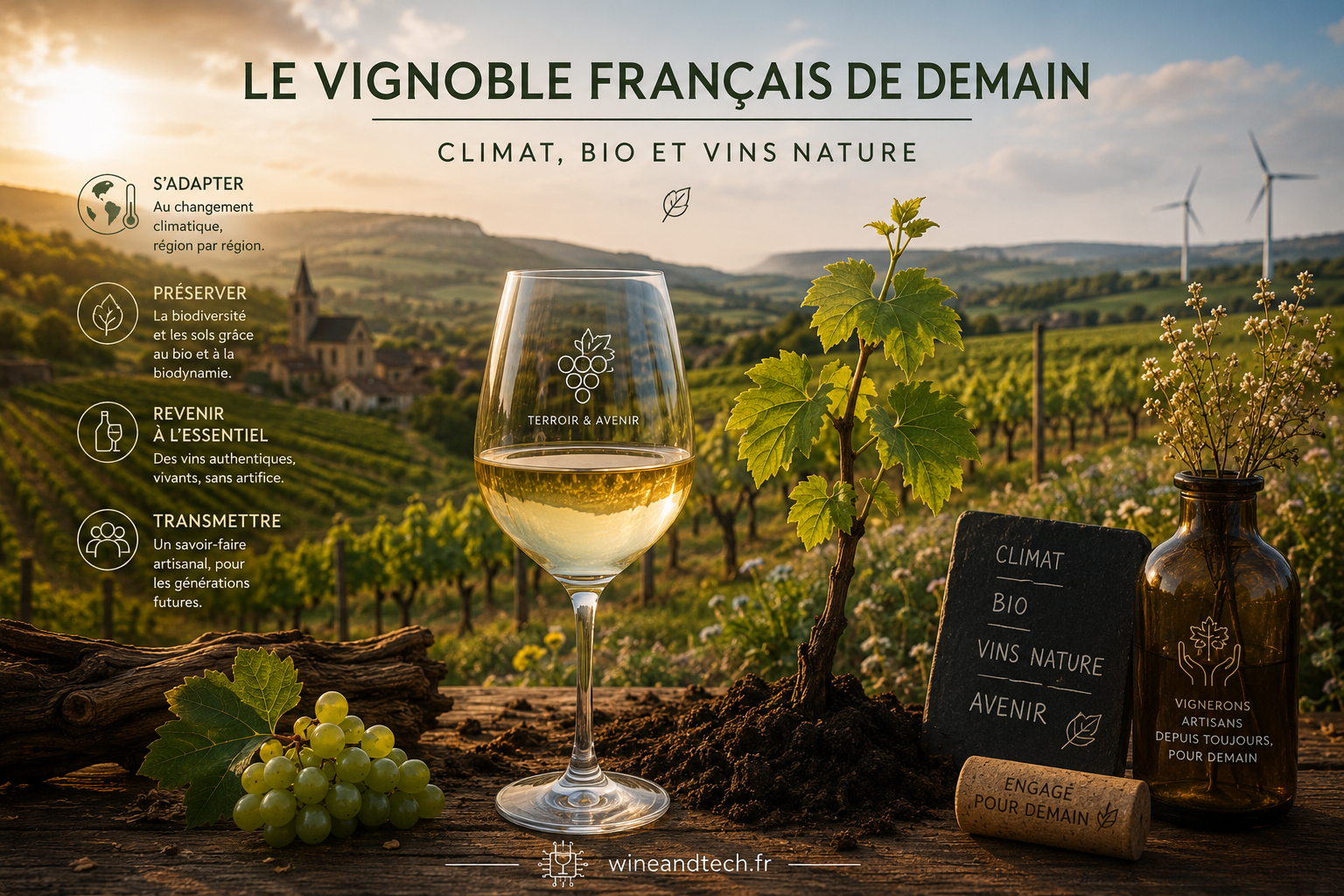
  • The French vineyard of tomorrow: climate change, organic wine and natural wine

    The French vineyard of tomorrow: climate change, organic wine and natural wine

    🇬🇧 Series · The Vinous Trinity · Article 13/15 · France · ⏱ 5 min

    🇫🇷 Lire en français → [lien à ajouter] · Mon 🇫🇷 / Wed 🇮🇹 / Fri 🇪🇸

    Three countries, twelve articles, fifteen weeks of The Vinous Trinity. Before arriving at the final chapter, a look back at what France has shown. And a glance at what lies ahead.

    What the French vineyard has that is exceptional is its diversity. Not only in terms of regions or grape varieties, but in its approach to wine: as an expression of a place, a history, a person. The future of this vineyard is now playing out on three fronts: climate change, the rise of organic farming and the natural wine movement.

    🇰 What we take away

    France has profoundly shaped modern wine culture. The concept of terroir, the hierarchy of appellations, the great blending models, barrel ageing and the promotion of emblematic grape varieties have all contributed to its worldwide influence.

    What the series will have shown: France is more diverse than its great names suggest. Beyond Bordeaux, Burgundy and Champagne, entire regions are working in relative obscurity, with grape varieties found almost nowhere else and wines that still sell at honest prices.

    Jura, Savoie, the Beaujolais crus, the Grand South-West, Corsica, the secret Loire, French Moselle: territories that prove the French vineyard is far from having revealed everything. Behind each appellation, artisans practising this trade with complete independence, often for several generations.

    🌡️ Climate change: a reality region by region

    In Alsace, harvests have moved forward by more than three weeks over recent decades. In Champagne, preserving the acidity and freshness that are part of the wines’ identity is becoming more complex in a warming climate. In Languedoc, episodes of intense heat can lead to high ripeness levels and significant alcohol content.

    The responses are diverse. Planting later-ripening varieties. Moving to higher altitudes. Rehabilitating forgotten local varieties, better adapted to current conditions. Irrigation, long tightly regulated in French appellations, is permitted in certain situations and is now the subject of new regulatory thinking.

    The paradox: certain regions once too cold to produce quality wines are now benefiting. French Moselle, Auvergne, Haute-Savoie: terroirs gaining in potential at the very moment their more southerly neighbours are seeking to preserve their freshness.

    🌿 Organic farming: a quiet transformation

    France has become one of Europe’s leading organic vineyards. In 2023, around 22% of the French vineyard was managed organically, including certified and under-conversion operations, with more than 131,000 hectares already fully certified. The progression has been remarkable.

    Behind this figure, a diverse reality. Some producers have been organic since the 1980s, often in pioneering regions: Alsace, Loire, Roussillon, Languedoc. Others have converted more recently, driven by demand or conviction.

    Biodynamics, a distinct approach from organic farming and generally more demanding in its practices, is also progressing. In Burgundy, Alsace and Champagne, emblematic estates have worked biodynamically for decades. These practices are often invisible on the label, but very real in the cellar.

    🍷 Natural wine: between Paris and the rest of the world

    The natural wine movement took particular shape in France from the 1980s-90s, notably in Beaujolais and the Loire, around winemakers such as Marcel Lapierre, Jo Pithon, Pierre Overnoy and Nicolas Joly.

    There is no single official definition of “natural wine”. The term generally refers to a production philosophy seeking minimal intervention, in both the vineyard and the cellar: grapes from low-intervention farming, spontaneous fermentations, limited oenological inputs and reduced use of sulphur, to varying degrees depending on the producer.

    Today the movement is worldwide, but France remains its symbolic epicentre. Paris has become one of the world’s great natural wine capitals, with a remarkable concentration of specialist wine shops, wine bars and restaurants.

    What was marginal in the 1990s has become, thirty years on, an underlying trend that influences even the most conventional producers.


    What the series will have shown

    French wine’s richness does not rest on its great names. It rests on the density of its artisan fabric. Thousands of small producers, dozens of lesser-known regions, hundreds of local grape varieties.

    The future does not depend on a grand plan. It is built plot by plot, family by family, harvest by harvest.

    France has not exhausted its surprises. It just needs people to keep looking for them.

    🇫🇷 Lire cet article en français → [lien à ajouter après liaison Polylang]

  • Las bodegas familiares: tradition and modernity in Spanish wine

    Las bodegas familiares: tradition and modernity in Spanish wine

    🇬🇧 Series · The Vinous Trinity · Article 12/15 · Spain · ⏱ 5 min

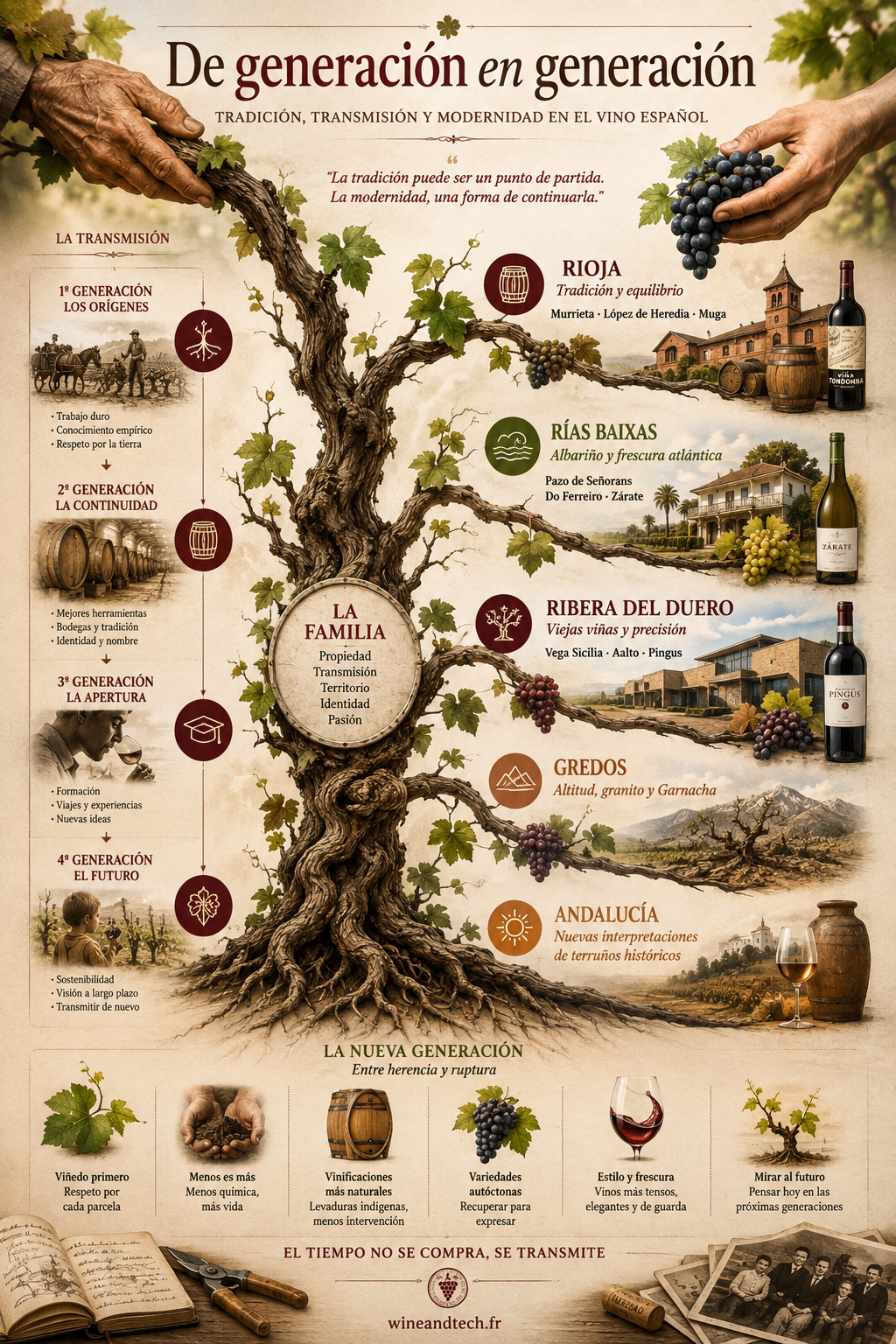
    In Spain, the family winery occupies a particular place in the viticultural landscape. Families cultivating the same plots for several generations, some of which have become international references, others working more discreetly, away from the spotlight.

    Between transmission, rootedness and the will to innovate, the Spanish vineyard also tells a story of families.

    🏠 The family winery: what sets it apart

    The Spanish family winery is built above all on a logic of ownership, transmission and territorial rootedness.

    Unlike large cooperatives that bring together numerous producers, or wine groups present across several regions, it is organised around a name, a family and a territory.

    The link with the vineyard is generally very direct. Generations follow each other, plots are passed on, practices evolve. Decisions taken today can have consequences well beyond a single harvest.

    This long-term vision is perhaps the true signature of these houses.

    🍷 Rioja: the great wine dynasties

    Rioja has given rise to some of Spain’s greatest viticultural dynasties.

    Marqués de Murrieta belongs to this ancient history. From the 19th century, Don Luciano de Murrieta introduced an approach inspired by the Bordeaux model, helping to lay the foundations of modern Rioja wine.

    López de Heredia, founded in Haro from 1877, represents another expression of this tradition. The house remains today one of the rare historic family wineries of the DOCa Rioja.

    More recent, Bodegas Muga, founded in 1932, embodies the same family continuity. Three generations of the Muga family have followed each other at the winery, with a philosophy seeking to combine artisan tradition and openness toward the future.

    Traditional Rioja remains associated with extended ageing and the use of oak, particularly American, with profiles that can develop notes of vanilla, leather and evolved fruit.

    But another Rioja has developed in parallel.

    Artadi, whose Lacalle y Laorden family took the helm in 1992, champions an approach based on plot identity and respect for the vineyard. Remírez de Ganuza, founded in 1989, has introduced various innovations in viticulture and winemaking.

    Two visions can coexist within the same appellation: fidelity to historic codes and the search for a more plot-based, contemporary expression.

    It is precisely this diversity that makes Rioja impossible to sum up in a single sentence.

    🌊 Galicia: the new Albarino families

    The Rías Baixas tells another story.

    In the Val do Salnés, small farms and family work have long occupied an essential place. The creation of the Rías Baixas Denominación de Origen in 1988 accompanied the region’s professionalisation and quality upgrade.

    Some families played a determining role in this evolution.

    Pazo de Señorans was acquired in 1979 by Marisol Bueno and Javier Mareque. The family subsequently contributed to gaining recognition for Albariño’s ageing potential and to the development of the new appellation.

    Do Ferreiro, founded by Gerardo Méndez, is another emblematic family story. The next generation continued work around old vines and the identity of the various Salnés terroirs. Some of its Albariños are capable of evolving for ten years or more in bottle.

    Zárate goes even further in this notion of transmission. The family has cultivated its own vineyards for several generations and works particularly with old plots. Eulogio Pomares, now at the head of the estate, represents this new generation of Galician winemakers trained outside before returning to work on the family heritage.

    Galicia is no longer associated solely with young, aromatic whites.

    Albariño can also be a wine for ageing, gaining in complexity and depth with time.

    🔴 Ribera del Duero: modernity and tradition

    Ribera del Duero is much more recent in its official organisation than Rioja, with the Denominación de Origen created in 1982.

    But its history already includes some mythical names.

    Vega Sicilia, founded in 1864, is the absolute reference. The winery has belonged to the Álvarez family since 1982 and remains one of the great benchmarks of Spanish wine. Its Único has become one of the iconic great wines of the peninsula.

    Around this monument, a new generation of producers has contributed to transforming the image of the region.

    Aalto, founded in 1999 by Mariano García and Javier Zaccagnini, was built around Tinto Fino and old vines spread across several municipalities. The Masaveu and Nozaleda families later joined the project in 2006.

    Dominio de Pingus, created by Peter Sisseck in 1995, belongs more to this generation of personal, high-precision projects than to the classic definition of a family winery.

    This distinction matters: Spanish renewal does not come solely from historic families. It also comes from winemakers who chose to settle in a region, understand its old vines and offer a new reading of them.

    🆕 The new generation: between heritage and rupture

    Across Spain, the same question is now being asked.

    What to do with the heritage received?

    Some heirs choose to continue exactly the work of their parents and grandparents. Others return after studying or working in Bordeaux, Dijon or other great wine regions and wish to progressively modify the estate’s practices.

    Less new wood, more plot-based work, a search for freshness, reduced inputs, a return to certain traditional methods or experimentation around yeasts and fermentations: the paths are numerous.

    There is no single definition of modernity.

    For some families, preserving tradition is already a form of innovation. For others, evolving practices is the best way to remain faithful to the terroir.

    ☀️ The South: forgotten families making a comeback

    Spanish renewal is not limited to the great historic appellations.

    In the Sierra de Gredos, in central Spain, young winemakers and small families are rediscovering old Garnacha vines planted on granite soils, often at high altitude.

    The region is characterised by small-scale viticulture, numerous plots of very small surface area and a new generation of family wineries working particularly with old Garnacha and Albillo Real vines.

    In Andalusia too, certain producers are seeking to move beyond traditional representations of the regional vineyard. Alongside the great historic wines of Jerez and Montilla-Moriles, new projects explore other expressions of the climate, soils and Andalusian varieties.

    The terroirs are there. The old vines too.

    Sometimes it simply took a different way of looking at them.


    A philosophy of the long term

    What ultimately unites these wineries is not their size, their prestige or even their wine style.

    It is their relationship with time.

    A vineyard that is transmitted.

    A plot that continues to be worked because the previous generations did so before us.

    A winery built to last.

    Decisions taken today with the conviction that their consequences will be visible in ten, twenty or thirty years.

    This logic is not that of a simple investment.

    It is closer to a living heritage.

    And it is perhaps there that the singularity of Spanish family wineries lies: they are not simply seeking to produce wine.

    They are seeking to transmit a story.

    A family winery is not measured in bottles produced. It is measured in generations transmitted.

  • The vignaioli: when a family does everything

    The vignaioli: when a family does everything

    🇬🇧 Series · The Vinous Trinity · Article 11/15 · Italy · ⏱ 5 min

    In Italy, the vignaiolo is not a winemaker like any other. An artisan who grows the grapes, vinifies the harvest and bottles, most of the time, without an intermediary. Sometimes on just a few hectares, passed down through several generations. This model is behind what Italian wine has that is most singular: a direct relationship between a person, a piece of land and a bottle.

    🏡 The vignaiolo: a philosophy as much as a trade

    The term vignaiolo refers to a precise reality. Unlike négociant houses that buy grapes or wines in bulk to blend them, the vignaiolo manages the whole process: vineyard, cellar, ageing, bottling. What France calls a récoltant-manipulant (though in Italy, unlike France, not all of them go as far as commercialising their wine). This independence often goes hand in hand with an intimate knowledge of the terroir. Each bottle carries the imprint of a family, a place, a conviction.

    🌿 From vine to bottle: independence as a choice

    The internal diversity of the Italian artisan vineyard is striking. A Piedmontese vignaiolo on 5 hectares in the Langhe has little in common with a Tuscan owner managing 30 hectares in Chianti Classico. What unites them is the conviction that wine expresses first and foremost the place and the person who makes it. This sets them apart from large cooperatives and industrial groups that prioritise consistency and volume. That said, it would be wrong to tar everything with the same brush: some Italian cooperatives now produce remarkable terroir wines. The same conviction also explains why many have chosen organic farming: not for the sake of fashion, but because coherence between vineyard and cellar matches their way of working.

    🏔️ Piedmont: the families behind the great wines

    In the Langhe, modern Barolo owes a great deal to a handful of families. Families like the Conterno, Mascarello, Rinaldi and Giacosa have embodied different expressions of this Piedmontese tradition. Names little known to the general public, venerated by serious wine lovers. These producers were at the heart of the 1980s-90s controversy between traditionalists and modernists. The former defended long ageing in large oak barrels, a rustic style but of remarkable longevity. The latter made greater use of small French barrels, different extraction approaches and shorter ageing periods. It is this diversity that makes Piedmont so difficult to summarise.

    🌿 Tuscany: tradition and renaissance

    The Tuscan transformation was radical. In the 1970s, Chianti was often synonymous with wine sold in fiasco bottles. A few families changed everything. The Antinoris on a large scale, Sergio Manetti at Montevertine on a smaller one. Today, dozens of small family estates produce Chianti Classico of great quality. It should be noted, though, that Montevertine is not really a Chianti Classico renaissance example in the strict sense: the estate actually left the Chianti Classico appellation to market its celebrated Pergole Torte as a Vino da Tavola, then IGT Toscana.

    In Maremma, new vignaioli are settling on terroirs still little explored. In Montalcino, historic families are defending their appellation against the temptation of economic growth, international prestige and artisan identity. A balance that is genuinely difficult to hold.

    ☀️ The South and the islands: the renaissance

    The South and the islands were long associated with production partly aimed at volume and blending markets. That has changed. In Campania, houses like Mastroberardino and Quintodecimo revealed the potential of Aglianico, Greco di Tufo and Fiano d’Avellino. In Sicily, Etna attracted a new generation of producers, local and from elsewhere. In Sardinia, families who had cultivated Vermentino for generations are beginning to be recognised at their true value. The lesson is simple: when a family bets on quality, the results follow.

    🆕 The new generation: break or continuity?

    Across Italy, a new generation is taking over. Trained at oenology university or abroad, they arrive with questions about century-old practices. Some choose total continuity: the same wine, the same methods. Others reinterpret: same vineyard, natural winemaking, fewer inputs. Both coexist, and that is what makes Italian wine so difficult to sum up in a sentence.


    What large structures cannot copy

    What gives a vignaiolo their value is precisely what a large structure cannot reproduce: a single family, a single piece of land, a coherent style over the long term. Each bottle is the signature of a specific place, bringing readability to the terroir and genuine personality.

    A vignaiolo doesn’t buy grapes. They harvest their own life into a bottle.

  • Tempranillo, Garnacha, Albariño: the Spanish grape varieties you need to know

    Tempranillo, Garnacha, Albariño: the Spanish grape varieties you need to know

    🇬🇧 Series · The Vinous Trinity · Article 9/15 · Spain — English translation of the French original

    ⏱ 5 min

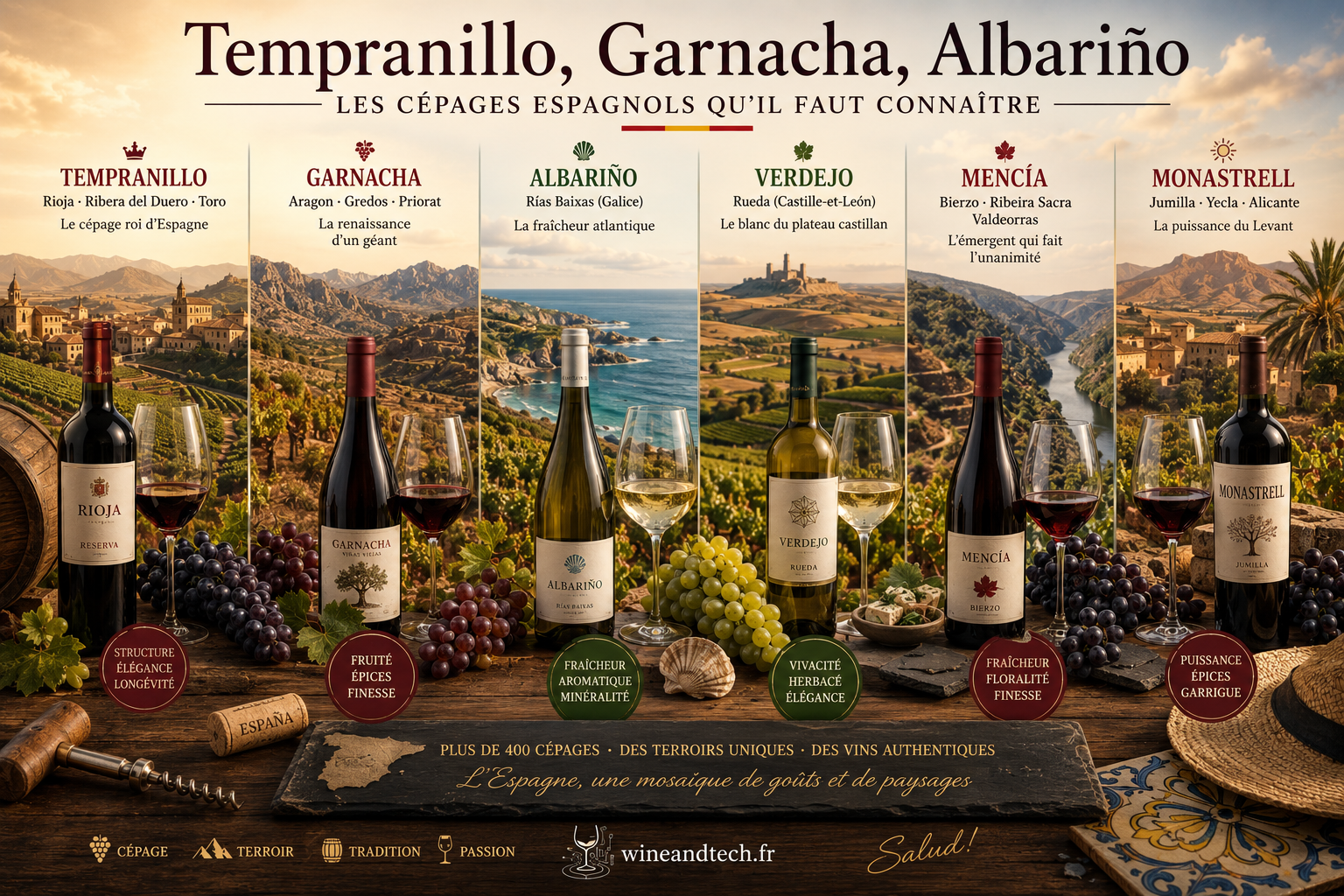
    Spain boasts exceptional viticultural diversity, with more than 400 grape varieties recorded depending on the source. Much of this wealth remains little known, while a handful of varieties dominate the great appellations and define the most distinctive styles of the Iberian vineyard.

    Tempranillo, Garnacha, Albariño: an iconic trio. But also Verdejo, Mencía, Monastrell, Graciano and many more. Varieties whose character largely explains why Spain has established itself among the world’s great wine nations, often with a particularly competitive offer in terms of value for money.

    The Spanish Ministry of Agriculture confirms Tempranillo’s current dominance: as of 31 July 2024, it covered 195,076 hectares, ahead of Airén with 185,614 hectares.

    🍇 Grape varieties explored in this article

    Tempranillo · Garnacha · Albariño · Verdejo · Mencía · Monastrell

    🔴 Tempranillo — Spain’s king of grapes

    Tempranillo is today Spain’s most widely planted wine grape. It changes name from region to region: Tinto Fino or Tinta del País in Ribera del Duero, Tinto de Toro in Toro, Cencibel in parts of Castilla-La Mancha. It is also known as Tinta Roriz in Portugal.

    In Rioja, it forms the backbone of the great reds and lends itself equally well to youthful cuvées and long barrel ageing. Traditional expressions can develop notes of red fruit, strawberry, vanilla, liquorice, cocoa, leather and tobacco with age.

    In Ribera del Duero, high-altitude vineyards and wide day-night temperature swings favour wines that are often more structured and concentrated, while retaining welcome freshness.

    In Toro, under the name Tinta de Toro, old vines and dry conditions produce particularly rich and powerful wines.

    Tempranillo’s real strength lies in this ability to change personality according to climate, altitude, soils and the winemaker’s hand.

    A true Iberian chameleon.

    🔴 Garnacha — the rebirth of a giant

    Garnacha, known as Grenache in France and Cannonau in Sardinia, is deeply tied to the north-east of the Iberian Peninsula. Aragón is one of its most important historic homelands.

    Long used in blends or to produce simple wines and rosés, it has been enjoying a genuine qualitative renaissance for several decades.

    This revolution rests above all on the rediscovery of old Garnacha vines in Aragón, in appellations such as Campo de Borja and Calatayud, but also in Terra Alta, in Catalonia, and in the vineyards of the Sierra de Gredos, south-west of Madrid.

    In Gredos, some old vines planted on granite soils at high altitude yield reds of remarkable finesse, with floral, spicy and very fresh profiles.

    Garnacha thus proves it can deliver far more than sun-drenched, generous wines: given old vines, altitude and controlled yields, it can reach spectacular elegance and complexity.

    Its rebirth is one of the most exciting stories in contemporary Spanish wine.

    🟡 Albariño — Atlantic freshness

    Albariño is the flagship grape of Rías Baixas, in Galicia, on the Atlantic coast of north-west Spain.

    In this cool, humid, ocean-driven region, it produces dry, aromatic, taut whites with notes of white peach, citrus, apricot, flowers and sometimes a saline touch. Granite soils and the maritime climate contribute strongly to their identity.

    Rías Baixas comprises five sub-zones: Val do Salnés, O Rosal, Condado do Tea, Ribeira do Ulla and Soutomaior, each bringing different nuances to the grape’s expression.

    Albariño’s natural acidity makes it an exceptional partner for seafood: oysters, shellfish, mussels, crustaceans or Galician-style octopus.

    But its potential doesn’t stop at young wines. Extended ageing on the lees can bring more texture, depth and complexity, and some cuvées are perfectly capable of evolving in bottle.

    An Atlantic white that combines freshness, precision and true territorial identity.

    🟡 Verdejo — the white of the Castilian plateau

    Verdejo is the great white grape of Rueda, in Castilla y León.

    The appellation’s vineyards sit mainly on a high plateau, between 700 and 800 metres in altitude, subject to cold winters, hot dry summers and wide temperature swings.

    In the glass, Verdejo generally delivers dry, fresh, aromatic wines with notes of fennel, citrus, fresh herbs and white-fleshed fruit, along with a characteristic touch of bitterness on the finish.

    Long regarded as a simple, easy-drinking wine, Verdejo has grown considerably in ambition. The best producers now work specific plots, use lees or oak ageing and winemaking approaches capable of revealing more texture and depth.

    A particularly interesting Spanish alternative to the world’s great aromatic whites.

    🔴 Mencía — the rising star everyone agrees on

    Mencía is one of the most interesting red grapes of north-west Spain.

    It is particularly important in Bierzo, in Castilla y León, but also in Galicia, notably in the Ribeira Sacra, Valdeorras and Monterrei appellations.

    Since the 2000s, several generations of winegrowers have profoundly renewed its image. Old vines, controlled yields and more precise work in the vineyard and cellar have revealed a grape capable of producing reds of great finesse.

    On the slopes of the Ribeira Sacra, with its spectacular terraced vineyards above the Sil and Miño valleys, Mencía can yield fresh, floral, slender wines.

    In Bierzo, it often shows more depth and structure while keeping remarkable natural acidity.

    Cherry, red fruit, flowers, spice, herbal and mineral notes: its profile can bring to mind certain Pinot Noirs or Cabernet Francs through its freshness and elegance, without ever losing its Iberian identity.

    Mencía is now far more than an emerging grape: it has become one of the signatures of Spain’s wine revival.

    🔴 Monastrell — the power of the Levante

    Monastrell, known as Mourvèdre in France, is one of the great grapes of south-east Spain.

    It reigns notably over Jumilla, Yecla and Bullas, but also over other appellations along Spain’s Mediterranean coast. The Monastrell España association brings together six major appellations around this grape: Alicante, Almansa, Bullas, Jumilla, Valencia and Yecla.

    In Jumilla, Monastrell accounts for around 70% of the vineyard and has adapted remarkably well to a hot, dry, water-scarce environment. A large share of the vines is grown without irrigation.

    It produces generous, deeply Mediterranean wines, with aromas of ripe black fruit, spice, liquorice, wild herbs and garrigue.

    But modern Monastrell is no longer just about power. The best producers now seek to preserve its acidity and freshness, thanks in particular to altitude, limestone soils and precise harvesting at ripeness.

    The result: rich, structured wines that can still show real freshness.

    One of the great trump cards of Spain’s Mediterranean vineyard.

    The inimitable Spaniards

    What unites these grapes is not just their popularity. It is their ability to tell the story of a territory.

    Tempranillo from Rioja, Ribera del Duero or Toro doesn’t tell quite the same story.

    Garnacha from Aragón or Gredos changes its face with altitude and soils.

    Albariño from Rías Baixas carries the influence of the Atlantic and Galician granite.

    Verdejo from Rueda reflects the contrasts of the high Castilian plateau.

    Mencía from Bierzo and Ribeira Sacra expresses the freshness and diversity of the north-western terroirs.

    Finally, Monastrell from Jumilla tells of another Spain: sun-baked, dry, Mediterranean, where the vine must cope with water scarcity.

    These grapes can be planted elsewhere. But their expression changes as soon as the territory that shaped them disappears.

    Grape × soil × climate × altitude × history × know-how:

    that is the equation behind the singularity of Spanish wine.

    Spain hasn’t merely preserved an exceptional viticultural genetic heritage.

    It is now giving it a new voice.

    Spain hasn’t merely preserved an exceptional viticultural genetic heritage. It is now giving it a new voice.

  • Nebbiolo, Sangiovese, Vermentino: Italy’s inimitable treasures

    Nebbiolo, Sangiovese, Vermentino: Italy’s inimitable treasures

    🇬🇧 Series · The Vinous Trinity · Article 8/15 · Italy · ⏱ 5 min

    🇫🇷+🇮🇹 Lire en français + italiano → [lien à ajouter] · Mon 🇫🇷 / Wed 🇮🇹 / Fri 🇪🇸

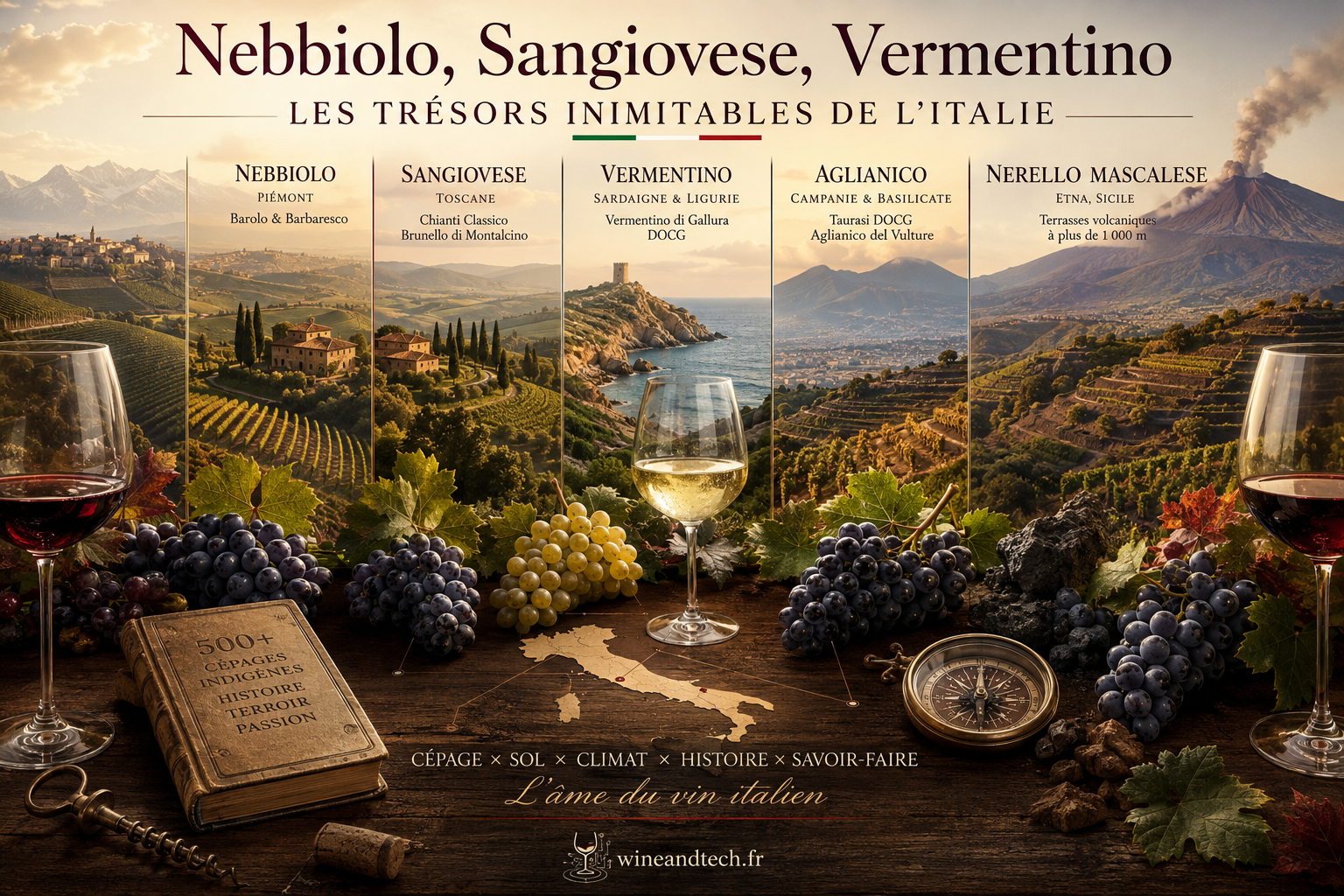
    Italy officially catalogues more than 500 indigenous grape varieties. Among them, some stand apart for a rare quality: their capacity to express with particular force the territory that shaped them.

    Grown far from their home ground, they can produce excellent wines, but their expression changes. Vinified differently, they reveal other facets. Nebbiolo, Sangiovese, Vermentino, Aglianico, Nerello Mascalese: these names are deeply bound to a soil, a climate, a history and craftsmanship passed down through the generations.

    🍇 Grape varieties explored in this article

    Nebbiolo · Sangiovese · Vermentino · Barbera and Dolcetto · Aglianico · Nerello Mascalese

    🔴 Nebbiolo · the king of the Langhe

    Nebbiolo is one of Italy’s most emblematic grape varieties. Its most prestigious home is the Piedmontese Langhe, where it gives rise to the two great DOCGs, Barolo and Barbaresco. It is also present in other Alpine and Piedmontese territories, notably Valtellina in Lombardy, and at Gattinara and Ghemme in northern Piedmont.

    Its signature is immediately recognisable: a colour often relatively pale despite an important tannic structure, high acidity and a remarkable capacity for ageing.

    In youth, its tannins can be particularly firm. Over the years, the wine gains complexity and develops aromas of faded rose, cherry, liquorice, tar, undergrowth and truffle.

    This alliance of aromatic finesse, structure and ageing potential puts Nebbiolo among the world’s great long-lived grape varieties.

    Its expression varies considerably according to soils, exposures and altitude. In the Langhe, the combination of marl, hillsides, microclimates and winemaking tradition has forged an identity difficult to reproduce anywhere else.

    🔴 Sangiovese · the soul of Tuscany

    Sangiovese is the most widely planted grape variety in Italy and arguably one of the most polymorphic on the peninsula. Its most celebrated expression remains deeply linked to Tuscany.

    In Chianti Classico, it produces wines characterised by bright acidity, structured tannins and aromas of cherry, violet, herbs and spice, to which notes of leather and tobacco can be added with age.

    In Montalcino, under the name Brunello, it reaches an expression of particular depth and longevity. In Montepulciano, it forms the heart of Vino Nobile di Montepulciano, in a generally softer and more accessible style.

    This should not be confused with Montepulciano d’Abruzzo, made from the Montepulciano grape variety and not from Sangiovese.

    The strength of Sangiovese lies precisely in its capacity to change face according to its environment. But in central Tuscany, on the soils of galestro and alberese, it finds a particularly emblematic expression, where acidity, structure and freshness balance with remarkable precision.

    🟡 Vermentino · the white of the shores

    Vermentino is one of the Mediterranean’s great white grape varieties.

    It is found in Sardinia, Liguria and Tuscany, as well as in Corsica, where it is traditionally called Rolle.

    In Sardinia, its most prestigious expression is found in Vermentino di Gallura DOCG, the emblematic appellation of the island’s north-east. The regulations require a minimum of 95% Vermentino.

    In the glass, it generally offers dry, fresh and aromatic whites, with notes of white flowers, citrus, peach, white-fleshed fruits and almond, accompanied by a sometimes slightly bitter finish that adds length.

    In Gallura, the granite soils, the wind and the Mediterranean climate contribute strongly to its identity.

    The result is a wine that combines freshness, salinity and elegance. A bottle of Vermentino di Gallura around €12-18 offers a remarkable pleasure-to-price ratio, particularly at table with fish, seafood or Mediterranean cuisine.

    🔴 Barbera and Dolcetto · everyday elegance in Piedmont

    In Piedmont, two other grape varieties occupy an essential place in everyday wine culture: Barbera and Dolcetto.

    Barbera, with its bright acidity, moderate tannins and generous fruit, produces wines that are particularly easy to pair at table. Young and fruity or aged to greater depth, it remains one of Piedmont’s great convivial wines.

    Dolcetto, despite its name, is not a sweet wine. Its name refers to the sweetness of its grapes rather than the sweetness of the wine produced.

    It generally yields soft, fruity and accessible reds, with tannins more present than one might expect and characteristic notes of dark fruits, cherry and almond.

    Barbera and Dolcetto represent another face of Piedmont: less aristocratic than Barolo or Barbaresco, but deeply rooted in everyday life and regional gastronomy.

    🔴 Aglianico · the power of the South

    Aglianico is one of southern Italy’s great red grape varieties and remains relatively underrated internationally.

    Its two most celebrated expressions are found in Campania, with Taurasi DOCG, and in Basilicata, with Aglianico del Vulture.

    It produces structured, deep wines well-suited to ageing: firm tannins, high acidity, dark fruits, spice, balsamic notes and touches of tobacco and undergrowth with development.

    At Taurasi, its keeping potential can be extraordinary. The altitude and relatively cool conditions of some vineyards help preserve its freshness despite the southern latitudes.

    Its late ripening cycle also shapes its identity. Aglianico can reach full maturity late in the season, sometimes into October in certain areas, which builds concentration and complexity in its wines.

    Austere in youth, but capable of becoming spectacular with time.

    🔴 Nerello Mascalese · the child of Etna

    Nerello Mascalese is inseparable from Etna, in eastern Sicily.

    Long used mainly in regional blends, it has undergone a genuine qualitative renaissance over several decades. The rise of Etna wines has revealed its full potential when vinified with precision and drawn from carefully selected parcels.

    On the slopes of the volcano, it produces wines of astonishing finesse: high natural acidity, fine tannins, red fruits, pomegranate, flowers, spice and notes evoking rock or smoke.

    One of its distinctive qualities lies in Etna’s exceptional environment. The vineyards are planted on soils derived from successive lava flows and at sometimes considerable altitude, with significant thermal variation between day and night.

    This combination of volcano, altitude, exposure, Mediterranean climate and the diversity of lava flows creates a mosaic of particularly expressive terroirs.

    The result can evoke, in its finesse and freshness, some of the great reds of northern Italy or Burgundy, while retaining a profoundly Sicilian identity.

    Etna is not just a dramatic backdrop. It’s a genuine winegrowing matrix.


    Inimitable by nature

    Italian wine’s real strength isn’t the number of its grape varieties. It’s the organic bond that links them to their territories.

    Nebbiolo in the Langhe.
    Sangiovese on the Tuscan hills.
    Vermentino facing the winds of Gallura.
    Aglianico on the volcanic heights of Vulture or around Taurasi.
    Nerello Mascalese on the slopes of Etna.

    Elsewhere, these grape varieties can produce excellent wines. But their identity changes when the environment that shaped them disappears.

    This is the full magic of Italian terroir: grape variety × soil × climate × history × craftsmanship.

    More than 500 indigenous grape varieties, hundreds of territories, centuries of adaptation. Italy hasn’t simply preserved this diversity.

    It has transformed it into living heritage.

    And it is perhaps there that its greatest treasure lies: grape varieties the whole world can plant, but whose soul no one can totally reproduce.

    A grape variety doesn’t lie. Separate it from its land, and it tells a different story, or stops telling any at all.

    🇫🇷+🇮🇹 Lire cet article en français + italiano → [lien à ajouter après liaison Polylang]