WineAndTech’

Author: Jean-Sébastien LASSERE

  • Syrah, Grenache, Chenin: the grape varieties that tell France’s story

    Syrah, Grenache, Chenin: the grape varieties that tell France’s story

    🇬🇧 Series · The Vinous Trinity · Article 7/15 · France · ⏱ 5 min

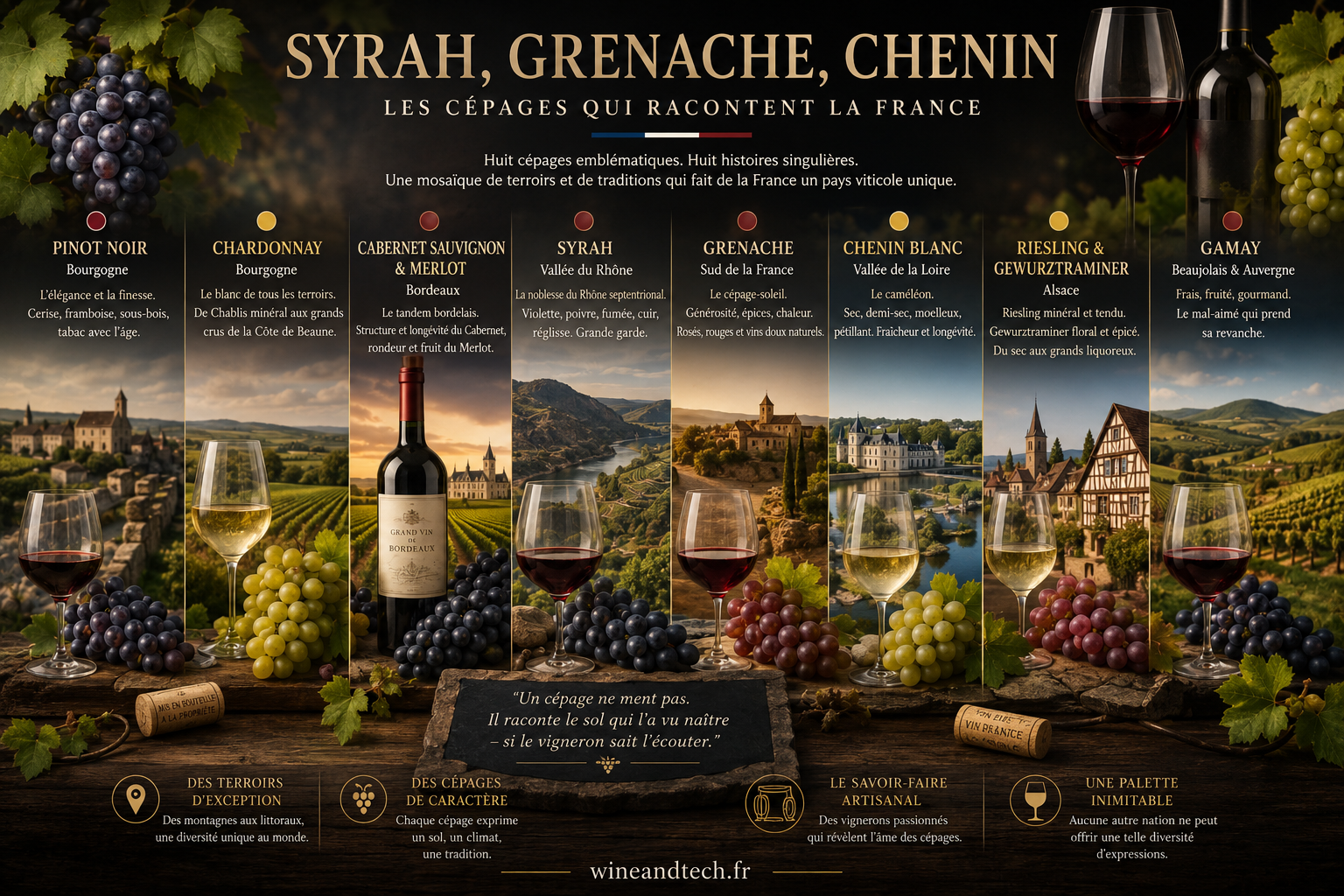
    In France, grape varieties are not simply types of grape. They are characters, each with its own personality, its preferred soils, its infinite variations depending on the land and the winemaker. Syrah, Grenache, Chenin Blanc, Pinot Noir, Chardonnay, Riesling, Gamay: every one of these names tells a story of soil, climate and tradition. Together, they form a palette no other wine nation can match.

    🍇 Grape varieties explored in this article

    Pinot Noir · Chardonnay · Cabernet Sauvignon & Merlot · Syrah · Grenache · Chenin Blanc · Riesling · Gamay

    🔴 Pinot Noir · the soul of Burgundy

    Pinot Noir is perhaps the most difficult grape variety in the world to master. Thin skin, light tannins, extraordinary sensitivity to terroir: it expresses with remarkable precision the differences between parcels sometimes separated by just a few dozen metres. In Burgundy, it produces wines of finesse, elegance and aromatic complexity (cherry, raspberry, flowers, undergrowth, tobacco with age) that have forged its worldwide reputation. But Burgundian Pinot Noir is not limited to inaccessible grands crus: a village Bourgogne or a Côte de Nuits-Villages from an artisan winemaker between €18 and €30 can deliver a remarkable experience. It also thrives in Alsace, Champagne and Savoie.

    🟡 Chardonnay · the white of all terroirs

    Chardonnay is the most widely planted white grape variety in the world, but it is in Burgundy that it reaches its highest expression. From the Côte de Beaune (Meursault, Puligny-Montrachet, Chassagne-Montrachet) to taut, mineral Chablis, from fruity, affordable Mâcon-Villages to Champagne where it forms the base of Blancs de Blancs, Chardonnay covers an extraordinary range of styles. Its initial neutrality makes it a chameleon grape: it takes on the imprint of terroir and winemaker with remarkable fidelity. A Chablis Premier Cru or a Mâcon-Uchizy from an artisan producer between €12 and €22: wines of real class at reasonable prices.

    🔴 Cabernet Sauvignon & Merlot · the Bordeaux tandem

    In Bordeaux, blending is never accidental. Cabernet Sauvignon (structure, firm tannins, longevity, blackcurrant, cedar) and Merlot (roundness, ripe red fruits, earlier accessibility) complement each other with a logic that defined the concept of fine wine for the entire world. The left bank (Médoc, Graves) favours Cabernet Sauvignon on its well-drained gravels. The right bank (Saint-Émilion, Pomerol) favours Merlot on its cooler clays. The real secret: hundreds of artisan estates produce increasingly high-quality Bordeaux at €10-18, often from old vines on remarkable terroirs.

    🔴 Syrah · the nobility of the northern Rhône

    On the steep granites of Côte-Rôtie, Hermitage or Cornas, Syrah reaches a level of expression that few grape varieties in the world can match: violet, black olive, white pepper, smoke, leather, liquorice. Wines of striking power and depth, capable of ageing 20 to 30 years. What makes Rhône Syrah unique is a long winemaking history, a marked climate and particularly demanding granite terroirs. In Crozes-Hermitage or Saint-Joseph, more accessible neighbours, remarkable Syrahs can be found between €12 and €20. It also succeeds in Languedoc and Provence, with looser, fruitier expressions.

    🔴 Grenache · the generosity of the deep South

    Originally from Spain (Garnacha), naturalised French in the southern Rhône and Languedoc, Grenache is the sunshine grape. It finds in Châteauneuf-du-Pape, on its terraces of rounded stones, one of its most emblematic French expressions, producing wines of remarkable generosity, warmth and spiced complexity. But it appears everywhere across the south of France: in rosé in Provence, in sweet natural wines (Banyuls, Maury, Rasteau), in Languedoc where century-old vines often yield the country’s best value-for-money. A Rasteau or Gigondas from an artisan winemaker at €12-18: southern generosity at an honest price.

    🟡 Chenin Blanc · the Loire’s chameleon

    Chenin Blanc is perhaps one of the most versatile white grape varieties in France. From the Loire Valley, it produces dry wines of striking tension and minerality (Savannières), fresh and complex off-dry wines (Vouvray), sweet wines of astonishing aromatic richness (Coteaux du Layon, Bonnezeaux) and remarkable sparkling wines (Vouvray pétillant, Crémant de Loire). Its naturally high acidity allows it to age 30, 40, even 50 years while retaining intact freshness. A dry Vouvray or an Anjou blanc from a winemaker between €10 and €16 can reveal astonishing complexity with a few years in the cellar.

    🟡 Riesling & Gewurztraminer · two of Alsace’s great grape varieties

    Alsace has the rare distinction of labelling wines by grape variety, and two dominate. Riesling, mineral, taut, citrus with petrol notes emerging with age, is one of France’s greatest dry whites, capable of exceptional longevity on the finest terroirs of the wine route. Gewurztraminer, at the opposite extreme, is flamboyant and opulent: rose, lychee, spice, ginger. Both can range from bone-dry to late harvest, up to Sélections de Grains Nobles, the equivalent of the world’s greatest sweet wines. Exceptional wines, often undervalued relative to their quality.

    🔴 Gamay · the unloved grape having its moment

    Long confined to the image of Beaujolais Nouveau, a marketing product drunk in November and forgotten by December, Gamay is now at the heart of a worldwide enthusiasm for light, fresh, easy-drinking wines. On the granites of Beaujolais, it produces the 10 crus explored in the previous article. But Gamay also grows in Touraine (Touraine Gamay, fresh and fruity), in Auvergne (Côtes d’Auvergne, often remarkable at under €10), in Savoie. A new generation of winemakers vinifies it with renewed finesse, gentler extraction, more precise ageing. A grape that turns out to have real depth.


    The inimitable · what these grape varieties share

    What sets many French grape varieties apart, including some now planted worldwide like Chardonnay, Cabernet Sauvignon or Merlot, is their capacity to produce profoundly different expressions depending on their territory. Savagnin from Jura, Mondeuse from Savoie, Romorantin from the Loire, Nielluccio from Corsica, Mourvèdre from Bandol: grape varieties that cannot be reproduced anywhere else with the same results. This combination, grape variety × terroir × tradition, is what makes France a unique wine country. Not because its wines are systematically the best in the world, but because they are irreplaceable.

    A grape variety doesn’t lie. It tells the story of the soil that gave it birth, if the winemaker knows how to listen.
  • Beyond Rioja: Spain’s new wine stars

    Beyond Rioja: Spain’s new wine stars

    🇬🇧 Series · The Vinous Trinity · Article 6/15 · Spain · ⏱ 5 min

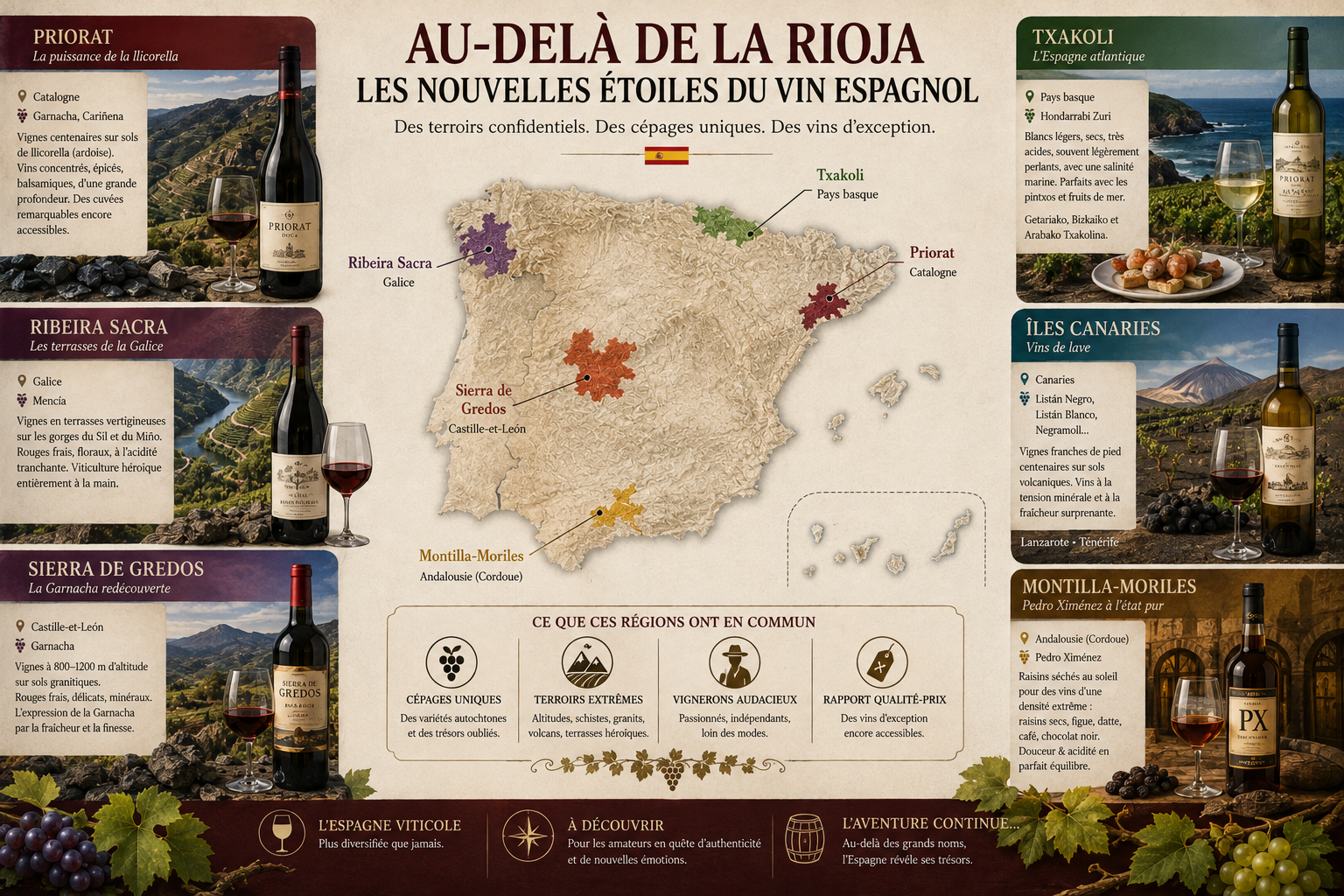
    Rioja, Ribera del Duero, Rías Baixas. The three names international wine buyers know. The Spanish vineyard doesn’t stop there. Beyond these appellations, other regions are doing work that deserves attention: more confidential, with different priorities. Old terroirs, indigenous grape varieties, producers who have no interest in making wines that taste like anything else.

    🗺️ Regions explored in this article

    Priorat · Ribeira Sacra · Sierra de Gredos · Canary Islands · Txakoli · Montilla-Moriles

    Priorat · the power of llicorella

    Priorat (DOCa since 2000) built its reputation in the 1990s on something very specific: century-old Garnacha and Cariñena vines on llicorella, a crumbling black slate that gives wines their mineral grip and distinctive balsamic character. The result is concentrated, complex, long-lived. Among the top producers, prices have followed the reputation. But artisan winemakers here still craft remarkable bottles at prices that remain accessible.

    Ribeira Sacra · Galicia’s terraced vineyards

    In the gorges of the Sil and Miño in Galicia, Ribeira Sacra grows Mencía on vertiginous granite terraces that require entirely manual work. Fresh, floral, precise reds with a natural acidity that surprises anyone expecting southern Spanish weight. An appellation that was still little-known five years ago and is now on the radar of most serious sommeliers. Prices haven’t caught up yet.

    Sierra de Gredos · Garnacha rediscovered

    Between Madrid and Ávila, the Sierra de Gredos gave a handful of producers something they couldn’t find elsewhere: old Garnacha vines at 800 to 1,200 metres, on granite. Fresh, delicate, mineral reds. Producers like Comando G and Bernabeleva showed that Spanish Garnacha doesn’t have to mean extracted and heavy. The style they developed is now influencing producers across the country.

    Canary Islands · wines from lava

    The Canaries escaped phylloxera. The result is ungrafted vines, some over a century old, on black volcanic soils, with rare pre-phylloxera varieties: Listán Negro, Listán Blanco, Negramoll. Wines of mineral tension and freshness that are completely unexpected at these latitudes. Lanzarote and Tenerife both have serious producers. Prices are still reasonable.

    Txakoli · Atlantic Spain

    Txakoli is the Basques’ white wine: light (10-11% alcohol), often lightly sparkling, dry, very acidic, with a marine salinity that makes it an obvious match for pintxos and seafood. Three appellations: Getariako Txakolina, Bizkaiko Txakolina, Arabako Txakolina. Same philosophy throughout: a sharp, lively, genuine wine. Still affordable.

    Montilla-Moriles · Pedro Ximénez in its purest form

    Montilla-Moriles, in the Córdoba area, makes wine from Pedro Jiménez grapes dried in the sun until concentrated. The result: a dense, sweet wine full of raisins, fig, date, coffee and dark chocolate, with enough natural acidity to keep it balanced. Often available at lower prices than comparable wines from Jerez, for similar quality.


    What connects these regions

    It isn’t geography. It’s a certain stubbornness. Producers making wine from grape varieties nobody planted for decades, on terroirs nobody paid attention to. More sommeliers and wine merchants are noticing now. The prices haven’t fully caught up. That will change.

    Spain has shown the world its Rioja. The rest is only now becoming visible.

  • From Barolo to Nero d’Avola: a journey from North to South Italy

    From Barolo to Nero d’Avola: a journey from North to South Italy

    🇬🇧 Series · The Vinous Trinity · Article 5/15 · Italy

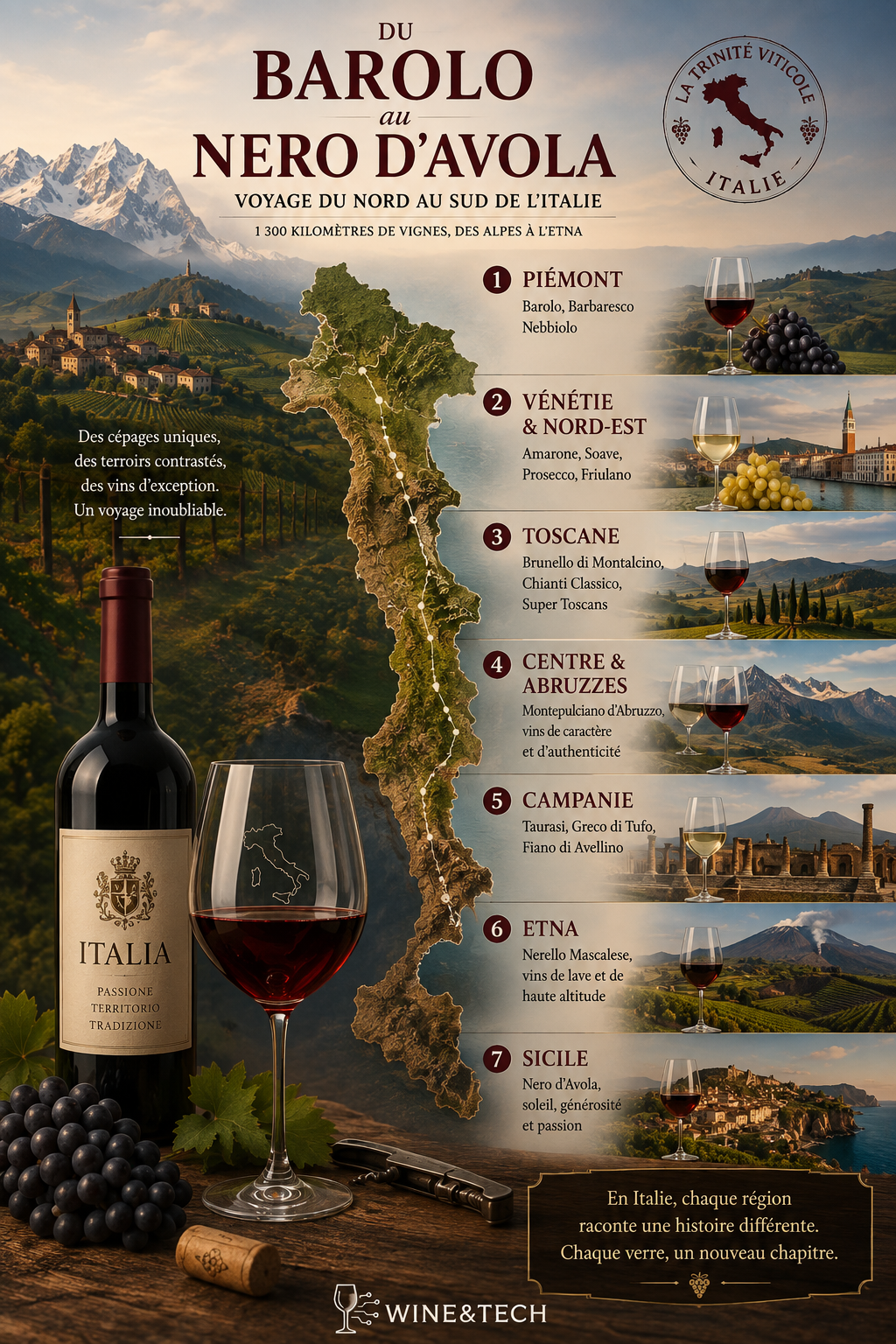
    From Turin to Palermo, nearly 1,300 kilometres of travel through the Italian vineyards. Italian wine doesn’t reveal itself in a single glance, it unfolds, at the pace of grape varieties that change every hundred kilometres, terroirs shifting from Alpine granite to Sicilian volcanic ash. This journey from north to south is one of the most rewarding the wine world has to offer.

    🗺️ Stops on the journey

    Piedmont · Veneto & North-East · Tuscany · Centre & Abruzzo · Campania · Etna · Sicily

    🏔️ The Great North: Barolo, Barbaresco and Piedmont’s power

    The journey begins in the Langhe hills of Piedmont. Barolo and Barbaresco, both from Nebbiolo, are the undisputed aristocrats of northern Italy: wines with a garnet colour that pales quickly, austere tannins in youth, that develop after 10 to 20 years a complexity of tar, faded rose, truffle and black cherry that is absolutely unique in the world. Barolo is often called the king of Italian wines; Barbaresco, generally earlier in its evolution, can show itself more approachable when young. But Piedmont is not just its two DOCG kings: Barbera d’Asti (juicy, fresh, delicious young at €9–12), Dolcetto d’Alba (elegantly bitter), Moscato d’Asti (delicate sparkling sweet, irresistible), the palette is immense.

    🌊 Veneto and the North-East: from Amarone to Soave

    Heading east, the Veneto establishes itself as Italy’s most productive wine region, offering one of the widest ranges of styles on the peninsula. From sparkling, fresh Prosecco di Valdobbiadene, to Soave Classico of remarkable minerality on volcanic soils, to Valpolicella Ripasso gaining body through partial drying, through to Amarone della Valpolicella : grapes dried through appassimento, concentrated, long-aged, a wine of power and meditation capable of crossing several decades for the finest cuvées. Friuli produces some of Italy’s finest dry whites: Friulano, Ribolla Gialla, Pinot Grigio of a precision and tension rarely matched anywhere.

    🌿 Tuscany: Brunello, Chianti, Super Tuscans

    At the midpoint, Tuscany asserts itself as the great theatre. Chianti Classico : Sangiovese on the hills between Florence and Siena, cherry, tobacco, bright acidity, is one of Italy’s most versatile food-wine pairings. Brunello di Montalcino is another dimension entirely: made exclusively from Sangiovese, known locally as Brunello, it must wait at least five years before release, including a minimum of two years in wood. Capable of crossing several decades in the cellar, it ranks among the great ageing wines of the peninsula. The Super Tuscans of Bolgheri (Sassicaia, Ornellaia, Tignanello) helped to revolutionise Italian wine from the 1970s onwards, introducing Cabernet Sauvignon and Merlot into world-class blends freed from appellation constraints.

    ☀️ From Centre to South: Montepulciano, Taurasi and Campania’s awakening

    Continuing south, less publicised but increasingly high-quality wines emerge. Montepulciano d’Abruzzo, not to be confused with Tuscany’s Vino Nobile, is one of Italy’s best value wines: generous red with supple tannins, accessible from €8–10. Campania confirms its reputation as a revelation: Taurasi, made from Aglianico and often nicknamed the Barolo of the South for its ageing potential and structure, Greco di Tufo (nervously taut yet opulent white), Fiano di Avellino (complex, hazelnut and saffron notes). Grape varieties of an originality and depth the world is progressively discovering.

    🌋 Etna and the end of the journey: Nerello Mascalese and Nero d’Avola

    The journey ends on the slopes of Etna, the tallest active volcano in Europe. Etna has become one of the great wine revelations of the past twenty years: Nerello Mascalese, grown on the volcanic slopes, sometimes at over 1,000 metres altitude, produces reds of a finesse, freshness and complexity unexpected at these latitudes. Fine tannins, vibrant acidity, notes of red fruits, spice and volcanic stone: some of these wines evoke in their delicacy the great Pinot Noirs of Burgundy. It is one of the great emotions of contemporary Italian wine. And Nero d’Avola, the emblematic grape of Sicily, brings the journey to a close with its warm, generous reds, fleshy tannins and ripe dark fruits, in the light and warmth of deep Sicily.


    What this journey reveals

    This 1,300 km journey reveals a fundamental truth: few countries in the world can offer such a succession of styles, grape varieties and identities over such a short distance. Every stop contradicts the previous one. A Barolo and a Nerello from Etna are two wines so different you struggle to believe they come from the same country and yet both reach absolute peaks in their respective registers. This is precisely why Italy is the most fascinating wine country to explore.

    You don’t visit Italian wine country. You explore it, as long as you’re ready to be surprised at every stop.

  • France’s overlooked wine regions: where excellence goes unnoticed

    France’s overlooked wine regions: where excellence goes unnoticed

    🇬🇧 Series · The Vinous Trinity · Article 4/15 · France · ⏱ 4 min

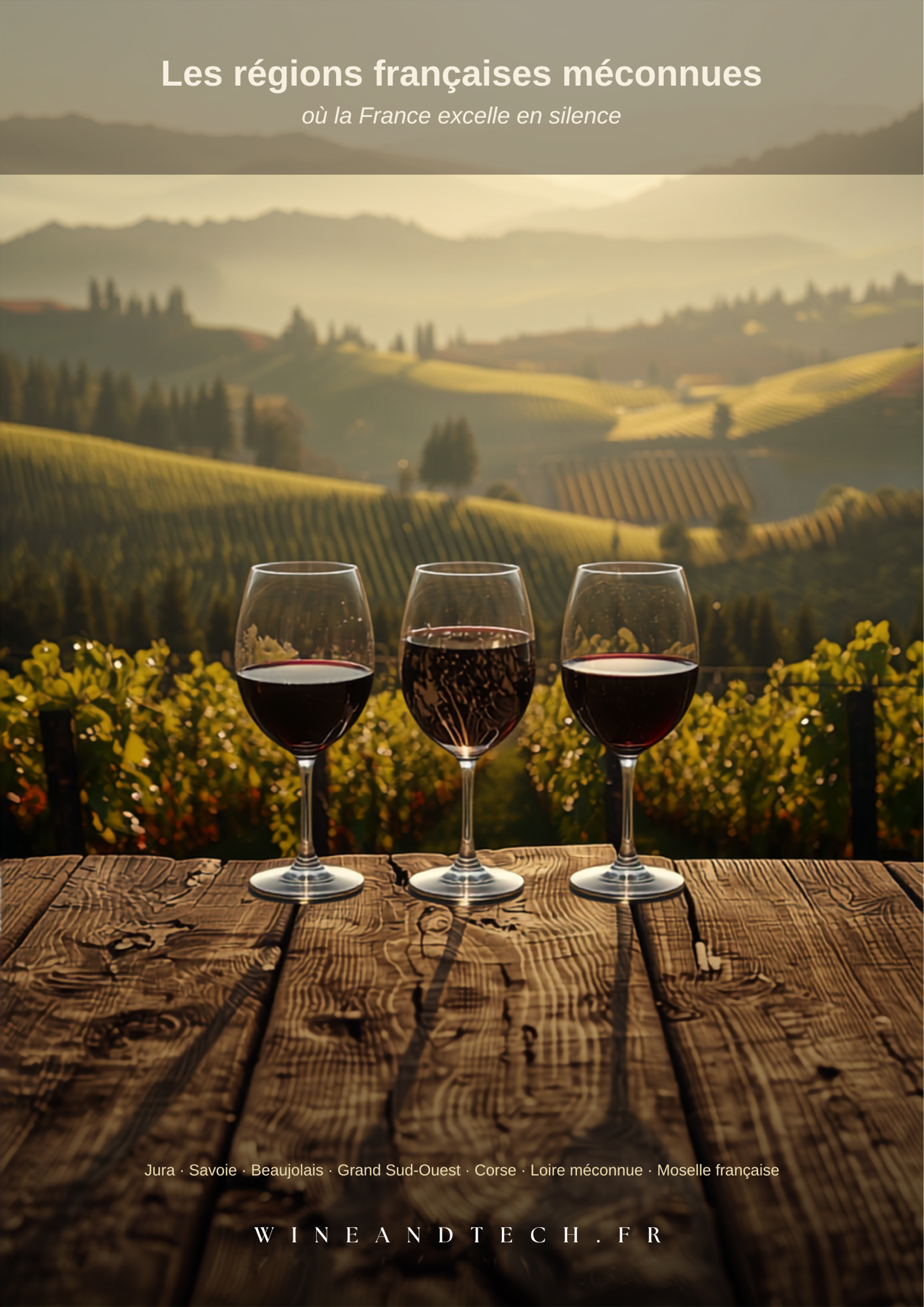
    Bordeaux, Burgundy, Champagne have occupied the spotlight for decades. But one of the deeper pleasures of the French vineyard is what’s happening just outside the lights. Entire regions, sometimes invisible to the general public, produce wines of an originality and value-for-money their celebrated neighbours struggle to match. A journey through the France that surprises, even the most experienced drinkers.

    🗺️ Regions explored in this article

    Jura · Savoie · Beaujolais · Grand South-West · Corsica · Secret Loire · French Moselle

    🏔️ Jura & Savoie: two Alpine treasures

    Jura is perhaps the most singular wine region in France. Its vins jaunes, aged under a yeast veil for at least 6 years and 3 months in unsealed barrels, are like nothing else in the world: walnut, curry, spice, fresh nut and dried fruit… a tasting experience without equivalent. Its other wines, ouillé Savagnin, Poulsard (a light red with barely perceptible tannins) and the more structured Trousseau, have won over a community of drinkers in search of authenticity and character. A Jura white from an artisan winemaker between €12 and €18: one of the best surprises you can put in a glass.

    Savoie produces high-altitude wines of mineral freshness that seem made for mountain tables, but not exclusively. Altesse (Roussette de Savoie) in white, Mondeuse in red (a parent grape of Syrah) and the sparkling wines of Seyssel: a confidential region that rewards curiosity well beyond fondues and raclettes.

    🍇 Beaujolais: far beyond the Nouveau

    Beaujolais has long suffered from the image of Beaujolais Nouveau, a marketing product drunk in November and forgotten by December. But the 10 Beaujolais crus (Moulin-à-Vent, Morgon, Fleurie, Côte de Brouilly, Brouilly, Régnié, Chiroubles, Juliénas, Chénas, Saint-Amour) tell a completely different story: terroir wines on granite, schist and volcanic rock, with Gamay that can age ten years, sometimes longer from the best producers, developing a complexity that regularly trips up blind tasters convinced they are drinking Burgundy. A Morgon or Moulin-à-Vent from an artisan producer between €12 and €20: hard to find better in France for a red built to keep.

    🌄 The Grand South-West: the great overlooked

    Wedged between Bordeaux and the Pyrenees, the South-West wine country is a constellation of small appellations that never had the geographical luck to become well known. Cahors with its original Malbec, dense, structured, built for long ageing, long predating the grape’s Argentine glory. Madiran with its Tannat, among the richest red wines in polyphenols. Jurançon with its dry whites and Petit Manseng sweet wines of unexpected complexity. Irouléguy, the small Basque appellation with characterful reds on slate terraces. Marcillac and its Fer Servadou, all violet and liquorice. Passionate winemakers, often farming organically, at prices that seem almost too honest.

    🏝️ Corsica: grape varieties from the edge of the world

    Corsica deserves a mention of its own. Its grape varieties, Nielluccio (closely related to Tuscan Sangiovese), Sciacarello and insular Vermentino, are found almost nowhere else in the world. The island produces whites of striking aromatic freshness, rosés with far more character than those of Provence, spiced and sunny reds. And Muscat du Cap Corse, a protected natural sweet wine, is one of the great French Muscats: confidential, remarkable, still accessible. Prices that haven’t caught up with what’s in the bottle.

    💎 The Loire beyond Sancerre

    The Loire was introduced in our panorama. But beyond the Sancerre and Muscadet everyone knows, there is a secret Loire. The Coteaux du Layon and their Chenin Blanc sweet wines offer remarkable quality at a fraction of the price of the great Bordeaux liquoreux. Bonnezeaux and Quarts de Chaume, two tiny appellations producing exceptional liquoreux. Cour-Cheverny and its Romorantin grape, unique in the world, planted only here, with aromas of beeswax and acacia that are distinctly its own. Fiefs Vendéens with their coastal Pinot Noir. The secret Loire rewards those who take the time to venture in.

    🏺 French Moselle: a region being born

    Already mentioned in our 16-region panorama, French Moselle deserves a special note here. Long in the shadow of neighbouring Alsace and Luxembourg’s Moselle, it has been carried in recent years by a new generation of demanding, passionate winemakers. While its dry whites and gris on limestone soils, taut, mineral, precise, are winning over more and more enthusiasts, the region is also revealing a Pinot Noir of real elegance. Made with care by several of the region’s leading estates, it has a freshness, delicacy and precision that hint at everything this northern terroir is capable of. These wines are finding their way onto wine lists across the Grand Est, championed by sommeliers looking for authentic terroirs and new signatures. A region to watch… before the prices follow suit.


    The paradox of the unknown wine

    What all these regions have in common: they are not yet fashionable. Which means winemakers haven’t yet raised prices under demand pressure, labels don’t carry the weight of speculation, and the curious buyer can make remarkable finds for €10 to €18. The great secret of French wine: its most singular treasures are often hidden where no one is looking yet. The best sommeliers have known this for a long time. It’s time everyone else did too.

    The wines that surprise most in blind tastings don’t always come from where you’d expect.

  • Spanish wine: a million hectares, a quiet revolution

    Spanish wine: a million hectares, a quiet revolution

    ⏱ 4 min

    If France is the homeland of terroir and Italy the homeland of absolute diversity, Spain is the homeland of generosity. Close to a million hectares of vines — the largest wine-growing area in the world. Over 70 designations of origin. A quiet quality revolution that began in the 1990s and has never let up. Tempranillo, Garnacha, Albariño, Mencía: inimitable grape varieties offering character and complexity at prices that remain among the most reasonable in Europe. Spain doesn’t just make wine: it has reinvented its wine identity, region by region.

    ~950,000

    hectares (world record)

    70+

    designations of origin

    2

    DOCa (Rioja · Priorat)

    ~4,000

    wineries and bodegas

    The quiet revolution

    In the 1980s, Spain was still mainly a supplier of bulk wine. Then a combination of new winemaking talent, massive investment in cellars, the rediscovery of old vines and a renewed regional pride changed everything. Today, Spain produces some of the most original and complex wines in the world — while keeping prices that remain, on the whole, lower than their French or Italian equivalents of the same quality.

    🏔️ The Historic North: Rioja, Ribera del Duero, Navarra

    Rioja (DOCa since 1991) remains the region’s figurehead — its Tempranillo, aged in barrel across three tiers (Crianza: at least twelve months in barrel for reds, Reserva: 1 year in barrel + 1 year in bottle, Gran Reserva: 2 years in barrel + 3 in bottle), defined the Spanish style for the entire world. But it’s also where small artisan producers do some of the most interesting work: a quality Crianza remains accessible at €8–14. Ribera del Duero, at 850m altitude, produces a more structured, denser Tempranillo (known locally as Tinto Fino) with more pronounced natural acidity. Vega Sicilia, Pingus — the legends are here. But so are many remarkable artisan producers at far lower prices. Navarra, long known for its Garnacha rosés, is now exploring far more ambitious styles.

    🌊 Atlantic Galicia: Rías Baixas, Bierzo, Ribeiro

    Spain’s green, rainy north-west is the polar opposite of the sun-drenched Spanish wine cliché. Rías Baixas produces Albariño — a fresh, aromatic, high-acid white, perfect with Galician seafood and one of the most seductive Atlantic whites in Europe. Bierzo, with its Mencía grown on granite and slate, is one of the most exciting discoveries of the past twenty years: fresh, floral, age-worthy reds at still-modest prices. Ribeiro offers original, little-known blends of indigenous white varieties.

    ☀️ The Levante and the South: Priorat, Jumilla, Jerez

    Priorat (DOCa since 2000 — one of only two in the whole of Spain, alongside Rioja) produces wines of striking concentration and complexity, made from century-old Garnacha and Cariñena grown on llicorella (black slate) soils. Intense, deep, built to age. Jumilla and its Monastrell offer full-bodied, highly accessible wines. But it’s Jerez that perhaps represents Spain’s most original proposition: fino, manzanilla, amontillado, oloroso, Pedro Ximénez — five radically different styles, produced through a solera ageing system unique in the world, blending biological and oxidative winemaking. One of wine’s great forgotten treasures — and one of its greatest gifts of generosity.

    🥂 Bubbles and Whites: Cava and Rueda

    Cava (Penedès, Catalonia) produces traditional-method sparkling wine from indigenous grape varieties (Macabeu, Xarel·lo, Parellada) at prices that rival entry-level Champagne — with a very different character, more fruit-forward, mineral in its own way. Rueda and its Verdejo is Spain’s best-selling white wine domestically: crisp, herbaceous, fresh — a delicious, very affordable alternative to Sauvignon Blanc.


    Price: the real revolution

    This is perhaps where Spain impresses most: quality has risen, but prices haven’t kept pace. A serious producer’s Rioja Crianza at €8–14. An old-vine Garnacha from Aragón at €7–10. A Jumilla Monastrell at €6. A quality Cava at €8. Few countries today offer a comparable quality-to-price ratio. Across every price bracket, from everyday wines to great age-worthy cuvées, Spanish wine manages to combine identity, quality and accessibility. That is probably its greatest strength. It’s the great promise of Spanish wine — and it delivers.

    It took Spain thirty years to reveal what its vines had been hiding for centuries.

  • Water and the Vine: When Irrigation Becomes a Matter of Precision

    Water and the Vine: When Irrigation Becomes a Matter of Precision

    ⏱️ Reading time: 9 minutes

    Summer 2026. Between 17 and 29 June, an early heatwave pushed soils across several French regions — notably Aquitaine, Auvergne and Midi-Pyrénées — to some of the most severe drought levels recorded since monitoring began in 1959. By the end of June, nearly 80 départements were under water restriction orders. And this time, it is hard to call it an isolated incident: since 2001, according to the French Ministry of Ecological Transition, France has lost almost 14% of its renewable water resources, and a growing share of its territory now faces restriction measures every year. For the vine, the question is no longer whether drought will return, but how to live with it.

    Yet something has just shifted — not in the sky, but in the law. Meeting on 17 and 18 June 2026, the INAO’s national committee for AOC wines endorsed an approach that, ten years ago, would have seemed heretical: reversing the very logic of irrigation. Moving from a ban in principle with individual exemptions to a regulated authorisation, capped at modest volumes. The barrier is no longer legal. It has become technical. And that is where everything is at stake: because irrigating a vine today is not about opening the floodgates. It is about learning to give very little water, in exactly the right place, at exactly the right moment.

    A DOGMA CRUMBLING

    From prohibition to management: what INAO is changing

    For decades, irrigation of appellation vineyards was close to forbidden. The logic was clear: an AOC is a terroir, and a terroir worthy of the name imposes its own water stress on the plant. Watering was cheating. Decree no. 2017-1327 of 8 September 2017 pushed the door ajar: irrigation once again became possible for AOCs whose specifications explicitly allow a departure from the prohibition, subject to an annual request from the ODG (the appellation management body) to INAO, within a strict calendar window. Originally, only a small fraction of French appellations was concerned (88 out of 309 at the time of the decree), with the others free to amend their specifications accordingly.

    This exemption-based regime has one major flaw, well known to the sector: latency. By the time the request works its way up and authorisation comes back down, water sometimes arrives several days after the optimal moment — time the vine will never recover. That is precisely the paradigm the June 2026 orientation intends to overturn. According to INAO director general Caroline Ly, the idea is no longer to prohibit unless exempted, but to authorise irrigation within a framework that keeps consumption modest. A shift in philosophy as much as in procedure.

    Adding water does not increase yield, but it is essential to keep the plant alive — in quantities that are not that significant.

    Caroline Ly, Director General of INAO (from statements to Vitisphère, June 2026)

    That sentence contains the whole thread of this story. For that is the ridge line: water applied without precision inflates yield, dilutes the berries, genericises the wine — exactly what the AOC exists to prevent. Applied with precision, it keeps the plant alive without betraying the terroir. And one final safeguard remains: whatever INAO says, water law still takes precedence. In the middle of a heatwave, with nearly 80 départements under prefectoral restriction orders, a viticultural exemption is worthless against a crisis-level ban. The right to irrigate does not create the resource.

    Under Mediterranean summers, water stress is no longer an exception but a structural reality.

    MEASURE BEFORE YOU WATER

    The real question is not whether to irrigate — it is knowing when

    If the barrier is now technical, then the subject shifts from “should we irrigate?” to “how do we manage it?” And management always begins with measurement. Let us recall the agronomic principle: the vine thrives on a degree of thirst. Moderate water stress as véraison approaches concentrates the berries, promotes sugar development and quality. But beyond a certain threshold, stress halts ripening, dehydrates the bunches and causes yield to plummet. All the skill lies in navigating between these two limits — impossible to judge by eye: data is required. Welcome to precision irrigation.

    The soil: tensiometers and capacitive probes

    First layer of data: the water status of the soil. Two families of sensors share the field, and the distinction is more than a detail. The capacitive probe measures volumetric humidity — the actual percentage of water present in the soil. The tensiometer measures something different: the matric potential, meaning the force the roots must exert to extract water, expressed in centibars or kPa. This is often the more informative reading, as it directly reflects the effort demanded of the plant. Manufacturers such as Weenat offer connected tensiometer kits distributed across multiple depths (typically 15–30 cm and 30–60 cm), with readings fed in real time to an app, with no need to walk the plot. The old dial-gauge tensiometer that had to be read in the field is disappearing.

    The plant: the pressure chamber, the reference measurement

    Measuring the soil is good; measuring what the plant actually does with it is better. The pressure chamber (or Scholander chamber) remains the gold standard: a leaf or shoot is inserted, and increasing pressure is applied until sap exudes, giving the plant’s water potential — a direct reading of its stress level. It is the benchmark of technical centres and advisors: precise, but demanding — a delicate instrument, a point-in-time measurement, and specialist know-how required. Hence the value of pairing it with soil sensors running continuously. The plant measurement calibrates; the sensors monitor.

    The sky: remote sensing and NDVI

    Scale up. To map the heterogeneity of an entire vineyard — because no plot is uniformly thirsty — you look upward. Satellite remote sensing exploits the NDVI (Normalized Difference Vegetation Index), which indicates canopy vigour and, indirectly, water stress. The key advantage: Sentinel-2 satellites from the European Copernicus programme deliver an image every five days, at 10–20 metre resolution, free of charge. Groupe ICV and TerraNIS have built on this foundation a large-scale management tool capable of tracking water status plot by plot, and even of verifying whether the water trajectory matches the target wine profile. Known limitation: resolution does not reach individual vines, and cloud cover can obscure an image. Where fine detail is needed, the drone takes over.

    Connected probe at the base of the vine: data before the drop.

    The logic of precision irrigation is one of layered, complementary inputs: soil (tensiometry, capacity), plant (pressure chamber), sky (satellite, drone). None is sufficient alone. It is their combination that transforms an intuition — “the vine is thirsty” — into a precise decision: how many cubic metres, on which plots, which night.

    The brain: decision-support tools

    The final step is making all this data speak. That is the role of DSTs (decision-support tools), which combine sensor data, weather forecasts and water-balance models. Vintel, developed by itk, simulates the vine’s water trajectory. Irré-LIS, the Arvalis model, calculates balances across multiple crops. Weenat offers Weedriq, which projects tensiometry readings seven days ahead based on field measurements and local weather. In other words, it does not merely say “your soil is dry today” — it says “it will be in a week; act now.” That is where artificial intelligence makes its real contribution: not to water in place of the winegrower, but to anticipate the window for action before stress sets in. Irrigation shifts from being a reaction to becoming an anticipation.

    TECHNOLOGY IN SERVICE OF TERROIR

    Irrigating without diluting

    Back to the ridge line. All this instrumentation serves one objective: delivering the strict minimum, at the precise moment when it makes a difference — often at night, around véraison — without ever inflating yield. To the measurement tools correspond the distribution tools, and here too precision is the rule. Buried drip irrigation, now permitted in AOC vineyards, achieves an efficiency of 90 to 95%: evapotranspiration is near zero, every drop reaches the roots. The cost is not negligible — the Hérault Chamber of Agriculture estimated installation of an above-ground network at between €2,000 and €3,000 per hectare, excluding the pumping station, for consumption of 300 to 1,000 m³/ha — but the order of magnitude remains modest against the value of a saved harvest.

    It is the only method that allows water to be delivered with precision and efficiency.

    Hernan Ojeda, director of the INRAE unit at Pech-Rouge, on drip irrigation

    And irrigation is not always the first answer anyway. Before watering, demand can be reduced: soil mulching, hydro-retaining agents, drought-tolerant grape varieties, adapted canopy management. Precision management tools have a quiet virtue here too: by making actual needs objective, they often reveal that less irrigation than expected is required. That may be the most reassuring paradox in this story — well measured, the vine’s thirst turns out to be more reasonable than feared.

    France starts from behind: it irrigates a far smaller share of its vineyards than Spain or Italy, where watering the vine is standard practice, irrigation having long been integral to viticulture in many Spanish and Italian regions. That is a lag, but perhaps an opportunity: arriving at irrigation in the era of sensors and satellites, with the tools to do it soberly from the outset, rather than opening the taps first and counting the water afterwards. The drought of 2026 is not a parenthesis. Intelligent irrigation is not a gadget for the tech-savvy winegrower. It is, increasingly, the condition for terroir to survive its own climate — without ceasing to be terroir.

    And you? Probes, remote sensing, DSTs… if you are already managing water on your plots, share your experience in the comments. And if this breakdown has been useful, pass it on.


    Sources: INAO — national committee for AOC wines, orientation of 17–18 June 2026 (via Vitisphère); Decree no. 2017-1327 of 8 September 2017 on irrigation of AOC vineyards; Météo-France and BRGM — 2026 drought bulletins; VigiEau (restrictions as of 26 June 2026); Pyrénées-Orientales Chamber of Agriculture (triggering of irrigation in AOP, June 2026); Réussir Vigne, “Irrigation en viticulture : mode d’emploi”; ICV / TerraNIS (Sentinel-2 remote sensing management); Weenat (tensiometric probes and Weedriq DST); INRAE Pech-Rouge (Hernan Ojeda); Hérault Chamber of Agriculture (installation costs). Market figures: projected growth of smart irrigation in France 2025–2031.

  • Italy’s 500 grape varieties: an extraordinary panorama

    Italy’s 500 grape varieties: an extraordinary panorama

    ⏱ 4 min

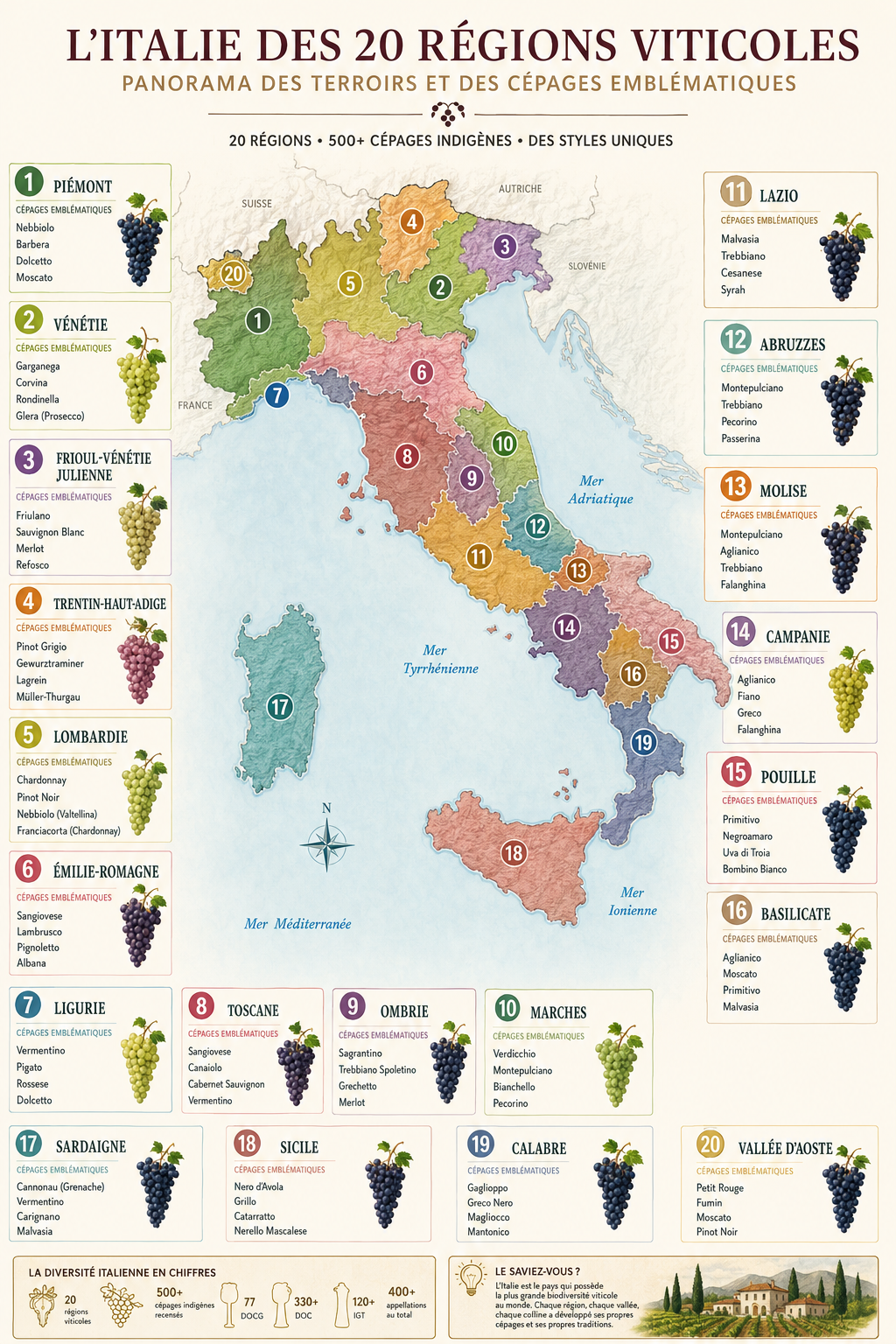
    If France is the homeland of terroir, Italy is the homeland of absolute diversity. Twenty wine regions, all active. Five hundred indigenous grape varieties recorded — a diversity probably unmatched anywhere in the wine world. Over four hundred appellations. Styles ranging from the sparkling Prosecco of Veneto to Piedmontese Barolo, from the mineral freshness of Soave to the generous warmth of Puglia’s Primitivo. Italy doesn’t just make wine: it reinvents the definition of wine in every region.

    20

    wine regions

    500+

    indigenous grape varieties

    400+

    DOCG + DOC appellations

    50,000+

    wineries and wine businesses

    The geography of taste: from the alpine North to the Mediterranean South

    Italy’s wine country stretches 1,300 km from north to south, an extraordinary succession of microclimates. In the north, the Alps shelter the vines and allow for wines of remarkable freshness and precision. In Tuscany and the Centre, altitude and proximity to the sea create a perfect balance between ripeness and acidity. In the south and on the islands, Mediterranean sun pushes concentration and aromatic richness. Every region has developed its own grape varieties, its own techniques, its own philosophy.

    Map of Italy's wine regions

    🏔️ The Great North: from Piedmont to Friuli

    Piedmont is Italy’s Burgundy — not as flattery, but as logic: a king grape almost impossible to reproduce elsewhere (Nebbiolo), hierarchised crus (Barolo, Barbaresco), a precision of terroir that tolerates no approximation. But it’s also the home of juicy, affordable Barbera, fresh Dolcetto, and Moscato d’Asti, which delights even the most demanding palates. Veneto is Italy’s largest wine-producing region, with an unbeatable quality-to-price ratio: Prosecco for the aperitif, Soave Classico with seafood, Valpolicella Ripasso with meat, Amarone for special occasions. Friuli produces some of Italy’s finest dry whites. Trentino-Alto Adige, with its Austro-Germanic influences, refines Pinot Blanc, Gewürztraminer and Lagrein on exceptional alpine terroirs. Lombardy rounds things out with Franciacorta and Valtellina (Nebbiolo grown on mountain terraces).

    🌿 The Tuscan Heart and the Centre

    Tuscany is the best-known face of Italian wine internationally: Chianti Classico, Brunello di Montalcino, Vino Nobile di Montepulciano, and the Bolgheri “Super Tuscans” (Sassicaia, Ornellaia, Tignanello) — wines that redefined modern Italy. Umbria reveals Sagrantino di Montefalco, one of the most tannic grape varieties in the world, capable of ageing for thirty years. The Marche region offers Verdicchio, a dry white of striking freshness and minerality. Abruzzo — not to be confused with the Tuscan town of Montepulciano — produces a generous, accessible Montepulciano d’Abruzzo, one of the best value wines in Italy.

    ☀️ The Deep South and the Islands

    Campania is the great revelation of the past twenty years: Taurasi, sometimes nicknamed the “Barolo of the South” for its ageing potential, Greco di Tufo, and Fiano di Avellino — three grape varieties of remarkable depth and originality. Puglia produces in volume but is rising in quality: Primitivo di Manduria, Negroamaro and Salice Salentino deserve attention. Sicily has undergone the most spectacular transformation of all: Etna (Nerello Mascalese grown on volcanic soils) produces wines of an elegance utterly unexpected at these latitudes, while Nero d’Avola remains the island’s warm, approachable ambassador. Sardinia, with its Cannonau and Vermentino, completes a panorama of extraordinary richness.


    500 inimitable grape varieties — Italy’s true strength

    France has several hundred recorded grape varieties, Spain around 400, but Italy ranks among the richest countries with over 500 identified varieties — and some studies on the genetic diversity of Italian vines suggest the existence of thousands of historic local varieties or populations still to be documented.

    Grape varieties that cannot be grown anywhere else with the same results: Nebbiolo loses its character outside Piedmont, Sagrantino outside Montefalco, Nerello outside the volcanic ash of Etna. It’s this irreducible specificity that makes every Italian bottle a journey to a precise place, a particular story. Where France built its identity around terroir and Spain around an extraordinary capacity for modern transformation, Italy celebrates, above all, the meeting of a land, a history and a forgotten grape variety.

    Italy doesn’t produce wine. It produces civilisations in a bottle.

  • The French wine panorama: 16 regions, one obsession

    The French wine panorama: 16 regions, one obsession

    🇬🇧 Series · The Vinous Trinity · Article 1/15 · France

    ⏱ 5 min

    France has been producing wine for over 2,600 years. But it’s not seniority that makes it unique — it’s diversity.

    From Alsace to Corsica, from Champagne to Moselle, through Bordeaux, Burgundy, Beaujolais, Jura, Savoie-Bugey, the Loire Valley, the South-West, the Rhône Valley, Provence, Languedoc and Roussillon, France offers one of the richest and most diverse wine heritages in the world.

    France traditionally counts 13 major wine regions, although some classifications distinguish more. With close to 360 Protected Designations of Origin (PDO) and thousands of winemakers, every corner of the country has developed its own grape varieties, its own styles, its own identity. A panoramic view of a vineyard without equal in the world.

    16

    wine regions

    360+

    AOC / AOP

    ~200

    grape varieties

    ~60 000

    wine estates

    Geography as the first grape variety

    Before talking about Merlot or Pinot Noir, we need to talk about geography. France’s wine map follows climate above all else: in the West, Atlantic influences shape fresh, fruit-forward wines. In the Centre, continental conditions bring tension and minerality. In the South, the Mediterranean delivers sunshine and body. In the East, mountain ridges create unique microclimates. And everywhere, the soil — limestone, granite, schist, clay, flint — imprints its signature on every bottle. That’s terroir: not a marketing word, but a genuinely untranslatable concept that France gave the world.

    🌊 The Atlantic West: Bordeaux, Loire, South-West

    Bordeaux is the most globally recognised French wine name — its Merlot and Cabernet Sauvignon blends defined ‘fine wine’ for an entire generation. But behind the famous châteaux, hundreds of family properties produce remarkable wines at €10–20. Generic Bordeaux is quietly making a qualitative comeback, driven by a new generation of winemakers and a voluntary reduction in yields. The Loire Valley (300 km of vines!) is the region of diversity: Muscadet sur lie, Sancerre on flint, Chinon on tuffeau, Vouvray’s honeyed Chenin Blanc — all wildly different, all from one river. The South-West, often overlooked, is a genuine treasure: Cahors with its original Malbec, Madiran’s grippy Tannat, Jurançon’s extraordinary sweet whites — winemakers’ wines, at very honest prices.

    ☀️ The Southern Corridor: Rhône, Languedoc, Provence, Corsica

    The Rhône Valley shifts personality from north to south: in the north, Syrah on steep granite slopes in Côte-Rôtie and Hermitage produces wines of rare depth and tension. In the south, the rounded stones of Châteauneuf-du-Pape bring out the generous side of Grenache. Between the two, Crozes-Hermitage and Côtes-du-Rhône Villages offer rising quality at accessible prices. Languedoc-Roussillon, France’s largest wine region by surface area, has transformed itself over 20 years: Minervois, Saint-Chinian, Pic Saint-Loup, Corbières offer terroir-driven wines at among the most accessible prices in the country. Provence conquered the world with its rosé. Corsica, with its endemic grape varieties (Nielluccio, Sciacarello), surprises everyone who ventures there.

    🗺️ The Continental Heart: Burgundy, Beaujolais, Jura, Savoie

    Burgundy is the other world capital — for reasons opposite to Bordeaux. No blending here: one grape variety (Pinot Noir or Chardonnay), one terroir (the climat), one interpretation of that terroir. Great Burgundies achieve a precision and elegance that remains unmatched. But regional or village Burgundies, often overlooked, are among the best deals in France. Beaujolais and its joyful Gamay, Jura and its vins jaunes (genuinely unique in the world), Savoie and its high-altitude wines: three small regions worth exploring urgently.

    🥂 East and North: Alsace, Champagne, Moselle

    Alsace is the only major French region where wines are labelled by grape variety — a Germanic tradition fully embraced. Riesling, Gewurztraminer, Pinot Gris, Muscat: four noble varieties, on exceptional terroirs between the Vosges and the Rhine, from bone-dry to luscious. Champagne needs no introduction, but its Récoltants-Manipulants (RM) — winemakers who grow, make and bottle their own wine on their own estate — are perhaps the great discovery of recent years: small 4–10 ha houses, striking individual identities, a world away from the big brands. French Moselle, a small Lorraine outpost, rounds out the picture with its dry whites and gris on limestone soils. Driven by a new generation of ambitious and demanding winemakers, it is gradually establishing itself as one of France’s most promising emerging wine regions. Although still little known to the general public, its cuvées are already finding their way onto the wine lists of many restaurants in the Grand Est, championed by sommeliers in search of authentic terroirs and new signatures.


    360+ AOC: an unmatched guarantee of origin

    With over 360 Protected Designations of Origin, France has built a wine certification system where few countries push the level of plot-level and regulatory precision as far. Each AOC sets precise rules: authorised grape varieties, maximum yields, cultivation and winemaking methods. It’s not an absolute guarantee of quality for every individual bottle — but it’s a guarantee of typicity and origin that no other nation can match at this scale. When you buy a Sancerre, you know it’s Sauvignon Blanc, grown on flint and clay soils, within a precisely defined geographic boundary. That level of traceability is unmatched anywhere in the wine world.

    France doesn’t produce wine. It produces territories in a bottle.

    What’s coming next

    This panorama is just the door. Over the coming weeks: the overlooked regions that surprise even seasoned sommeliers (next Monday), the emblematic grape varieties that define French identity, the artisan winemakers who are its soul, and our selection of 5 bottles under €15 that prove excellence isn’t reserved for big budgets.

    Wednesday: Italy — the country of 500 grape varieties. Friday: Spain and its quiet wine revolution.

  • Cabernet Sauvignon: The King of Grape Varieties — Why Does It Dominate the World?

    Cabernet Sauvignon: The King of Grape Varieties — Why Does It Dominate the World?

    📚 Grape Varieties of the World · Episode 1  |  ⏱ Reading time: 7 minutes

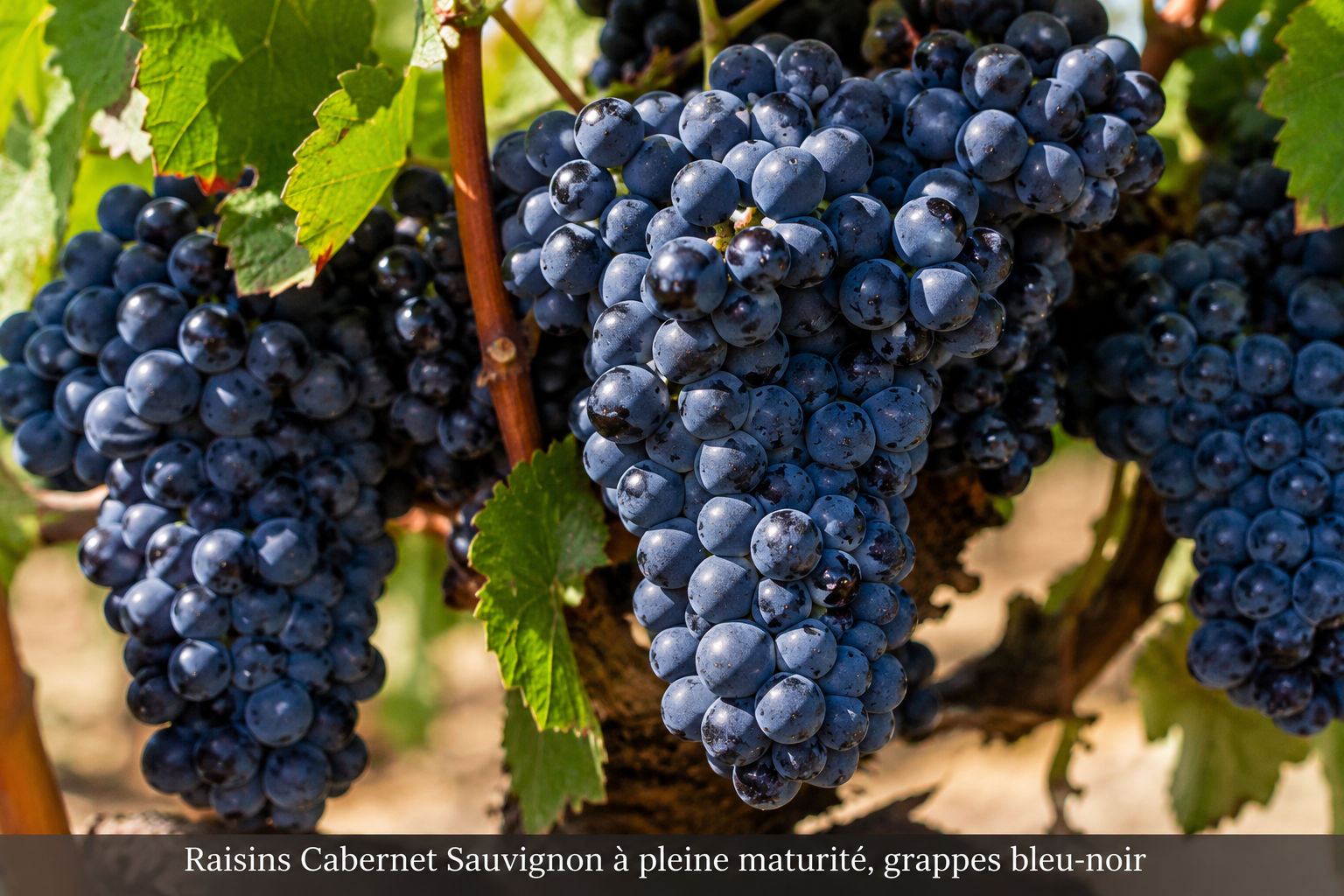
    Every year, millions of bottles of Cabernet Sauvignon are opened across the globe. From the great châteaux of Bordeaux to Californian estates, from Chilean vineyards to Australian terroirs, few grape varieties have conquered so many territories while retaining such a recognisable identity. Robust, built for ageing and capable of producing some of the planet’s greatest wines, Cabernet Sauvignon has established itself as the undisputed king of red grape varieties.

    In this first episode of our Grape Varieties of the World series, we unpack a global dominance that has lasted for more than three centuries.


    A Botanical Accident Turned Global Superstar

    Cabernet Sauvignon was not created by a visionary winemaker, nor selected in a laboratory. It was born from a botanical accident. Probably in the 17th century, in the Bordeaux region, two grape varieties growing in close proximity crossed naturally: Cabernet Franc, already well established in south-west France, and Sauvignon Blanc, celebrated for its aromatic expression. From this chance encounter came a vigorous, late-ripening variety particularly rich in tannins.

    For a long time, this origin remained nothing more than a hypothesis passed down from generation to generation.

    🔬 The Science Behind the Grape

    In 1996, a team of geneticists at the University of California, Davis, led by John Bowers and Carole Meredith, scientifically confirmed the parentage of Cabernet Sauvignon through DNA analysis. This discovery explained why the variety inherits the structure of Cabernet Franc while exhibiting specific aromatic compounds: methoxypyrazines, responsible for the green pepper notes that appear when grapes are harvested before full maturity. Molecular biology at the service of the sommelier.

    From Bordeaux to Napa: A Grape That Travels Remarkably Well

    The Bordeaux region is the historical birthplace of Cabernet Sauvignon. It is in the Médoc that it found its most iconic expression. The gravelly soils, made up of pebbles deposited by the Garonne river during the Quaternary period, provide exceptional drainage. The vine is forced to send its roots deep in search of water, encouraging slow ripening and a remarkable concentration of tannins and aromas. This combination shaped the reputation of Pauillac, Margaux and Saint-Julien.

    Its extraordinary capacity for adaptation is one of its greatest strengths. Four major expressions illustrate this versatility:

    • 🇫🇷 Médoc, Bordeaux — elegance and slow ageing, blended with Merlot and Cabernet Franc, complexity that reveals itself over decades
    • 🇺🇸 Napa Valley (Rutherford, Oakville) — more generous and sun-drenched wines, powerful structure, pronounced fruit maturity
    • 🇨🇱 Maipo Valley, Chile — fresh expression, characteristic minty notes, the signature of large day-to-night temperature swings
    • 🇦🇺 Coonawarra, Australiaterra rossa (red clay over limestone), dense, spiced wines of remarkable longevity
    Carte des principaux vignobles de Cabernet Sauvignon dans le monde ✦ VITICULTURE MONDIALE ✦ Carte des principaux vignobles de Cabernet Sauvignon dans le monde Les 4 grands terroirs mondiaux · Ancien & Nouveau Monde Bordeaux — Médoc · Pauillac (France) Bordeaux France Ribera del Duero — Castille-et-León (Espagne) Ribera del Duero Espagne Toscane — Bolgheri · Super Toscans (Italie) Toscane Italie Napa Valley — Oakville · Rutherford (Californie, USA) Napa Valley Californie, USA Washington State — Columbia Valley (USA) Washington State USA Maipo Valley — Puente Alto (Chili) Maipo Valley Chili Mendoza — Luján de Cuyo (Argentine) Mendoza Argentine Coonawarra — Terra Rossa (Australie) Coonawarra Australie Margaret River — Australie-Occidentale (Australie) Margaret River Australie Stellenbosch — Cap-Occidental (Afrique du Sud) Stellenbosch Afrique du Sud Équateur 50°N 30°N 30°S 50°S Terroir emblématique Vignoble reconnu Europe · Ancien Monde Bordeaux · Ribera del Duero · Toscane Amérique du Nord Napa Valley · Washington State Amérique du Sud Maipo Valley · Mendoza Hémisphère Sud Coonawarra · Margaret River · Stellenbosch Le Cabernet Sauvignon s’épanouit entre 30° et 50° de latitude Nord et Sud · wineandtech.fr
    Carte des principaux vignobles de Cabernet Sauvignon dans le monde — wineandtech.fr

    The Wines That Built Its Legend

    No discussion of Cabernet Sauvignon would be complete without the wines that forged its worldwide reputation:

    • 🇫🇷 Château Latour & Château Mouton Rothschild — the mastered power of the Médoc, wines capable of evolving over several decades
    • 🇺🇸 Opus One (1979, Robert Mondavi × Baron Philippe de Rothschild) — proof that the New World could rival the finest Bordeaux classified growths
    • 🇨🇱 Almaviva — the successful alliance of Bordeaux expertise and Andean terroirs
    • 🇦🇺 Penfolds Bin 707 — Australia’s benchmark Cabernet, known for its intensity, aromatic richness and immense ageing potential

    One Style, A Thousand Faces

    On the palate, Cabernet Sauvignon is immediately recognisable by its assertive tannic structure and aromas of blackcurrant, blackberry and dark fruit. Depending on climate and ripeness level, notes of cedar, graphite, tobacco, green pepper, eucalyptus or mint can enrich its aromatic profile.

    In Bordeaux, it is rarely vinified alone — it typically forms the backbone of blends with Merlot, Cabernet Franc or Petit Verdot. In warmer climates such as California or Australia, it is more often crafted as a single variety: wines gain in breadth, fruit maturity and richness, with a more pronounced oak influence.

    🍷 Classic Tasting Note

    💃 Colour: Deep red, purple hues in youth, brick tones with age
    👃 Nose: Blackcurrant, blackberry, plum · cedar, graphite, tobacco, leather at maturity
    👄 Palate: Firm yet silky tannins, good acidity, long and persistent finish
    🍽️ Food pairing: Roast lamb, rib-eye steak, aged cheeses, rich meat dishes

    Cabernet Sauvignon and Climate Change

    Long regarded as a natural ally of global warming due to its late-ripening nature, Cabernet Sauvignon is now seeing its equilibrium shift. Increasingly early harvests are driving up alcohol levels while progressively reducing acidity. In the warmest vintages, this evolution can diminish the freshness that forms a key part of the variety’s identity.

    Faced with these new conditions, winemakers are adapting their practices: rebalancing blends, seeking out cooler plots, and experimenting with newly authorised varieties. At the same time, Cabernet Sauvignon is conquering new territories — southern England, British Columbia, high-altitude vineyards in Argentina and Chile. Its world geography is in full transformation.

    Why It Remains Unbeatable

    Sunset grape harvest, adaptation to viticultural climate change (Kent Porter / The Press Democrat)

    Resilient, adaptable, equally comfortable in a blend or as a single variety, gifted with an exceptional ageing potential and able to express the character of a terroir with rare precision: Cabernet Sauvignon brings together all the qualities that explain its enduring success. It remains today the most widely planted red grape variety in the world, ahead of Merlot and Syrah.

    From Bordeaux to Coonawarra, via Napa and the Maipo, it continues to write the story of a botanical accident that became one of wine’s greatest ambassadors.

    📌 Key Takeaways

    • Born from a natural cross between Cabernet Franc × Sauvignon Blanc (17th century, Bordeaux)
    • Parentage confirmed by DNA analysis in 1996 — University of California, Davis
    • The world’s most planted red grape variety
    • 4 major expressions: Bordeaux · Napa Valley · Chile · Australia
    • High tannic structure → ideal for ageing (10 to 30+ years)
    • Evolving in the face of climate change

    ➡️ Next Episode — 1st September

    Its aromatic identity is surprisingly understated — and that is precisely what allows it to reveal, with rare faithfulness, the terroirs from which it comes. Mineral in Chablis, rich and generous in California, taut in Champagne or complex in Burgundy, it shifts character without ever losing its elegance.

    Next up: Chardonnay — how did such a versatile grape become the most planted white variety in the world?

  • France · Italy · Spain: the vinous trinity — a multilingual series

    🇬🇧 This series explores Europe’s three great wine countries. Italy articles are published in French and Italian on the same page. Spain articles in French and Spanish. The French version is the original — this is the English translation.

    🇫🇷 Cette série explore les trois grands pays du vin européen. Les articles sur l’Italie sont publiés en français et en italien. Les articles sur l’Espagne, en français et en espagnol.

    🇮🇹 Questa serie esplora i tre grandi paesi europei del vino. Gli articoli sull’Italia saranno pubblicati in francese e in italiano sulla stessa pagina. La versione inglese è disponibile in fondo alla pagina.

    🇪🇸 Esta serie explora los tres grandes países del vino europeos. Los artículos sobre España se publicarán en francés y en español en la misma página. La versión en inglés está disponible al final de la página.

    Three countries. Thousands of appellations. And close to 70% of global wine export value. France, Italy and Spain don’t dominate the wine world by chance — they are three civilisations of the vine, three thousand-year histories that shaped wine culture as we know it today. Over the next eight months, we’ll explore them together, in depth, and in their own languages.

    Sixteen articles. Four languages. Three countries. One thread: the conviction that the world’s finest wines are also its most accessible — and that they deserve to be discovered in the language that gave them life.


    🇫🇷 France: where the concept of terroir was born

    Thirteen major wine regions. Over 350 AOC/AOP appellations. Around 200 grape varieties cultivated. France invented the concept of terroir — the idea that soil, climate and the history of a place translate directly into the glass. From Alsatian Riesling to Châteauneuf-du-Pape Grenache, from Muscadet sur lie to Champagne, every French bottle tells a story of a precise location. And for every legendary grand cru, ten independent winemakers produce artisanal gems for under €15.

    Coming up: an overview of the regions, overlooked terroirs, emblematic grape varieties, winemaker portraits, and our selection of 5 bottles under €15.


    🇮🇹 Italy: diversity in its purest form

    Five hundred indigenous grape varieties. Twenty fully active wine regions. 77 DOCG, 341 DOC. Italy is the most complex and generous wine country in the world — and probably the one that delivers the most surprises in every bottle. Nebbiolo, Sangiovese, Vermentino, Nerello Mascalese: grape varieties that cannot be replicated anywhere else. A Barbera d’Asti at €9 that outclasses many New World wines at €25.

    Italy articles will be published in French and Italian on the same page — because Nebbiolo makes more sense when you read «vino di grande struttura tannica» alongside its translation. Coming up: overview, North-to-South journey, inimitable grape varieties, vignaioli portraits, selection under €15.


    🇪🇸 Spain: the world’s largest vineyard

    Nearly one million hectares of vines. Over 70 denominations of origin. And the best value-for-money in Europe. Spain underwent a spectacular quality revolution from the 1990s onwards: Rioja, Ribera del Duero, Priorat, Rías Baixas, Bierzo — world-class terroirs, inimitable grape varieties, prices that remain remarkably reasonable. An artisanal Rioja Crianza between €8 and €12 is still very much a reality.

    Spain articles will be published in French and Spanish on the same pageporque el vino se entiende mejor en su idioma. Coming up: overview, new rising stars, grape varieties, family bodegas, selection under €12.


    The programme: 16 articles, 4 languages, 8 months

    🇫🇷 France — articles in French · English version available

    • The French wine panorama: 13 regions, one obsession
    • The overlooked regions: where France excels in silence
    • Syrah, Grenache, Chenin: the grape varieties that tell France’s story
    • Winemaker portraits: French craftsmanship up close
    • France in 5 bottles under €15: our selection

    🇮🇹 Italy — French + italiano on the same page · English version available

    • Italy of the 500 grape varieties: an extraordinary panorama / L’Italia dei 500 vitigni : un panorama unico
    • From Barolo to Nero d’Avola: a journey from North to South / Dal Barolo al Nero d’Avola : viaggio da Nord a Sud
    • Nebbiolo, Sangiovese, Vermentino: inimitable treasures / Nebbiolo, Sangiovese, Vermentino : tesori inimitabili
    • The vignaioli: when one family does everything / I vignaioli : quando una famiglia fa tutto
    • Italy in 5 bottles under €15 / L’Italia in 5 bottiglie sotto i 15 €

    🇪🇸 Spain — French + español on the same page · English version available

    • The wine landscape of Spain: one million hectares, one revolution / España vinícola : un millón de hectáreas, una revolución
    • Beyond Rioja: Spain’s new wine stars / Más allá de La Rioja : las nuevas estrellas del vino español
    • Tempranillo, Garnacha, Albariño: the grape varieties to know / Tempranillo, Garnacha, Albariño : los varietales que hay que conocer
    • Family bodegas: centuries of tradition, modern ambition / Las bodegas familiares : tradición y modernidad
    • Spain in 5 bottles under €12 / España en 5 botellas por menos de 12 €

    Wine makes more sense in its native tongue. This series is an invitation to taste differently — with the words of the