🇬🇧 Series · The Vinous Trinity · Article 9/15 · Spain — English translation of the French original
⏱ 5 min
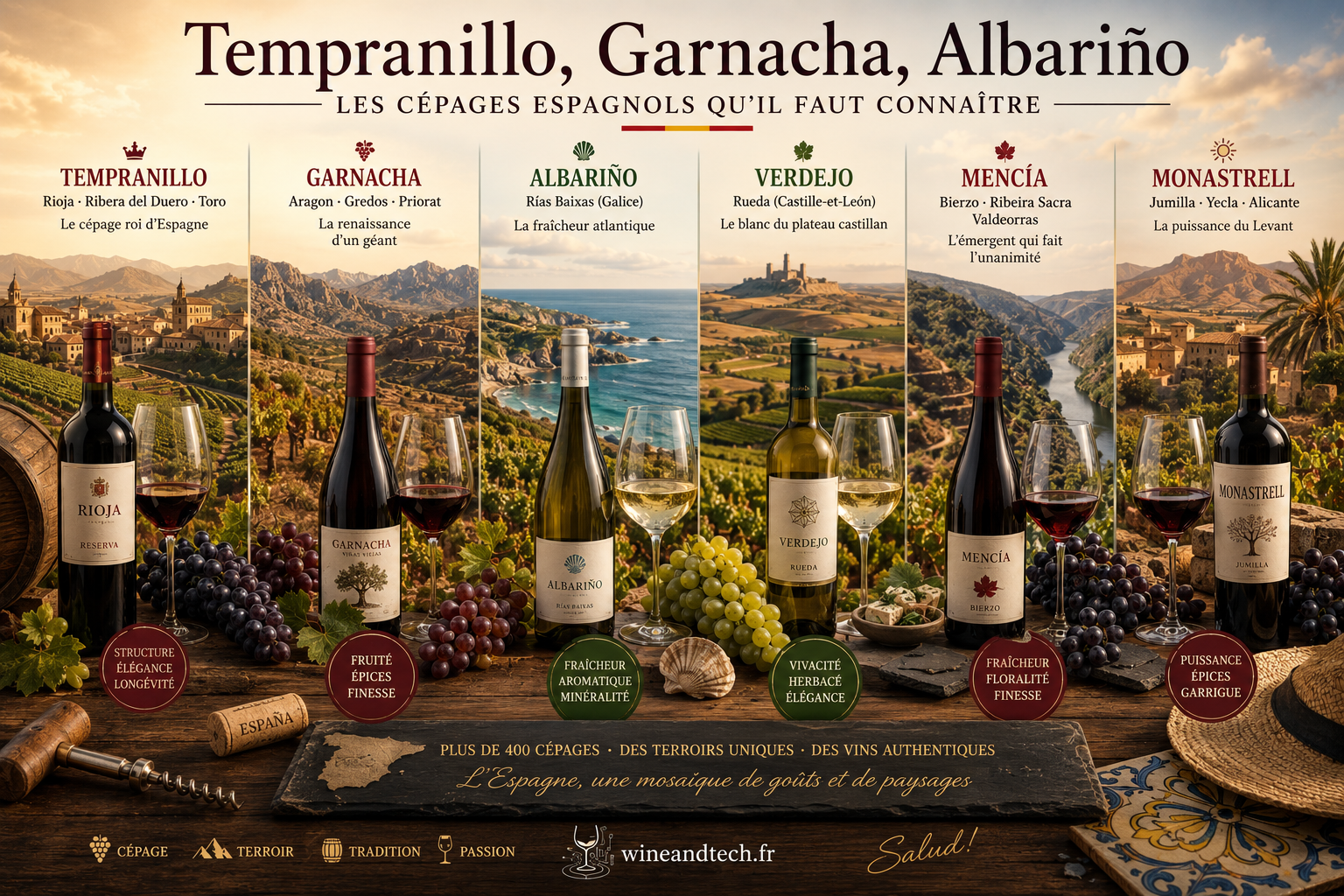
Spain boasts exceptional viticultural diversity, with more than 400 grape varieties recorded depending on the source. Much of this wealth remains little known, while a handful of varieties dominate the great appellations and define the most distinctive styles of the Iberian vineyard.
Tempranillo, Garnacha, Albariño: an iconic trio. But also Verdejo, Mencía, Monastrell, Graciano and many more. Varieties whose character largely explains why Spain has established itself among the world’s great wine nations, often with a particularly competitive offer in terms of value for money.
The Spanish Ministry of Agriculture confirms Tempranillo’s current dominance: as of 31 July 2024, it covered 195,076 hectares, ahead of Airén with 185,614 hectares.
🍇 Grape varieties explored in this article
Tempranillo · Garnacha · Albariño · Verdejo · Mencía · Monastrell
🔴 Tempranillo — Spain’s king of grapes
Tempranillo is today Spain’s most widely planted wine grape. It changes name from region to region: Tinto Fino or Tinta del País in Ribera del Duero, Tinto de Toro in Toro, Cencibel in parts of Castilla-La Mancha. It is also known as Tinta Roriz in Portugal.
In Rioja, it forms the backbone of the great reds and lends itself equally well to youthful cuvées and long barrel ageing. Traditional expressions can develop notes of red fruit, strawberry, vanilla, liquorice, cocoa, leather and tobacco with age.
In Ribera del Duero, high-altitude vineyards and wide day-night temperature swings favour wines that are often more structured and concentrated, while retaining welcome freshness.
In Toro, under the name Tinta de Toro, old vines and dry conditions produce particularly rich and powerful wines.
Tempranillo’s real strength lies in this ability to change personality according to climate, altitude, soils and the winemaker’s hand.
A true Iberian chameleon.
🔴 Garnacha — the rebirth of a giant
Garnacha, known as Grenache in France and Cannonau in Sardinia, is deeply tied to the north-east of the Iberian Peninsula. Aragón is one of its most important historic homelands.
Long used in blends or to produce simple wines and rosés, it has been enjoying a genuine qualitative renaissance for several decades.
This revolution rests above all on the rediscovery of old Garnacha vines in Aragón, in appellations such as Campo de Borja and Calatayud, but also in Terra Alta, in Catalonia, and in the vineyards of the Sierra de Gredos, south-west of Madrid.
In Gredos, some old vines planted on granite soils at high altitude yield reds of remarkable finesse, with floral, spicy and very fresh profiles.
Garnacha thus proves it can deliver far more than sun-drenched, generous wines: given old vines, altitude and controlled yields, it can reach spectacular elegance and complexity.
Its rebirth is one of the most exciting stories in contemporary Spanish wine.
🟡 Albariño — Atlantic freshness
Albariño is the flagship grape of Rías Baixas, in Galicia, on the Atlantic coast of north-west Spain.
In this cool, humid, ocean-driven region, it produces dry, aromatic, taut whites with notes of white peach, citrus, apricot, flowers and sometimes a saline touch. Granite soils and the maritime climate contribute strongly to their identity.
Rías Baixas comprises five sub-zones: Val do Salnés, O Rosal, Condado do Tea, Ribeira do Ulla and Soutomaior, each bringing different nuances to the grape’s expression.
Albariño’s natural acidity makes it an exceptional partner for seafood: oysters, shellfish, mussels, crustaceans or Galician-style octopus.
But its potential doesn’t stop at young wines. Extended ageing on the lees can bring more texture, depth and complexity, and some cuvées are perfectly capable of evolving in bottle.
An Atlantic white that combines freshness, precision and true territorial identity.
🟡 Verdejo — the white of the Castilian plateau
Verdejo is the great white grape of Rueda, in Castilla y León.
The appellation’s vineyards sit mainly on a high plateau, between 700 and 800 metres in altitude, subject to cold winters, hot dry summers and wide temperature swings.
In the glass, Verdejo generally delivers dry, fresh, aromatic wines with notes of fennel, citrus, fresh herbs and white-fleshed fruit, along with a characteristic touch of bitterness on the finish.
Long regarded as a simple, easy-drinking wine, Verdejo has grown considerably in ambition. The best producers now work specific plots, use lees or oak ageing and winemaking approaches capable of revealing more texture and depth.
A particularly interesting Spanish alternative to the world’s great aromatic whites.
🔴 Mencía — the rising star everyone agrees on
Mencía is one of the most interesting red grapes of north-west Spain.
It is particularly important in Bierzo, in Castilla y León, but also in Galicia, notably in the Ribeira Sacra, Valdeorras and Monterrei appellations.
Since the 2000s, several generations of winegrowers have profoundly renewed its image. Old vines, controlled yields and more precise work in the vineyard and cellar have revealed a grape capable of producing reds of great finesse.
On the slopes of the Ribeira Sacra, with its spectacular terraced vineyards above the Sil and Miño valleys, Mencía can yield fresh, floral, slender wines.
In Bierzo, it often shows more depth and structure while keeping remarkable natural acidity.
Cherry, red fruit, flowers, spice, herbal and mineral notes: its profile can bring to mind certain Pinot Noirs or Cabernet Francs through its freshness and elegance, without ever losing its Iberian identity.
Mencía is now far more than an emerging grape: it has become one of the signatures of Spain’s wine revival.
🔴 Monastrell — the power of the Levante
Monastrell, known as Mourvèdre in France, is one of the great grapes of south-east Spain.
It reigns notably over Jumilla, Yecla and Bullas, but also over other appellations along Spain’s Mediterranean coast. The Monastrell España association brings together six major appellations around this grape: Alicante, Almansa, Bullas, Jumilla, Valencia and Yecla.
In Jumilla, Monastrell accounts for around 70% of the vineyard and has adapted remarkably well to a hot, dry, water-scarce environment. A large share of the vines is grown without irrigation.
It produces generous, deeply Mediterranean wines, with aromas of ripe black fruit, spice, liquorice, wild herbs and garrigue.
But modern Monastrell is no longer just about power. The best producers now seek to preserve its acidity and freshness, thanks in particular to altitude, limestone soils and precise harvesting at ripeness.
The result: rich, structured wines that can still show real freshness.
One of the great trump cards of Spain’s Mediterranean vineyard.
The inimitable Spaniards
What unites these grapes is not just their popularity. It is their ability to tell the story of a territory.
Tempranillo from Rioja, Ribera del Duero or Toro doesn’t tell quite the same story.
Garnacha from Aragón or Gredos changes its face with altitude and soils.
Albariño from Rías Baixas carries the influence of the Atlantic and Galician granite.
Verdejo from Rueda reflects the contrasts of the high Castilian plateau.
Mencía from Bierzo and Ribeira Sacra expresses the freshness and diversity of the north-western terroirs.
Finally, Monastrell from Jumilla tells of another Spain: sun-baked, dry, Mediterranean, where the vine must cope with water scarcity.
These grapes can be planted elsewhere. But their expression changes as soon as the territory that shaped them disappears.
Grape × soil × climate × altitude × history × know-how:
that is the equation behind the singularity of Spanish wine.
Spain hasn’t merely preserved an exceptional viticultural genetic heritage.
It is now giving it a new voice.
Spain hasn’t merely preserved an exceptional viticultural genetic heritage. It is now giving it a new voice.
Leave a Reply