WineAndTech’

Category: Espagne

  • The Spanish vineyard of tomorrow: climate change, organic farming and natural wine

    The Spanish vineyard of tomorrow: climate change, organic farming and natural wine

    🇬🇧 Series · The Vinous Trinity · Article 15/15 · Spain · ⏱ 5 min

    Three countries, fifteen articles, a series that ends. What Spain will have brought to The Vinous Trinity: a lesson on old vines, families holding on, terroirs once written off that are now revealing themselves. And now, a question: where is the Spanish vineyard heading?

    🇰 What we take away

    Spain has a reputation for being a vineyard easy to summarise. Rioja, Tempranillo, Albariño: three names will do, apparently.

    This series will have shown otherwise. Spain is the country where you can still find century-old ungrafted vines on volcanic or granite terroirs that nobody knew twenty years ago. The country where families have defended for four or five generations varieties the rest of the world has forgotten. The country where the most interesting viticultural work is often done without a budget, in regions that still have no international name.

    Priorat, Ribeira Sacra, Sierra de Gredos, the Canary Islands, Txakoli: places that did not appear on the world wine map thirty years ago and which now hold a recognised position on it.

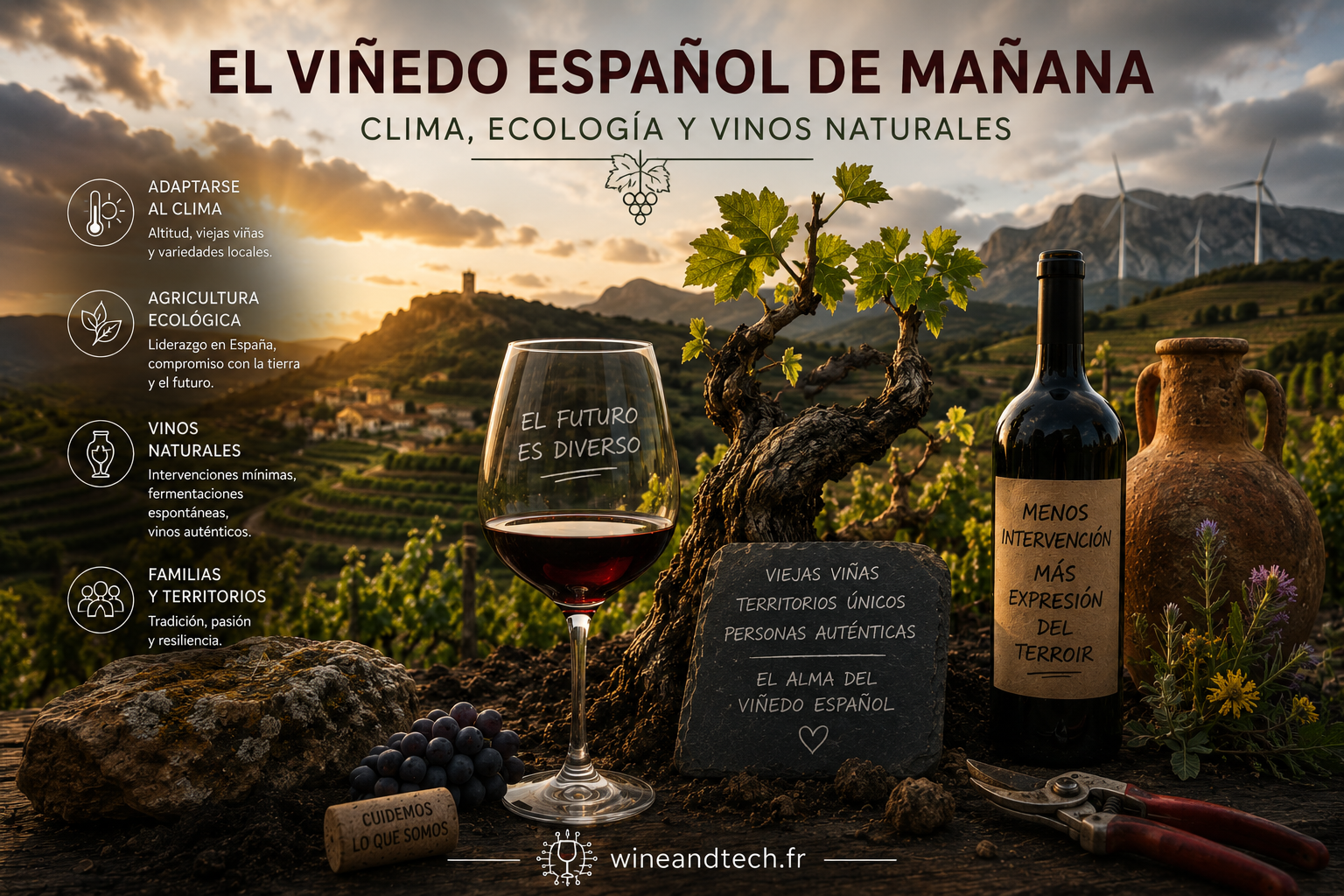
    🌡️ Climate change: Europe’s most acute challenge

    Spain is among the European countries most exposed to the effects of climate warming. This is not an opinion: scientific projections show an intensification of heat episodes, drought and water stress across the Iberian Peninsula. In certain very hot areas of La Mancha, the Levant or Extremadura, high ripeness levels can lead to naturally very elevated alcohol content. Drought and increasing aridification are advancing across several regions of the Centre and South, adding pressure on water resources.

    Spain’s response runs through altitude. Sierra de Gredos, where some old Garnacha vines are cultivated between 800 and 1,200 metres. Producers are also seeking solutions in forgotten local varieties: varieties selected and cultivated for centuries in demanding environments can represent a valuable resource for adaptation, particularly when they ripen late or show good tolerance to water stress.

    Galicia, wetter and more Atlantic, still benefits from a climate that allows it to retain a certain freshness. But warming is already shifting the balances: Albariño more easily reaches higher ripeness levels and water management is becoming a topic there too. The Rías Baixas season is lengthening; Albariño is gaining in maturity.

    🌿 Organic farming: Spain in the lead

    Spain is by far Europe’s largest organic vineyard by surface area. In 2023, around 166,000 hectares of vines were managed organically, representing roughly one fifth of the national vineyard.

    This figure deserves nuance. It covers very different realities: between a small family estate with a longstanding ecological commitment and a large structure certified to meet market demand, the motivations and practices can vary considerably.

    The gap between an artisan producer in the Sierra de Gredos and a large certified organic cooperative in Extremadura is significant.

    But the underlying trend is real. A new generation of family wineries is explicitly choosing organic or biodynamic conversion as both philosophy and identity.

    🍷 Natural wine in Spain: a movement taking shape

    The natural wine movement was slow to take hold in Spain. Spanish wine culture was traditionally oriented toward stabilised, technical wines designed to withstand transport and storage.

    The 2000-2010 generation changed that. Producers such as Comando G in Gredos, Partida Creus in Catalonia or Envínate in the Canary Islands and Galicia helped popularise a low-intervention winemaking approach: spontaneous fermentations, reduced use of sulphur and limited cellar inputs.

    These wines quickly found an audience among specialist wine merchants, sommeliers and importers internationally, before gradually gaining visibility on the Spanish market itself.


    What the series will have shown, and what remains

    A vineyard that had not yet said its last word. Terroirs once thought exhausted that are finding their purpose again. Families transmitting against all odds.

    The future of the Spanish vineyard will not be built from Madrid. It will be built in the Sierra de Gredos, in the gorges of Ribeira Sacra, on the volcanic slopes of the Canary Islands, in the Galician granite. Where nobody expected much.

    The end of The Vinous Trinity. Thank you for following along.

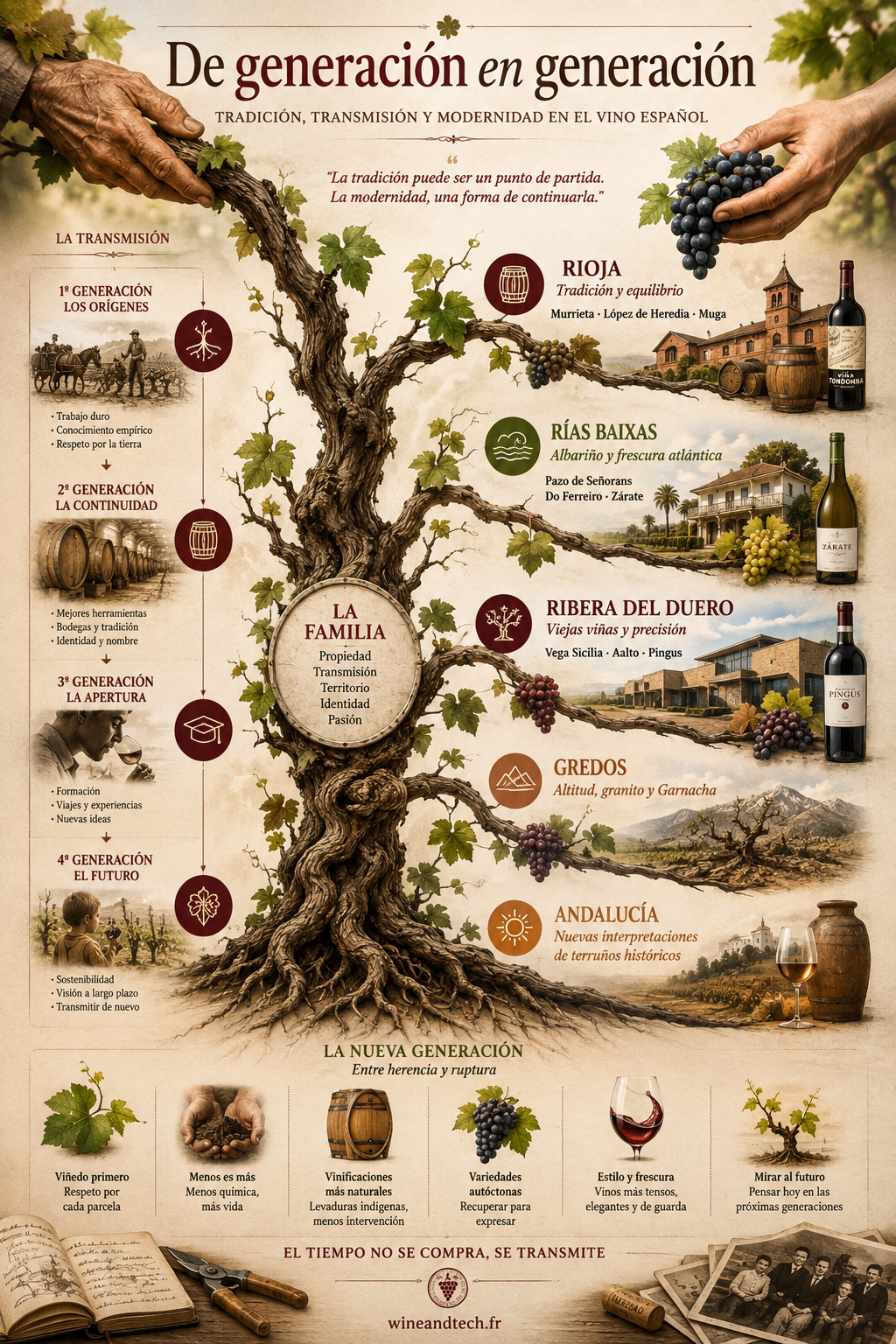
    Tradition can be a starting point. Modernity, a way of continuing it.
  • Las bodegas familiares: tradition and modernity in Spanish wine

    Las bodegas familiares: tradition and modernity in Spanish wine

    🇬🇧 Series · The Vinous Trinity · Article 12/15 · Spain · ⏱ 5 min

    In Spain, the family winery occupies a particular place in the viticultural landscape. Families cultivating the same plots for several generations, some of which have become international references, others working more discreetly, away from the spotlight.

    Between transmission, rootedness and the will to innovate, the Spanish vineyard also tells a story of families.

    🏠 The family winery: what sets it apart

    The Spanish family winery is built above all on a logic of ownership, transmission and territorial rootedness.

    Unlike large cooperatives that bring together numerous producers, or wine groups present across several regions, it is organised around a name, a family and a territory.

    The link with the vineyard is generally very direct. Generations follow each other, plots are passed on, practices evolve. Decisions taken today can have consequences well beyond a single harvest.

    This long-term vision is perhaps the true signature of these houses.

    🍷 Rioja: the great wine dynasties

    Rioja has given rise to some of Spain’s greatest viticultural dynasties.

    Marqués de Murrieta belongs to this ancient history. From the 19th century, Don Luciano de Murrieta introduced an approach inspired by the Bordeaux model, helping to lay the foundations of modern Rioja wine.

    López de Heredia, founded in Haro from 1877, represents another expression of this tradition. The house remains today one of the rare historic family wineries of the DOCa Rioja.

    More recent, Bodegas Muga, founded in 1932, embodies the same family continuity. Three generations of the Muga family have followed each other at the winery, with a philosophy seeking to combine artisan tradition and openness toward the future.

    Traditional Rioja remains associated with extended ageing and the use of oak, particularly American, with profiles that can develop notes of vanilla, leather and evolved fruit.

    But another Rioja has developed in parallel.

    Artadi, whose Lacalle y Laorden family took the helm in 1992, champions an approach based on plot identity and respect for the vineyard. Remírez de Ganuza, founded in 1989, has introduced various innovations in viticulture and winemaking.

    Two visions can coexist within the same appellation: fidelity to historic codes and the search for a more plot-based, contemporary expression.

    It is precisely this diversity that makes Rioja impossible to sum up in a single sentence.

    🌊 Galicia: the new Albarino families

    The Rías Baixas tells another story.

    In the Val do Salnés, small farms and family work have long occupied an essential place. The creation of the Rías Baixas Denominación de Origen in 1988 accompanied the region’s professionalisation and quality upgrade.

    Some families played a determining role in this evolution.

    Pazo de Señorans was acquired in 1979 by Marisol Bueno and Javier Mareque. The family subsequently contributed to gaining recognition for Albariño’s ageing potential and to the development of the new appellation.

    Do Ferreiro, founded by Gerardo Méndez, is another emblematic family story. The next generation continued work around old vines and the identity of the various Salnés terroirs. Some of its Albariños are capable of evolving for ten years or more in bottle.

    Zárate goes even further in this notion of transmission. The family has cultivated its own vineyards for several generations and works particularly with old plots. Eulogio Pomares, now at the head of the estate, represents this new generation of Galician winemakers trained outside before returning to work on the family heritage.

    Galicia is no longer associated solely with young, aromatic whites.

    Albariño can also be a wine for ageing, gaining in complexity and depth with time.

    🔴 Ribera del Duero: modernity and tradition

    Ribera del Duero is much more recent in its official organisation than Rioja, with the Denominación de Origen created in 1982.

    But its history already includes some mythical names.

    Vega Sicilia, founded in 1864, is the absolute reference. The winery has belonged to the Álvarez family since 1982 and remains one of the great benchmarks of Spanish wine. Its Único has become one of the iconic great wines of the peninsula.

    Around this monument, a new generation of producers has contributed to transforming the image of the region.

    Aalto, founded in 1999 by Mariano García and Javier Zaccagnini, was built around Tinto Fino and old vines spread across several municipalities. The Masaveu and Nozaleda families later joined the project in 2006.

    Dominio de Pingus, created by Peter Sisseck in 1995, belongs more to this generation of personal, high-precision projects than to the classic definition of a family winery.

    This distinction matters: Spanish renewal does not come solely from historic families. It also comes from winemakers who chose to settle in a region, understand its old vines and offer a new reading of them.

    🆕 The new generation: between heritage and rupture

    Across Spain, the same question is now being asked.

    What to do with the heritage received?

    Some heirs choose to continue exactly the work of their parents and grandparents. Others return after studying or working in Bordeaux, Dijon or other great wine regions and wish to progressively modify the estate’s practices.

    Less new wood, more plot-based work, a search for freshness, reduced inputs, a return to certain traditional methods or experimentation around yeasts and fermentations: the paths are numerous.

    There is no single definition of modernity.

    For some families, preserving tradition is already a form of innovation. For others, evolving practices is the best way to remain faithful to the terroir.

    ☀️ The South: forgotten families making a comeback

    Spanish renewal is not limited to the great historic appellations.

    In the Sierra de Gredos, in central Spain, young winemakers and small families are rediscovering old Garnacha vines planted on granite soils, often at high altitude.

    The region is characterised by small-scale viticulture, numerous plots of very small surface area and a new generation of family wineries working particularly with old Garnacha and Albillo Real vines.

    In Andalusia too, certain producers are seeking to move beyond traditional representations of the regional vineyard. Alongside the great historic wines of Jerez and Montilla-Moriles, new projects explore other expressions of the climate, soils and Andalusian varieties.

    The terroirs are there. The old vines too.

    Sometimes it simply took a different way of looking at them.


    A philosophy of the long term

    What ultimately unites these wineries is not their size, their prestige or even their wine style.

    It is their relationship with time.

    A vineyard that is transmitted.

    A plot that continues to be worked because the previous generations did so before us.

    A winery built to last.

    Decisions taken today with the conviction that their consequences will be visible in ten, twenty or thirty years.

    This logic is not that of a simple investment.

    It is closer to a living heritage.

    And it is perhaps there that the singularity of Spanish family wineries lies: they are not simply seeking to produce wine.

    They are seeking to transmit a story.

    A family winery is not measured in bottles produced. It is measured in generations transmitted.

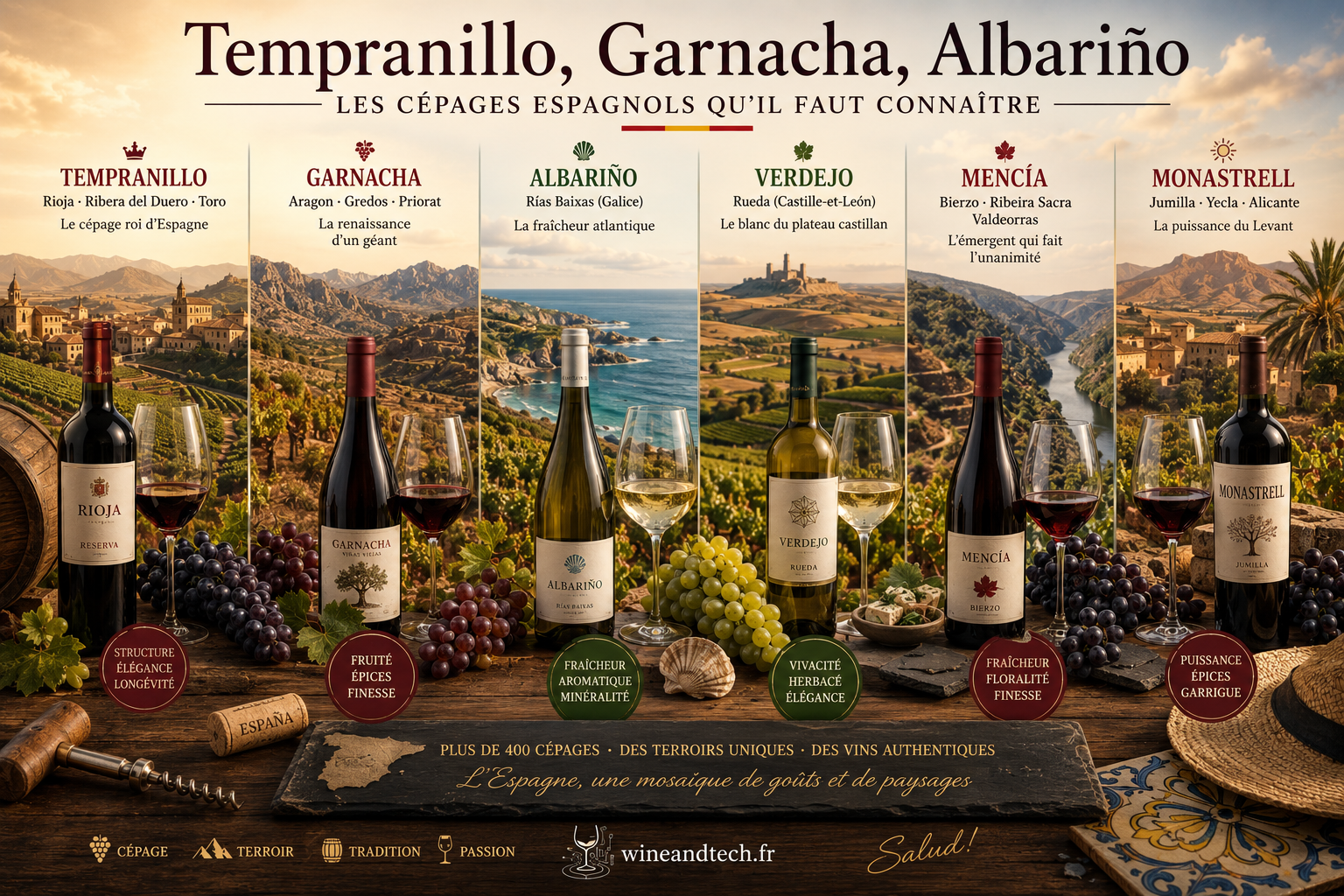
  • Tempranillo, Garnacha, Albariño: the Spanish grape varieties you need to know

    Tempranillo, Garnacha, Albariño: the Spanish grape varieties you need to know

    🇬🇧 Series · The Vinous Trinity · Article 9/15 · Spain — English translation of the French original

    ⏱ 5 min

    Spain boasts exceptional viticultural diversity, with more than 400 grape varieties recorded depending on the source. Much of this wealth remains little known, while a handful of varieties dominate the great appellations and define the most distinctive styles of the Iberian vineyard.

    Tempranillo, Garnacha, Albariño: an iconic trio. But also Verdejo, Mencía, Monastrell, Graciano and many more. Varieties whose character largely explains why Spain has established itself among the world’s great wine nations, often with a particularly competitive offer in terms of value for money.

    The Spanish Ministry of Agriculture confirms Tempranillo’s current dominance: as of 31 July 2024, it covered 195,076 hectares, ahead of Airén with 185,614 hectares.

    🍇 Grape varieties explored in this article

    Tempranillo · Garnacha · Albariño · Verdejo · Mencía · Monastrell

    🔴 Tempranillo — Spain’s king of grapes

    Tempranillo is today Spain’s most widely planted wine grape. It changes name from region to region: Tinto Fino or Tinta del País in Ribera del Duero, Tinto de Toro in Toro, Cencibel in parts of Castilla-La Mancha. It is also known as Tinta Roriz in Portugal.

    In Rioja, it forms the backbone of the great reds and lends itself equally well to youthful cuvées and long barrel ageing. Traditional expressions can develop notes of red fruit, strawberry, vanilla, liquorice, cocoa, leather and tobacco with age.

    In Ribera del Duero, high-altitude vineyards and wide day-night temperature swings favour wines that are often more structured and concentrated, while retaining welcome freshness.

    In Toro, under the name Tinta de Toro, old vines and dry conditions produce particularly rich and powerful wines.

    Tempranillo’s real strength lies in this ability to change personality according to climate, altitude, soils and the winemaker’s hand.

    A true Iberian chameleon.

    🔴 Garnacha — the rebirth of a giant

    Garnacha, known as Grenache in France and Cannonau in Sardinia, is deeply tied to the north-east of the Iberian Peninsula. Aragón is one of its most important historic homelands.

    Long used in blends or to produce simple wines and rosés, it has been enjoying a genuine qualitative renaissance for several decades.

    This revolution rests above all on the rediscovery of old Garnacha vines in Aragón, in appellations such as Campo de Borja and Calatayud, but also in Terra Alta, in Catalonia, and in the vineyards of the Sierra de Gredos, south-west of Madrid.

    In Gredos, some old vines planted on granite soils at high altitude yield reds of remarkable finesse, with floral, spicy and very fresh profiles.

    Garnacha thus proves it can deliver far more than sun-drenched, generous wines: given old vines, altitude and controlled yields, it can reach spectacular elegance and complexity.

    Its rebirth is one of the most exciting stories in contemporary Spanish wine.

    🟡 Albariño — Atlantic freshness

    Albariño is the flagship grape of Rías Baixas, in Galicia, on the Atlantic coast of north-west Spain.

    In this cool, humid, ocean-driven region, it produces dry, aromatic, taut whites with notes of white peach, citrus, apricot, flowers and sometimes a saline touch. Granite soils and the maritime climate contribute strongly to their identity.

    Rías Baixas comprises five sub-zones: Val do Salnés, O Rosal, Condado do Tea, Ribeira do Ulla and Soutomaior, each bringing different nuances to the grape’s expression.

    Albariño’s natural acidity makes it an exceptional partner for seafood: oysters, shellfish, mussels, crustaceans or Galician-style octopus.

    But its potential doesn’t stop at young wines. Extended ageing on the lees can bring more texture, depth and complexity, and some cuvées are perfectly capable of evolving in bottle.

    An Atlantic white that combines freshness, precision and true territorial identity.

    🟡 Verdejo — the white of the Castilian plateau

    Verdejo is the great white grape of Rueda, in Castilla y León.

    The appellation’s vineyards sit mainly on a high plateau, between 700 and 800 metres in altitude, subject to cold winters, hot dry summers and wide temperature swings.

    In the glass, Verdejo generally delivers dry, fresh, aromatic wines with notes of fennel, citrus, fresh herbs and white-fleshed fruit, along with a characteristic touch of bitterness on the finish.

    Long regarded as a simple, easy-drinking wine, Verdejo has grown considerably in ambition. The best producers now work specific plots, use lees or oak ageing and winemaking approaches capable of revealing more texture and depth.

    A particularly interesting Spanish alternative to the world’s great aromatic whites.

    🔴 Mencía — the rising star everyone agrees on

    Mencía is one of the most interesting red grapes of north-west Spain.

    It is particularly important in Bierzo, in Castilla y León, but also in Galicia, notably in the Ribeira Sacra, Valdeorras and Monterrei appellations.

    Since the 2000s, several generations of winegrowers have profoundly renewed its image. Old vines, controlled yields and more precise work in the vineyard and cellar have revealed a grape capable of producing reds of great finesse.

    On the slopes of the Ribeira Sacra, with its spectacular terraced vineyards above the Sil and Miño valleys, Mencía can yield fresh, floral, slender wines.

    In Bierzo, it often shows more depth and structure while keeping remarkable natural acidity.

    Cherry, red fruit, flowers, spice, herbal and mineral notes: its profile can bring to mind certain Pinot Noirs or Cabernet Francs through its freshness and elegance, without ever losing its Iberian identity.

    Mencía is now far more than an emerging grape: it has become one of the signatures of Spain’s wine revival.

    🔴 Monastrell — the power of the Levante

    Monastrell, known as Mourvèdre in France, is one of the great grapes of south-east Spain.

    It reigns notably over Jumilla, Yecla and Bullas, but also over other appellations along Spain’s Mediterranean coast. The Monastrell España association brings together six major appellations around this grape: Alicante, Almansa, Bullas, Jumilla, Valencia and Yecla.

    In Jumilla, Monastrell accounts for around 70% of the vineyard and has adapted remarkably well to a hot, dry, water-scarce environment. A large share of the vines is grown without irrigation.

    It produces generous, deeply Mediterranean wines, with aromas of ripe black fruit, spice, liquorice, wild herbs and garrigue.

    But modern Monastrell is no longer just about power. The best producers now seek to preserve its acidity and freshness, thanks in particular to altitude, limestone soils and precise harvesting at ripeness.

    The result: rich, structured wines that can still show real freshness.

    One of the great trump cards of Spain’s Mediterranean vineyard.

    The inimitable Spaniards

    What unites these grapes is not just their popularity. It is their ability to tell the story of a territory.

    Tempranillo from Rioja, Ribera del Duero or Toro doesn’t tell quite the same story.

    Garnacha from Aragón or Gredos changes its face with altitude and soils.

    Albariño from Rías Baixas carries the influence of the Atlantic and Galician granite.

    Verdejo from Rueda reflects the contrasts of the high Castilian plateau.

    Mencía from Bierzo and Ribeira Sacra expresses the freshness and diversity of the north-western terroirs.

    Finally, Monastrell from Jumilla tells of another Spain: sun-baked, dry, Mediterranean, where the vine must cope with water scarcity.

    These grapes can be planted elsewhere. But their expression changes as soon as the territory that shaped them disappears.

    Grape × soil × climate × altitude × history × know-how:

    that is the equation behind the singularity of Spanish wine.

    Spain hasn’t merely preserved an exceptional viticultural genetic heritage.

    It is now giving it a new voice.

    Spain hasn’t merely preserved an exceptional viticultural genetic heritage. It is now giving it a new voice.

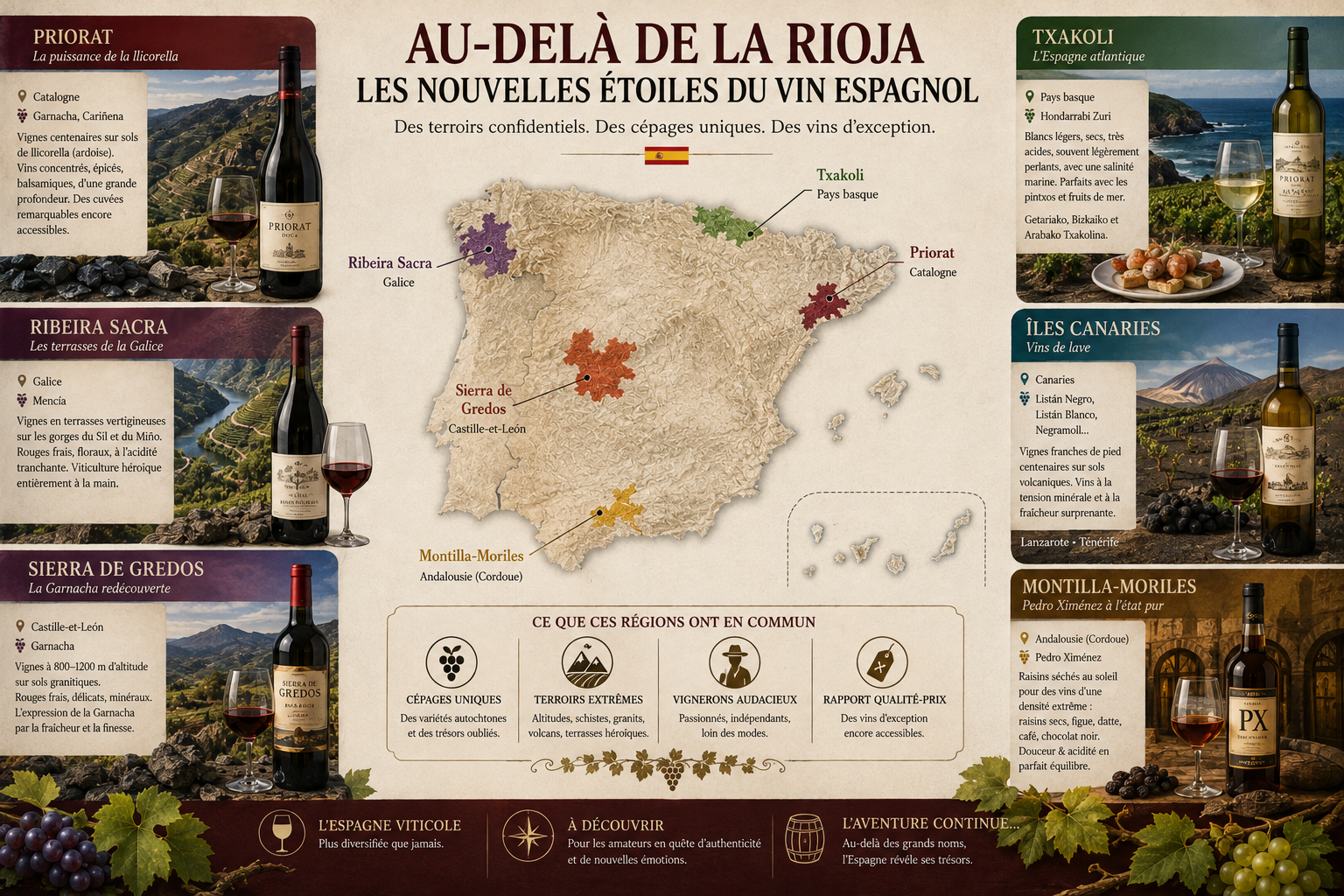
  • Beyond Rioja: Spain’s new wine stars

    Beyond Rioja: Spain’s new wine stars

    🇬🇧 Series · The Vinous Trinity · Article 6/15 · Spain · ⏱ 5 min

    Rioja, Ribera del Duero, Rías Baixas. The three names international wine buyers know. The Spanish vineyard doesn’t stop there. Beyond these appellations, other regions are doing work that deserves attention: more confidential, with different priorities. Old terroirs, indigenous grape varieties, producers who have no interest in making wines that taste like anything else.

    🗺️ Regions explored in this article

    Priorat · Ribeira Sacra · Sierra de Gredos · Canary Islands · Txakoli · Montilla-Moriles

    Priorat · the power of llicorella

    Priorat (DOCa since 2000) built its reputation in the 1990s on something very specific: century-old Garnacha and Cariñena vines on llicorella, a crumbling black slate that gives wines their mineral grip and distinctive balsamic character. The result is concentrated, complex, long-lived. Among the top producers, prices have followed the reputation. But artisan winemakers here still craft remarkable bottles at prices that remain accessible.

    Ribeira Sacra · Galicia’s terraced vineyards

    In the gorges of the Sil and Miño in Galicia, Ribeira Sacra grows Mencía on vertiginous granite terraces that require entirely manual work. Fresh, floral, precise reds with a natural acidity that surprises anyone expecting southern Spanish weight. An appellation that was still little-known five years ago and is now on the radar of most serious sommeliers. Prices haven’t caught up yet.

    Sierra de Gredos · Garnacha rediscovered

    Between Madrid and Ávila, the Sierra de Gredos gave a handful of producers something they couldn’t find elsewhere: old Garnacha vines at 800 to 1,200 metres, on granite. Fresh, delicate, mineral reds. Producers like Comando G and Bernabeleva showed that Spanish Garnacha doesn’t have to mean extracted and heavy. The style they developed is now influencing producers across the country.

    Canary Islands · wines from lava

    The Canaries escaped phylloxera. The result is ungrafted vines, some over a century old, on black volcanic soils, with rare pre-phylloxera varieties: Listán Negro, Listán Blanco, Negramoll. Wines of mineral tension and freshness that are completely unexpected at these latitudes. Lanzarote and Tenerife both have serious producers. Prices are still reasonable.

    Txakoli · Atlantic Spain

    Txakoli is the Basques’ white wine: light (10-11% alcohol), often lightly sparkling, dry, very acidic, with a marine salinity that makes it an obvious match for pintxos and seafood. Three appellations: Getariako Txakolina, Bizkaiko Txakolina, Arabako Txakolina. Same philosophy throughout: a sharp, lively, genuine wine. Still affordable.

    Montilla-Moriles · Pedro Ximénez in its purest form

    Montilla-Moriles, in the Córdoba area, makes wine from Pedro Jiménez grapes dried in the sun until concentrated. The result: a dense, sweet wine full of raisins, fig, date, coffee and dark chocolate, with enough natural acidity to keep it balanced. Often available at lower prices than comparable wines from Jerez, for similar quality.


    What connects these regions

    It isn’t geography. It’s a certain stubbornness. Producers making wine from grape varieties nobody planted for decades, on terroirs nobody paid attention to. More sommeliers and wine merchants are noticing now. The prices haven’t fully caught up. That will change.

    Spain has shown the world its Rioja. The rest is only now becoming visible.

  • Spanish wine: a million hectares, a quiet revolution

    Spanish wine: a million hectares, a quiet revolution

    ⏱ 4 min

    If France is the homeland of terroir and Italy the homeland of absolute diversity, Spain is the homeland of generosity. Close to a million hectares of vines — the largest wine-growing area in the world. Over 70 designations of origin. A quiet quality revolution that began in the 1990s and has never let up. Tempranillo, Garnacha, Albariño, Mencía: inimitable grape varieties offering character and complexity at prices that remain among the most reasonable in Europe. Spain doesn’t just make wine: it has reinvented its wine identity, region by region.

    ~950,000

    hectares (world record)

    70+

    designations of origin

    2

    DOCa (Rioja · Priorat)

    ~4,000

    wineries and bodegas

    The quiet revolution

    In the 1980s, Spain was still mainly a supplier of bulk wine. Then a combination of new winemaking talent, massive investment in cellars, the rediscovery of old vines and a renewed regional pride changed everything. Today, Spain produces some of the most original and complex wines in the world — while keeping prices that remain, on the whole, lower than their French or Italian equivalents of the same quality.

    🏔️ The Historic North: Rioja, Ribera del Duero, Navarra

    Rioja (DOCa since 1991) remains the region’s figurehead — its Tempranillo, aged in barrel across three tiers (Crianza: at least twelve months in barrel for reds, Reserva: 1 year in barrel + 1 year in bottle, Gran Reserva: 2 years in barrel + 3 in bottle), defined the Spanish style for the entire world. But it’s also where small artisan producers do some of the most interesting work: a quality Crianza remains accessible at €8–14. Ribera del Duero, at 850m altitude, produces a more structured, denser Tempranillo (known locally as Tinto Fino) with more pronounced natural acidity. Vega Sicilia, Pingus — the legends are here. But so are many remarkable artisan producers at far lower prices. Navarra, long known for its Garnacha rosés, is now exploring far more ambitious styles.

    🌊 Atlantic Galicia: Rías Baixas, Bierzo, Ribeiro

    Spain’s green, rainy north-west is the polar opposite of the sun-drenched Spanish wine cliché. Rías Baixas produces Albariño — a fresh, aromatic, high-acid white, perfect with Galician seafood and one of the most seductive Atlantic whites in Europe. Bierzo, with its Mencía grown on granite and slate, is one of the most exciting discoveries of the past twenty years: fresh, floral, age-worthy reds at still-modest prices. Ribeiro offers original, little-known blends of indigenous white varieties.

    ☀️ The Levante and the South: Priorat, Jumilla, Jerez

    Priorat (DOCa since 2000 — one of only two in the whole of Spain, alongside Rioja) produces wines of striking concentration and complexity, made from century-old Garnacha and Cariñena grown on llicorella (black slate) soils. Intense, deep, built to age. Jumilla and its Monastrell offer full-bodied, highly accessible wines. But it’s Jerez that perhaps represents Spain’s most original proposition: fino, manzanilla, amontillado, oloroso, Pedro Ximénez — five radically different styles, produced through a solera ageing system unique in the world, blending biological and oxidative winemaking. One of wine’s great forgotten treasures — and one of its greatest gifts of generosity.

    🥂 Bubbles and Whites: Cava and Rueda

    Cava (Penedès, Catalonia) produces traditional-method sparkling wine from indigenous grape varieties (Macabeu, Xarel·lo, Parellada) at prices that rival entry-level Champagne — with a very different character, more fruit-forward, mineral in its own way. Rueda and its Verdejo is Spain’s best-selling white wine domestically: crisp, herbaceous, fresh — a delicious, very affordable alternative to Sauvignon Blanc.


    Price: the real revolution

    This is perhaps where Spain impresses most: quality has risen, but prices haven’t kept pace. A serious producer’s Rioja Crianza at €8–14. An old-vine Garnacha from Aragón at €7–10. A Jumilla Monastrell at €6. A quality Cava at €8. Few countries today offer a comparable quality-to-price ratio. Across every price bracket, from everyday wines to great age-worthy cuvées, Spanish wine manages to combine identity, quality and accessibility. That is probably its greatest strength. It’s the great promise of Spanish wine — and it delivers.

    It took Spain thirty years to reveal what its vines had been hiding for centuries.

  • World Wines Days

    World Wines Days

    Source : https://www.winetourism.com/international-wine-days/

    1st February – International Furmint Day

    18th February – World Drink Wine Day

    3rd March – Mulled Wine Day

    13th March – International Riesling Day

    14th April – Tannat Day

    17th April – Malbec World Day

    29th April – International Viognier Day

    6th May – International Sauvignon Blanc Day

    17th May – Pinot Grigio Day

    21st June – World Lambrusco Day

    24th June – International Rosé Day

    28th July – Shiraz Day

    1st August – International Albariño Day

    18th August – International Pinot Noir Day

    30th August – International Cabernet Sauvignon

    1st September – International Cap Classique Day

    10th September – International Port Wine Day

    16th September – International Grenache Day

    8th October – International Pinotage Day

    28th October – Champagne Day

    7th November – International Merlot Day

    10th November – International Tempranillo Day

    4th December – International Cabernet Franc Day

    10th December – International Tokaj Day

    16th December – Pinot Meunier Day

  • Which Glasses for Which Uses?

    Which Glasses for Which Uses?

    It’s often worth remembering that the glass, and its shape, matter when tasting a wine.

    Here’s a nice article (in French) that explains the basics:

    You may already have noticed, but there are several types of wine glass. In truth, there are countless numbers of them, every maker…

    Service : Quels verres pour quels usages ?
  • Power Can Sometimes Be Disconcerting…

    Power Can Sometimes Be Disconcerting…

    “The wines of Rioja Alta are refined wines, with a great tannic structure and a persistent finish.” – Wine Spectator

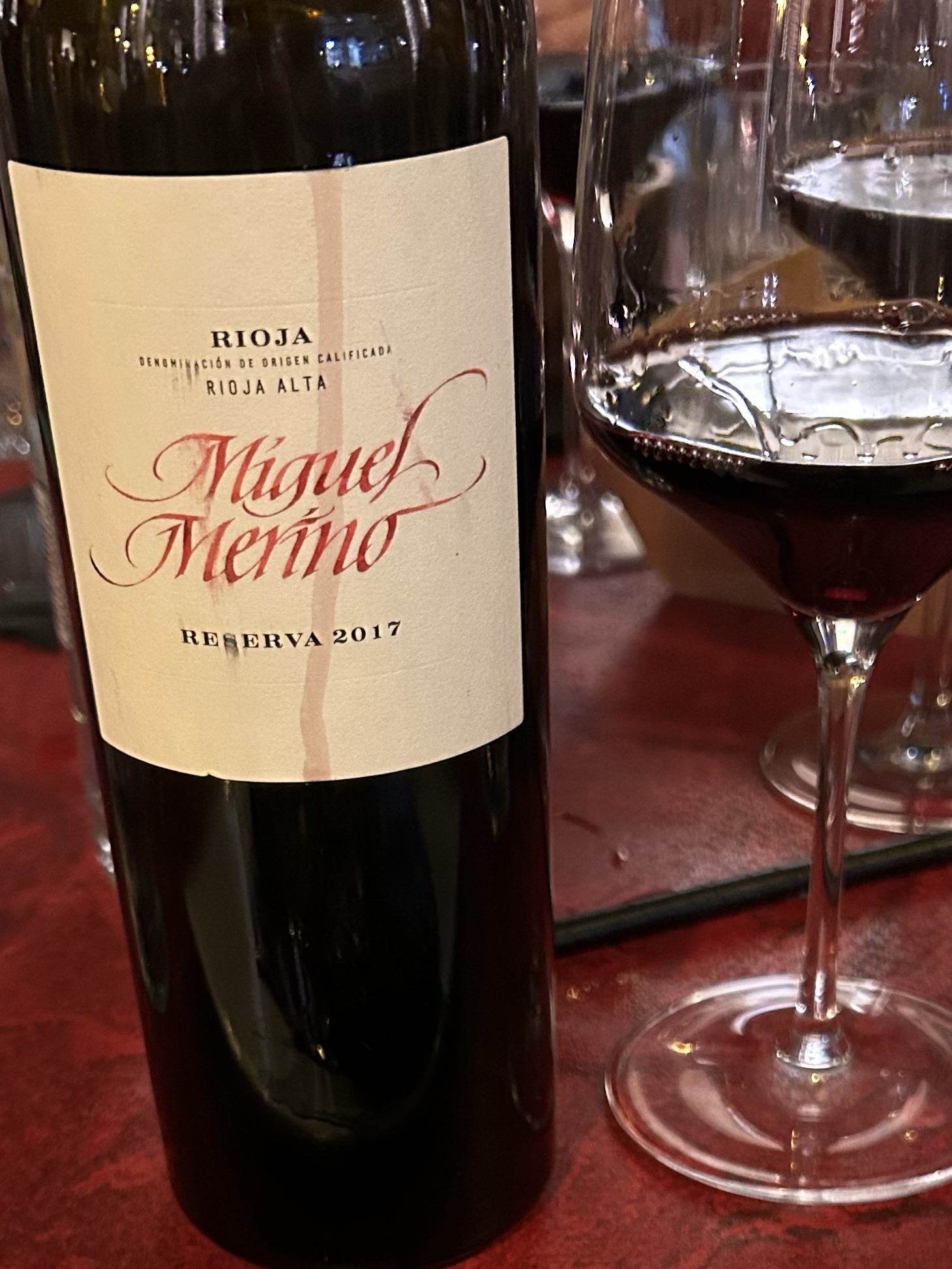
    Miguel Merino – Reserva 2017 El Barrio Luxembourg

    A pleasant place, an excellent meal, and then comes the choice of wine: one of my friends picks a Spanish one, which delights me.

    A Rioja — more precisely, a Rioja Alta.

    The Miguel Merino estate was founded in 1994 and is located in the village of Briones. The vineyard covers around 25 hectares and is planted mainly with Tempranillo, with a few plots of Graciano and Viura for the white wines.

    Miguel Merino’s red wines are crafted with care and aged in French and American oak barrels for periods of up to 24 months.

    Let’s taste this wine!

    The nose is woody and spicy, on aromas of tobacco. It doesn’t reveal itself easily and I struggle to make out anything else. I’m expecting powerful tannins.

    This 2017 is out of the ordinary, disconcerting — I lose my palate over it, I can’t break this wine down, and I have to admit I’m lost. It’s a strong wine that will, I think, leave you as it left me: particularly frustrated, lost in its complexity.

    Miguel Merino has won! He’s won the bet of making a wine that’s good, powerful, and that will teach you a fine lesson in humility.

    At under 30 euros, you’ll need to give it a fine plate of meat to do justice to that balance. A wonderful discovery!

  • Spain Among Friends…

    Spain Among Friends…

    “Ribera del Duero is a complex and sophisticated wine, a wine that demands particular attention and rewards those who take it seriously.” – Stephen Tanzer

    The Cruz de Alba 2019 is a red wine produced in the Ribera del Duero wine region of Spain. This region is renowned for producing some of Spain’s finest reds, thanks to its unique terroir and favourable climate.

    The Cruz de Alba 2019 is produced from Tempranillo grapes, the most widely grown variety in the region. It was aged for 12 months in French and American oak barrels, which gave it woody, spicy notes.

    On to the tasting:

    On the nose, beyond the red fruit, you can pick out vanilla and spice.

    The robe is dark, and it announces its colours: on the palate you won’t be disappointed — this 2019 is full-bodied with a touch of acidity, but balanced. You’ll note a quick passage through the length; clearly that isn’t this wine’s strong point.

    This wine was chosen by one of my friends during a meal. Even though the wine was enjoyed by everyone around the table, notably for its respectful tannins, it’s the meal among friends that will stay in my memory. Then again, would I have remembered the wine without my friends? That’s less certain.

    It’s really the place and the good company that made this wine mark our memories of that get-together. It accompanied us effectively and left us with a pleasant memory. Not a false note alongside our meat-based dishes.

    At around €15 a bottle, it will go with a good meal but also work as a tasting wine. Don’t keep it too long — it isn’t necessary; it’s already very pleasant.

    Vino Orgánico:

    We noticed that this wine carries “biodynamic wines” on its label. These wines are similar to organic wines, but they’re produced according to stricter, more holistic principles. Biodynamic wine producers take the vine’s whole ecosystem into account — the soil, the surrounding plants and the animals — in order to produce a wine in harmony with its environment.

    It’s possible that the Cruz de Alba 2019 is a biodynamic wine but, despite my research, I haven’t found information on its production method, so it’s hard to confirm with certainty.

  • In Spain, Marqués de Riscal — the Symbol of an Excellent Rioja

    In Spain, Marqués de Riscal — the Symbol of an Excellent Rioja

    “Rioja embodies elegance, depth and complexity, while staying true to its roots.”

    Mariano García

    1858: the birth of this incredible family adventure — and it wouldn’t be long before the first bottles began to stand out.

    marquesderiscal.com

    In 1895, the Lord of Rioja received a distinction that would, for the time, resonate around the world: the diploma of honour at the Bordeaux exhibition. It became the first non-French wine to win this award. That distinction proudly adorns the present-day label.

    marquesderiscal.com

    Marqués de Riscal is a famous wine producer located in Rioja, a renowned wine region in Spain.

    One of their most emblematic creations is the Marqués de Riscal Reserva, often regarded as a classic Spanish wine of great quality. This wine is known for its complex taste, its aromas of red fruit and its ageing in oak barrels.

    Marqués de Riscal is also famous for its impressive modern architecture. In 2006, the Hotel Marqués de Riscal, designed by architect Frank Gehry, is a work of art in its own right and has become a sought-after destination for lovers of wine and architecture.

    marquesderiscal.com
    marquesderiscal.com

    The Marqués de Riscal bottle is often recognisable thanks to the characteristic golden wire that surrounds it. This golden wire is in fact a metal-wire cage, also known as a “mesh”. Its purpose is mainly decorative, but it also has a practical function.

    1. Decorative aspect: the golden wire adds a touch of elegance and prestige to the bottle’s presentation. It has become a signature of the Marqués de Riscal brand and is associated with the quality of their wines.
    2. Practical function: the metal-wire mesh also helps keep the cork in place. It prevents the cork from shifting or deteriorating over time, which helps preserve the wine’s quality by preventing any intrusion of air.

    Let’s taste this 2018 “Reserva” together: a robe of a bright, uniform red.

    On the nose it’s spicy, on leathery notes. We already know it’s going to surprise us.

    After dazzling the table with its aroma, its taste — with strongly pronounced tannins — wraps around your mouth perfectly. After a few moments, just when you think the brew has given all it has, a second wave of aromas appears, bringing red fruits to the fore. A discreet touch of acidity comes to close the show, then slowly fades, offering a balanced and persistent length. A delight…….

    At under 20 euros, it’s an extraordinary wine that will grace any cellar and can stay there for several more years.