WineAndTech’

Tag: vinous trinity

  • Italy’s 500 grape varieties: an extraordinary panorama

    Italy’s 500 grape varieties: an extraordinary panorama

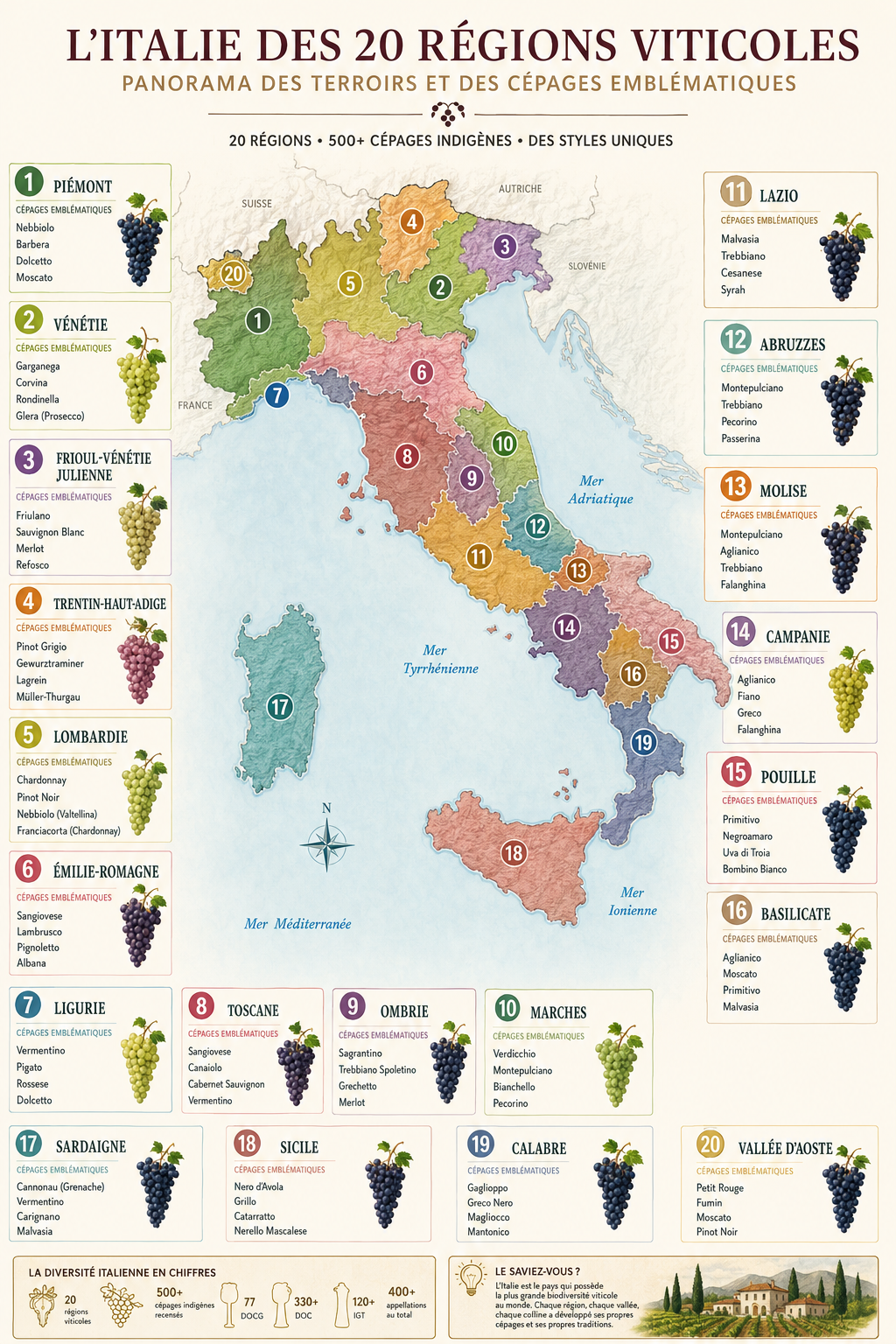
    If France is the homeland of terroir, Italy is the homeland of absolute diversity. Twenty wine regions, all active. Five hundred indigenous grape varieties recorded — a diversity probably unmatched anywhere in the wine world. Over four hundred appellations. Styles ranging from the sparkling Prosecco of Veneto to Piedmontese Barolo, from the mineral freshness of Soave to the generous warmth of Puglia’s Primitivo. Italy doesn’t just make wine: it reinvents the definition of wine in every region.

    20

    wine regions

    500+

    indigenous grape varieties

    400+

    DOCG + DOC appellations

    50,000+

    wineries and wine businesses

    The geography of taste: from the alpine North to the Mediterranean South

    Italy’s wine country stretches 1,300 km from north to south, an extraordinary succession of microclimates. In the north, the Alps shelter the vines and allow for wines of remarkable freshness and precision. In Tuscany and the Centre, altitude and proximity to the sea create a perfect balance between ripeness and acidity. In the south and on the islands, Mediterranean sun pushes concentration and aromatic richness. Every region has developed its own grape varieties, its own techniques, its own philosophy.

    Map of Italy's wine regions

    🏔️ The Great North: from Piedmont to Friuli

    Piedmont is Italy’s Burgundy — not as flattery, but as logic: a king grape almost impossible to reproduce elsewhere (Nebbiolo), hierarchised crus (Barolo, Barbaresco), a precision of terroir that tolerates no approximation. But it’s also the home of juicy, affordable Barbera, fresh Dolcetto, and Moscato d’Asti, which delights even the most demanding palates. Veneto is Italy’s largest wine-producing region, with an unbeatable quality-to-price ratio: Prosecco for the aperitif, Soave Classico with seafood, Valpolicella Ripasso with meat, Amarone for special occasions. Friuli produces some of Italy’s finest dry whites. Trentino-Alto Adige, with its Austro-Germanic influences, refines Pinot Blanc, Gewürztraminer and Lagrein on exceptional alpine terroirs. Lombardy rounds things out with Franciacorta and Valtellina (Nebbiolo grown on mountain terraces).

    🌿 The Tuscan Heart and the Centre

    Tuscany is the best-known face of Italian wine internationally: Chianti Classico, Brunello di Montalcino, Vino Nobile di Montepulciano, and the Bolgheri “Super Tuscans” (Sassicaia, Ornellaia, Tignanello) — wines that redefined modern Italy. Umbria reveals Sagrantino di Montefalco, one of the most tannic grape varieties in the world, capable of ageing for thirty years. The Marche region offers Verdicchio, a dry white of striking freshness and minerality. Abruzzo — not to be confused with the Tuscan town of Montepulciano — produces a generous, accessible Montepulciano d’Abruzzo, one of the best value wines in Italy.

    ☀️ The Deep South and the Islands

    Campania is the great revelation of the past twenty years: Taurasi, sometimes nicknamed the “Barolo of the South” for its ageing potential, Greco di Tufo, and Fiano di Avellino — three grape varieties of remarkable depth and originality. Puglia produces in volume but is rising in quality: Primitivo di Manduria, Negroamaro and Salice Salentino deserve attention. Sicily has undergone the most spectacular transformation of all: Etna (Nerello Mascalese grown on volcanic soils) produces wines of an elegance utterly unexpected at these latitudes, while Nero d’Avola remains the island’s warm, approachable ambassador. Sardinia, with its Cannonau and Vermentino, completes a panorama of extraordinary richness.


    500 inimitable grape varieties — Italy’s true strength

    France has several hundred recorded grape varieties, Spain around 400, but Italy ranks among the richest countries with over 500 identified varieties — and some studies on the genetic diversity of Italian vines suggest the existence of thousands of historic local varieties or populations still to be documented.

    Grape varieties that cannot be grown anywhere else with the same results: Nebbiolo loses its character outside Piedmont, Sagrantino outside Montefalco, Nerello outside the volcanic ash of Etna. It’s this irreducible specificity that makes every Italian bottle a journey to a precise place, a particular story. Where France built its identity around terroir and Spain around an extraordinary capacity for modern transformation, Italy celebrates, above all, the meeting of a land, a history and a forgotten grape variety.

    Italy doesn’t produce wine. It produces civilisations in a bottle.

  • France · Italy · Spain: the vinous trinity — a multilingual series

    🇬🇧 This series explores Europe’s three great wine countries. Italy articles are published in French and Italian on the same page. Spain articles in French and Spanish. The French version is the original — this is the English translation.

    🇫🇷 Cette série explore les trois grands pays du vin européen. Les articles sur l’Italie sont publiés en français et en italien. Les articles sur l’Espagne, en français et en espagnol.

    🇮🇹 Questa serie esplora i tre grandi paesi europei del vino. Gli articoli sull’Italia saranno pubblicati in francese e in italiano sulla stessa pagina. La versione inglese è disponibile in fondo alla pagina.

    🇪🇸 Esta serie explora los tres grandes países del vino europeos. Los artículos sobre España se publicarán en francés y en español en la misma página. La versión en inglés está disponible al final de la página.

    Three countries. Thousands of appellations. And close to 70% of global wine export value. France, Italy and Spain don’t dominate the wine world by chance — they are three civilisations of the vine, three thousand-year histories that shaped wine culture as we know it today. Over the next eight months, we’ll explore them together, in depth, and in their own languages.

    Sixteen articles. Four languages. Three countries. One thread: the conviction that the world’s finest wines are also its most accessible — and that they deserve to be discovered in the language that gave them life.


    🇫🇷 France: where the concept of terroir was born

    Thirteen major wine regions. Over 350 AOC/AOP appellations. Around 200 grape varieties cultivated. France invented the concept of terroir — the idea that soil, climate and the history of a place translate directly into the glass. From Alsatian Riesling to Châteauneuf-du-Pape Grenache, from Muscadet sur lie to Champagne, every French bottle tells a story of a precise location. And for every legendary grand cru, ten independent winemakers produce artisanal gems for under €15.

    Coming up: an overview of the regions, overlooked terroirs, emblematic grape varieties, winemaker portraits, and our selection of 5 bottles under €15.


    🇮🇹 Italy: diversity in its purest form

    Five hundred indigenous grape varieties. Twenty fully active wine regions. 77 DOCG, 341 DOC. Italy is the most complex and generous wine country in the world — and probably the one that delivers the most surprises in every bottle. Nebbiolo, Sangiovese, Vermentino, Nerello Mascalese: grape varieties that cannot be replicated anywhere else. A Barbera d’Asti at €9 that outclasses many New World wines at €25.

    Italy articles will be published in French and Italian on the same page — because Nebbiolo makes more sense when you read «vino di grande struttura tannica» alongside its translation. Coming up: overview, North-to-South journey, inimitable grape varieties, vignaioli portraits, selection under €15.


    🇪🇸 Spain: the world’s largest vineyard

    Nearly one million hectares of vines. Over 70 denominations of origin. And the best value-for-money in Europe. Spain underwent a spectacular quality revolution from the 1990s onwards: Rioja, Ribera del Duero, Priorat, Rías Baixas, Bierzo — world-class terroirs, inimitable grape varieties, prices that remain remarkably reasonable. An artisanal Rioja Crianza between €8 and €12 is still very much a reality.

    Spain articles will be published in French and Spanish on the same pageporque el vino se entiende mejor en su idioma. Coming up: overview, new rising stars, grape varieties, family bodegas, selection under €12.


    The programme: 16 articles, 4 languages, 8 months

    🇫🇷 France — articles in French · English version available

    • The French wine panorama: 13 regions, one obsession
    • The overlooked regions: where France excels in silence
    • Syrah, Grenache, Chenin: the grape varieties that tell France’s story
    • Winemaker portraits: French craftsmanship up close
    • France in 5 bottles under €15: our selection

    🇮🇹 Italy — French + italiano on the same page · English version available

    • Italy of the 500 grape varieties: an extraordinary panorama / L’Italia dei 500 vitigni : un panorama unico
    • From Barolo to Nero d’Avola: a journey from North to South / Dal Barolo al Nero d’Avola : viaggio da Nord a Sud
    • Nebbiolo, Sangiovese, Vermentino: inimitable treasures / Nebbiolo, Sangiovese, Vermentino : tesori inimitabili
    • The vignaioli: when one family does everything / I vignaioli : quando una famiglia fa tutto
    • Italy in 5 bottles under €15 / L’Italia in 5 bottiglie sotto i 15 €

    🇪🇸 Spain — French + español on the same page · English version available

    • The wine landscape of Spain: one million hectares, one revolution / España vinícola : un millón de hectáreas, una revolución
    • Beyond Rioja: Spain’s new wine stars / Más allá de La Rioja : las nuevas estrellas del vino español
    • Tempranillo, Garnacha, Albariño: the grape varieties to know / Tempranillo, Garnacha, Albariño : los varietales que hay que conocer
    • Family bodegas: centuries of tradition, modern ambition / Las bodegas familiares : tradición y modernidad
    • Spain in 5 bottles under €12 / España en 5 botellas por menos de 12 €

    Wine makes more sense in its native tongue. This series is an invitation to taste differently — with the words of the