⏱ 4 min
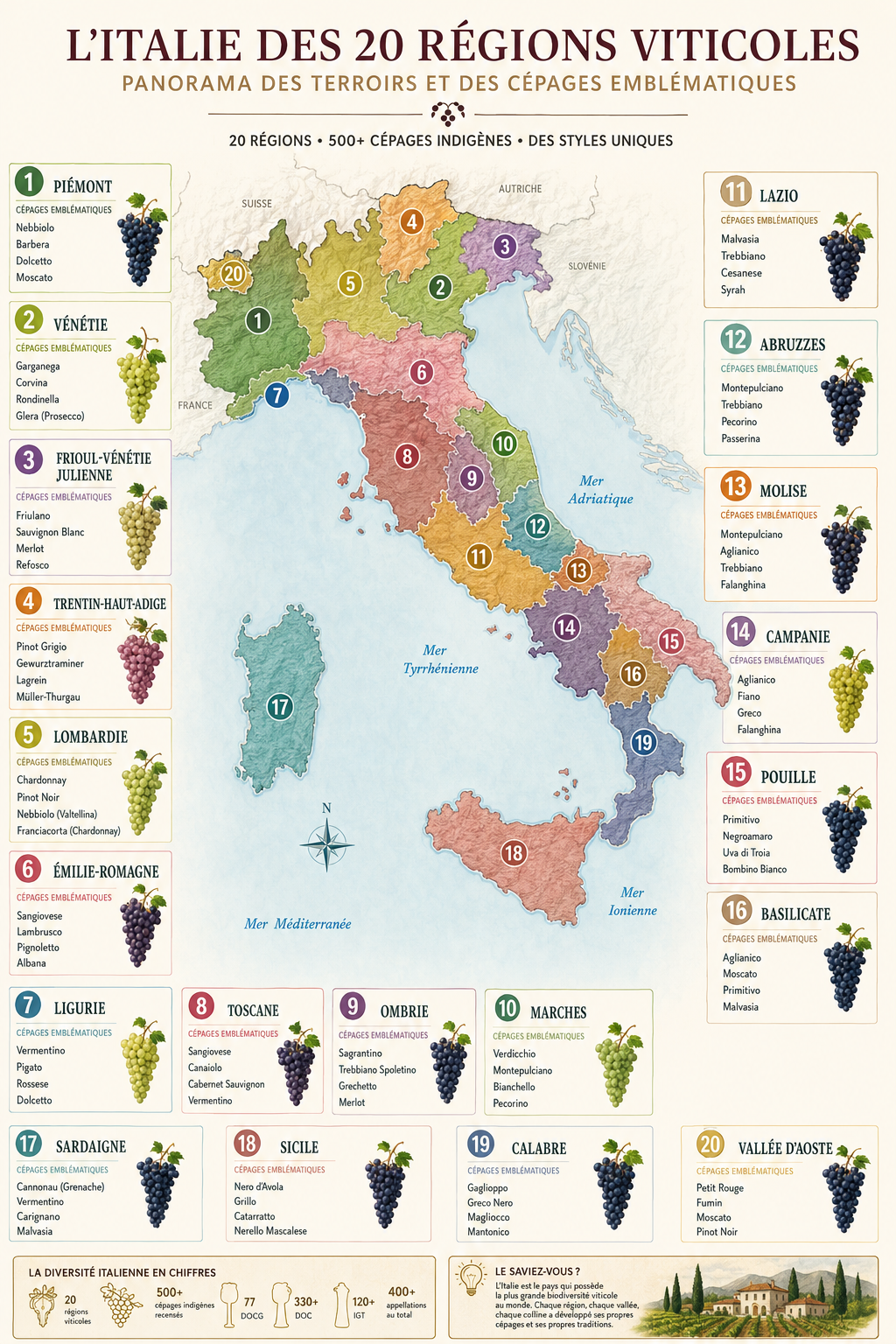
If France is the homeland of terroir, Italy is the homeland of absolute diversity. Twenty wine regions, all active. Five hundred indigenous grape varieties recorded — a diversity probably unmatched anywhere in the wine world. Over four hundred appellations. Styles ranging from the sparkling Prosecco of Veneto to Piedmontese Barolo, from the mineral freshness of Soave to the generous warmth of Puglia’s Primitivo. Italy doesn’t just make wine: it reinvents the definition of wine in every region.
20
wine regions
500+
indigenous grape varieties
400+
DOCG + DOC appellations
50,000+
wineries and wine businesses
The geography of taste: from the alpine North to the Mediterranean South
Italy’s wine country stretches 1,300 km from north to south, an extraordinary succession of microclimates. In the north, the Alps shelter the vines and allow for wines of remarkable freshness and precision. In Tuscany and the Centre, altitude and proximity to the sea create a perfect balance between ripeness and acidity. In the south and on the islands, Mediterranean sun pushes concentration and aromatic richness. Every region has developed its own grape varieties, its own techniques, its own philosophy.

🏔️ The Great North: from Piedmont to Friuli
Piedmont is Italy’s Burgundy — not as flattery, but as logic: a king grape almost impossible to reproduce elsewhere (Nebbiolo), hierarchised crus (Barolo, Barbaresco), a precision of terroir that tolerates no approximation. But it’s also the home of juicy, affordable Barbera, fresh Dolcetto, and Moscato d’Asti, which delights even the most demanding palates. Veneto is Italy’s largest wine-producing region, with an unbeatable quality-to-price ratio: Prosecco for the aperitif, Soave Classico with seafood, Valpolicella Ripasso with meat, Amarone for special occasions. Friuli produces some of Italy’s finest dry whites. Trentino-Alto Adige, with its Austro-Germanic influences, refines Pinot Blanc, Gewürztraminer and Lagrein on exceptional alpine terroirs. Lombardy rounds things out with Franciacorta and Valtellina (Nebbiolo grown on mountain terraces).
🌿 The Tuscan Heart and the Centre
Tuscany is the best-known face of Italian wine internationally: Chianti Classico, Brunello di Montalcino, Vino Nobile di Montepulciano, and the Bolgheri “Super Tuscans” (Sassicaia, Ornellaia, Tignanello) — wines that redefined modern Italy. Umbria reveals Sagrantino di Montefalco, one of the most tannic grape varieties in the world, capable of ageing for thirty years. The Marche region offers Verdicchio, a dry white of striking freshness and minerality. Abruzzo — not to be confused with the Tuscan town of Montepulciano — produces a generous, accessible Montepulciano d’Abruzzo, one of the best value wines in Italy.
☀️ The Deep South and the Islands
Campania is the great revelation of the past twenty years: Taurasi, sometimes nicknamed the “Barolo of the South” for its ageing potential, Greco di Tufo, and Fiano di Avellino — three grape varieties of remarkable depth and originality. Puglia produces in volume but is rising in quality: Primitivo di Manduria, Negroamaro and Salice Salentino deserve attention. Sicily has undergone the most spectacular transformation of all: Etna (Nerello Mascalese grown on volcanic soils) produces wines of an elegance utterly unexpected at these latitudes, while Nero d’Avola remains the island’s warm, approachable ambassador. Sardinia, with its Cannonau and Vermentino, completes a panorama of extraordinary richness.
500 inimitable grape varieties — Italy’s true strength
France has several hundred recorded grape varieties, Spain around 400, but Italy ranks among the richest countries with over 500 identified varieties — and some studies on the genetic diversity of Italian vines suggest the existence of thousands of historic local varieties or populations still to be documented.
Grape varieties that cannot be grown anywhere else with the same results: Nebbiolo loses its character outside Piedmont, Sagrantino outside Montefalco, Nerello outside the volcanic ash of Etna. It’s this irreducible specificity that makes every Italian bottle a journey to a precise place, a particular story. Where France built its identity around terroir and Spain around an extraordinary capacity for modern transformation, Italy celebrates, above all, the meeting of a land, a history and a forgotten grape variety.
Italy doesn’t produce wine. It produces civilisations in a bottle.
Leave a Reply