Category: Italie

  • The Italian vineyard of tomorrow: climate change, organic and natural wine

    The Italian vineyard of tomorrow: climate change, organic and natural wine

    🇬🇧 Series · The Vinous Trinity · Article 14/15 · Italy · ⏱ 5 min

    🇫🇷+🇮🇹 Lire en français + italiano → [lien à ajouter] · Mon 🇫🇷 / Wed 🇮🇹 / Fri 🇪🇸

    Three countries, fourteen articles, and already time for a synthesis. What Italy will have brought to The Vinous Trinity: a lesson on diversity as strength, on inimitable grape varieties, on the vignaioli who do everything themselves. And now, a question: where is the Italian vineyard heading?

    🇰 What we take away

    Italy possesses one of the world’s greatest viticultural biodiversities, with more than 500 indigenous grape varieties officially recognised. This figure is not a footnote: it is the key to understanding everything the series has explored.

    Nebbiolo in the Langhe. Sangiovese on the Tuscan hills. Vermentino facing the winds of Gallura. Aglianico on the volcanic heights of Vulture or around Taurasi. Nerello Mascalese on the slopes of Etna. Each deeply marked by the territory in which it developed, capable of expressing very different profiles elsewhere.

    And behind these grape varieties, the vignaioli: artisans who grow, vinify and bottle. Often on just a few hectares. Often for several generations. This interlocking of variety, terroir and independent producer is the strength of the Italian vineyard.

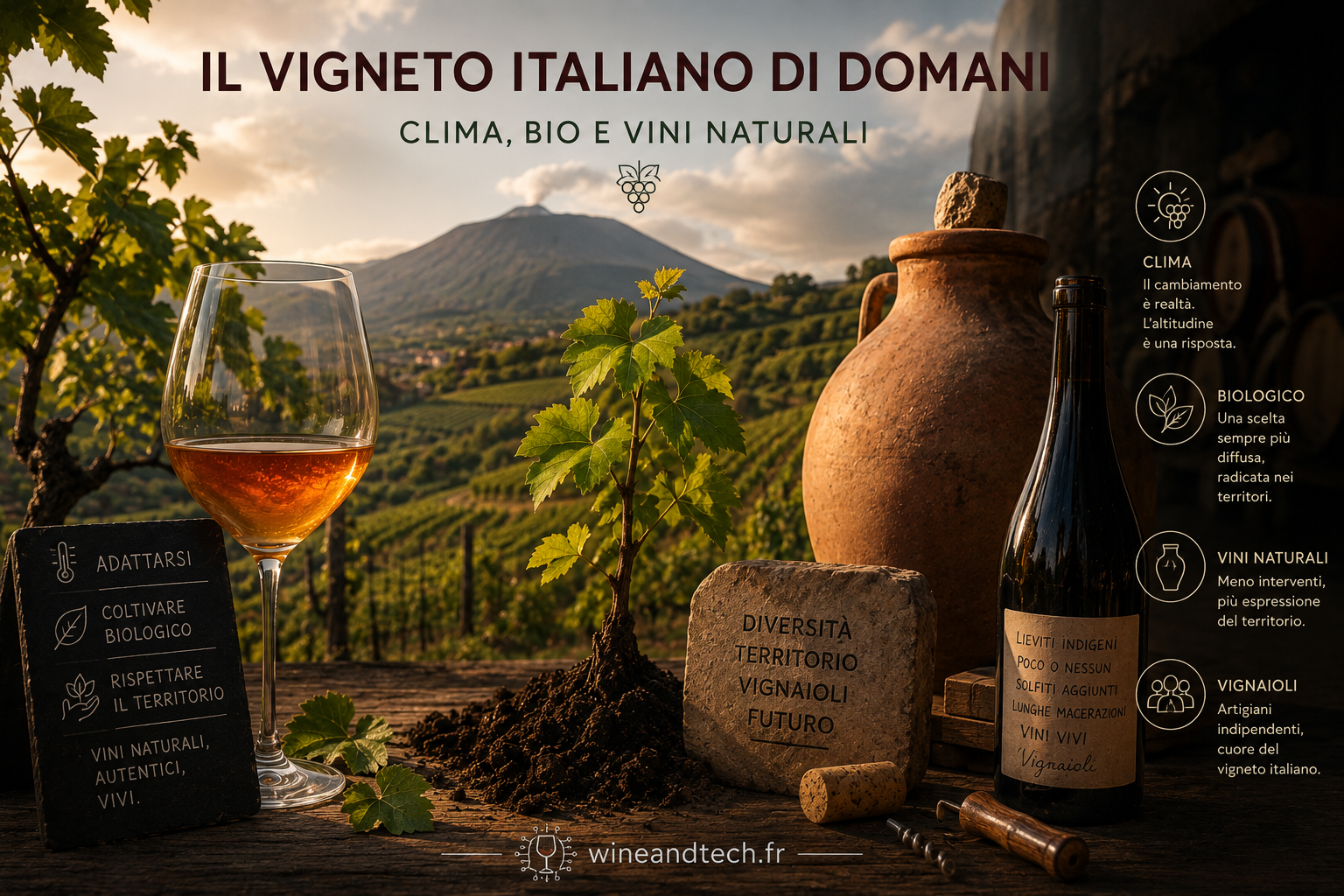
    🌡️ Climate change: Etna as a model?

    Climate change is affecting Italy very unevenly. In the north-east and certain areas of Lombardy, harvests tend to come earlier and earlier. The South and Sicily, already warm, are facing record temperatures during harvest.

    Italy’s response runs in part through altitude. Etna is the most striking example: vineyards at 600, 800, 1,000 metres, with day-to-night temperature swings that preserve freshness even in the full heat of a Sicilian summer. This capacity to seek out freshness and altitude now represents an adaptation strategy observed across other Italian regions.

    In Campania and Basilicata, Aglianico, a late-ripening variety, is also finding renewed interest in the context of climate warming. In Sardinia, altitude and sea winds play a regulatory role. In Piedmont, producers are planting on cooler exposures that were once set aside.

    🌿 Organic farming: a movement rooted in the land

    Italy is among the European leaders in organic viticulture. Around 129,000 hectares of wine grape vines were managed organically or in conversion in 2023, accounting for roughly one fifth of the national vineyard. Sicily, Sardinia and Tuscany account for a significant share of certified operations.

    This is not simply a response to demand. In Italy, many winemakers have long worked in a thoughtful or organic way. For some, certification formalised practices that had already been in place for several years.

    Biodynamics is also progressing, carried by a new generation of vignaioli seeking total coherence between their philosophy and their practices.

    🍷 Natural wine, Italian style

    Italy has its own natural wine pioneers. Josko Gravner in Friuli, who from the 1990s explored long skin macerations before turning to Georgian amphorae at the start of the 2000s. Stanislao Radikon, his neighbour, who created an aesthetic of oxidative, slowly evolving white wine now recognised worldwide.

    These orange wines from Friuli-Venezia Giulia were first misunderstood, then marginal, then cult. This Italian renaissance helped bring skin-contact whites back to the international stage, and Friuli remains one of the world’s great references for maceration whites, now emblematic of the so-called natural wine revival.

    In Piedmont, Tuscany and Sicily, a new generation of vignaioli works with indigenous yeasts, reduced or zero added sulphur depending on the producer, long ageing in clay or old wood. No official label. But an approach that converges with what the world calls natural.


    What the series will have shown

    Italy has transformed its diversity into living heritage. More than 500 indigenous varieties, hundreds of territories, centuries of adaptation.

    Against climate change, this diversity is a resource. A grape variety selected and cultivated for centuries in a given environment can represent a valuable tool for adaptation, particularly when it ripens late or shows good tolerance to local conditions.

    The future of the Italian vineyard will not be written by the great houses. It will play out in the Langhe, on Etna, in the gorges of Campania, in the Sardinian granite. Where a vignaiolo decides, season after season, to keep going.

    Italy has not exhausted its surprises. It just needs people to keep looking for them.

    🇫🇷+🇮🇹 Lire cet article en français + italiano → [lien à ajouter après liaison Polylang]
  • The French vineyard of tomorrow: climate change, organic wine and natural wine

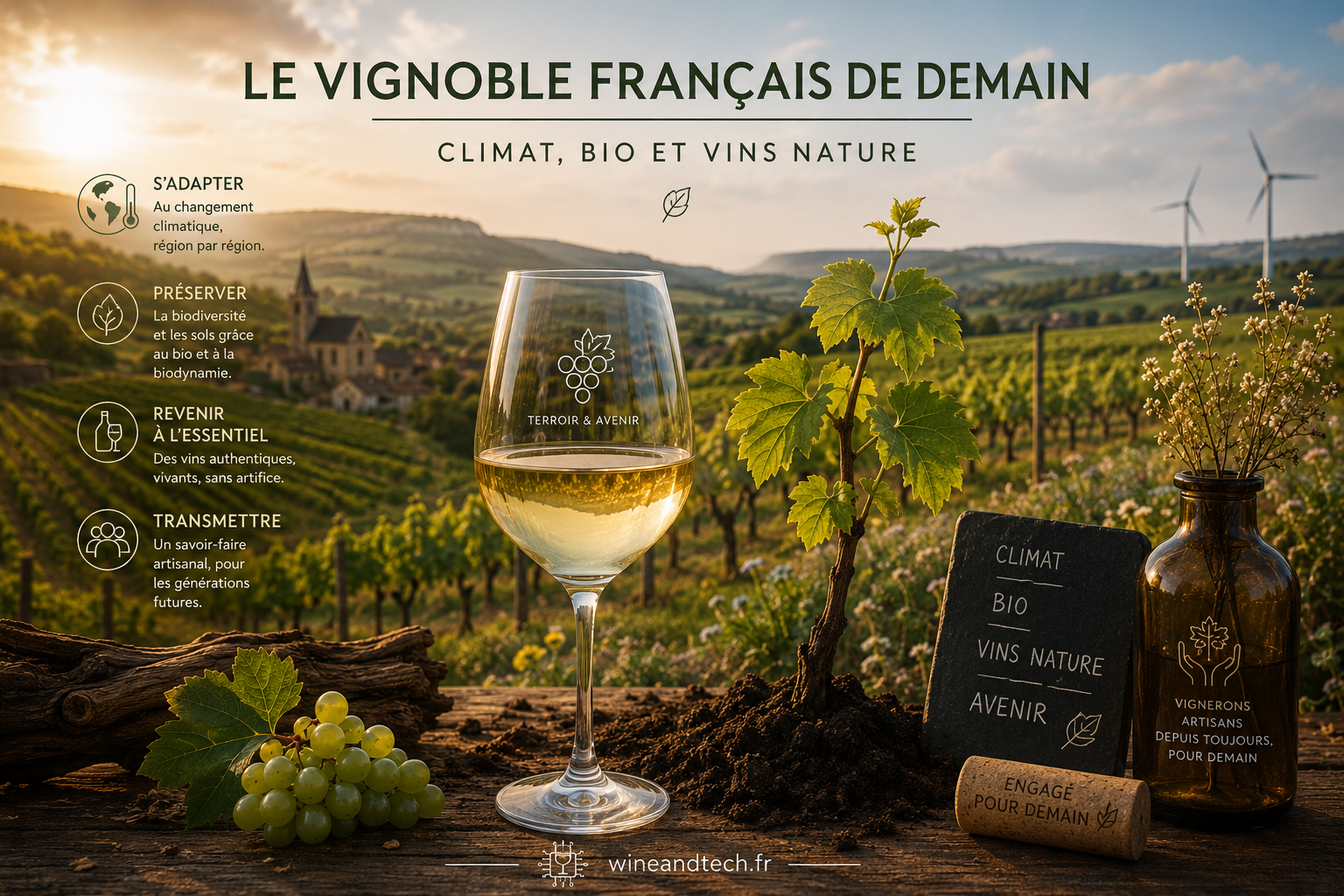
    The French vineyard of tomorrow: climate change, organic wine and natural wine

    🇬🇧 Series · The Vinous Trinity · Article 13/15 · France · ⏱ 5 min

    🇫🇷 Lire en français → [lien à ajouter] · Mon 🇫🇷 / Wed 🇮🇹 / Fri 🇪🇸

    Three countries, twelve articles, fifteen weeks of The Vinous Trinity. Before arriving at the final chapter, a look back at what France has shown. And a glance at what lies ahead.

    What the French vineyard has that is exceptional is its diversity. Not only in terms of regions or grape varieties, but in its approach to wine: as an expression of a place, a history, a person. The future of this vineyard is now playing out on three fronts: climate change, the rise of organic farming and the natural wine movement.

    🇰 What we take away

    France has profoundly shaped modern wine culture. The concept of terroir, the hierarchy of appellations, the great blending models, barrel ageing and the promotion of emblematic grape varieties have all contributed to its worldwide influence.

    What the series will have shown: France is more diverse than its great names suggest. Beyond Bordeaux, Burgundy and Champagne, entire regions are working in relative obscurity, with grape varieties found almost nowhere else and wines that still sell at honest prices.

    Jura, Savoie, the Beaujolais crus, the Grand South-West, Corsica, the secret Loire, French Moselle: territories that prove the French vineyard is far from having revealed everything. Behind each appellation, artisans practising this trade with complete independence, often for several generations.

    🌡️ Climate change: a reality region by region

    In Alsace, harvests have moved forward by more than three weeks over recent decades. In Champagne, preserving the acidity and freshness that are part of the wines’ identity is becoming more complex in a warming climate. In Languedoc, episodes of intense heat can lead to high ripeness levels and significant alcohol content.

    The responses are diverse. Planting later-ripening varieties. Moving to higher altitudes. Rehabilitating forgotten local varieties, better adapted to current conditions. Irrigation, long tightly regulated in French appellations, is permitted in certain situations and is now the subject of new regulatory thinking.

    The paradox: certain regions once too cold to produce quality wines are now benefiting. French Moselle, Auvergne, Haute-Savoie: terroirs gaining in potential at the very moment their more southerly neighbours are seeking to preserve their freshness.

    🌿 Organic farming: a quiet transformation

    France has become one of Europe’s leading organic vineyards. In 2023, around 22% of the French vineyard was managed organically, including certified and under-conversion operations, with more than 131,000 hectares already fully certified. The progression has been remarkable.

    Behind this figure, a diverse reality. Some producers have been organic since the 1980s, often in pioneering regions: Alsace, Loire, Roussillon, Languedoc. Others have converted more recently, driven by demand or conviction.

    Biodynamics, a distinct approach from organic farming and generally more demanding in its practices, is also progressing. In Burgundy, Alsace and Champagne, emblematic estates have worked biodynamically for decades. These practices are often invisible on the label, but very real in the cellar.

    🍷 Natural wine: between Paris and the rest of the world

    The natural wine movement took particular shape in France from the 1980s-90s, notably in Beaujolais and the Loire, around winemakers such as Marcel Lapierre, Jo Pithon, Pierre Overnoy and Nicolas Joly.

    There is no single official definition of “natural wine”. The term generally refers to a production philosophy seeking minimal intervention, in both the vineyard and the cellar: grapes from low-intervention farming, spontaneous fermentations, limited oenological inputs and reduced use of sulphur, to varying degrees depending on the producer.

    Today the movement is worldwide, but France remains its symbolic epicentre. Paris has become one of the world’s great natural wine capitals, with a remarkable concentration of specialist wine shops, wine bars and restaurants.

    What was marginal in the 1990s has become, thirty years on, an underlying trend that influences even the most conventional producers.


    What the series will have shown

    French wine’s richness does not rest on its great names. It rests on the density of its artisan fabric. Thousands of small producers, dozens of lesser-known regions, hundreds of local grape varieties.

    The future does not depend on a grand plan. It is built plot by plot, family by family, harvest by harvest.

    France has not exhausted its surprises. It just needs people to keep looking for them.

    🇫🇷 Lire cet article en français → [lien à ajouter après liaison Polylang]

  • The vignaioli: when a family does everything

    The vignaioli: when a family does everything

    🇬🇧 Series · The Vinous Trinity · Article 11/15 · Italy · ⏱ 5 min

    In Italy, the vignaiolo is not a winemaker like any other. An artisan who grows the grapes, vinifies the harvest and bottles, most of the time, without an intermediary. Sometimes on just a few hectares, passed down through several generations. This model is behind what Italian wine has that is most singular: a direct relationship between a person, a piece of land and a bottle.

    🏡 The vignaiolo: a philosophy as much as a trade

    The term vignaiolo refers to a precise reality. Unlike négociant houses that buy grapes or wines in bulk to blend them, the vignaiolo manages the whole process: vineyard, cellar, ageing, bottling. What France calls a récoltant-manipulant (though in Italy, unlike France, not all of them go as far as commercialising their wine). This independence often goes hand in hand with an intimate knowledge of the terroir. Each bottle carries the imprint of a family, a place, a conviction.

    🌿 From vine to bottle: independence as a choice

    The internal diversity of the Italian artisan vineyard is striking. A Piedmontese vignaiolo on 5 hectares in the Langhe has little in common with a Tuscan owner managing 30 hectares in Chianti Classico. What unites them is the conviction that wine expresses first and foremost the place and the person who makes it. This sets them apart from large cooperatives and industrial groups that prioritise consistency and volume. That said, it would be wrong to tar everything with the same brush: some Italian cooperatives now produce remarkable terroir wines. The same conviction also explains why many have chosen organic farming: not for the sake of fashion, but because coherence between vineyard and cellar matches their way of working.

    🏔️ Piedmont: the families behind the great wines

    In the Langhe, modern Barolo owes a great deal to a handful of families. Families like the Conterno, Mascarello, Rinaldi and Giacosa have embodied different expressions of this Piedmontese tradition. Names little known to the general public, venerated by serious wine lovers. These producers were at the heart of the 1980s-90s controversy between traditionalists and modernists. The former defended long ageing in large oak barrels, a rustic style but of remarkable longevity. The latter made greater use of small French barrels, different extraction approaches and shorter ageing periods. It is this diversity that makes Piedmont so difficult to summarise.

    🌿 Tuscany: tradition and renaissance

    The Tuscan transformation was radical. In the 1970s, Chianti was often synonymous with wine sold in fiasco bottles. A few families changed everything. The Antinoris on a large scale, Sergio Manetti at Montevertine on a smaller one. Today, dozens of small family estates produce Chianti Classico of great quality. It should be noted, though, that Montevertine is not really a Chianti Classico renaissance example in the strict sense: the estate actually left the Chianti Classico appellation to market its celebrated Pergole Torte as a Vino da Tavola, then IGT Toscana.

    In Maremma, new vignaioli are settling on terroirs still little explored. In Montalcino, historic families are defending their appellation against the temptation of economic growth, international prestige and artisan identity. A balance that is genuinely difficult to hold.

    ☀️ The South and the islands: the renaissance

    The South and the islands were long associated with production partly aimed at volume and blending markets. That has changed. In Campania, houses like Mastroberardino and Quintodecimo revealed the potential of Aglianico, Greco di Tufo and Fiano d’Avellino. In Sicily, Etna attracted a new generation of producers, local and from elsewhere. In Sardinia, families who had cultivated Vermentino for generations are beginning to be recognised at their true value. The lesson is simple: when a family bets on quality, the results follow.

    🆕 The new generation: break or continuity?

    Across Italy, a new generation is taking over. Trained at oenology university or abroad, they arrive with questions about century-old practices. Some choose total continuity: the same wine, the same methods. Others reinterpret: same vineyard, natural winemaking, fewer inputs. Both coexist, and that is what makes Italian wine so difficult to sum up in a sentence.


    What large structures cannot copy

    What gives a vignaiolo their value is precisely what a large structure cannot reproduce: a single family, a single piece of land, a coherent style over the long term. Each bottle is the signature of a specific place, bringing readability to the terroir and genuine personality.

    A vignaiolo doesn’t buy grapes. They harvest their own life into a bottle.

  • Nebbiolo, Sangiovese, Vermentino: Italy’s inimitable treasures

    Nebbiolo, Sangiovese, Vermentino: Italy’s inimitable treasures

    🇬🇧 Series · The Vinous Trinity · Article 8/15 · Italy · ⏱ 5 min

    🇫🇷+🇮🇹 Lire en français + italiano → [lien à ajouter] · Mon 🇫🇷 / Wed 🇮🇹 / Fri 🇪🇸

    Italy officially catalogues more than 500 indigenous grape varieties. Among them, some stand apart for a rare quality: their capacity to express with particular force the territory that shaped them.

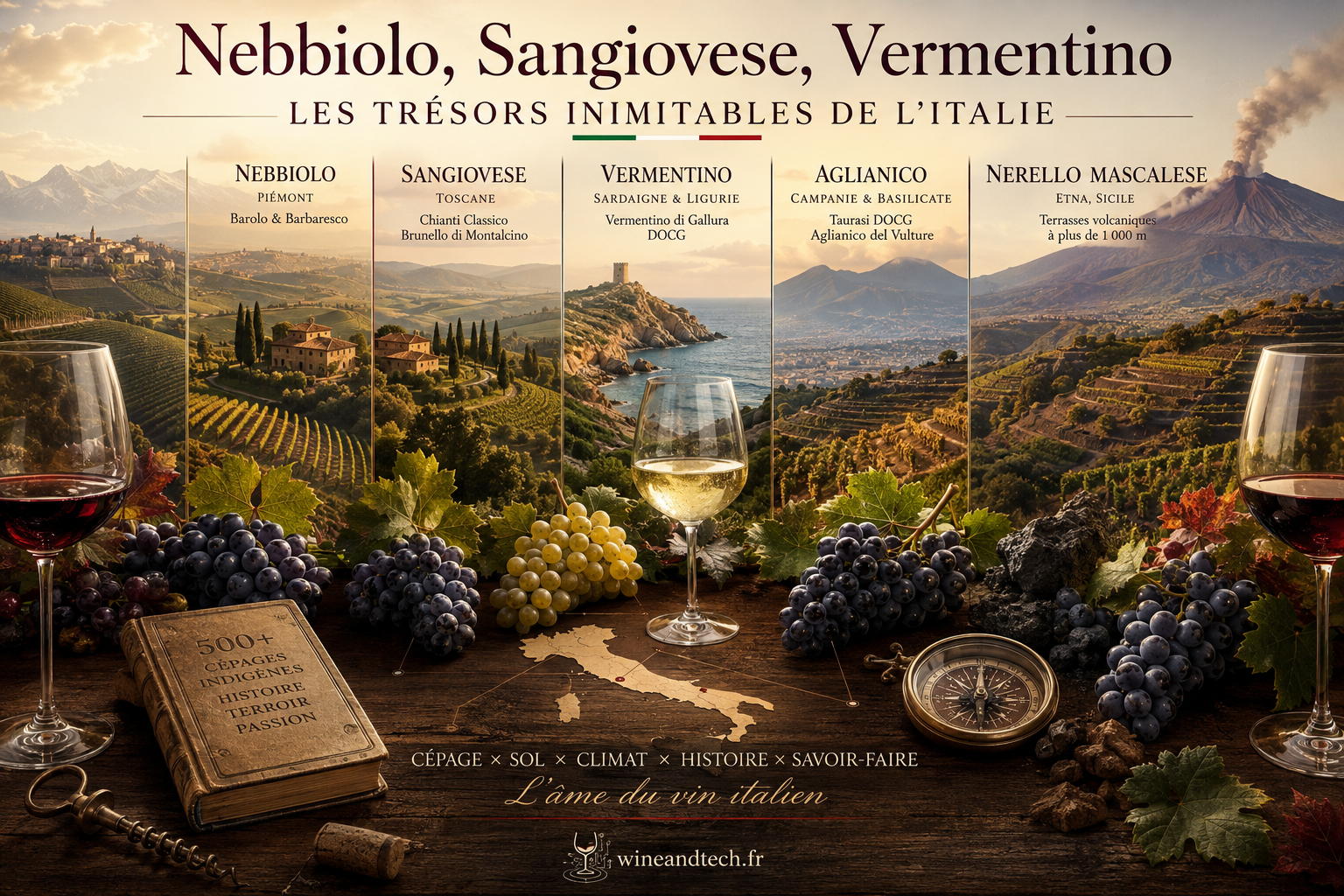
    Grown far from their home ground, they can produce excellent wines, but their expression changes. Vinified differently, they reveal other facets. Nebbiolo, Sangiovese, Vermentino, Aglianico, Nerello Mascalese: these names are deeply bound to a soil, a climate, a history and craftsmanship passed down through the generations.

    🍇 Grape varieties explored in this article

    Nebbiolo · Sangiovese · Vermentino · Barbera and Dolcetto · Aglianico · Nerello Mascalese

    🔴 Nebbiolo · the king of the Langhe

    Nebbiolo is one of Italy’s most emblematic grape varieties. Its most prestigious home is the Piedmontese Langhe, where it gives rise to the two great DOCGs, Barolo and Barbaresco. It is also present in other Alpine and Piedmontese territories, notably Valtellina in Lombardy, and at Gattinara and Ghemme in northern Piedmont.

    Its signature is immediately recognisable: a colour often relatively pale despite an important tannic structure, high acidity and a remarkable capacity for ageing.

    In youth, its tannins can be particularly firm. Over the years, the wine gains complexity and develops aromas of faded rose, cherry, liquorice, tar, undergrowth and truffle.

    This alliance of aromatic finesse, structure and ageing potential puts Nebbiolo among the world’s great long-lived grape varieties.

    Its expression varies considerably according to soils, exposures and altitude. In the Langhe, the combination of marl, hillsides, microclimates and winemaking tradition has forged an identity difficult to reproduce anywhere else.

    🔴 Sangiovese · the soul of Tuscany

    Sangiovese is the most widely planted grape variety in Italy and arguably one of the most polymorphic on the peninsula. Its most celebrated expression remains deeply linked to Tuscany.

    In Chianti Classico, it produces wines characterised by bright acidity, structured tannins and aromas of cherry, violet, herbs and spice, to which notes of leather and tobacco can be added with age.

    In Montalcino, under the name Brunello, it reaches an expression of particular depth and longevity. In Montepulciano, it forms the heart of Vino Nobile di Montepulciano, in a generally softer and more accessible style.

    This should not be confused with Montepulciano d’Abruzzo, made from the Montepulciano grape variety and not from Sangiovese.

    The strength of Sangiovese lies precisely in its capacity to change face according to its environment. But in central Tuscany, on the soils of galestro and alberese, it finds a particularly emblematic expression, where acidity, structure and freshness balance with remarkable precision.

    🟡 Vermentino · the white of the shores

    Vermentino is one of the Mediterranean’s great white grape varieties.

    It is found in Sardinia, Liguria and Tuscany, as well as in Corsica, where it is traditionally called Rolle.

    In Sardinia, its most prestigious expression is found in Vermentino di Gallura DOCG, the emblematic appellation of the island’s north-east. The regulations require a minimum of 95% Vermentino.

    In the glass, it generally offers dry, fresh and aromatic whites, with notes of white flowers, citrus, peach, white-fleshed fruits and almond, accompanied by a sometimes slightly bitter finish that adds length.

    In Gallura, the granite soils, the wind and the Mediterranean climate contribute strongly to its identity.

    The result is a wine that combines freshness, salinity and elegance. A bottle of Vermentino di Gallura around €12-18 offers a remarkable pleasure-to-price ratio, particularly at table with fish, seafood or Mediterranean cuisine.

    🔴 Barbera and Dolcetto · everyday elegance in Piedmont

    In Piedmont, two other grape varieties occupy an essential place in everyday wine culture: Barbera and Dolcetto.

    Barbera, with its bright acidity, moderate tannins and generous fruit, produces wines that are particularly easy to pair at table. Young and fruity or aged to greater depth, it remains one of Piedmont’s great convivial wines.

    Dolcetto, despite its name, is not a sweet wine. Its name refers to the sweetness of its grapes rather than the sweetness of the wine produced.

    It generally yields soft, fruity and accessible reds, with tannins more present than one might expect and characteristic notes of dark fruits, cherry and almond.

    Barbera and Dolcetto represent another face of Piedmont: less aristocratic than Barolo or Barbaresco, but deeply rooted in everyday life and regional gastronomy.

    🔴 Aglianico · the power of the South

    Aglianico is one of southern Italy’s great red grape varieties and remains relatively underrated internationally.

    Its two most celebrated expressions are found in Campania, with Taurasi DOCG, and in Basilicata, with Aglianico del Vulture.

    It produces structured, deep wines well-suited to ageing: firm tannins, high acidity, dark fruits, spice, balsamic notes and touches of tobacco and undergrowth with development.

    At Taurasi, its keeping potential can be extraordinary. The altitude and relatively cool conditions of some vineyards help preserve its freshness despite the southern latitudes.

    Its late ripening cycle also shapes its identity. Aglianico can reach full maturity late in the season, sometimes into October in certain areas, which builds concentration and complexity in its wines.

    Austere in youth, but capable of becoming spectacular with time.

    🔴 Nerello Mascalese · the child of Etna

    Nerello Mascalese is inseparable from Etna, in eastern Sicily.

    Long used mainly in regional blends, it has undergone a genuine qualitative renaissance over several decades. The rise of Etna wines has revealed its full potential when vinified with precision and drawn from carefully selected parcels.

    On the slopes of the volcano, it produces wines of astonishing finesse: high natural acidity, fine tannins, red fruits, pomegranate, flowers, spice and notes evoking rock or smoke.

    One of its distinctive qualities lies in Etna’s exceptional environment. The vineyards are planted on soils derived from successive lava flows and at sometimes considerable altitude, with significant thermal variation between day and night.

    This combination of volcano, altitude, exposure, Mediterranean climate and the diversity of lava flows creates a mosaic of particularly expressive terroirs.

    The result can evoke, in its finesse and freshness, some of the great reds of northern Italy or Burgundy, while retaining a profoundly Sicilian identity.

    Etna is not just a dramatic backdrop. It’s a genuine winegrowing matrix.


    Inimitable by nature

    Italian wine’s real strength isn’t the number of its grape varieties. It’s the organic bond that links them to their territories.

    Nebbiolo in the Langhe.
    Sangiovese on the Tuscan hills.
    Vermentino facing the winds of Gallura.
    Aglianico on the volcanic heights of Vulture or around Taurasi.
    Nerello Mascalese on the slopes of Etna.

    Elsewhere, these grape varieties can produce excellent wines. But their identity changes when the environment that shaped them disappears.

    This is the full magic of Italian terroir: grape variety × soil × climate × history × craftsmanship.

    More than 500 indigenous grape varieties, hundreds of territories, centuries of adaptation. Italy hasn’t simply preserved this diversity.

    It has transformed it into living heritage.

    And it is perhaps there that its greatest treasure lies: grape varieties the whole world can plant, but whose soul no one can totally reproduce.

    A grape variety doesn’t lie. Separate it from its land, and it tells a different story, or stops telling any at all.

    🇫🇷+🇮🇹 Lire cet article en français + italiano → [lien à ajouter après liaison Polylang]
  • From Barolo to Nero d’Avola: a journey from North to South Italy

    From Barolo to Nero d’Avola: a journey from North to South Italy

    🇬🇧 Series · The Vinous Trinity · Article 5/15 · Italy

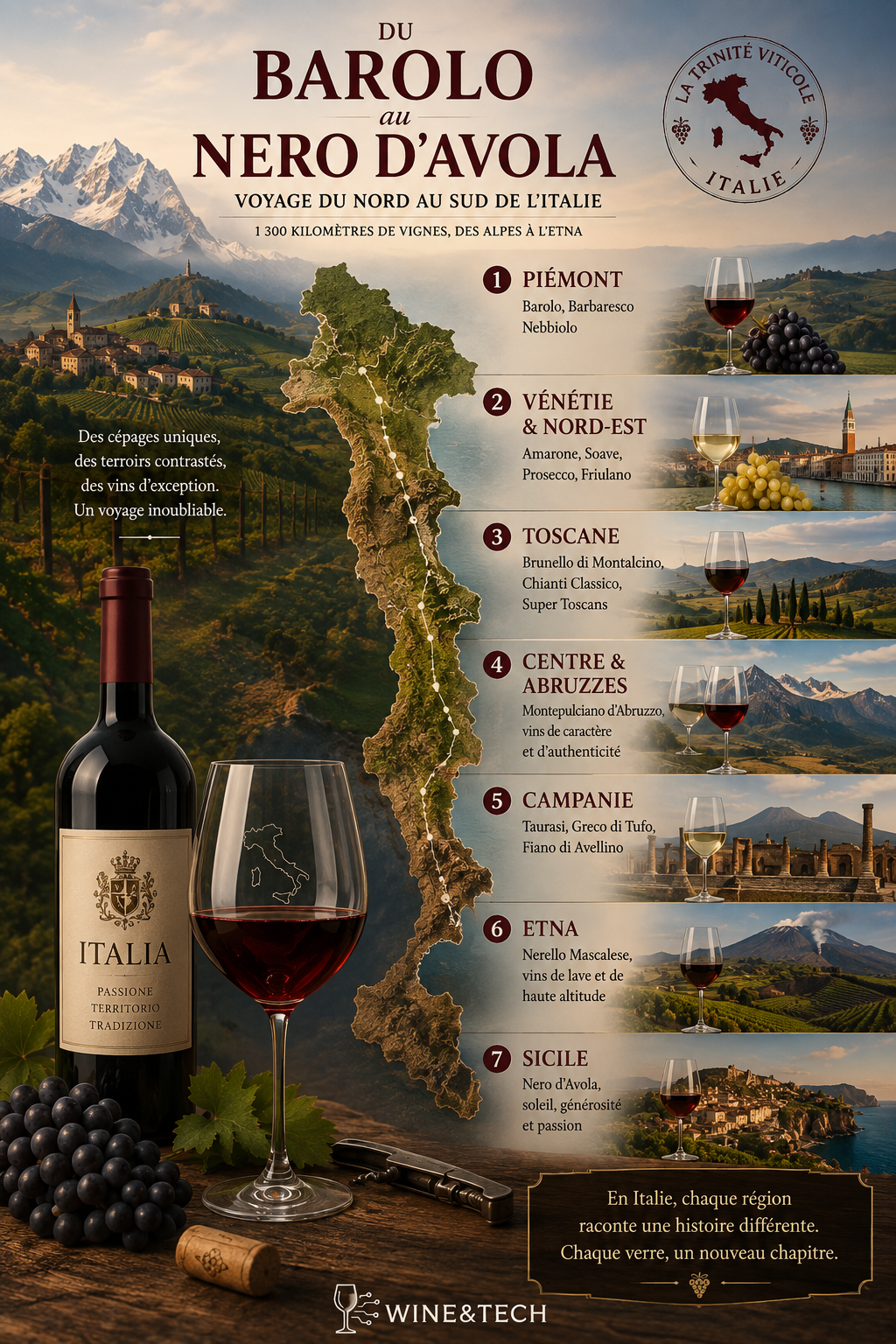
    From Turin to Palermo, nearly 1,300 kilometres of travel through the Italian vineyards. Italian wine doesn’t reveal itself in a single glance, it unfolds, at the pace of grape varieties that change every hundred kilometres, terroirs shifting from Alpine granite to Sicilian volcanic ash. This journey from north to south is one of the most rewarding the wine world has to offer.

    🗺️ Stops on the journey

    Piedmont · Veneto & North-East · Tuscany · Centre & Abruzzo · Campania · Etna · Sicily

    🏔️ The Great North: Barolo, Barbaresco and Piedmont’s power

    The journey begins in the Langhe hills of Piedmont. Barolo and Barbaresco, both from Nebbiolo, are the undisputed aristocrats of northern Italy: wines with a garnet colour that pales quickly, austere tannins in youth, that develop after 10 to 20 years a complexity of tar, faded rose, truffle and black cherry that is absolutely unique in the world. Barolo is often called the king of Italian wines; Barbaresco, generally earlier in its evolution, can show itself more approachable when young. But Piedmont is not just its two DOCG kings: Barbera d’Asti (juicy, fresh, delicious young at €9–12), Dolcetto d’Alba (elegantly bitter), Moscato d’Asti (delicate sparkling sweet, irresistible), the palette is immense.

    🌊 Veneto and the North-East: from Amarone to Soave

    Heading east, the Veneto establishes itself as Italy’s most productive wine region, offering one of the widest ranges of styles on the peninsula. From sparkling, fresh Prosecco di Valdobbiadene, to Soave Classico of remarkable minerality on volcanic soils, to Valpolicella Ripasso gaining body through partial drying, through to Amarone della Valpolicella : grapes dried through appassimento, concentrated, long-aged, a wine of power and meditation capable of crossing several decades for the finest cuvées. Friuli produces some of Italy’s finest dry whites: Friulano, Ribolla Gialla, Pinot Grigio of a precision and tension rarely matched anywhere.

    🌿 Tuscany: Brunello, Chianti, Super Tuscans

    At the midpoint, Tuscany asserts itself as the great theatre. Chianti Classico : Sangiovese on the hills between Florence and Siena, cherry, tobacco, bright acidity, is one of Italy’s most versatile food-wine pairings. Brunello di Montalcino is another dimension entirely: made exclusively from Sangiovese, known locally as Brunello, it must wait at least five years before release, including a minimum of two years in wood. Capable of crossing several decades in the cellar, it ranks among the great ageing wines of the peninsula. The Super Tuscans of Bolgheri (Sassicaia, Ornellaia, Tignanello) helped to revolutionise Italian wine from the 1970s onwards, introducing Cabernet Sauvignon and Merlot into world-class blends freed from appellation constraints.

    ☀️ From Centre to South: Montepulciano, Taurasi and Campania’s awakening

    Continuing south, less publicised but increasingly high-quality wines emerge. Montepulciano d’Abruzzo, not to be confused with Tuscany’s Vino Nobile, is one of Italy’s best value wines: generous red with supple tannins, accessible from €8–10. Campania confirms its reputation as a revelation: Taurasi, made from Aglianico and often nicknamed the Barolo of the South for its ageing potential and structure, Greco di Tufo (nervously taut yet opulent white), Fiano di Avellino (complex, hazelnut and saffron notes). Grape varieties of an originality and depth the world is progressively discovering.

    🌋 Etna and the end of the journey: Nerello Mascalese and Nero d’Avola

    The journey ends on the slopes of Etna, the tallest active volcano in Europe. Etna has become one of the great wine revelations of the past twenty years: Nerello Mascalese, grown on the volcanic slopes, sometimes at over 1,000 metres altitude, produces reds of a finesse, freshness and complexity unexpected at these latitudes. Fine tannins, vibrant acidity, notes of red fruits, spice and volcanic stone: some of these wines evoke in their delicacy the great Pinot Noirs of Burgundy. It is one of the great emotions of contemporary Italian wine. And Nero d’Avola, the emblematic grape of Sicily, brings the journey to a close with its warm, generous reds, fleshy tannins and ripe dark fruits, in the light and warmth of deep Sicily.


    What this journey reveals

    This 1,300 km journey reveals a fundamental truth: few countries in the world can offer such a succession of styles, grape varieties and identities over such a short distance. Every stop contradicts the previous one. A Barolo and a Nerello from Etna are two wines so different you struggle to believe they come from the same country and yet both reach absolute peaks in their respective registers. This is precisely why Italy is the most fascinating wine country to explore.

    You don’t visit Italian wine country. You explore it, as long as you’re ready to be surprised at every stop.

  • Italy’s 500 grape varieties: an extraordinary panorama

    Italy’s 500 grape varieties: an extraordinary panorama

    ⏱ 4 min

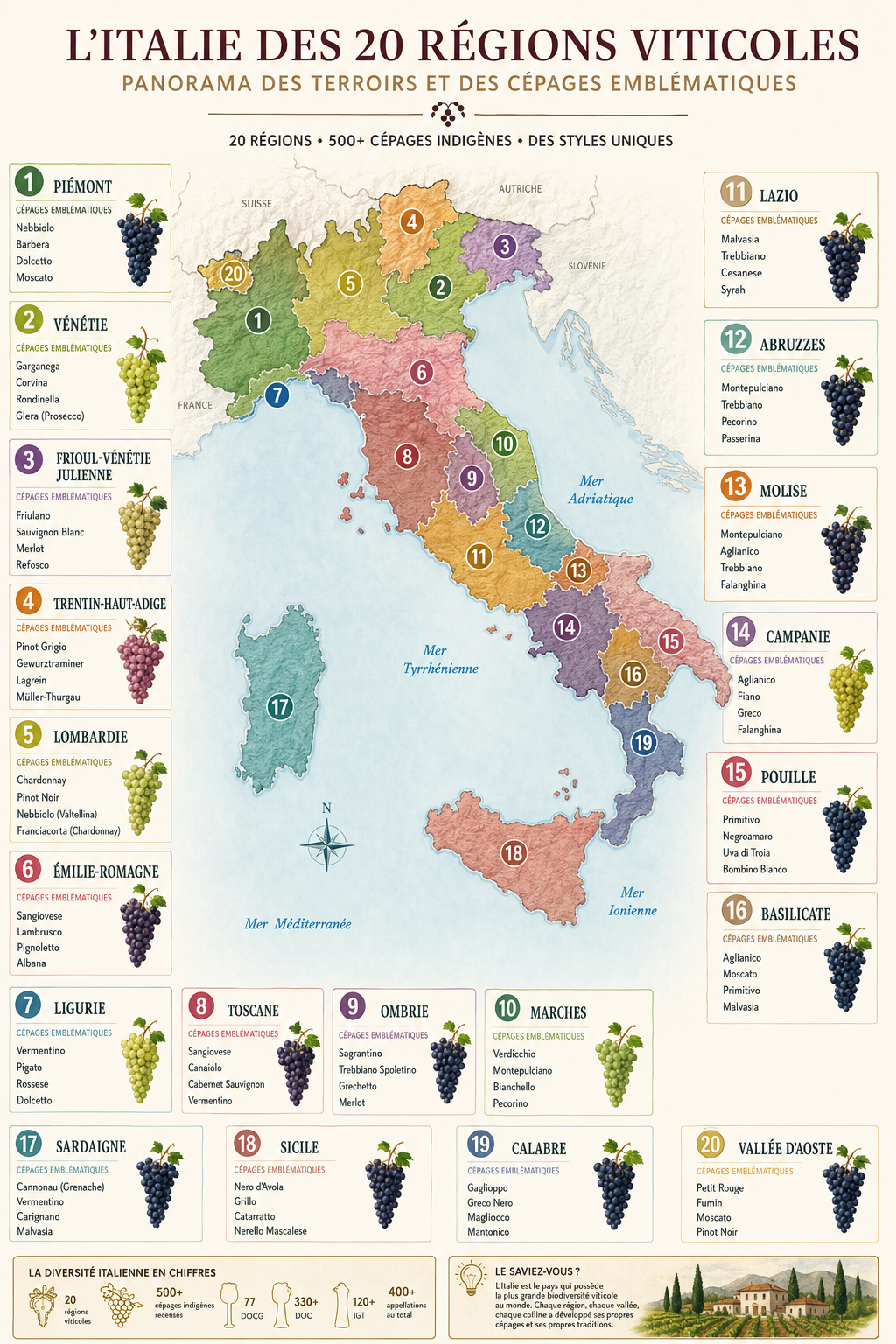
    If France is the homeland of terroir, Italy is the homeland of absolute diversity. Twenty wine regions, all active. Five hundred indigenous grape varieties recorded — a diversity probably unmatched anywhere in the wine world. Over four hundred appellations. Styles ranging from the sparkling Prosecco of Veneto to Piedmontese Barolo, from the mineral freshness of Soave to the generous warmth of Puglia’s Primitivo. Italy doesn’t just make wine: it reinvents the definition of wine in every region.

    20

    wine regions

    500+

    indigenous grape varieties

    400+

    DOCG + DOC appellations

    50,000+

    wineries and wine businesses

    The geography of taste: from the alpine North to the Mediterranean South

    Italy’s wine country stretches 1,300 km from north to south, an extraordinary succession of microclimates. In the north, the Alps shelter the vines and allow for wines of remarkable freshness and precision. In Tuscany and the Centre, altitude and proximity to the sea create a perfect balance between ripeness and acidity. In the south and on the islands, Mediterranean sun pushes concentration and aromatic richness. Every region has developed its own grape varieties, its own techniques, its own philosophy.

    Map of Italy's wine regions

    🏔️ The Great North: from Piedmont to Friuli

    Piedmont is Italy’s Burgundy — not as flattery, but as logic: a king grape almost impossible to reproduce elsewhere (Nebbiolo), hierarchised crus (Barolo, Barbaresco), a precision of terroir that tolerates no approximation. But it’s also the home of juicy, affordable Barbera, fresh Dolcetto, and Moscato d’Asti, which delights even the most demanding palates. Veneto is Italy’s largest wine-producing region, with an unbeatable quality-to-price ratio: Prosecco for the aperitif, Soave Classico with seafood, Valpolicella Ripasso with meat, Amarone for special occasions. Friuli produces some of Italy’s finest dry whites. Trentino-Alto Adige, with its Austro-Germanic influences, refines Pinot Blanc, Gewürztraminer and Lagrein on exceptional alpine terroirs. Lombardy rounds things out with Franciacorta and Valtellina (Nebbiolo grown on mountain terraces).

    🌿 The Tuscan Heart and the Centre

    Tuscany is the best-known face of Italian wine internationally: Chianti Classico, Brunello di Montalcino, Vino Nobile di Montepulciano, and the Bolgheri “Super Tuscans” (Sassicaia, Ornellaia, Tignanello) — wines that redefined modern Italy. Umbria reveals Sagrantino di Montefalco, one of the most tannic grape varieties in the world, capable of ageing for thirty years. The Marche region offers Verdicchio, a dry white of striking freshness and minerality. Abruzzo — not to be confused with the Tuscan town of Montepulciano — produces a generous, accessible Montepulciano d’Abruzzo, one of the best value wines in Italy.

    ☀️ The Deep South and the Islands

    Campania is the great revelation of the past twenty years: Taurasi, sometimes nicknamed the “Barolo of the South” for its ageing potential, Greco di Tufo, and Fiano di Avellino — three grape varieties of remarkable depth and originality. Puglia produces in volume but is rising in quality: Primitivo di Manduria, Negroamaro and Salice Salentino deserve attention. Sicily has undergone the most spectacular transformation of all: Etna (Nerello Mascalese grown on volcanic soils) produces wines of an elegance utterly unexpected at these latitudes, while Nero d’Avola remains the island’s warm, approachable ambassador. Sardinia, with its Cannonau and Vermentino, completes a panorama of extraordinary richness.


    500 inimitable grape varieties — Italy’s true strength

    France has several hundred recorded grape varieties, Spain around 400, but Italy ranks among the richest countries with over 500 identified varieties — and some studies on the genetic diversity of Italian vines suggest the existence of thousands of historic local varieties or populations still to be documented.

    Grape varieties that cannot be grown anywhere else with the same results: Nebbiolo loses its character outside Piedmont, Sagrantino outside Montefalco, Nerello outside the volcanic ash of Etna. It’s this irreducible specificity that makes every Italian bottle a journey to a precise place, a particular story. Where France built its identity around terroir and Spain around an extraordinary capacity for modern transformation, Italy celebrates, above all, the meeting of a land, a history and a forgotten grape variety.

    Italy doesn’t produce wine. It produces civilisations in a bottle.

  • World Wines Days

    World Wines Days

    Source : https://www.winetourism.com/international-wine-days/

    1st February – International Furmint Day

    18th February – World Drink Wine Day

    3rd March – Mulled Wine Day

    13th March – International Riesling Day

    14th April – Tannat Day

    17th April – Malbec World Day

    29th April – International Viognier Day

    6th May – International Sauvignon Blanc Day

    17th May – Pinot Grigio Day

    21st June – World Lambrusco Day

    24th June – International Rosé Day

    28th July – Shiraz Day

    1st August – International Albariño Day

    18th August – International Pinot Noir Day

    30th August – International Cabernet Sauvignon

    1st September – International Cap Classique Day

    10th September – International Port Wine Day

    16th September – International Grenache Day

    8th October – International Pinotage Day

    28th October – Champagne Day

    7th November – International Merlot Day

    10th November – International Tempranillo Day

    4th December – International Cabernet Franc Day

    10th December – International Tokaj Day

    16th December – Pinot Meunier Day

  • Castello Monaci and the Wines of Puglia

    Castello Monaci and the Wines of Puglia


    “The wines of Puglia capture the essence of this sunny region of southern Italy, with generous wines, rich in flavour, that reflect the influence of the Adriatic Sea and of a unique terroir.” – Wine Enthusiast

    Castello Monaci wines are produced by an estate located in the Puglia region of southern Italy.

    The Castello Monaci estate is in the province of Lecce, and its name refers to the old medieval castle that stands on the property. The estate covers around 350 hectares, of which about 150 are given over to vineyards.

    Castello Monaci: https://www.castellomonaci.com/wine-experience-salento/

    Castello Monaci wines are often made from varieties typical of Puglia, such as Primitivo, Negroamaro, Malvasia Nera and Fiano. Primitivo is particularly prized for its richness and its aromas of ripe red fruit, while Negroamaro gives full-bodied wines with spicy notes. Fiano, for its part, produces fresh, fragrant whites.

    Whether you’re tasting an intense, velvety red or savouring an aromatic, refreshing white, Castello Monaci’s wines offer a distinctive taste experience and represent the terroir of Puglia well.

    My tasting:

    A very lovely red, soothing and pleasant.
    A light, discreet nose with aromas of caramel and wood, and a little black cherry.

    On the palate, an aroma of wood and a light acidity; through the length I dare to detect a little banana. It’s very balanced, pleasant to drink.

    I’ll remain a little disappointed by the short length, though it’s pleasant all the same.

    Tasted over a meal with friends at a restaurant, I’m still very surprised by this wine, chosen almost at random. In any case, it undeniably took us travelling.

  • Which Glasses for Which Uses?

    Which Glasses for Which Uses?

    It’s often worth remembering that the glass, and its shape, matter when tasting a wine.

    Here’s a nice article (in French) that explains the basics:

    You may already have noticed, but there are several types of wine glass. In truth, there are countless numbers of them, every maker…

    Service : Quels verres pour quels usages ?
  • Italy: Tuscany — Promis, Nothing but Pleasure

    Italy: Tuscany — Promis, Nothing but Pleasure

    “The wines of Tuscany are wines that reflect the beauty and elegance of this region, and that have an extraordinary capacity for ageing.” – Wine Spectator

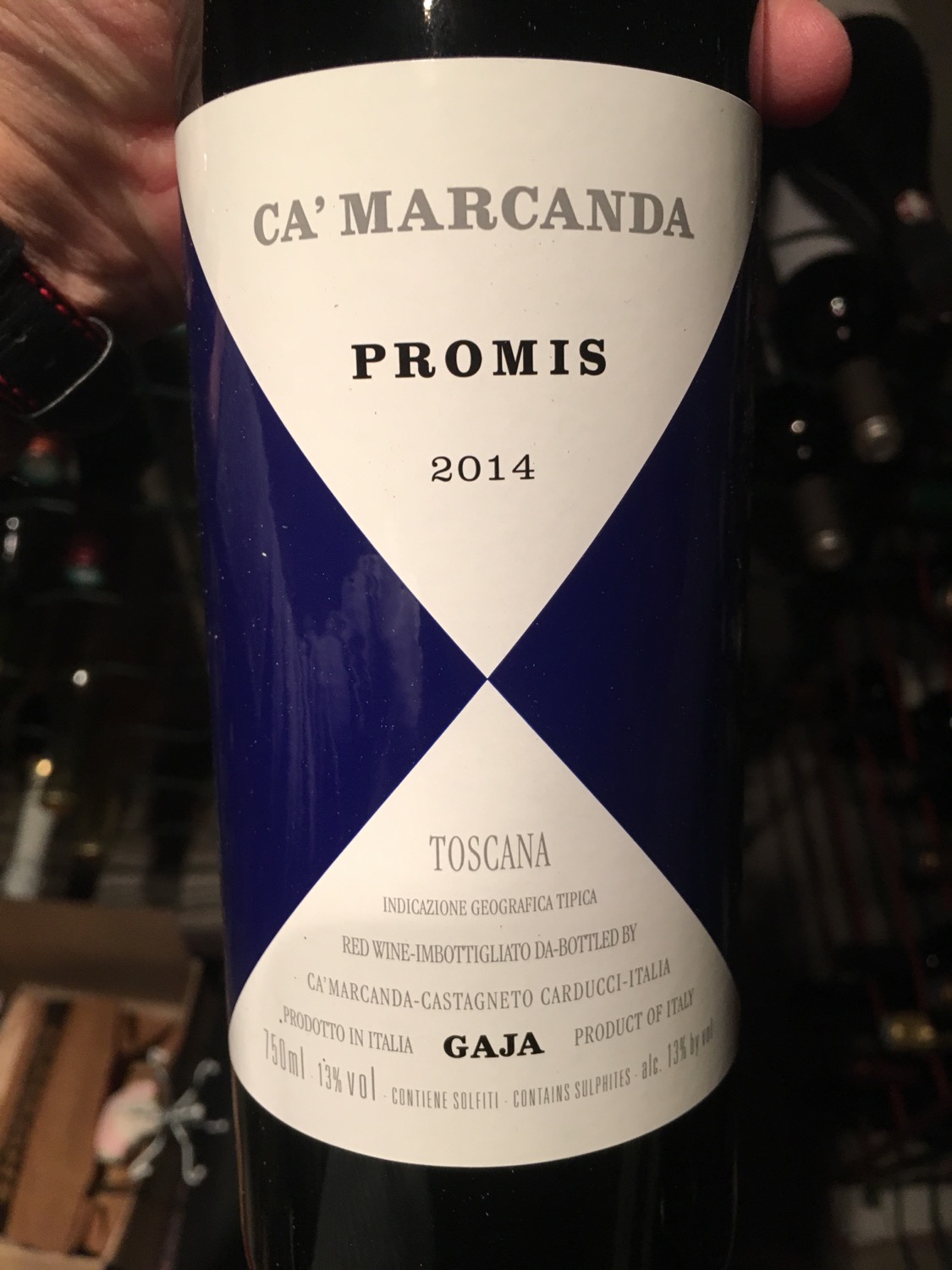
    Promis is produced by the Ca’Marcanda estate, located in the Bolgheri region of Tuscany. This estate belongs to the famous Gaja family of wine producers, who have a long winemaking tradition in Italy.

    Ca’Marcanda was founded by Angelo Gaja in 1996, with the aim of producing wines that reflect the unique terroir of the Bolgheri region. The estate covers around 150 hectares of vineyards, planted mainly with Bordeaux varieties such as Cabernet Sauvignon, Merlot, Cabernet Franc and Petit Verdot.

    Ca’Marcanda is known for producing wines of great quality, combining complexity, elegance and power. Besides Promis, the estate also produces several other prestigious wines, such as Magari, Camarcanda and Ca’Marcanda Vistamare.

    The 2019 vintage of Ca’Marcanda’s Promis is considered an excellent vintage in Tuscany. This wine is a blend of three varieties: Merlot, Syrah and Sangiovese.

    On the nose, Promis 2019 offers intense aromas of red and black fruit, such as cherry, blackberry and plum, along with notes of sweet spice and vanilla from its ageing in French oak barrels.

    On the palate, the wine is rich, powerful and structured, with firm tannins and a balanced acidity. The red and black fruit flavours are confirmed on the palate, along with notes of liquorice, tobacco and dark chocolate.

    Ca’Marcanda’s Promis is often considered a wine for keeping, one that can be cellared for several years and that improves with age. It’s recommended to serve Promis 2019 at a temperature of 16 to 18 degrees Celsius, and it pairs very well with rich meat dishes, such as roasts and game, as well as with mature cheeses.