⏱️ Reading time: 6 minutes
Blockchain won’t wipe out counterfeiting overnight. But bottle after bottle, it’s drawing the infrastructure of a wine market where every grand cru will, at last, have a tamper-proof memory.
Every year in the European Union, counterfeit wines and spirits cause losses estimated at €2.4 billion, according to the European Union Intellectual Property Office (EUIPO) — with French AOPs the first victims. Behind that figure lies a reality many consumers are unaware of: a far-from-negligible share of the bottles circulating on the secondary market don’t contain what their label promises.
This problem isn’t new. But it’s taking on a new dimension as grands crus establish themselves as investment assets. In 2022, the average price of a bottle at auction reached €194, up 40% on 2021. When value rises, forgers follow. It’s in this context that blockchain has established itself as a credible technological response — provided you understand what it really does, and what it doesn’t.
WHAT BLOCKCHAIN REALLY CHANGES
A technology in the service of traceability
Blockchain, in its simplest definition, is a shared, tamper-proof, decentralised ledger. Any information recorded in it can be neither modified nor deleted. Applied to wine, this property opens up very concrete possibilities.
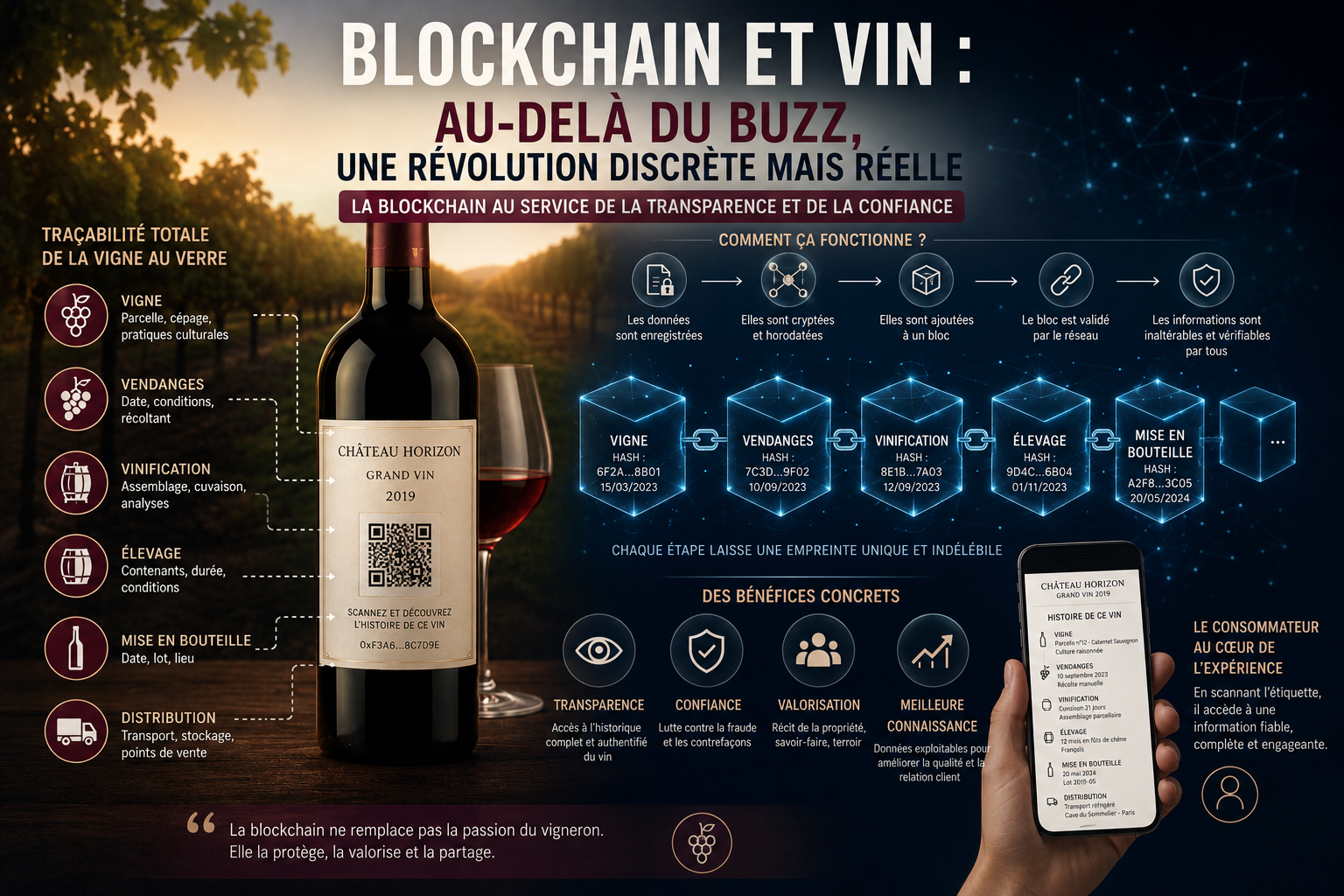
Each bottle can be recorded on the chain with a set of information all its own: grape variety, vintage, region of production, growing methods, harvest dates. Once entered, this data can no longer be altered. A consumer who scans a QR code on the back label gains access to this entire history — from vineyard to cellar, from bottling to the distributor’s warehouse.
Blockchain alone isn’t enough, though: you still have to link the physical bottle to its digital identity. That’s where NFC or RFID chips come in. Some solutions position the chip so that it’s destroyed when the bottle is opened, preventing any fraudulent reuse. Platforms such as WineDex can record up to 90 types of data per bottle — from a high-resolution photo to the ownership history, taking in storage conditions along the way.
Concrete players have already taken the plunge. Château Le Puy, a respected Bordeaux estate, has partnered with the company VeChain to integrate blockchain into its production. The Italian startup Ez Lab has built a platform called AgriOpenData on the Algorand blockchain, whose first wine use case dates back to 2016. In 2025-2026, solutions such as WineDex and Intercellar create digital certificates of authenticity for each bottle, making it possible to trace its complete journey from production to sale.
What these platforms guarantee, in essence, comes down to a simple principle: once entered, data can no longer be altered. Each bottle ends up with a memory that no one can falsify after the fact.
NFTS AND WINE: THE HYPE HAS FADED, AND THAT’S GOOD NEWS
From speculation to real usefulness
There was a time when NFTs seemed to be the future of collectible wine. In 2021 and 2022, several great houses launched experiments: Château Angélus with its 2020 vintage tied to digital tokens, promising exclusive access, virtual tours, private invitations. The promise was seductive.

Today, we have to face reality. In the first quarter of 2025, only 7 million NFT trades were recorded on dedicated platforms, for $1.5 billion in transactions — far from the peaks of 2021. In France, in early 2025, only 3% of those surveyed said they owned an NFT, a figure on the decline.
Carrefour, Renault, Lacoste, Ubisoft: examples of big brands quietly abandoning their NFT projects have multiplied. But beware of throwing the baby out with the bathwater. An NFT can allow a bottle of wine to become “phygital”: its physical reality is paired with a unique, tamper-proof digital identity certifying its origin, its vintage, its logistical conditions, even its environmental transparency. What was a speculative promise in 2021 can become a serious traceability tool in 2026 — provided it’s stripped of its financial aura.
The discreet, functional NFT, invisible to the end consumer but valuable to the players in the value chain: that’s where the realistic future of the technology in wine lies.
✓ What NFTs bring to wine
- A unique, tamper-proof digital identity for each bottle
- Certification of origin, vintage and logistics
- Environmental and social transparency
- Traceability of successive owners
- Exclusive experiences for collectors
✕ What the bubble revealed
- Valuations disconnected from any real usefulness
- Projects abandoned for lack of lasting communities
- Technical complexity out of reach of the general public
- Speculation taking priority over concrete use
- 95% of artistic NFT collections valued at zero in 2024
THE REAL OBSTACLES WE DON’T TALK ABOUT ENOUGH
Three structural obstacles to adoption
The data-entry problem. Blockchain guarantees that what is recorded cannot be modified. But it doesn’t guarantee that what is recorded is true. If an operator enters false information at the outset, the chain immortalises it. Trust still rests on human actors.
Cost and complexity. For a small estate of a few hectares, deploying a blockchain solution represents an investment in time, training and infrastructure that can seem disproportionate to the immediate perceived gain.
The absence of a universal standard. There’s still no protocol shared across the whole sector. Each platform — VeChain, Ethereum, Algorand, proprietary solutions — operates in its own ecosystem, which complicates matters for players downstream in the chain.
WHERE ARE WE IN 2026, AND WHERE ARE WE HEADED?
An infrastructure quietly settling in
Blockchain now plays a recognised role in the fine-wine market, in response to growing demand for transparency from collectors and investors. It’s no longer an experimental technology reserved for startups — it’s gradually becoming an expected standard in the high-end segment.

The next step will no doubt be integration with artificial intelligence: systems able to cross-reference blockchain data with spectrometric analyses to automatically detect anomalies in a bottle’s chemical composition. Authentication would no longer be merely administrative — it would become physical and scientific.
In Asian markets — and notably in China, the leading export destination for French grands crus —, blockchain is already establishing itself as a particularly relevant tool in the fight against counterfeiting. Verifying the authenticity of imported products is a major commercial issue there, and the technology finds natural ground for adoption.
Vigilance remains essential, especially on online sales sites, where consumers remain most exposed to fraud. Blockchain won’t eliminate that risk overnight, but it is already, bottle by bottle, cutting it down to size.
Have you ever scanned a QR code on a bottle of wine? Did the information available seem useful and reliable to you? Share your experience in the comments.
Sources: EUIPO — European Union Intellectual Property Office · The Conversation — NFTs in wine (Dec. 2025) · France Info — NFT review 2025 · Tudigo — The fine wines & spirits market 2025 · Isagri — Wine traceability and technology
Leave a Reply