⏱️ Reading time: 7 minutes
There’s something strange about pulling out your phone in front of a bottle of wine. A trivial gesture for sixty million users — and yet it raises a question few people put into words: who, ultimately, owns the opinion you’ve just left?
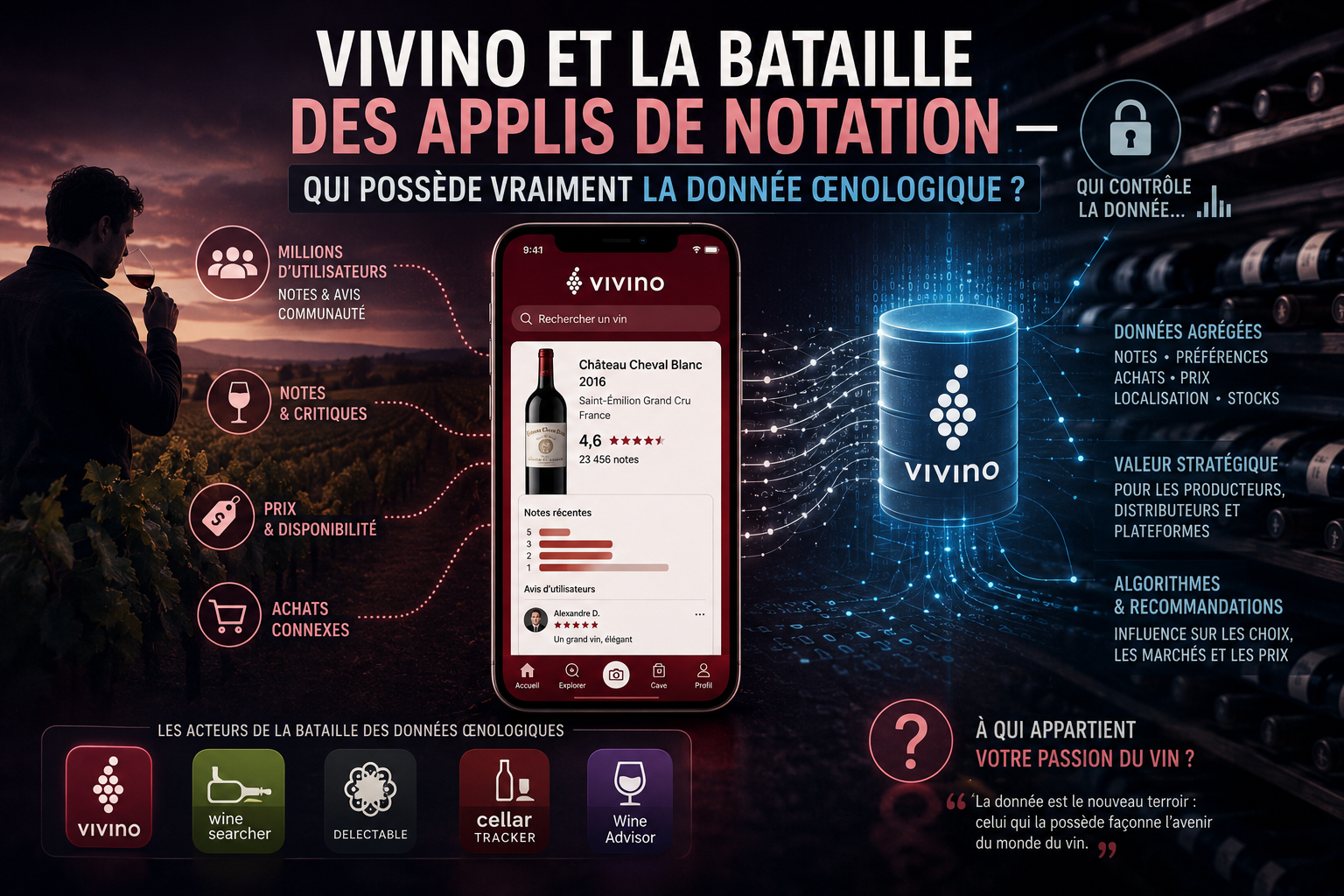
We’ve grown used to scanning labels, rating wines between two mouthfuls, following the recommendations of an algorithm that knows us better than our wine merchant. Vivino has slipped into our evenings with remarkable discretion, to the point of becoming an invisible infrastructure of taste. Behind that simplicity, however, lies a more complex reality: a silent battle for ownership of the world’s wine data. Who rates, who collects, who monetises, who decides? The question isn’t only economic. It touches on what we take to be expertise, trust, and the memory of wine.
A DANE WHO KNEW NOTHING ABOUT WINE BUILT THE WORLD’S LARGEST WINE DATABASE
The empire of the scan
Heini Zachariassen didn’t understand wine. A Faroese entrepreneur who came from cybersecurity, he often recounts that founding moment: finding himself lost in front of a supermarket shelf, unable to choose between one elegant label and another. “I didn’t know what to buy. There were only sophisticated labels and prices.” In 2010, with Theis Søndergaard, he co-founded Vivino in Copenhagen. The idea fits in one line: photograph a label to instantly get reviews from the community. A Shazam for wine.

Fourteen years later, the app boasts more than 60 million downloads, a database of 16 million wines catalogued, 200 million ratings and 1.5 billion label photos collected by its users. Vivino is today regarded as the largest online wine marketplace in the world — and the largest wine database ever built, fed free of charge by its own community. The company has raised more than $220 million in venture capital, including $155 million in a round led by the Swedish fund Kinnevik in 2021.
“No one else can do what we do, because no one else has access to the kind of data we own.”
Heini Zachariassen, founder of Vivino, at the opening of the first physical shop in Singapore, September 2024
YOU ARE THE USER, THE COMMUNITY — AND THE RAW MATERIAL
The question no one asks

Every rating you leave, every bottle you scan, every preference you express: all of it feeds a proprietary database, owned by a private company, financed by venture capital. You are at once the customer, the contributor and the resource. This isn’t a criticism in itself — Wikipedia runs on a comparable model. But the essential difference is that Vivino monetises that contribution.
The recommendation algorithm, the “Match for You” feature that calculates your personal affinity with a wine based on your tasting history, the recently launched AI Sommelier — everything rests on the data users have generated without pay. In 2024, Vivino opened its first physical shop in Singapore, whose selection was built entirely from the behavioural data of its local users. As Zachariassen himself puts it: “No one else can do that.”
The question of data ownership becomes even sharper for winemakers. A producer can find themselves rated by thousands of users without having been consulted, with no access to those aggregated ratings, and with no lever to influence their score — other than persuading their buyers to download the app and leave a good review. On wineandtech.fr, we’ve already explored how blockchain can give traceability and power back to producers — participatory rating poses a symmetrical but opposite problem: here it’s the consumption data that slips away from those who make the wine.
“If a wine drops below 4 stars on Vivino, people no longer give it a chance. It doesn’t matter what your reference guide or your wine merchant says.”
A French importer, in Bordeaux trade circles
THE CROWD VERSUS THE EXPERT: A BATTLE REDRAWING AUTHORITY IN THE WINE WORLD
Two hundred million ratings against five recognised palates
Traditional wine criticism rests on an aristocratic model: a handful of palates trained over decades define what deserves to be drunk. Robert Parker, Wine Spectator, Jancis Robinson, Decanter — these institutions rate perhaps 20,000 to 30,000 wines a year. Vivino handles two million scans a day. The argument of scale is real. A Polish Riesling or an emerging English wine can rack up hundreds of ratings on Vivino before a specialist critic has ever gone near them.

But the system’s limits are just as real. A Vivino rating carries the same weight from the palate of a beginner who has only ever drunk sweet wines as from that of a seasoned enthusiast who has been tasting for twenty years. The algorithm favours immediately pleasing wines — round, accessible, generous with fruit — at the expense of wines built to age, often austere in their youth and revealing their greatness after ten years in the cellar. A Barolo or a Chablis premier cru will be mechanically penalised if opened too early. It’s a structural bias that the crowd, by its very nature, cannot correct.
VIVINO, CELLARTRACKER, WINE-SEARCHER: THREE PHILOSOPHIES OF DATA, THREE VISIONS OF WINE
The ecosystem of challengers

CellarTracker, founded in 2003, is built on a radically different philosophy. Detailed technical notes, contributions from serious collectors, vintage sheets documented over decades — it’s the Wikipedia of wine, deep rather than broad. Its quasi-collaborative model keeps the data accessible to the community without monetising it in the same way. Wine-Searcher plays yet another tune: a global price engine, it covers nine million wines and their availability at thousands of merchants. The data here isn’t affective, it’s transactional.
Delectable, bought by critic Antonio Galloni’s Vinous group, bets on the quality of its notes rather than their quantity, with a community of recognised sommeliers and critics. In France, apps such as Wine Advisor (E.Leclerc) or Raisin (a natural-wine specialist) seek their niches from angles Vivino doesn’t cover. Each of these players aspires to become the infrastructure layer of the wine decision — but none yet has Vivino’s critical mass.
The advantage is self-reinforcing: the more users, the more precise the database; the more precise the database, the more users it attracts. It’s what platform economists call a data moat — a near-impassable moat of data. With 2 million daily scans, Vivino is fifty times bigger than its nearest competitor in this segment, according to Zachariassen himself.
THE ARTIFICIAL SOMMELIER WON’T REPLACE THE WINEMAKER — BUT IT HAS ALREADY CHANGED THE BUYER
AI moves into the cellar
Vivino recently launched its AI Sommelier — a conversational assistant that knows your scan history, your ratings, your preferences, and answers questions in natural language. It knows you’ve liked three Burgundy Pinot Noirs and that a heavily dosed Champagne doesn’t win you over. On the iPhone 16, integration with Apple Visual Intelligence even lets you scan a label directly via the Camera Control button, without opening the app — with Vivino’s data working in the background.

This shift isn’t neutral. It means that the wine data you produce — your tastes, your purchases, your personal palate — is now a commercial asset of the first importance, refined in real time by artificial intelligence. In our article on drones and AI in viticulture, we explored how technology is transforming the production side of wine; Vivino is carrying out the same transformation on the consumption side, with the same instrument — data — but in very different hands.
Vivino has undeniably democratised access to information about wine. It has given a voice to millions of enthusiasts who didn’t have one, shone a light on regions ignored by the specialist press, and made choosing a bottle less intimidating. But by consolidating that information into a proprietary architecture, it has also centralised a power that was once diffuse: the power to decide what deserves to be drunk — and what doesn’t.
Do you use Vivino or another app to choose your wines? Do you still trust your own palate — or have you delegated that decision to your phone? Share your experience in the comments.
Sources: Wikipedia — Vivino · A+ Singapore — Interview with Heini Zachariassen (2024) · Locals Insider — Vivino App Review (2026) · The Drinks Business — Vivino and the future of wine retail · InVintory — Best Wine Apps 2026 · Petit Vin Entre Copains — Wine-rating apps compared · SommelierX — Alternatives to Vivino (2026)