🇬🇧 Series · The Vinous Trinity · Article 10/15 · France — English translation of the French original
⏱ 5 min
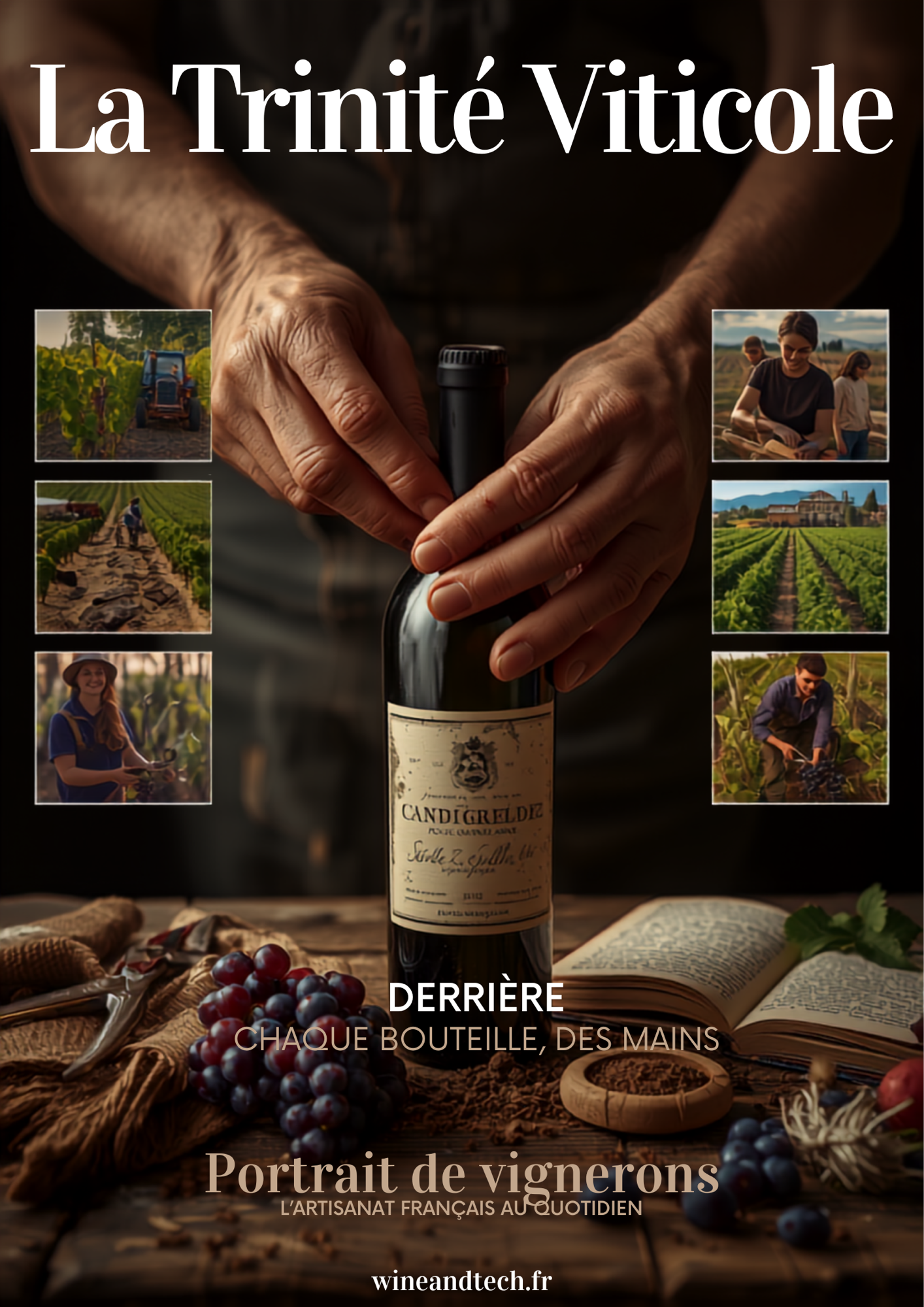
We talk a lot about terroirs, grape varieties, appellations. But behind every bottle, there are first and foremost hands. People who rise before dawn during harvest, who prune in midwinter with frozen fingers, who watch the April sky with the dread of frost.
France counts tens of thousands of wine estates, the vast majority of them family-run, artisanal structures. This article isn’t about any particular estate: it sketches four representative portraits, four paths you’ll come across everywhere in the French vineyard. Any resemblance to real winegrowers is, precisely, the point.
🍇 Four portraits in this article
The independent in Languedoc · The handover in the Loire · The organic conversion in the Rhône · The career change in the Jura
🍇 The independent in Languedoc — doing everything, alone
He farms some fifteen hectares between garrigue and limestone slopes. In the morning, he drives the tractor. At noon, he answers emails from a Belgian importer. In the afternoon, he’s a cellar hand, an oenologist, a mechanic. In the evening, an accountant. On weekends, he runs a stand at a wine fair 600 kilometres from home.
That’s the independent winegrower: a craftsman who tends his own vines, vinifies his own harvest and sells his own wine, from vine stock to label. Total versatility — at once his pride and his burden.
In Languedoc, this figure carried the rebirth of an entire region. Long confined to bulk wine, France’s largest vineyard reinvented itself thanks to these artisans who bet on old Carignan vines, schist terraces and controlled yields — with prices that remain among the most accessible in France.
No two of his days ever look alike. Which is exactly why he wouldn’t trade this job for anything.
🍇 The handover in the Loire — inheriting without copying
She took over the family estate five years ago. Fourth generation. Her father worked Chenin a certain way; she kept the essence and changed the rest.
Succession is one of the most delicate moments in an estate’s life. You have to reckon with the inheritance — the plots, the habits, the historic clientele, sometimes the debts — while asserting your own vision: more precise winemaking, rethought ageing, new single-plot cuvées, an online presence the previous generation never even imagined.
In the Loire, this generational renewal has transformed the image of the whole region: Chenin, Cabernet Franc and Melon de Bourgogne are now worked with a rigour that places some wines among the most sought-after in France — often still at reasonable prices.
Inheriting an estate doesn’t mean keeping it under glass. It means keeping it alive.
🍇 The organic conversion in the Rhône — a bet on patience
Three years. That’s the official duration of a conversion to organic farming. Three years of applying every organic constraint — without yet being allowed to say so on the label.
For this Côtes du Rhône winegrower, the decision wasn’t ideological but gradual: the desire to bring his soils back to life, pressure from neighbours and from his own family, and the realisation that his finest cuvées came from the least-treated plots.
Conversion means more soil work, more passes through the vines, more risk — mildew is unforgiving in wet years. But it also means a different relationship with the craft: observing more, intervening less, accepting that nature gets a say.
The Rhône valley is today one of the French regions where organic viticulture is growing fastest. Behind every certification lie three years of doubt — and, often, a conviction that has become unshakeable.
🍇 The career change in the Jura — leaving everything for the vine
Ten years ago, she worked in an office. Today, she farms three hectares of Savagnin and Poulsard on the marls of the Jura.
New-generation winegrowers — career changers from entirely different professional worlds — have become a familiar figure in the French vineyard. Agricultural training, years of apprenticeship with other growers, the search for affordable plots: the path is long, demanding, and often precarious at the start.
The Jura, with its small parcels, singular grape varieties and tight-knit winegrowing community, has attracted many of these profiles. They bring a fresh eye, a freedom of style, sometimes a boldness that heirs to estates allow themselves less readily.
Not all of them make it. But those who hold on remind us of a simple truth: the vine doesn’t belong only to those born among it.
The craft, day by day
Four portraits, four regions, four paths. And yet a surprisingly common daily life.
Winter pruning, the founding gesture that decides the harvest to come. The dread of frost in spring, those April nights spent watching thermometers. The treatments and trimming of summer. The harvest, the moment of truth when a year’s work plays out in a few weeks. Then the cellar, the ageing, the bottling, the selling — and already the next pruning.
It’s the job of a farmer, a craftsman, a merchant and a creator all at once. A job where you only produce once a year — which makes every vintage irreplaceable, and every mistake costly.
Next time you open a French bottle at €12, think about it: someone pruned every vine, watched every storm, tasted every vat.
Wine may be the last everyday product still overwhelmingly made by artisans.
Behind every bottle, there are first and foremost hands. Wine may be the last everyday product still overwhelmingly made by artisans.
Laisser un commentaire