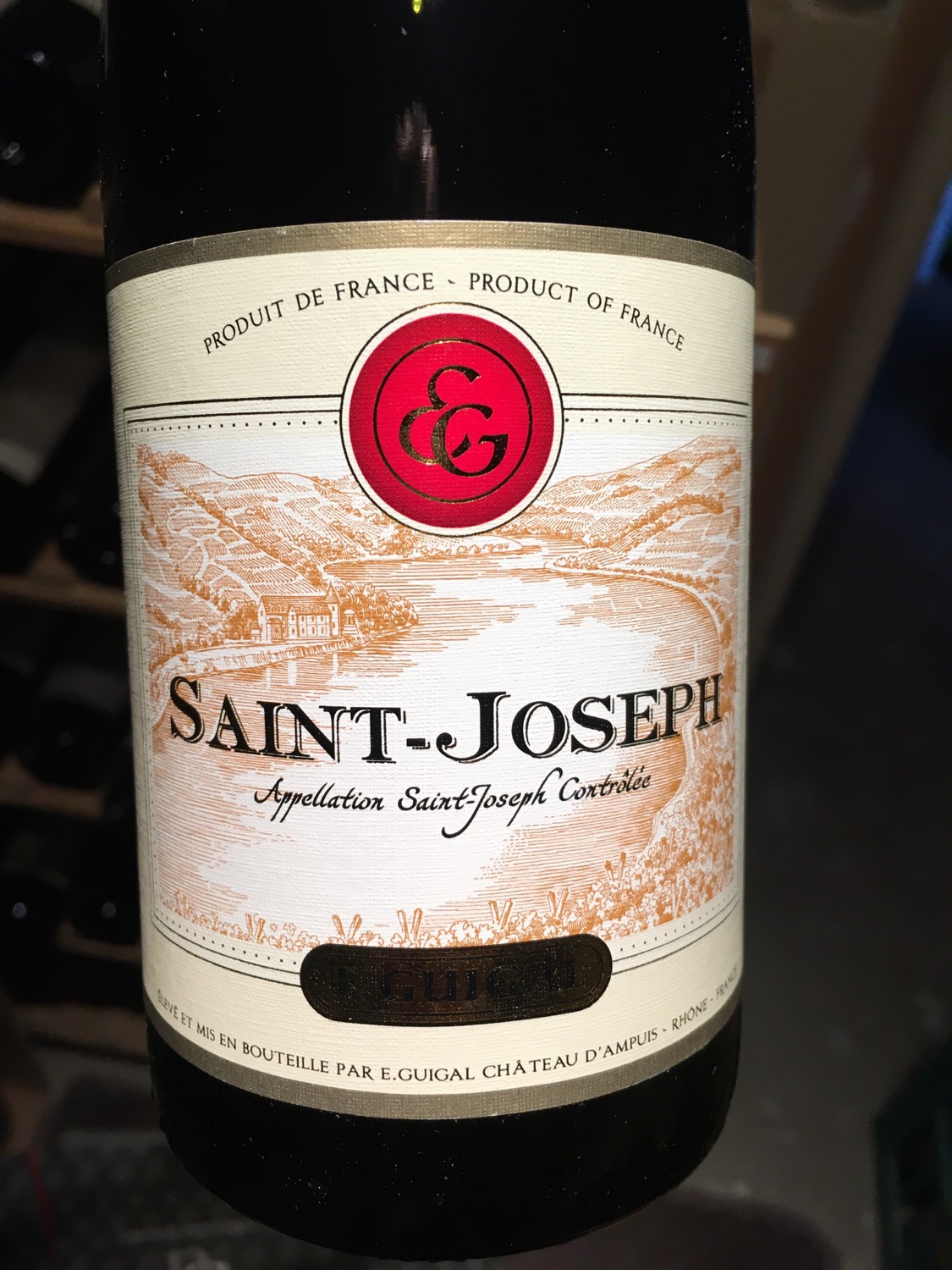
“Saint-Joseph is one of the finest jewels of the Rhône vineyard, a powerful and generous wine that expresses the richness of its terroir with great finesse.” – Robert Parker
The Guigal house is one of the most famous and respected producers in the Rhône Valley, in France. Founded in 1946 by Etienne Guigal, the house is today run by his son, Marcel Guigal, and his grandson, Philippe Guigal.
The Guigal house produces a wide variety of Rhône Valley wines, from whites to reds, taking in rosés. Its vineyards are located in the most prestigious appellations of the Rhône Valley, notably Côte-Rôtie, Hermitage, Saint-Joseph, Crozes-Hermitage, Condrieu and Châteauneuf-du-Pape.
Today I’ve decided to tell you about the Saint-Joseph. But I’ll certainly tell you about many others, because this house is exceptional.
This Guigal is special because it was one of the first “Saint-Josephs” I had the chance to taste. Why is it so special? Certainly because that day I was surrounded by my loved ones around a good table. It took no more than that for it to stay etched in my memory forever.
I often say it to those who join me: “the best of wines is the one I drink with you”!
Off we go to the tasting
It’s produced from Syrah grapes and is characterised by its aromas of red fruit and spice.
Its robe is silky and elegant, with a delicate scent.
On the palate it’s very balanced, with a persistent length, for this 2019 that served as my benchmark. We’re going to let it age a little longer and we’ll see in a few years, but I’m not too worried about the outcome — it will wait for us too.
And for those who’ve read to the end: no, I haven’t made a mistake — I am indeed talking about the Saint-Joseph Rouge, because it also exists in white, made from Marsanne and Roussanne grapes. I hope to taste it soon and tell you about it.
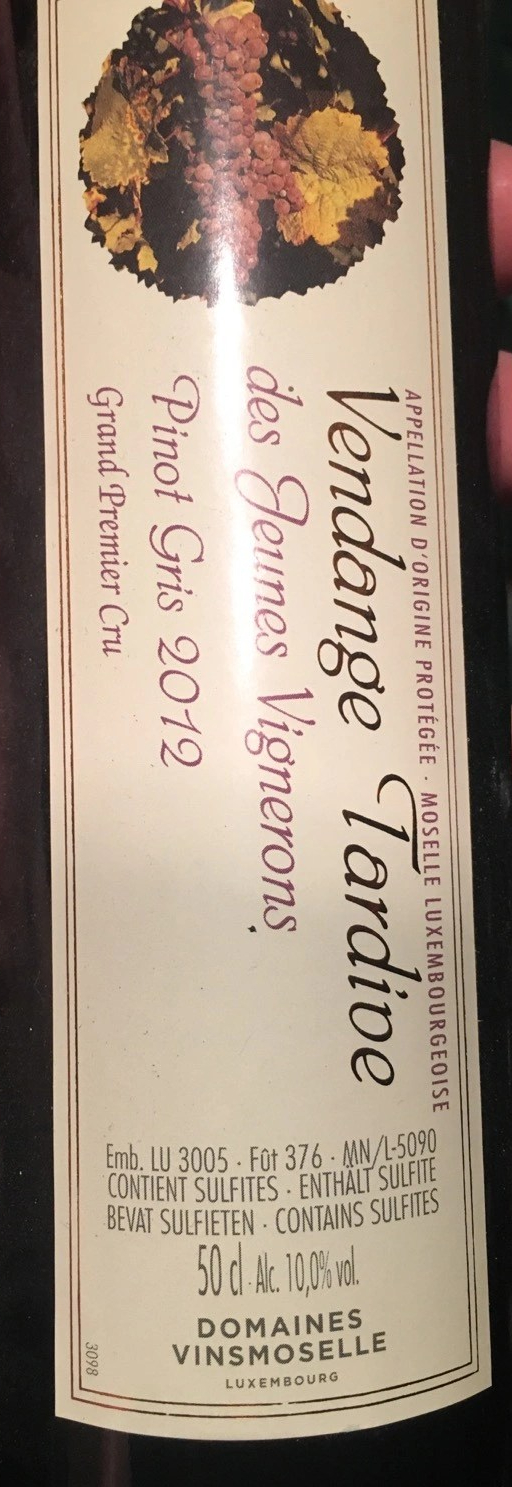
Domaines Vinsmoselle is a wine producer located on the border between France, Luxembourg and Germany. The estate is on the Luxembourg side of the Moselle. Here we are again near Remich.
Domaines Vinsmoselle produce a wide variety of wines, from dry white to full-bodied red, taking in sparkling and dessert wines. The wines are produced from grapes grown on the steep slopes that line the Moselle river. The region’s unique terroir, characterised by slate-rich soils and optimal sun exposure, gives the wines a distinctive and complex character.
I’m always amazed by the richness of their catalogue: with some 200 winegrowers tending the vine along the Moselle between Wasserbillig and Schengen — on almost two-thirds of Luxembourg’s arable land — this cooperative is the Grand Duchy’s largest producer of wine and crémant.
The estate also offers guided tours of its cellars and vineyards, as well as wine tastings. You can learn more about the winemaking techniques used by the estate, and about the history of the Moselle wine region. Book here.
On to the tasting
What struck me about this wine was, above all, the first look. With this slender, elongated 50 cl bottle, the estate wants to impress us and assert its elegance. We’re dealing with an exceptional nectar, and we’re being told so.
The Pinot Gris Vendanges Tardives has a deep, brilliant golden robe; its colour is extraordinary, the gold shining a thousand lights.
With an intense, complex nose of honey and spice, you could smell it for hours; with that robe I didn’t want to deprive the glass of contents of such beauty.
On the palate, the wine is rich and round, with a perceptible sweetness well balanced by a lively acidity that brings lovely freshness. At a price of around €25 for 50 cl of this brew, every drop counts.
Nothing like a nice little white for Valentine’s Day.
Pinot Gris is a great local pride for Alsace, but I’m interested in another region where “Pinot Gris”, “Pinot Blanc” and the likes of “Riesling” or “Gewurztraminer” reign supreme: Schengen and the Luxembourg Moselle.
The Caves Saint Martin are a winegrowing cooperative located in Remich, a small town on the banks of the Moselle, in eastern Luxembourg. Founded in 1919, the cooperative aims to promote winegrowing and the production of high-quality wine in the region.
The Caves Saint Martin also have a historic cellar dating from 1872. This cellar was built by the Benedictine monks of the Saint-Maurice abbey, in Switzerland, who stored their wine there for many years. You can visit it while listening to stories from the past, glass in hand.
On to the tasting:
Naturally, there’s no need to tell you that an hour or so in the fridge before serving will make it all the more pleasant.
The colour of this Pinot Gris is a crystalline white, of a hypnotic purity — you feel you’re admiring mountain water!
The nose is light and balanced, almost mineral; you start to think this Pinot Gris is more akin to a dry variety.
On the palate, citrus and a light acidity come first, then a slight prickle appears on the palate — you’d swear you detect tiny bubbles — but very quickly the fruit and the citrus emerge. Its length turns refreshing.
I particularly enjoyed this wine with cheese; the pairing lifted both partners.
At a price of around €10, the value for money is unbeatable — especially if you take the opportunity to tour the cellars.
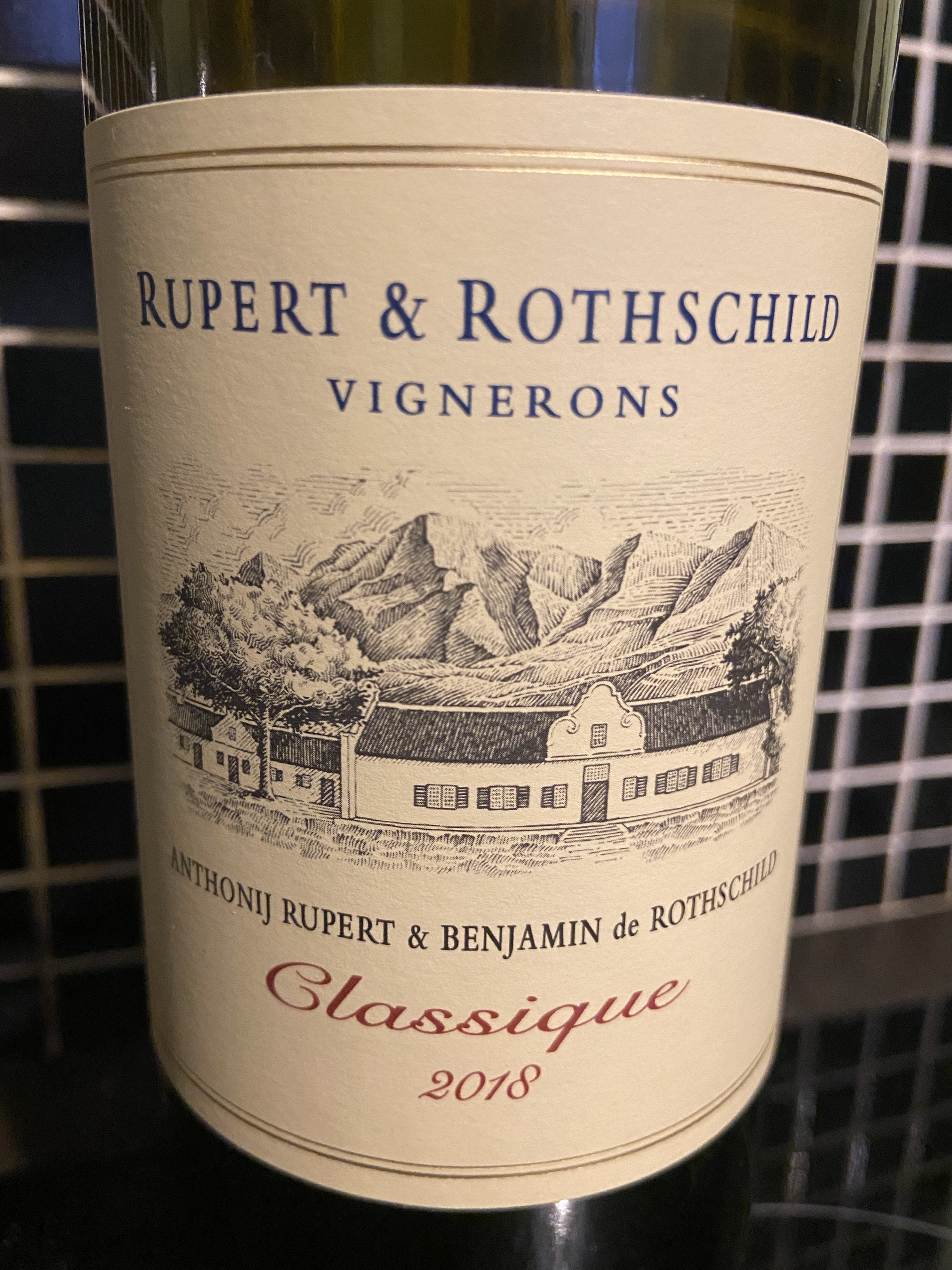
The Rothschild empire couldn’t resist the call of African soil — and I understand them.
It’s very surprising to see Listrac and South Africa on the same label; it’s a little disconcerting.
Label aside, you’ll have gathered that I enjoyed this wine — though make no mistake, there’s little of Listrac in this bottle.
A little history:
The Rupert & Rothschild vineyard was created in 1997 by two renowned families, the Ruperts of South Africa and the Rothschilds of France.
The Rupert & Rothschild vineyard covers 100 hectares of vines. The varieties grown are mainly Bordeaux ones, such as Cabernet Sauvignon, Merlot, Cabernet Franc and Petit Verdot.
The estate is equipped with a modern cellar, where the grapes are vinified and aged for 18 months in French oak barrels before bottling.
Since its creation, the Rupert & Rothschild Classique has become one of the estate’s most famous wines, as well as a symbol of winemaking excellence in South Africa.
On to the tasting:
The nose is discreet and the robe fairly pronounced. On the palate it’s pleasant and, just as the nose had signalled, it’s light with barely pronounced tannins. It’s only after it has passed that this wine reminds you of its origins, leaving a stronger scent in the mouth. But you’ll have to be quick, because it slips away fast.
This 2018 will have to stay in the cellar a little longer, unfortunately, because its youth made itself known.
I have to confess something: I hesitated for a long time before writing this post. This wine, you see, made me doubt my ability to grasp all its subtleties.
Let’s start with a little history:
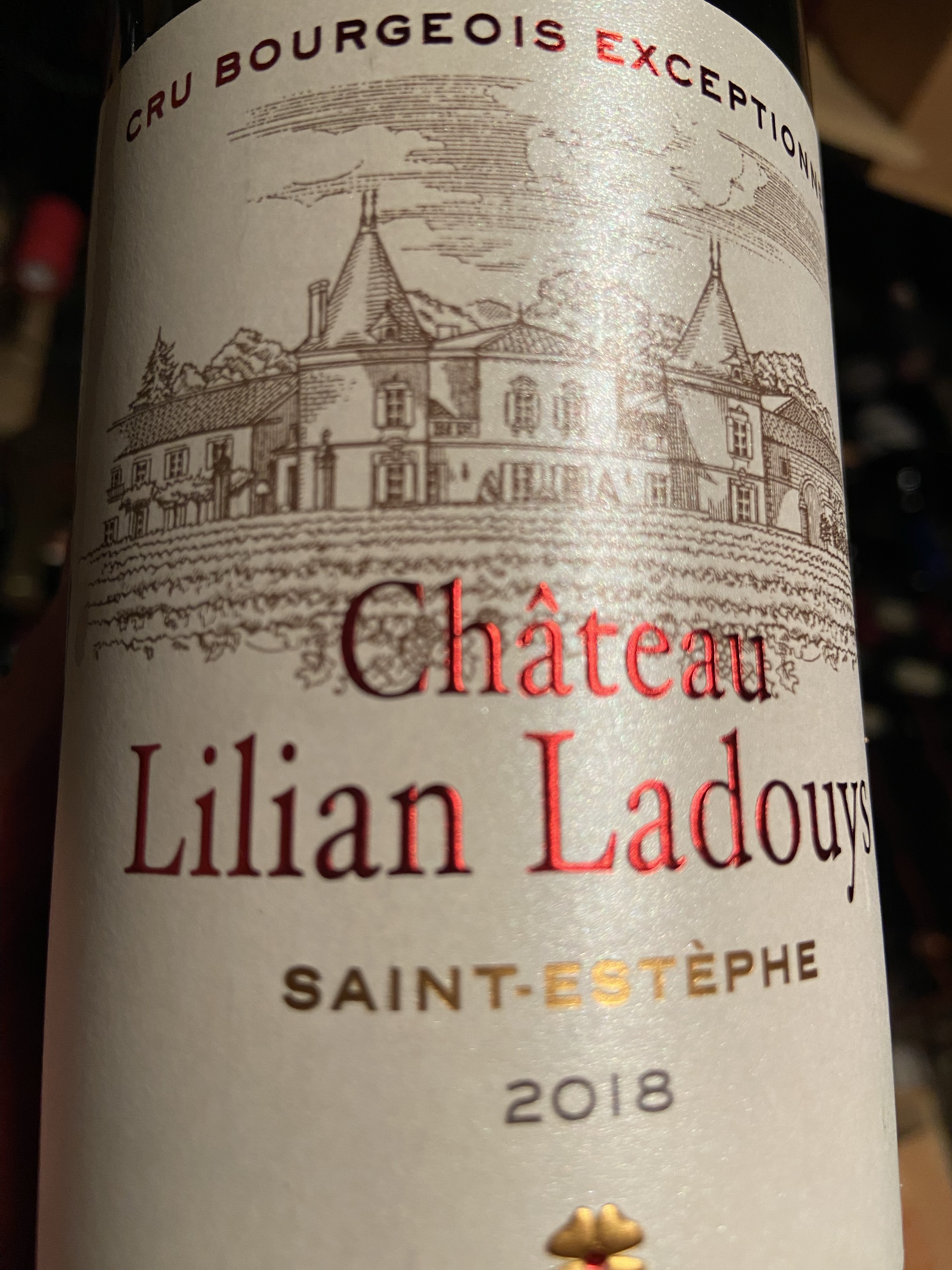
The Lilian Ladouys vineyard was founded in the 18th century. Over the years, the estate has had several owners and undergone many transformations, but it has always been recognised for the quality of its wines.
In 2008, the Lilian Ladouys vineyard was acquired by the Lorenzetti family, owners of the prestigious Château Pédesclaux in Pauillac. Since then, significant investment has been made to modernise the facilities and improve the quality of the wines that run across the property’s 47 hectares.
The Lilian Ladouys 2018 is a red wine from the Saint-Estèphe area, in the Médoc in Bordeaux. It’s produced from Merlot, Cabernet Sauvignon, Cabernet Franc and Petit Verdot, and was aged in oak barrels for around 12 months.
Now that the introductions are done, on to the tasting:
I found this wine very hard to understand; on the first glass I was surprised, because it isn’t like the Saint-Estèphes I’d tasted in the past. I have a particular feeling about this terroir — perhaps because my father was born there…
I was expecting a powerful wine with plenty of body and as tannic as you like! In short, the “Saint-Estèphe” trademark!
And then, as if by magic, you come across a wine of unsuspected balance. A soft yet pronounced nose, but an elegant robe. On the palate, this wine tenderly caresses you. And there go my preconceptions, blown to pieces.
Once all that was set aside, I had to pour another glass and start again from the beginning — and there, this wine’s balance will trap you, and the length on the palate is present and subtle. It will take a lot of willpower to share it with the other guests around the table.
This 2018 is already good to drink, but with a lot of perseverance you can also wait a few years to be surprised all over again.
At around €25, it will go with a fine piece of meat….
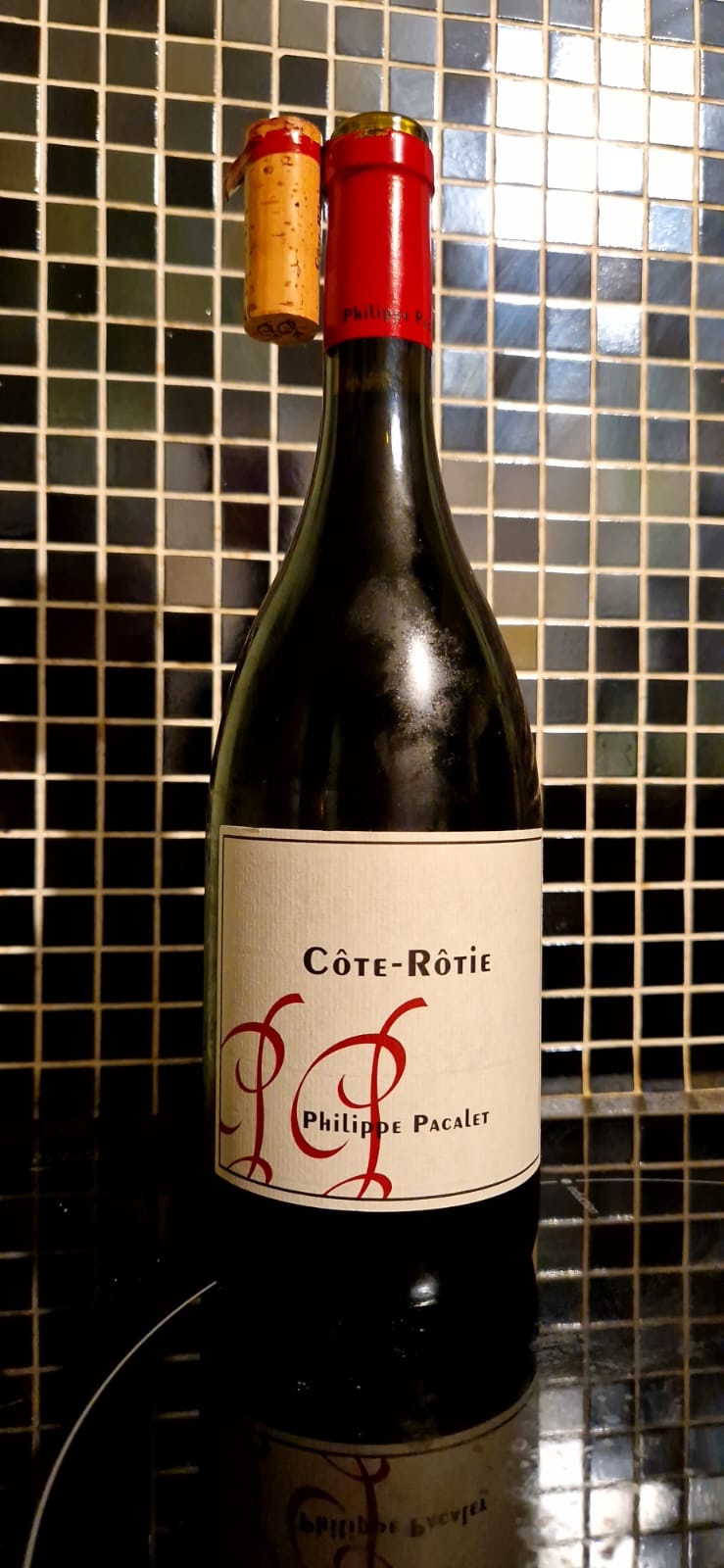
Here’s a Côte-Rôtie that left me anything but indifferent! Philippe Pacalet.
A little history:
In the 19th century, phylloxera devastated the vineyards of France, including that of Côte-Rôtie. The vines were destroyed and had to be replanted, which took several decades. The region’s winegrowers persevered, however, and managed to bring this vineyard back to life.
In the 20th century, winemakers such as Marius Gentaz and Marcel Guigal — I’ll tell you about him in a future post — helped build the reputation of Côte-Rôtie by producing exceptional wines. Today, the Côte-Rôtie vineyard is considered one of the most prestigious in France and in the world, and the wines produced there are highly prized by connoisseurs.
Back to this Côte-Rôtie by Philippe Pacalet:
It’s a red wine produced in the Rhône Valley wine region, in France. It’s made from Syrah and Viognier grapes, the latter added in small quantity to bring a touch of floral aromas.
Its structure is more complex than it seems. A very welcome and very pleasant length on the palate. A fragrant, typical nose right from opening. The Syrah grapes that make it up aren’t my favourites, but here, I admit it, I’m won over.
It’s elegant, complex and marked by spice — in short, everything I love in a wine. Young or old, you’ll enjoy it at any age!
At a tasting among friends, I was astonished to see it win everyone over. Ladies and gentlemen alike all enjoyed it.
If Côte-Rôtie isn’t to your taste, you’ll also find exceptional Pommard or Nuits-Saint-Georges wines at this house. Philippe Pacalet is a renowned winemaker known for his respectful approach to nature and his commitment to biodynamics. The grapes used for the Côte-Rôtie are grown organically and biodynamically, which means they’re grown without the use of chemicals and using environmentally friendly farming methods.
That said, I’ll grant you its price matches the brew: it will be hard to find below €80 — but it’s a “must-have”!
A Blockchain is like “a very large ledger, which everyone can read freely and for free, on which everyone can write, but which is impossible to erase and indestructible.”
Jean-Paul Delahaye – Mathematician
A bit of definition to start with: it was in 2008, just before the emergence of Bitcoin, that the first “Blockchain” came into existence, primarily to accelerate the development of cryptocurrencies. This technology for storing and transmitting information, in the form of a “chain of blocks”, is known for providing secure traceability of transactions.
The name “Blockchain” is explained by the fact that transactions between network-connected users are grouped into blocks. Data sharing happens quickly and without intermediaries.
Source: Bercy Entreprises Infos
That’s all well and good, but how can blockchain technology transform the wine industry? Here are a few key points on its use:
Traceability and transparency:
Blockchain makes it possible to track every step of wine production, from the vine to the bottle. Information such as the grape variety, geographic location, growing methods and harvest dates can be recorded securely and immutably. This lets consumers verify the authenticity and quality of the wine they buy by scanning a QR code on the bottle or an RFID tag.
Fight against counterfeiting:
Counterfeiting is a major problem in the wine industry, especially for fine wines. By using technologies such as RFID or NFC chips combined with blockchain, each bottle can be uniquely authenticated. This significantly reduces the risk of counterfeiting and reassures consumers that they’re buying a genuine product.
RFID tags can help authenticate wine bottles, reducing the risk of counterfeiting. Consumers can scan the tag to verify the product’s authenticity.
Inventory management:
Producers and distributors can use RFID readers to monitor stock in real time. This helps reduce management errors and optimise logistics processes.
RFID tags can also include sensors to monitor storage conditions, such as temperature and humidity, ensuring the wine is kept in optimal conditions.
Tokenisation and NFTs:
Blockchain also enables the tokenisation of wines, where each bottle can be represented by a digital token (NFT). This opens up new possibilities for selling and collecting wine, allowing consumers to buy, sell and trade wines securely and transparently.
Here is a concrete example of NFTs being used in the wine world:
Château Angélus, a prestigious Bordeaux estate, has launched a limited series of wine bottles linked to NFTs. Each NFT represents a unique bottle of their 2020 vintage. These NFTs guarantee the authenticity and provenance of each bottle, giving buyers immutable proof of the wine’s origin.
Buyers can also access exclusive content, such as virtual tours of the estate, videos on the winemaking process, and invitations to private events. This creates an immersive, interactive experience for collectors and wine lovers.
Supply chain optimisation:
By integrating blockchain into the supply chain, producers can improve the efficiency and profitability of their operations. Data on production, transport and distribution can be securely shared among all the players in the chain, reducing errors and fraud.
Living wine seeks its place in a world that prefers its certainties in a bottle.
There’s something strange about the relationship we have with what we drink. We want natural on our plates, local at our markets, living things in our gardens — but in our glasses, we always demand the same wine: the one that smells nicely of oaky vanilla, the one whose colour is perfect, the one whose taste never surprises.
And yet, a handful of stubborn winemakers are changing the rules of the game. Silently, in their cellars, on their knees in their vines, they are reinventing a thousand-year-old art. With little recognition, much scepticism — and one deeply rooted conviction: wine can be something else.
THE NEW PRACTICES
Biodynamics: tending the vine like a living organism
Far from being a New Age fad, biodynamics rests on a systemic approach to the vineyard. Inspired by the work of Rudolf Steiner, it sees the wine estate as a self-contained organism, capable of regulating itself if given the means.
In practice, this means working to the lunar calendar, preparing plant-based infusions and decoctions, and banishing every synthetic chemical input:
Working the soil according to the root, flower and fruit days of the lunar calendar
Decoctions of nettle, horsetail and valerian to strengthen the vine’s natural resistance
Preparation 500 — cow manure fermented in a buried horn — to energise the soils
Zero pesticides, zero synthetic herbicides across the entire estate
The result? Soils teeming with earthworms, mycorrhizal fungi, beneficial bacteria. Vines whose roots plunge deep, seeking out water and minerals on their own.
« A living wine evolves, breathes, changes with time and travel. For purists, that is where true nobility lies. For sceptics, that is where the risk begins. »
Sulphur-free winemaking and Georgian amphorae
In the cellar, the innovations are just as radical. Winemaking without added sulphur is the real revolution: SO₂ has been used for centuries as a preservative. Removing it means working without a safety net. The wine becomes living, unpredictable, sometimes capricious.
Other winemakers go even further, reviving ancient practices: amphora vinification, terracotta jars that allow micro-oxygenation without imparting any oaky taste. We told you about it a while back 😉
In parallel, the search for forgotten grape varieties becomes obsessive — Pineau d’Aunis in the Loire, topped-up Savagnin in the Jura, Tibouren in Provence. Wines we’ve never tasted, with no reference point in memory, and which for that very reason disorient as much as they enchant.
THE WALL OF PROFESSIONAL RECOGNITION
Juries that don’t know what to make of them
Wine competitions are the showcase of the wine world. But in this highly codified universe, natural wines often turn up as free electrons. A slightly cloudy wine — because it’s unfiltered — will be penalised on appearance. A wine with a slightly reduced nose — because it had no protective sulphur — will be marked down on the nose.
The problem? These evaluation criteria were designed to judge conventional wines. They’re incapable of grasping precisely what makes a living wine singular. It’s like judging a street artist at a Fine Arts competition: the form changes, the rules stay frozen, and it’s the creation that pays the price.
Competition criteria were designed to evaluate conventional wines
The tyranny of international taste
International criticism, long dominated by the Parker model, imposed a single ideal of taste: powerful, concentrated, oaky wines with ripe tannins. Natural wines, with their unapologetic lightness, their lively acidity, their sometimes atypical aromas, sit at the opposite end of that model.
« Some natural wines cannot claim their appellation — because they express a terroir in a way that yesterday’s rules never anticipated. »
Appellations that exclude their pioneers
The ultimate paradox: some natural wines cannot claim their appellation of origin. Because they’re made with atypical grape varieties or show sensory characteristics deemed non-compliant with the specifications. These wines are downgraded to plain “Vin de France” — even though they express a terroir with a precision that many a Grand Cru might envy.
Feel free to read our article on the definition of ‘Vin de France’:
The traditional wine consumer has built a relationship of trust founded on repeatability: each vintage must resemble the last, each bottle the one before. That’s the implicit promise the great houses managed to sell for decades.
Natural wine, on the other hand, is alive. It varies from one vintage to the next, sometimes from one bottle to the next. A wine opened too early can seem closed, austere. The same wine two hours later can open up in a deeply moving way. This isn’t a flaw — it’s a quality. But for a consumer used to predictability, it’s unsettling.
The spectre of faults and the lack of guidance
The fiercest debate revolves around the real or supposed faults of natural wines. Reduction, Brett, volatile acidity… These traits, tolerated in small doses as a sign of complexity, are considered deal-breakers in conventional wine. Where does the “living” end and the winemaking error begin? There’s no simple answer.
One last obstacle, a practical one this time: organic and natural wines are often pricier and distributed through alternative channels — independent wine merchants, natural-wine bistros, farmers’ markets — far from the supermarkets. And the labels, often lacking a legible grape variety or appellation, leave the consumer without bearings.
WINE AS A POLITICAL ACT
Things are changing, slowly but surely. Natural-wine bistros are blossoming in every big city — from Le Verre Volé in Paris, a pioneer since 2000, to Odessa Comptoir on the slopes of the Croix-Rousse in Lyon, by way of more than 1,000 addresseslisted across the whole of France.
« Natural-wine bistros and independent wine merchants are becoming the first places of taste education for the newly curious. »
A new generation of sommeliers questions, explores, embraces the unexpected. Figures like Pascaline Lepeltier, France’s Best Sommelier 2018, who champions natural wines on the biggest international stages, or Xavier Thuizat, France’s Best Sommelier 2022, who put around forty winemakers under 35 on the wine list at the Hôtel de Crillon, many of them working organically or naturally. The Guide to the Best Wines of France 2025 itself lists nearly half of its estates as certified organic or biodynamic — something that would have been unthinkable twenty years ago.
Choosing an organic or natural wine is more than a consumer choice. It’s an act of support for the men and women who have decided to work differently, even if it means giving up easy certifications, flattering scores and lucrative markets. It’s betting on diversity against uniformity. On the living against the standardised.
Natural wine isn’t perfect. It surprises, it disorients, it sometimes disappoints. But when it succeeds — and it often does — it says something no laboratory wine will ever be able to say: the truth of a place, a season, a human being who chose to trust nature.
Have you ever tasted a natural wine that won you over — or, on the contrary, let you down?
« He who knows how to taste no longer drinks wine, but savours secrets. »
January 2023. A Portuguese bottle, a few photos, a first article of 242 words. No one knew back then where this adventure would take us. Three and a half years later, the counter reads 65 published articles, 286 tastings shared on Instagram and hundreds of bottles opened — many of which will never see the light of a publication. It’s time to look in the rear-view mirror, to tell what has changed, what we’ve learned, and why Dalí’s quote sums up our journey better than anything: we no longer drink wine, we search for its secrets.
THE ORIGIN: A BOTTLE AND A DESIRE
It all starts with a simple gesture: opening a bottle and wanting to talk about it. Portugal had that honour, quickly followed by a Côte Rôtie, a New Zealand Sauvignon, a Luxembourg Pinot Gris that had literally thrilled us. In 2023, we published 49 articles — almost one a week. Short, spontaneous pieces, driven by pure discovery: more than 70 wines tasted that first year, escapes to Tuscany, Rioja, Savoie, Saint-Émilion.
Rereading those first articles today means measuring how far we’ve come. They overflow with enthusiasm, but stay on the surface: a colour, a nose, a palate, an emotion. It was already a lot. It wasn’t yet enough.
TWO SPACES, TWO WAYS OF WRITING
2024 marks the great pivot. The numbers speak for themselves: the blog goes from 49 articles to 11, then to 2 a year. At the same time, the average length explodes: from 300 words to more than 1,300. This isn’t running out of steam — it’s a redistribution of roles.
Instagram has become our tasting notebook: the spontaneous gesture, the emotion of the moment, the photo of the bottle on the table. 286 posts in three and a half years, a steady rhythm that tells of passion day by day.
It’s not said often enough: writing about wine takes time. Not just the time to taste — that one is a pleasure. The time to trace a statistic back to its original source, to understand a winemaking technique before daring to explain it, to rewrite a paragraph three times until it rings true. Our analyses have become more precise because our standards have grown with us. The reader of 2026 no longer reads the same blog as the one of 2023 — and so much the better.
This precision comes at a cost: scarcity. Two to four articles a year instead of fifty. We chose depth, with no regrets. Our first-year review already pointed in this direction: to dig deeper rather than pile up.
AI ENTERS THE CELLAR
A blog called Wine and Tech’ owed it to itself to live what it writes about. Since 2024, we’ve been writing about AI in the vineyards — and for a few months now, AI has been working with us too. Managing and editing photos for Instagram and the blog, help structuring articles, cross-checking sources, proofreading: artificial intelligence has become a full-fledged writing assistant.
Let’s be clear on one point: AI has never tasted a single one of our wines. The tasting, the emotion, the choice of angles, the convictions — all of that remains deeply human. But for the rest, it saves us what we lack most: time. And that saved time, we reinvest exactly where no machine can replace us: glass in hand, facing a winemaker telling the story of their vintage.
THE WINES YOU NEVER SEE
Let’s do the maths: 286 Instagram posts, 65 blog articles. Roughly one tasting in four or five becomes an article. And even then — those 286 posts are themselves only a selection. Behind them are all the others: the wines tasted that appear nowhere.
It’s an editorial choice we’ve owned from day one: we only publish what leaves a mark on us. A wine that’s correct, well made, but without emotion? It won’t be on Instagram, nor on the blog. Not out of contempt — every bottle represents years of work, brave choices, sometimes an entire life devoted to the vine. Out of respect for that work, precisely, we prefer silence to criticism. And it has to be said honestly: the wines that truly leave a mark are rare. That is the whole difficulty — and the whole beauty — of this quest. If everything were exceptional, nothing would be.
We’ve also made mistakes: statistics taken up too quickly that had to be corrected, angles abandoned along the way, articles left at the draft stage. Every mistake has sharpened our method. Today’s rigour is the daughter of yesterday’s approximations.
WHAT NOW?
The adventure continues, and the schedule is already full. This summer, we’re heading to Provence: four estates are opening their doors to us between Ramatuelle and Pampelonne — organic, biodynamics, a new generation of winemakers, there’ll be plenty to write about. Come autumn, we’ll tackle a touchy subject: the carbon footprint of the bottle, between lightweight glass, bag-in-box and cans. Tomorrow’s wine won’t look like yesterday’s, and we’ll be there to tell the story.
Thank you to those of you who read us, comment, and share — on the blog as much as on Instagram. This passion would make no sense without sharing. See you at the next vintage.
🍷 And you — which wine has left a mark on you these past three years? Tell us about your finest discovery in the comments, and follow our tastings day by day on Instagram @wineandtech!
Passers-by, you are entering the ancient and celebrated cru of Saint-Julien; pay your respects!
Motto of the commune of Saint-Julien-de-Beychevelle
The Saint-Julien appellation is one of the four communal appellations of the Médoc, alongside Margaux, Pauillac and Saint-Estèphe.
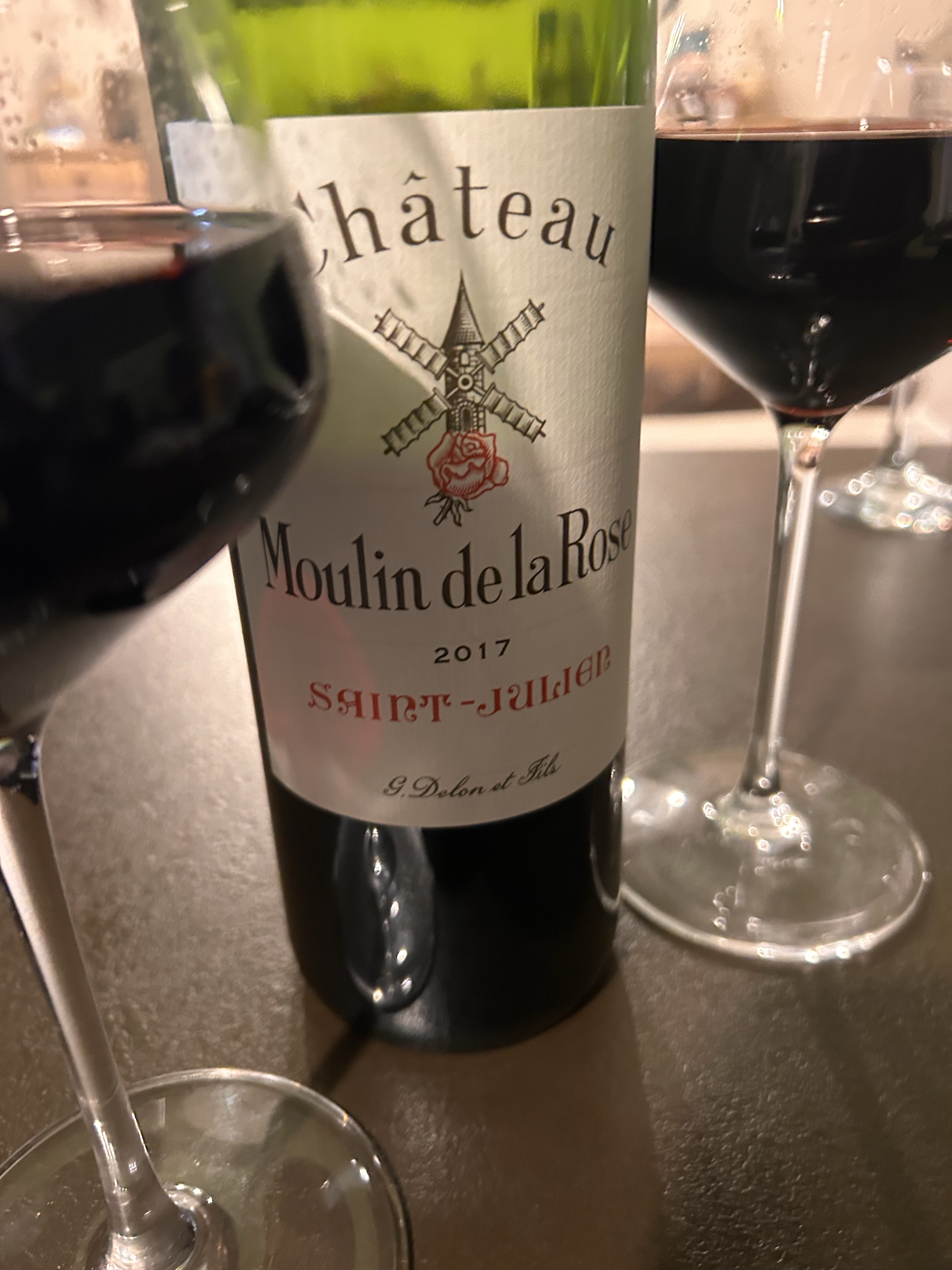
The most famous estates of Saint-Julien include names such as Château Léoville-Las Cases, Château Léoville-Poyferré, Château Léoville-Barton, Château Ducru-Beaucaillou, Château Gruaud-Larose and many others. Today I’m telling you about an estate less in the spotlight than these grands crus: Château Moulin de la Rose.
Since 1971, Guy Delon — together with his children Jean-François and Guylène, the first in the vines, the second handling the commercial side — has worked to produce an exceptional wine, and the result is sublime for this Lord of Saint-Julien.
You look at it, and quickly a lovely deep red with lighter, almost chocolatey edges appears as you swirl it.
The robe is highly nuanced; this brownish red is a warning: careful, you’d better get ready — we already sense it, we’ve got something good here!
On the nose it plays hide-and-seek. You have to hunt for the fruit — redcurrant, then vanilla — but leather and wood are ever-present. It nonetheless keeps a very steady balance; it won’t come and prickle your nose.
It’s confirmed: this wine is good — and yet we haven’t even tasted it.
After smelling and observing it, you feel this wine is extremely carefully crafted, every detail counts; no doubt the team is meticulous. I almost want to stop there, hardly daring to taste it for fear my eyes and nose might disappoint me.
Still, it’s hard to tell my host, “I won’t taste it!”.
On the palate, quickly it’s wood, wood and more wood… the tannins aren’t all that powerful but enough to remind us of its origin, typical of the great Médocs of Saint-Julien; the balance is striking and then, at last, the second curtain reveals the fruit.
The length begins with a little spike that reveals the wine’s maturity; it will be present and long.
Yes, it’s good, it’s very very good. The value for money is exceptional: at a price of around €30, it gives you access to an exceptional Saint-Julien! This 2017 is perfectly ready to drink and will surprise the most demanding guests. Don’t hesitate to pair this wine with a fine red meat, or poultry in sauce. No time? No problem — a nice pizza will do the trick.